

PEER OBSERVATION
OF TEACHING
By ANNE OLSEN
Outline
• Why should we evaluate our teaching?
• What is teaching evaluation?
• What is the purpose of evaluating our
teaching?
• Various lenses through which we can
evaluation our teaching
• How to get the most out of peer
evaluations
• Reflective practice
https://fbcdn-sphotos-h-a.akamaihd.net/hphotos-ak-ash3/p480x480/931250_10151633814201085_1642249177_n.jpg
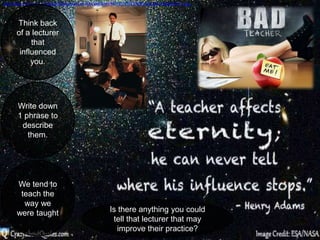
Think back
of a lecturer
that
influenced
you.
Write down
1 phrase to
describe
them.
We tend to
teach the
way we
were taught Is there anything you could
tell that lecturer that may
improve their practice?
Why evaluate our teaching?
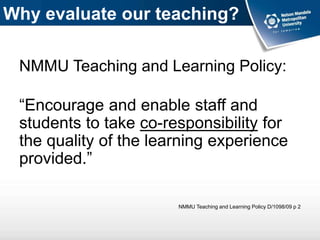
NMMU Teaching and Learning Policy:
“Encourage and enable staff and
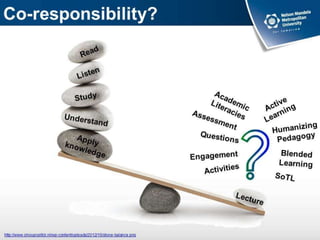
students to take co-responsibility for
the quality of the learning experience
provided.”
NMMU Teaching and Learning Policy D/1098/09 p 2
Food for thought
• What is our profession?
• Why do we teach?
• How do we know we are teaching
well?
• Is our students’ success our success?
• How can we take
responsibility for the
quality of our teaching?
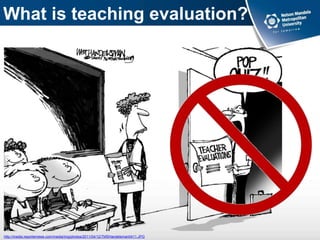
What is teaching evaluation?
http://media.reporternews.com/media/img/photos/2011/04/12/TMSHandelsman0411.JPG
Why evaluate our teaching?
A prerequisite to improving teaching is having an
effective way to evaluate it (Brent & Felder: 2004).
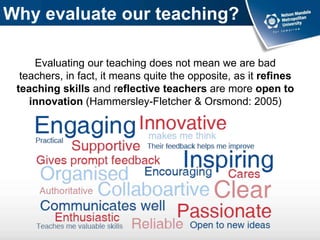
Why evaluate our teaching?
Evaluating our teaching does not mean we are bad
teachers, in fact, it means quite the opposite, as it refines
teaching skills and reflective teachers are more open to
innovation (Hammersley-Fletcher & Orsmond: 2005)
Why evaluate our teaching?
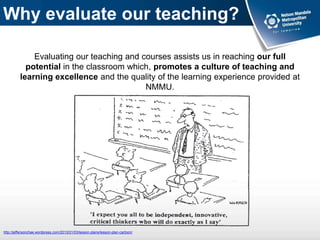
Evaluating our teaching and courses assists us in reaching our full
potential in the classroom which, promotes a culture of teaching and
learning excellence and the quality of the learning experience provided at
NMMU.
http://jeffersonchae.wordpress.com/2013/01/03/lesson-plans/lesson-plan-cartoon/
And the purpose?
To create and sustain a responsive
learning environment conducive to
excellence in teaching and learning and
fostering holistic student success
NMMU Vision 2020 Strategic Plan p31
It’s a process
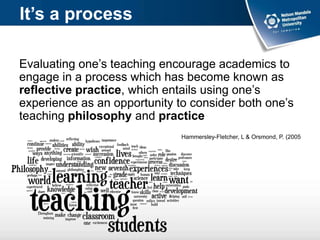
Evaluating one’s teaching encourage academics to
engage in a process which has become known as
reflective practice, which entails using one’s
experience as an opportunity to consider both one’s
teaching philosophy and practice
Hammersley-Fletcher, L & Orsmond, P. (2005
A successful evaluation:
• Valid
• Reliable
• Indicates directions and actions for
improvement
Which teaching practices are more effective
than others in a specific context?
• Responsibility for each individual academic
1 minute paper
Write down one thing that you would like to
know about your teaching practice.
Where would you get answer from?
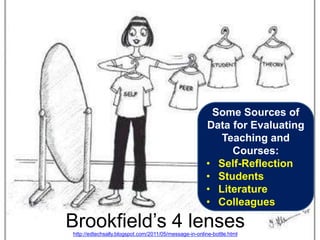
Brookfield’s 4 lenseshttp://edtechsally.blogspot.com/2011/05/message-in-online-bottle.html
Some Sources of
Data for Evaluating
Teaching and
Courses:
• Self-Reflection
• Students
• Literature
• Colleagues
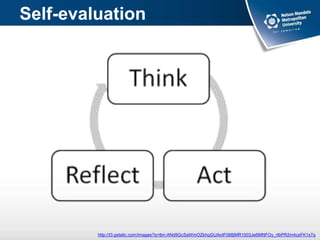
Self-evaluation
http://t3.gstatic.com/images?q=tbn:ANd9GcSaWmOZkhqGUAotF068jMR1003Je6MNFOy_rIbPR2m4csFK1x7q
Student feedback
• Student feedback questionnaire
• Small Group Instructional Diagnosis
(SGID)
• 1 minute papers
Literature
http://cft.vanderbilt.edu/files/sotl-spotlight.png
Colleagues: Teaching observation
How is a peer observation different to a
teaching observation?
z
Community of Practice
Activity
Consider the benefits of academics
observing each other’s teaching.
Note down what you consider the 3 most
important benefits are.
Feedback?
Some ideas
• Critical friend
• Maintain and improve quality
• Disseminate best practice
• Support continuing professional development
• Reflective practice
• Scholarship of teaching and learning
• Insight into:
– Content
– Student dynamic
Dr. Chris Wakeman
Peer observation of teaching by Centre for Professional Development, Staffordshire University
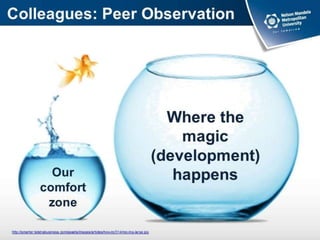
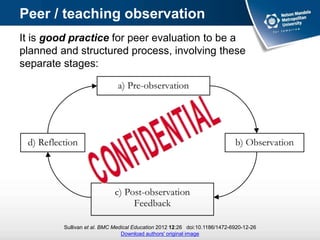
Peer / teaching observation
Sullivan et al. BMC Medical Education 2012 12:26 doi:10.1186/1472-6920-12-26
Download authors' original image
It is good practice for peer evaluation to be a
planned and structured process, involving these
separate stages:
Pre-Observation meeting
• Area that needs to be addressed based on
– Self evaluation
– Student feedback
– Teaching observation
– Trying something new
• Establish a rapport & dialogue
• Identify aims of observation
• Method of observation
– Checklist
– Open ended
• Date and time
What criteria
would you use
to decide who
to invite into
your lecture?
Observation
• Arrive in good time
• Decide where to sit
• Ensure that students are informed
• Observer records what happens in class
– Discussed during pre-observation meeting
• Observation tool
• Observer (don’t join in)
• Balance positive and negative
observations
What would
you like
someone to
observe in
your
classroom?
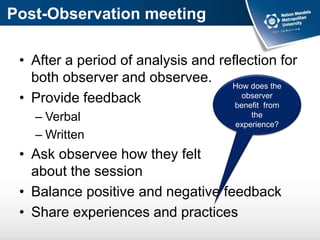
Post-Observation meeting
• After a period of analysis and reflection for
both observer and observee.
• Provide feedback
– Verbal
– Written
• Ask observee how they felt
about the session
• Balance positive and negative feedback
• Share experiences and practices
How does the
observer
benefit from
the
experience?
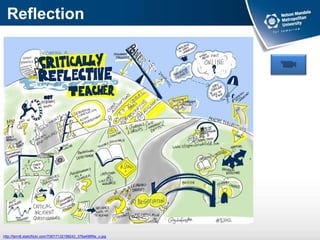
Reflection
http://farm8.staticflickr.com/7087/7132198243_376a498f6e_o.jpg
Scenario 1:
YouTube
Uploaded on 9 Feb 2012
Harvard Physics Professor Eric Mazur
demonstrates "Peer Instruction" and "Just-In-
Time" teaching techniques.
Scenario 2:
YouTube
Published on 8 Mar 2013
This is an (exaggerated) example of a
classic "chalk & talk" style lecture. Boring
monotone professor lecturing at (not
necessarily to) a class full of unengaged
students.
Produced by Andrew Bell, School of Fine
Arts and Design | South Bend, IN
z
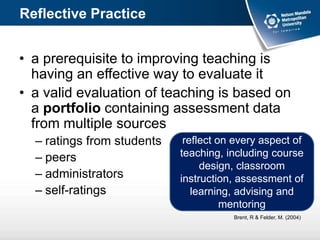
Reflective Practice
• a prerequisite to improving teaching is
having an effective way to evaluate it
• a valid evaluation of teaching is based on
a portfolio containing assessment data
from multiple sources
– ratings from students
– peers
– administrators
– self-ratings
Brent, R & Felder, M. (2004)
reflect on every aspect of
teaching, including course
design, classroom
instruction, assessment of
learning, advising and
mentoring
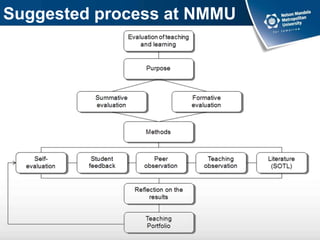
Suggested process at NMMU
Questions?
http://theorganisedhousewife.com.au/craft/teac
her-appreciation-gifts-teacher-quote-in-frame/
Thank you
CTLM
Teaching Development
Anne-Mart Olsen
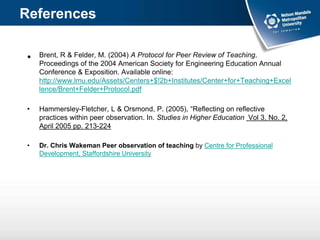
• Brent, R & Felder, M. (2004) A Protocol for Peer Review of Teaching.
Proceedings of the 2004 American Society for Engineering Education Annual
Conference & Exposition. Available online:
http://www.lmu.edu/Assets/Centers+$!2b+Institutes/Center+for+Teaching+Excel
lence/Brent+Felder+Protocol.pdf
• Hammersley-Fletcher, L & Orsmond, P. (2005), “Reflecting on reflective
practices within peer observation. In. Studies in Higher Education Vol 3, No. 2,
April 2005 pp. 213-224
• Dr. Chris Wakeman Peer observation of teaching by Centre for Professional
Development, Staffordshire University
References

Introduction to the peer observation

  • 1.
  • 2.
    Outline • Why shouldwe evaluate our teaching? • What is teaching evaluation? • What is the purpose of evaluating our teaching? • Various lenses through which we can evaluation our teaching • How to get the most out of peer evaluations • Reflective practice
  • 3.
    https://fbcdn-sphotos-h-a.akamaihd.net/hphotos-ak-ash3/p480x480/931250_10151633814201085_1642249177_n.jpg Think back of alecturer that influenced you. Write down 1 phrase to describe them. We tend to teach the way we were taught Is there anything you could tell that lecturer that may improve their practice?
  • 4.
    Why evaluate ourteaching? NMMU Teaching and Learning Policy: “Encourage and enable staff and students to take co-responsibility for the quality of the learning experience provided.” NMMU Teaching and Learning Policy D/1098/09 p 2
  • 6.
    Food for thought •What is our profession? • Why do we teach? • How do we know we are teaching well? • Is our students’ success our success? • How can we take responsibility for the quality of our teaching?
  • 7.
    What is teachingevaluation? http://media.reporternews.com/media/img/photos/2011/04/12/TMSHandelsman0411.JPG
  • 8.
    Why evaluate ourteaching? A prerequisite to improving teaching is having an effective way to evaluate it (Brent & Felder: 2004).
  • 9.
    Why evaluate ourteaching? Evaluating our teaching does not mean we are bad teachers, in fact, it means quite the opposite, as it refines teaching skills and reflective teachers are more open to innovation (Hammersley-Fletcher & Orsmond: 2005)
  • 10.
    Why evaluate ourteaching? Evaluating our teaching and courses assists us in reaching our full potential in the classroom which, promotes a culture of teaching and learning excellence and the quality of the learning experience provided at NMMU. http://jeffersonchae.wordpress.com/2013/01/03/lesson-plans/lesson-plan-cartoon/
  • 11.
    And the purpose? Tocreate and sustain a responsive learning environment conducive to excellence in teaching and learning and fostering holistic student success NMMU Vision 2020 Strategic Plan p31
  • 12.
    It’s a process Evaluatingone’s teaching encourage academics to engage in a process which has become known as reflective practice, which entails using one’s experience as an opportunity to consider both one’s teaching philosophy and practice Hammersley-Fletcher, L & Orsmond, P. (2005
  • 13.
    A successful evaluation: •Valid • Reliable • Indicates directions and actions for improvement Which teaching practices are more effective than others in a specific context? • Responsibility for each individual academic
  • 14.
    1 minute paper Writedown one thing that you would like to know about your teaching practice. Where would you get answer from?
  • 15.
    Brookfield’s 4 lenseshttp://edtechsally.blogspot.com/2011/05/message-in-online-bottle.html SomeSources of Data for Evaluating Teaching and Courses: • Self-Reflection • Students • Literature • Colleagues
  • 16.
  • 17.
    Student feedback • Studentfeedback questionnaire • Small Group Instructional Diagnosis (SGID) • 1 minute papers
  • 18.
  • 19.
    Colleagues: Teaching observation Howis a peer observation different to a teaching observation? z Community of Practice
  • 21.
    Activity Consider the benefitsof academics observing each other’s teaching. Note down what you consider the 3 most important benefits are. Feedback?
  • 22.
    Some ideas • Criticalfriend • Maintain and improve quality • Disseminate best practice • Support continuing professional development • Reflective practice • Scholarship of teaching and learning • Insight into: – Content – Student dynamic Dr. Chris Wakeman Peer observation of teaching by Centre for Professional Development, Staffordshire University
  • 23.
    Peer / teachingobservation Sullivan et al. BMC Medical Education 2012 12:26 doi:10.1186/1472-6920-12-26 Download authors' original image It is good practice for peer evaluation to be a planned and structured process, involving these separate stages:
  • 24.
    Pre-Observation meeting • Areathat needs to be addressed based on – Self evaluation – Student feedback – Teaching observation – Trying something new • Establish a rapport & dialogue • Identify aims of observation • Method of observation – Checklist – Open ended • Date and time What criteria would you use to decide who to invite into your lecture?
  • 25.
    Observation • Arrive ingood time • Decide where to sit • Ensure that students are informed • Observer records what happens in class – Discussed during pre-observation meeting • Observation tool • Observer (don’t join in) • Balance positive and negative observations What would you like someone to observe in your classroom?
  • 26.
    Post-Observation meeting • Aftera period of analysis and reflection for both observer and observee. • Provide feedback – Verbal – Written • Ask observee how they felt about the session • Balance positive and negative feedback • Share experiences and practices How does the observer benefit from the experience?
  • 27.
  • 28.
    Scenario 1: YouTube Uploaded on9 Feb 2012 Harvard Physics Professor Eric Mazur demonstrates "Peer Instruction" and "Just-In- Time" teaching techniques.
  • 29.
    Scenario 2: YouTube Published on8 Mar 2013 This is an (exaggerated) example of a classic "chalk & talk" style lecture. Boring monotone professor lecturing at (not necessarily to) a class full of unengaged students. Produced by Andrew Bell, School of Fine Arts and Design | South Bend, IN z
  • 30.
    Reflective Practice • aprerequisite to improving teaching is having an effective way to evaluate it • a valid evaluation of teaching is based on a portfolio containing assessment data from multiple sources – ratings from students – peers – administrators – self-ratings Brent, R & Felder, M. (2004) reflect on every aspect of teaching, including course design, classroom instruction, assessment of learning, advising and mentoring
  • 31.
  • 32.
  • 33.
    • Brent, R& Felder, M. (2004) A Protocol for Peer Review of Teaching. Proceedings of the 2004 American Society for Engineering Education Annual Conference & Exposition. Available online: http://www.lmu.edu/Assets/Centers+$!2b+Institutes/Center+for+Teaching+Excel lence/Brent+Felder+Protocol.pdf • Hammersley-Fletcher, L & Orsmond, P. (2005), “Reflecting on reflective practices within peer observation. In. Studies in Higher Education Vol 3, No. 2, April 2005 pp. 213-224 • Dr. Chris Wakeman Peer observation of teaching by Centre for Professional Development, Staffordshire University References

Editor's Notes

  • #4 Write phrase on a post it note. Place it on scale (good – bad). Read responses.
  • #18 . SGID is a whole class interviewing technique designed to gather consensus-based student data that enables lecturers to make informed decisions about teaching and courses. SGID’s are done in small groups and facilitated by someone other than the lecturer. When the groups report back to the whole class, the facilitator has the opportunity to delve more deeply into important issues that are raised. It is a very effective method of eliciting data, which focuses on areas of specific concern to a lecturer.
  • #29 Uploaded on 9 Feb 2012 Harvard Physics Professor Eric Mazur demonstrates "Peer Instruction" and "Just-In-Time" teaching techniques.
  • #30 Published on 8 Mar 2013 This is an (exaggerated) example of a classic "chalk & talk" style lecture. Boring monotone professor lecturing at (not necessarily to) a class full of unengaged students.  Produced by Andrew Bell, School of Fine Arts and Design | South Bend, IN