Attendance Management 3:00 – 4:00 pm Dec 7th, 2010  Infonex  951 Whitehorse Chris Hylton, MA CG Hylton & Associates Inc.  800 449-5866  [email_address]
What attendance issues we can try and solve for you in this session? Open discussion
Agenda Following up on absenteeism in the workplace Understanding the causes of absence and making case-by-case evaluations Making efforts to retain staff when appropriate Retraining staff when accommodation is a factor Developing a system for effectively communicating absences Implementing turn-over countermeasures
Employers must be knowledgeable about absences, how  much they have to tolerate and how they can respond effectively.
FORMS OF ABSENTEEISM Innocent Absenteeism Culpable Absenteeism CANNOT IMPOSE DISCIPLINE! DISCIPLINE WARRANTED Long   Term    Condition Repetitive   Short Term    Absences
INNOCENT ABSENTEEISM Disability, illness, other legitimate health reason Discipline is inappropriate  May lead to non-disciplinary termination if: Employee has record of excessive absenteeism Employee is incapable of regular attendance in the future
Do List Track absences Provide warnings Provide opportunity to improve Be consistent
MONITORING  INNOCENT ABSENTEEISM Institute attendance management program AMP Understand the actual levels of absenteeism Analyze and determine where problems are Record all incidents of absenteeism and lates
MANAGING  CULPABLE ABSENTEEISM Don’t rigidly adhere to defined policies  Disciplinary policies are helpful All absences are presumed innocent unless proven culpable (although the employer may put employees on notice that they need to substantiate the reasons for an absence) If culpable, then discipline  may  be warranted Use progressive discipline
FEATURES OF ATTENDANCE MANAGEMENT PROGRAMS Direct attention to improving health and safety; Provide health services and facilities; Provide employee assistance programs; Provide attendance incentive programs; Collect and publish attendance statistics; Set attendance goals and monitor achievement;
FEATURES OF AMP Provide feedback, counselling and other forms of support; Impose discipline when warranted; and Implement last chance agreements when all else fails (more common in the unionized setting).
Termination: THE LAST RESORT Employer has to demonstrate: Record of excessive absenteeism Incapable of regular attendance in the future Accommodation to the point of undue hardship Follow program of progressive discipline Terminate with caution = there is always a risk of a grievance or a human rights complaint
DOCTRINE OF FRUSTRATION Absenteeism resulting from illness or disability is not cause to terminate Test for frustration of contract: Is it temporary or permanent Does it prevents performance of essential duties of position, even after accommodation
FACTORS TO CONSIDER Terms of any existing contract Anticipated term of employment Nature of the employment Nature of the illness or injury & prospects for recovery Period of past employment
BOTTOM LINE The longer the relationship  + The greater the indicators of commitment and loyalty = The more difficult it will be to establish frustration
TERMINATION & SEVERANCE Even if frustrated, employer will have to pay termination and severance pay in accordance with the  ESA, 2000 Ontario Nurses’ Association v. St. Joseph’s General Hospital , [2006] O.L.A.A. No. 155 (Randall) Now reflected in changes to Reg. 288/01 – no longer an exemption from termination or severance pay under the  ESA, 2000
REINSTATEMENT OF EXCESSIVELY ABSENT EMPLOYEES Was there a triggering absence? Were the absences blameworthy or innocent? If innocent, what is the prognosis for future attendance? Did the employer adequately notify the employee of its expectations with respect to attendance? Did the employer warn the employee that discharge may result if attendance did not improve? What was the workplace average absenteeism rate?
THE LAST CHANCE AWARD Also referred to as a “conditional reinstatement” Where absences are culpable in whole or in part, an arbitrator may issue a last chance award; However, the award is based on the premise that the employee is  capable of improvement ; Last chance awards minimize further recourse to arbitration  — it’s the employee’s  last  chance; Clearly establishes attendance and conduct standards; Discharge will be appropriate if standard not met!
LAST CHANCE AGREEMENT Similar to a last chance award, but avoids the time, expense of arbitration – negotiated by the parties; Usually establish a very high attendance standard; Additional conditions, as applicable; Complete abstinence from the substance at issue; Completion of recovery program; Random drug testing; Each condition must be lawful.
LAST CHANCE  AGREEMENTS Purpose:  Keeps employee in the workplace, but imposes stringent conditions Ensures employee knows job is in jeopardy if performance does not improve May promote rehabilitation
When Are Last Chance  Agreements Appropriate? Where an employee has been unresponsive to progressive discipline or efforts to address an attendance problem (particularly if it’s related to an addiction or other disability) Should not be used too early in the process of dealing with a problem employee and is not a substitute for other accommodation options A last chance agreement should only be part of a broader effort to accommodate the employee’s underlying condition
Last Chance Agreements: What They Should Include   Employers should ensure that last chance agreements contain the following: An express recognition of the nature of the employee’s problem (e.g., addiction or alcoholism) and the efforts the employer has made to accommodate the employee Recognition that the employer and, if applicable, union have taken all reasonable steps necessary to accommodate the employee to the point of undue hardship Specific details of the conditions applied to the employee’s continued employment, including details of any treatment, after-care, attendance expectations, etc., as well as the employee’s  commitment to comply with these conditions
Last Chance Agreements: What They Should Include   (cont’d)   Employers should ensure that last chance agreements contain the following: A provision expressly stating that breach of any condition of the agreement will result in the employee’s discharge Agreement that reinstatement of the employee following a breach of the agreement would amount to undue hardship Agreement that failure to discharge for breach of the agreement does not constitute waiver An express prohibition on an arbitrator substituting any lesser penalty in the event that there is a breach A duration – generally never longer than 2 years
Benefits of an Enforceable  Last Chance Agreement Provides an additional opportunity for an employee to salvage his/her employment Provides the employee with a ‘wake-up call’ – often those who suffer from addictions will not seek and pursue treatment until they lose their employment May be viewed as being one aspect of the employer’s duty to accommodate (provided that it is complements other efforts)
 
Why  bother? Direct Costs Replacement of absent worker Loss of productivity Sick leave with pay and benefits Indirect Costs Reduced service to patients and larger community Damage to morale of other employees Time spent managing employee and/or claim
Types of Absenteeism Innocent (non culpable) absenteeism : individuals are legitimately away due to health issues Culpable absenteeism : individuals not validly away; are utilizing sick leave for purposes other than health issues
AMP monitors… Innocent (non-culpable) Absenteeism Culpable absenteeism is a disciplinary issue and once established, should  not  be dealt with under AMP However…..tracking all absenteeism can be helpful in determining culpable absenteeism
Legal Validity Policy regarding Absenteeism Management must be: Consistent with Collective Agreement Brought to the attention of employees Reasonable and Not Discriminatory Clear and Consistently enforced (KVP test, 16 L.A.C. 73)
Legal Validity Absenteeism Management Process  must allow for: Flexibility and consideration of individual circumstances “ Progressive escalating response” Not disciplinary ( Hospital Employees Union v. Health Employers Association of BC (2002) BCLRBD No. 112 )
Facts about CLS’ AMP Program Implemented May 2005 Revisions July 2008 Four Step Program Target 3.5% absenteeism (9 days/year) Absenteeism rate range 3.73% to 4.5% Includes Sick with pay; Sick without pay; Medical Appointments
CLS ISSUES People working when sick Targeting right people Target vs. Average How to exit the program Ownership and accountability Time required to manage program EDUCATION!!!
UNION ISSUES People working when sick Targeting right people Target vs. Average How to exit the program Concern singling people out Early intervention – intrusive Supervisor abuse – “I’ll be watching you” EDUCATION!!!
Changes Implemented Updated I-Web Clarified criteria for exiting the program Clarified payroll coding process  Clarify process regarding how to make an Employment Decision in Step 4 Updated process for leaders to manage program with their employees
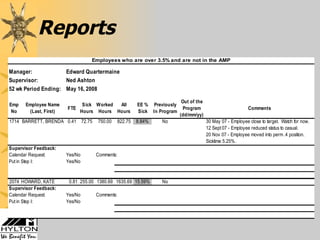
What Reports Exist? Monthly Sick Time Reports AMP Reports Employee Absence Calendars
Reports
Reports
Reports
 
Process
What to Consider When Entering Employees Into AMP? Are they over the corporate standard of 3.50%? Are they over the departmental average? How long have they been over the standard? By how much are they above the standard? How many incidents of illness are there? Is this an isolated incident with low probability of recurrence? Is absenteeism related to a disability?
What to Consider When Entering Employees Into AMP? What is their length of service? Is the employee participating in a graduated RTW plan? Has the employee achieved a full RTW with no restrictions? Are there any unusual circumstances that may have precipitated a spike in absenteeism? Has the person be at Step 1 or 2 previously? Does the employee have a chronic illness?
What to Consider When Entering Employees Into AMP? Consideration for enrolment is over the corporate standard for a period of at least six months If you have initial concerns in determining entrance into AMP, contact your HR consultant
Step 1 Step 1:  Informal Notification, Initial Concern Notification package provided to employee Contains absence history, AMP process, internal and external support Goal is to inform employee and offer education
Step 2 Formal Discussion, Continued Concern Supervisor and employee meet Union representation is offered Purpose is to determine of there are underlying health issues A referral to Occupational Health and Wellness may be made
Step 3 Formal Discussion, Advance Concern Supervisor and employee meet Union Representation offered Attempt to get at underlying issues Mandatory referral to Occupational Health and Wellness
Step 4 Employment Discussion Supervisor and Employee meet Union Representation required Focus on continued employment relationship in serious jeopardy Employee is placed on a 90 day trial period.
Legal Validity Termination for Non-Culpable absenteeism Past record of excessive absenteeism No reasonable expectation or prospect of regular attendance in the future Employee has been warned multiple times and knew expectations and possible outcomes If there is a disability, it has  been  accommodated to the point of undue hardship
When do Employees move to the next step? Where the level of absenteeism has not improved. Where the level of absenteeism has increased. Where an employee has been non-compliant in recommendations for improvement. A reasonable amount of time has lapsed since entering the previous step.
AMP Letters Follow up letters should be sent every 3-6 months so the employee can see their progress – Employer obligation!! A separate file is kept in HR for each employee in AMP
How Are Employees Removed From AMP? Steps 1 & 2 Maintain sick time average below corporate standard for at least six months Step 3 Maintain sick time average below corporate standard for at least nine months Step 4 Maintain sick time average below corporate standard for at least twelve months, evaluated on a case-by-case basis
What Works? Metrics Organizational Target (ie. 3.5%) Regular Communication Supervisor Buy-In and Education Consistency in the message and actions Involving the Union
What Works (Cont’d.) Not one size fits all approach.  Absenteeism Management Policy Supervisor tools:  Guidelines, Letter Templates, Discussion Templates Highlighting the Exit strategy for employees as the goal.
What Doesn’t Work? Lack of supervisor buy-in and education Not being on top of the program Blanket policies or actions Chronic Illness Employees High maintenance – Do the Cost-Benefit Analysis
Next Steps Integrated Health Program Lead – Occupational Health and Wellness Focusing on high usage Supervisor buy-in Distribution of Sick hours
Sick Notes Guidelines: What does the C/A say? Is the employee in AMP? 3.  What is the employee’s current absenteeism rate? 4.  Does the employee have patterns of calling in sick on certain days/weekends? 5.  Is there a written requirement to provide sick notes as a result of an agreement? 6.  Has the employee requested the same time off and been denied?
Question & Answer If an employee is placed in the program, is that considered disciplinary? Absolutely not!  The purpose of the program is to provide support and assistance to employees with a goal of achieving regular attendance at work and meeting the corporate absenteeism standards.
Question & Answer The letters to the employees may give the impression of being punitive.  Is there a different approach? It  is the employer’s obligation to follow up with employees so they can see their progress.  In addition to the standard letters, supervisors may choose to meet with employees for a verbal follow up and discussion or they can work with HR to tailor the follow up letter.
Question & Answer What do you do when you have employees that continually run without any sick time in their banks, and they don’t care if they are still sick and don’t get paid for it? If this is the case, they are likely a good candidate for AMP.  However, they would get coded unpaid sick for this time – not vacation, banked OT, etc.
Question & Answer What if I have an employee who self-identifies an underlying medical condition that affects their attendance? The employee should be referred to the OH&W office as per the Disability Management process.  Employee’s may or may not continue to be managed through the AMP program depending on the nature of the illness.  You may be required to accommodate to the point of undue hardship.
Question & Answer What can you do if proof of illness is required and the employee does not provide it? The employee should not be paid from their sick bank unless the note  is provided.  They should be coded unpaid leave of absence, unless you can prove abuse of sick leave.
 
References http://iweb/library/CorporateManuals/HR/5.7.pdf http://iweb/Library/HRRefGuideIndex.htm Slides adapted from Calgary Lab Services & Filion Wakely Thorup Angeletti presentations
My offer to you Please call if you have any HR, or workplace issue that you are overwhelmed with We can help you
Thank you for the opportunity to meet today! Tel 403 264 5288   or 800 449 5866  [email_address]
CG Hylton - Services HR Consulting Job Descriptions Salary Grids Classification System - free & easy to understand (NOC) Wellness at Work Staff Morale Training Benefits, Pensions, EAP Strategic Planning Drug and Alcohol programs Dept re-orgs Leadership compensation Tel 403 264 5288 [email_address]
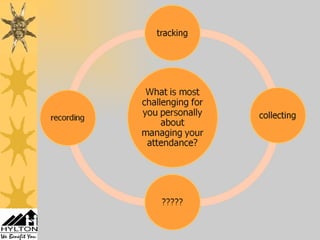
Managing & Tracking Attendance
Why track attendance?
 
Why??????
Tracking solutions Create and maintain excel spreadsheet Create attendance sheets for supervisors Variety of software programs HR Manager from Sage Software www.techserious.com www.dsolutionsgroup.com
Admin Create a FAQ’s page for new staff How do I get paid? How often do I get paid? How much do I get paid? Is there a benefit plan? When am I eligible? Is my family eligible? What are my benefits? * Be sure to update FAQ’s page as needed *
Questions?
New Hires
Exercise: How Much Do You Spend? Select one position that a group member has recently filled.  Estimate the cost of hiring. Time to prepare ad (hours x wage) Cost of Advertising (direct cost) Application processing (hours x wage) Applicant interviews (hours x wages)
How Much Do You Spend? Cont… Reference checks (hours x wages) Offer process (hours x wages) Orientation (hours x wages) Performance loss (hours x wages)
How Can I Minimize Costs? By following  a thorough and reliable Hiring Process
HR Outputs PLANNING CANDIDATE IDENTIFICATION CANDIDATE EVALUATION FINAL SELECTION INTEGRATION AND FOLLOW-UP Define need Agree on candidate  specifications and process Meet with key individuals Draft and place  advertisement Network Screen prospective candidates Conduct/chair  in-depth interviews Review short-lists with client Prepare client and candidates for interview Orchestrate more interviews Conduct in-depth reference checks Assist in negotiation with offer of  employment Assist with Smooth  transition of  candidate to  new job Communicate with candidate on on-going basis Position guide and ideal candidate profile Progress report Candidate assessment report Reference check report Signed offer Strengthened management team
Exercise: Preparing to Hire In your group identify  ONE  hard to recruit position that many in the group are familiar with. What are the characteristics of the Ideal Candidate
Ideal Candidate Personality Skills  Reliability Experience Education
Applicant Evaluation Screen resumes based on “ideal candidate” must have criteria First reading:  Yes, No and Maybe piles Determine number of  tentative  interviews Telephone screening of candidates saves time for both of you
Applicant Evaluation Check some references if permitted Identify candidates for shortlist Interview “Yes” pile Develop interview committee and questions Nation members, non nation members
Developing your questions Ask different questions for different positions Skills testing Drug or medical testing Trick situations Create tests to see if they can pick out errors
Do’s: the Interview Do: Collect only job-related information Concentrate on past behaviour/experiences Use more than one interview Treat all candidates equally Do: Have a checklist of ?’s Provide job-related information  Compare impressions with others on committee. See sample interview questions
Don’ts: the Interview Don’t: Attempt to predict personality traits Be guided by initial impressions Be influenced by single characteristics Make “Snap judgments” Don’t: Ask leading questions Exhibit personal biases Dominate the interview Forget to communicate timelines
Human Rights Hiring Rules Any ideas?
Info Can’t ask Recommended Name Maiden name, reference to name origin Previous names, only if needed to verify past employment / education Race, colour, ancestry place of origin Place of birth, citizenship, racial origin, next of kin Legally permitted to work in Canada
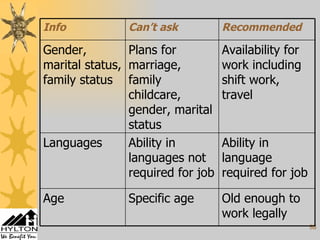
Info Can’t ask Recommended Gender, marital status, family status Plans for marriage, family childcare, gender, marital status Availability for work including shift work, travel Languages Ability in languages not required for job Ability in language required for job Age Specific age Old enough to work legally
Technical Questions Relate to the specific technical information that is required on the job.  Could be on a written test if a specific level of skill is needed Provide evidence that a person MAY have the knowledge that is required. (Not possible to ask about every task) Do NOT predict whether a person will choose to use their skills and knowledge on the job.  Interview Questions
Technical Questions Examples: What information would you need to  open a personnel file in? How would check the system to determine the length of someone’s years of service? What process would you follow to pay an invoice? Interview Questions
Value or Interest  Questions  A type of opinion question, these ask what is important to the candidate.  May help in determining fit with the organizational culture.  As with opinion questions, some candidates may be very astute in picking up what you want to hear. Interview Questions
Value or Interest  Questions  Examples: Why do you want to work here? What is important to you? Where do you want to be in 5 years? Interview Questions
Exercise: Interview Questions Develop one Behaviour Description question and one Situational Question for the position your group has considered.  Discuss what an ideal response would be for one of the questions.
Exercise: How would you find out? Work environment they find comfortable  Relevant experience  Track record  Education  Technical know how  Transferable skills  Unique skills  Personal characteristics Extra curricular activities Which of these areas will help you predict performance?
Orientation Create an orientation checklist so new hires can transition quickly into their new environment.  Tour of office Important numbers Who they will have to develop relationships with Breaks – where & when Pay & benefits info (faq’s sheet) Job description Make them feel welcome and part of the team
Group Activity 1 You have hired your ideal candidate for an administrative assistant position and within the first few days you have noticed some gaps between what they said and what they are doing.
Problems The employee did not know how to open a commonly used word program to create labels Problems opening and using other Microsoft programs.
Problems cont… Very pleasant telephone manner but unable to communicate the importance of the project you are working on Asked if they should start evening cleanup 1 hour before scheduled quitting time with important documents not completed
Problems cont… Files that were to be completed that day (quick small tasks) were not completed by the end of day Must explain tasks 2 or 3 times before the new ee understands what needs to be done Chatting on internet when a lot of time sensitive work needs to be done
Problems cont… First day of employment new ee was over an hour late with no phone call to state this would be the case or what the problem was Asked for 2 days off on first day for the following week
What Happens Next??? What approach would you take to handle these issues? How would you address these problems? What would you do in this situation? Is a few days enough time to know if the ee misrepresented themselves?
Group Discussion As a group, how do you feel this should be handled?  Termination or patience?  If immediate termination is the answer, does the ee or the er have a chance to learn and grow?
Group Discussion cont… If a discussion with the ee is the answer, would you address it in a positive manner, monitor the situation and see if there is a noticeable improvement?
Group Activity 2 Hearing that Wal*Mart was Hiring, your newly hired HR Assistant, who has an attitude, sent the Wal*Mart HR Director a letter demanding that they hire and train community members.
Divide into small groups How would you respond if you were the Wal*Mart HR Director? How would you respond if you were the HR Director for the community organization?
Role Play Choose a spokesperson Role play begins
Facebook and Privacy Canada leads the charge University of Ottawa students Canada’s Privacy Commissioner Third party game providers 250,000 Facebook users impacted worldwide Yeah Canada!
Privacy 101
Employee Information Organizations may collect personal employee info without consent if the individual is an employee of the organization, or the info is for recruiting purposes Orgs may not collect personal info unless the collection is for reasonable purposes and is related to the employment or volunteer work relationship
Recruitment
Recruitment At hire – opportunity to have employee consent to use of their info while employed and after If the ee is not hired, the org must destroy the info, or give it back to the person, unless person consents otherwise If keeping resume on file, say for how long, then destroy Source Bill 44
Definition of Employee Includes apprentices, volunteers, participants, students, and individuals under contract to an organization Your policy should include all May wish to include your Board of Directors as well
Employee calls in sick Er may ask for general info necessary for operation of the position How long the employee is expected to be away and return date Doctor’s note No diagnostic info please
Reference Checks Only an individual’s name and title is public, most other info requested during a reference check is considered personal Many orgs have chosen not to provide references of any kind, even prior to privacy legislation, due to the potential risk of litigation
Old Legal Proverb A closed mouth gathers no feet!
Little risk of privacy implications with this approach, however, it may not be in the best interest of your org The goodwill of your org in the minds of former ee’s who left on good terms may suffer, as they may have difficulty securing employment without a reference
Morale – be reasonable, get consent Rule of thumb – state facts not opinions, don’t say anything you wouldn’t say to their face Try to control ee’s providing references directly – control the flow – tough to do, but worthwhile
You may with to confirm employment dates, titles and salaries only, with the provision of a signed authorization by the former ee May be done at time of request or included at employee hire Have departing ee’s complete a standard Reference Authorization Form detailing what specific info you can release, to whom and for how long
You receive a call from a potential er requesting a reference Prudent to request that they provide you with authorization in writing from the former ee via fax, unless you have authorization on file Compare signatures on file
EAP Er should not get involved in EAP  Be very careful about release of any info EAP counsellor usually owns the info under contract, and the er  should not have ANY  access, except in very specific situations like return to work, or danger, or managed referrals EAP counsellor should obtain consent from ee
Mortgage or Loan Request Info like status (full time or part time), date of hire, salary is personal The ee would specify exactly what info is to be released and to whom Handle in hire letter
Duplicate Personnel Files Managers often keep personal notes and info about staff in duplicate files Risky practice from more than just a privacy perspective Should an ee file a complaint under Human Rights, Employment Standards or launch a civil suit against an er, all documents are subject to subpoena and disclosure HR File Audit – Boy Scouts say it best, “Be Prepared”
Access to ee Info Differing depts need different info about an ee Not all need to see everything Segregating certain types of ee info as separate files or within the file with different access protocols would help
What sticky issues are you having? Open discussion
We would like to thank you for the opportunity to meet with you today! Questions? lisa@hylton.ca  [email_address]
CG Hylton - Services HR Consulting Job Descriptions Salary grids Wellness at work Staff morale training Classification system Free & easy to understand (NOC) Benefits, pensions, EAP Strategic planning Workplans Hiring process HR policies Dept policies Chief & Council compensation
Some of our Clients Siksika Resource Developments Ltd Siksika Child & Family Services Tsuu T’ina Nation Administration Dept Tsuu T’ina Finance Dept Treaty 7 Tribal Council Ben Calf Robe Society Samson Management Ltd
Some of our Clients Siksika Resource Developments Ltd Siksika Child & Family Services Tsuu T’ina Nation Administration Dept Tsuu T’ina Finance Dept Treaty 7 Tribal Council Ben Calf Robe Society Samson Management Ltd  YK Dene First Nation Paul First Nation Louis Bull First Nation Saddle Lake First Nation Ermineskin First Nation Champagne Aishihik First Nation MacLeod Lake Indian Band Metis Settlements of AB

Attendance Management: Getting Staff to Come to Work

  • 1.
    Attendance Management 3:00– 4:00 pm Dec 7th, 2010 Infonex 951 Whitehorse Chris Hylton, MA CG Hylton & Associates Inc. 800 449-5866 [email_address]
  • 2.
    What attendance issueswe can try and solve for you in this session? Open discussion
  • 3.
    Agenda Following upon absenteeism in the workplace Understanding the causes of absence and making case-by-case evaluations Making efforts to retain staff when appropriate Retraining staff when accommodation is a factor Developing a system for effectively communicating absences Implementing turn-over countermeasures
  • 4.
    Employers must beknowledgeable about absences, how much they have to tolerate and how they can respond effectively.
  • 5.
    FORMS OF ABSENTEEISMInnocent Absenteeism Culpable Absenteeism CANNOT IMPOSE DISCIPLINE! DISCIPLINE WARRANTED Long Term Condition Repetitive Short Term Absences
  • 6.
    INNOCENT ABSENTEEISM Disability,illness, other legitimate health reason Discipline is inappropriate May lead to non-disciplinary termination if: Employee has record of excessive absenteeism Employee is incapable of regular attendance in the future
  • 7.
    Do List Trackabsences Provide warnings Provide opportunity to improve Be consistent
  • 8.
    MONITORING INNOCENTABSENTEEISM Institute attendance management program AMP Understand the actual levels of absenteeism Analyze and determine where problems are Record all incidents of absenteeism and lates
  • 9.
    MANAGING CULPABLEABSENTEEISM Don’t rigidly adhere to defined policies Disciplinary policies are helpful All absences are presumed innocent unless proven culpable (although the employer may put employees on notice that they need to substantiate the reasons for an absence) If culpable, then discipline may be warranted Use progressive discipline
  • 10.
    FEATURES OF ATTENDANCEMANAGEMENT PROGRAMS Direct attention to improving health and safety; Provide health services and facilities; Provide employee assistance programs; Provide attendance incentive programs; Collect and publish attendance statistics; Set attendance goals and monitor achievement;
  • 11.
    FEATURES OF AMPProvide feedback, counselling and other forms of support; Impose discipline when warranted; and Implement last chance agreements when all else fails (more common in the unionized setting).
  • 12.
    Termination: THE LASTRESORT Employer has to demonstrate: Record of excessive absenteeism Incapable of regular attendance in the future Accommodation to the point of undue hardship Follow program of progressive discipline Terminate with caution = there is always a risk of a grievance or a human rights complaint
  • 13.
    DOCTRINE OF FRUSTRATIONAbsenteeism resulting from illness or disability is not cause to terminate Test for frustration of contract: Is it temporary or permanent Does it prevents performance of essential duties of position, even after accommodation
  • 14.
    FACTORS TO CONSIDERTerms of any existing contract Anticipated term of employment Nature of the employment Nature of the illness or injury & prospects for recovery Period of past employment
  • 15.
    BOTTOM LINE Thelonger the relationship + The greater the indicators of commitment and loyalty = The more difficult it will be to establish frustration
  • 16.
    TERMINATION & SEVERANCEEven if frustrated, employer will have to pay termination and severance pay in accordance with the ESA, 2000 Ontario Nurses’ Association v. St. Joseph’s General Hospital , [2006] O.L.A.A. No. 155 (Randall) Now reflected in changes to Reg. 288/01 – no longer an exemption from termination or severance pay under the ESA, 2000
  • 17.
    REINSTATEMENT OF EXCESSIVELYABSENT EMPLOYEES Was there a triggering absence? Were the absences blameworthy or innocent? If innocent, what is the prognosis for future attendance? Did the employer adequately notify the employee of its expectations with respect to attendance? Did the employer warn the employee that discharge may result if attendance did not improve? What was the workplace average absenteeism rate?
  • 18.
    THE LAST CHANCEAWARD Also referred to as a “conditional reinstatement” Where absences are culpable in whole or in part, an arbitrator may issue a last chance award; However, the award is based on the premise that the employee is capable of improvement ; Last chance awards minimize further recourse to arbitration — it’s the employee’s last chance; Clearly establishes attendance and conduct standards; Discharge will be appropriate if standard not met!
  • 19.
    LAST CHANCE AGREEMENTSimilar to a last chance award, but avoids the time, expense of arbitration – negotiated by the parties; Usually establish a very high attendance standard; Additional conditions, as applicable; Complete abstinence from the substance at issue; Completion of recovery program; Random drug testing; Each condition must be lawful.
  • 20.
    LAST CHANCE AGREEMENTS Purpose: Keeps employee in the workplace, but imposes stringent conditions Ensures employee knows job is in jeopardy if performance does not improve May promote rehabilitation
  • 21.
    When Are LastChance Agreements Appropriate? Where an employee has been unresponsive to progressive discipline or efforts to address an attendance problem (particularly if it’s related to an addiction or other disability) Should not be used too early in the process of dealing with a problem employee and is not a substitute for other accommodation options A last chance agreement should only be part of a broader effort to accommodate the employee’s underlying condition
  • 22.
    Last Chance Agreements:What They Should Include Employers should ensure that last chance agreements contain the following: An express recognition of the nature of the employee’s problem (e.g., addiction or alcoholism) and the efforts the employer has made to accommodate the employee Recognition that the employer and, if applicable, union have taken all reasonable steps necessary to accommodate the employee to the point of undue hardship Specific details of the conditions applied to the employee’s continued employment, including details of any treatment, after-care, attendance expectations, etc., as well as the employee’s commitment to comply with these conditions
  • 23.
    Last Chance Agreements:What They Should Include (cont’d) Employers should ensure that last chance agreements contain the following: A provision expressly stating that breach of any condition of the agreement will result in the employee’s discharge Agreement that reinstatement of the employee following a breach of the agreement would amount to undue hardship Agreement that failure to discharge for breach of the agreement does not constitute waiver An express prohibition on an arbitrator substituting any lesser penalty in the event that there is a breach A duration – generally never longer than 2 years
  • 24.
    Benefits of anEnforceable Last Chance Agreement Provides an additional opportunity for an employee to salvage his/her employment Provides the employee with a ‘wake-up call’ – often those who suffer from addictions will not seek and pursue treatment until they lose their employment May be viewed as being one aspect of the employer’s duty to accommodate (provided that it is complements other efforts)
  • 25.
  • 26.
    Why bother?Direct Costs Replacement of absent worker Loss of productivity Sick leave with pay and benefits Indirect Costs Reduced service to patients and larger community Damage to morale of other employees Time spent managing employee and/or claim
  • 27.
    Types of AbsenteeismInnocent (non culpable) absenteeism : individuals are legitimately away due to health issues Culpable absenteeism : individuals not validly away; are utilizing sick leave for purposes other than health issues
  • 28.
    AMP monitors… Innocent(non-culpable) Absenteeism Culpable absenteeism is a disciplinary issue and once established, should not be dealt with under AMP However…..tracking all absenteeism can be helpful in determining culpable absenteeism
  • 29.
    Legal Validity Policyregarding Absenteeism Management must be: Consistent with Collective Agreement Brought to the attention of employees Reasonable and Not Discriminatory Clear and Consistently enforced (KVP test, 16 L.A.C. 73)
  • 30.
    Legal Validity AbsenteeismManagement Process must allow for: Flexibility and consideration of individual circumstances “ Progressive escalating response” Not disciplinary ( Hospital Employees Union v. Health Employers Association of BC (2002) BCLRBD No. 112 )
  • 31.
    Facts about CLS’AMP Program Implemented May 2005 Revisions July 2008 Four Step Program Target 3.5% absenteeism (9 days/year) Absenteeism rate range 3.73% to 4.5% Includes Sick with pay; Sick without pay; Medical Appointments
  • 32.
    CLS ISSUES Peopleworking when sick Targeting right people Target vs. Average How to exit the program Ownership and accountability Time required to manage program EDUCATION!!!
  • 33.
    UNION ISSUES Peopleworking when sick Targeting right people Target vs. Average How to exit the program Concern singling people out Early intervention – intrusive Supervisor abuse – “I’ll be watching you” EDUCATION!!!
  • 34.
    Changes Implemented UpdatedI-Web Clarified criteria for exiting the program Clarified payroll coding process Clarify process regarding how to make an Employment Decision in Step 4 Updated process for leaders to manage program with their employees
  • 35.
    What Reports Exist?Monthly Sick Time Reports AMP Reports Employee Absence Calendars
  • 36.
  • 37.
  • 38.
  • 39.
  • 40.
  • 41.
    What to ConsiderWhen Entering Employees Into AMP? Are they over the corporate standard of 3.50%? Are they over the departmental average? How long have they been over the standard? By how much are they above the standard? How many incidents of illness are there? Is this an isolated incident with low probability of recurrence? Is absenteeism related to a disability?
  • 42.
    What to ConsiderWhen Entering Employees Into AMP? What is their length of service? Is the employee participating in a graduated RTW plan? Has the employee achieved a full RTW with no restrictions? Are there any unusual circumstances that may have precipitated a spike in absenteeism? Has the person be at Step 1 or 2 previously? Does the employee have a chronic illness?
  • 43.
    What to ConsiderWhen Entering Employees Into AMP? Consideration for enrolment is over the corporate standard for a period of at least six months If you have initial concerns in determining entrance into AMP, contact your HR consultant
  • 44.
    Step 1 Step1: Informal Notification, Initial Concern Notification package provided to employee Contains absence history, AMP process, internal and external support Goal is to inform employee and offer education
  • 45.
    Step 2 FormalDiscussion, Continued Concern Supervisor and employee meet Union representation is offered Purpose is to determine of there are underlying health issues A referral to Occupational Health and Wellness may be made
  • 46.
    Step 3 FormalDiscussion, Advance Concern Supervisor and employee meet Union Representation offered Attempt to get at underlying issues Mandatory referral to Occupational Health and Wellness
  • 47.
    Step 4 EmploymentDiscussion Supervisor and Employee meet Union Representation required Focus on continued employment relationship in serious jeopardy Employee is placed on a 90 day trial period.
  • 48.
    Legal Validity Terminationfor Non-Culpable absenteeism Past record of excessive absenteeism No reasonable expectation or prospect of regular attendance in the future Employee has been warned multiple times and knew expectations and possible outcomes If there is a disability, it has been accommodated to the point of undue hardship
  • 49.
    When do Employeesmove to the next step? Where the level of absenteeism has not improved. Where the level of absenteeism has increased. Where an employee has been non-compliant in recommendations for improvement. A reasonable amount of time has lapsed since entering the previous step.
  • 50.
    AMP Letters Followup letters should be sent every 3-6 months so the employee can see their progress – Employer obligation!! A separate file is kept in HR for each employee in AMP
  • 51.
    How Are EmployeesRemoved From AMP? Steps 1 & 2 Maintain sick time average below corporate standard for at least six months Step 3 Maintain sick time average below corporate standard for at least nine months Step 4 Maintain sick time average below corporate standard for at least twelve months, evaluated on a case-by-case basis
  • 52.
    What Works? MetricsOrganizational Target (ie. 3.5%) Regular Communication Supervisor Buy-In and Education Consistency in the message and actions Involving the Union
  • 53.
    What Works (Cont’d.)Not one size fits all approach. Absenteeism Management Policy Supervisor tools: Guidelines, Letter Templates, Discussion Templates Highlighting the Exit strategy for employees as the goal.
  • 54.
    What Doesn’t Work?Lack of supervisor buy-in and education Not being on top of the program Blanket policies or actions Chronic Illness Employees High maintenance – Do the Cost-Benefit Analysis
  • 55.
    Next Steps IntegratedHealth Program Lead – Occupational Health and Wellness Focusing on high usage Supervisor buy-in Distribution of Sick hours
  • 56.
    Sick Notes Guidelines:What does the C/A say? Is the employee in AMP? 3. What is the employee’s current absenteeism rate? 4. Does the employee have patterns of calling in sick on certain days/weekends? 5. Is there a written requirement to provide sick notes as a result of an agreement? 6. Has the employee requested the same time off and been denied?
  • 57.
    Question & AnswerIf an employee is placed in the program, is that considered disciplinary? Absolutely not! The purpose of the program is to provide support and assistance to employees with a goal of achieving regular attendance at work and meeting the corporate absenteeism standards.
  • 58.
    Question & AnswerThe letters to the employees may give the impression of being punitive. Is there a different approach? It is the employer’s obligation to follow up with employees so they can see their progress. In addition to the standard letters, supervisors may choose to meet with employees for a verbal follow up and discussion or they can work with HR to tailor the follow up letter.
  • 59.
    Question & AnswerWhat do you do when you have employees that continually run without any sick time in their banks, and they don’t care if they are still sick and don’t get paid for it? If this is the case, they are likely a good candidate for AMP. However, they would get coded unpaid sick for this time – not vacation, banked OT, etc.
  • 60.
    Question & AnswerWhat if I have an employee who self-identifies an underlying medical condition that affects their attendance? The employee should be referred to the OH&W office as per the Disability Management process. Employee’s may or may not continue to be managed through the AMP program depending on the nature of the illness. You may be required to accommodate to the point of undue hardship.
  • 61.
    Question & AnswerWhat can you do if proof of illness is required and the employee does not provide it? The employee should not be paid from their sick bank unless the note is provided. They should be coded unpaid leave of absence, unless you can prove abuse of sick leave.
  • 62.
  • 63.
    References http://iweb/library/CorporateManuals/HR/5.7.pdf http://iweb/Library/HRRefGuideIndex.htmSlides adapted from Calgary Lab Services & Filion Wakely Thorup Angeletti presentations
  • 64.
    My offer toyou Please call if you have any HR, or workplace issue that you are overwhelmed with We can help you
  • 65.
    Thank you forthe opportunity to meet today! Tel 403 264 5288 or 800 449 5866 [email_address]
  • 66.
    CG Hylton -Services HR Consulting Job Descriptions Salary Grids Classification System - free & easy to understand (NOC) Wellness at Work Staff Morale Training Benefits, Pensions, EAP Strategic Planning Drug and Alcohol programs Dept re-orgs Leadership compensation Tel 403 264 5288 [email_address]
  • 67.
  • 68.
  • 69.
  • 70.
  • 71.
    Tracking solutions Createand maintain excel spreadsheet Create attendance sheets for supervisors Variety of software programs HR Manager from Sage Software www.techserious.com www.dsolutionsgroup.com
  • 72.
    Admin Create aFAQ’s page for new staff How do I get paid? How often do I get paid? How much do I get paid? Is there a benefit plan? When am I eligible? Is my family eligible? What are my benefits? * Be sure to update FAQ’s page as needed *
  • 73.
  • 74.
  • 75.
    Exercise: How MuchDo You Spend? Select one position that a group member has recently filled. Estimate the cost of hiring. Time to prepare ad (hours x wage) Cost of Advertising (direct cost) Application processing (hours x wage) Applicant interviews (hours x wages)
  • 76.
    How Much DoYou Spend? Cont… Reference checks (hours x wages) Offer process (hours x wages) Orientation (hours x wages) Performance loss (hours x wages)
  • 77.
    How Can IMinimize Costs? By following a thorough and reliable Hiring Process
  • 78.
    HR Outputs PLANNINGCANDIDATE IDENTIFICATION CANDIDATE EVALUATION FINAL SELECTION INTEGRATION AND FOLLOW-UP Define need Agree on candidate specifications and process Meet with key individuals Draft and place advertisement Network Screen prospective candidates Conduct/chair in-depth interviews Review short-lists with client Prepare client and candidates for interview Orchestrate more interviews Conduct in-depth reference checks Assist in negotiation with offer of employment Assist with Smooth transition of candidate to new job Communicate with candidate on on-going basis Position guide and ideal candidate profile Progress report Candidate assessment report Reference check report Signed offer Strengthened management team
  • 79.
    Exercise: Preparing toHire In your group identify ONE hard to recruit position that many in the group are familiar with. What are the characteristics of the Ideal Candidate
  • 80.
    Ideal Candidate PersonalitySkills Reliability Experience Education
  • 81.
    Applicant Evaluation Screenresumes based on “ideal candidate” must have criteria First reading: Yes, No and Maybe piles Determine number of tentative interviews Telephone screening of candidates saves time for both of you
  • 82.
    Applicant Evaluation Checksome references if permitted Identify candidates for shortlist Interview “Yes” pile Develop interview committee and questions Nation members, non nation members
  • 83.
    Developing your questionsAsk different questions for different positions Skills testing Drug or medical testing Trick situations Create tests to see if they can pick out errors
  • 84.
    Do’s: the InterviewDo: Collect only job-related information Concentrate on past behaviour/experiences Use more than one interview Treat all candidates equally Do: Have a checklist of ?’s Provide job-related information Compare impressions with others on committee. See sample interview questions
  • 85.
    Don’ts: the InterviewDon’t: Attempt to predict personality traits Be guided by initial impressions Be influenced by single characteristics Make “Snap judgments” Don’t: Ask leading questions Exhibit personal biases Dominate the interview Forget to communicate timelines
  • 86.
    Human Rights HiringRules Any ideas?
  • 87.
    Info Can’t askRecommended Name Maiden name, reference to name origin Previous names, only if needed to verify past employment / education Race, colour, ancestry place of origin Place of birth, citizenship, racial origin, next of kin Legally permitted to work in Canada
  • 88.
    Info Can’t askRecommended Gender, marital status, family status Plans for marriage, family childcare, gender, marital status Availability for work including shift work, travel Languages Ability in languages not required for job Ability in language required for job Age Specific age Old enough to work legally
  • 89.
    Technical Questions Relateto the specific technical information that is required on the job. Could be on a written test if a specific level of skill is needed Provide evidence that a person MAY have the knowledge that is required. (Not possible to ask about every task) Do NOT predict whether a person will choose to use their skills and knowledge on the job. Interview Questions
  • 90.
    Technical Questions Examples:What information would you need to open a personnel file in? How would check the system to determine the length of someone’s years of service? What process would you follow to pay an invoice? Interview Questions
  • 91.
    Value or Interest Questions A type of opinion question, these ask what is important to the candidate. May help in determining fit with the organizational culture. As with opinion questions, some candidates may be very astute in picking up what you want to hear. Interview Questions
  • 92.
    Value or Interest Questions Examples: Why do you want to work here? What is important to you? Where do you want to be in 5 years? Interview Questions
  • 93.
    Exercise: Interview QuestionsDevelop one Behaviour Description question and one Situational Question for the position your group has considered. Discuss what an ideal response would be for one of the questions.
  • 94.
    Exercise: How wouldyou find out? Work environment they find comfortable Relevant experience Track record Education Technical know how Transferable skills Unique skills Personal characteristics Extra curricular activities Which of these areas will help you predict performance?
  • 95.
    Orientation Create anorientation checklist so new hires can transition quickly into their new environment. Tour of office Important numbers Who they will have to develop relationships with Breaks – where & when Pay & benefits info (faq’s sheet) Job description Make them feel welcome and part of the team
  • 96.
    Group Activity 1You have hired your ideal candidate for an administrative assistant position and within the first few days you have noticed some gaps between what they said and what they are doing.
  • 97.
    Problems The employeedid not know how to open a commonly used word program to create labels Problems opening and using other Microsoft programs.
  • 98.
    Problems cont… Verypleasant telephone manner but unable to communicate the importance of the project you are working on Asked if they should start evening cleanup 1 hour before scheduled quitting time with important documents not completed
  • 99.
    Problems cont… Filesthat were to be completed that day (quick small tasks) were not completed by the end of day Must explain tasks 2 or 3 times before the new ee understands what needs to be done Chatting on internet when a lot of time sensitive work needs to be done
  • 100.
    Problems cont… Firstday of employment new ee was over an hour late with no phone call to state this would be the case or what the problem was Asked for 2 days off on first day for the following week
  • 101.
    What Happens Next???What approach would you take to handle these issues? How would you address these problems? What would you do in this situation? Is a few days enough time to know if the ee misrepresented themselves?
  • 102.
    Group Discussion Asa group, how do you feel this should be handled? Termination or patience? If immediate termination is the answer, does the ee or the er have a chance to learn and grow?
  • 103.
    Group Discussion cont…If a discussion with the ee is the answer, would you address it in a positive manner, monitor the situation and see if there is a noticeable improvement?
  • 104.
    Group Activity 2Hearing that Wal*Mart was Hiring, your newly hired HR Assistant, who has an attitude, sent the Wal*Mart HR Director a letter demanding that they hire and train community members.
  • 105.
    Divide into smallgroups How would you respond if you were the Wal*Mart HR Director? How would you respond if you were the HR Director for the community organization?
  • 106.
    Role Play Choosea spokesperson Role play begins
  • 107.
    Facebook and PrivacyCanada leads the charge University of Ottawa students Canada’s Privacy Commissioner Third party game providers 250,000 Facebook users impacted worldwide Yeah Canada!
  • 108.
  • 109.
    Employee Information Organizationsmay collect personal employee info without consent if the individual is an employee of the organization, or the info is for recruiting purposes Orgs may not collect personal info unless the collection is for reasonable purposes and is related to the employment or volunteer work relationship
  • 110.
  • 111.
    Recruitment At hire– opportunity to have employee consent to use of their info while employed and after If the ee is not hired, the org must destroy the info, or give it back to the person, unless person consents otherwise If keeping resume on file, say for how long, then destroy Source Bill 44
  • 112.
    Definition of EmployeeIncludes apprentices, volunteers, participants, students, and individuals under contract to an organization Your policy should include all May wish to include your Board of Directors as well
  • 113.
    Employee calls insick Er may ask for general info necessary for operation of the position How long the employee is expected to be away and return date Doctor’s note No diagnostic info please
  • 114.
    Reference Checks Onlyan individual’s name and title is public, most other info requested during a reference check is considered personal Many orgs have chosen not to provide references of any kind, even prior to privacy legislation, due to the potential risk of litigation
  • 115.
    Old Legal ProverbA closed mouth gathers no feet!
  • 116.
    Little risk ofprivacy implications with this approach, however, it may not be in the best interest of your org The goodwill of your org in the minds of former ee’s who left on good terms may suffer, as they may have difficulty securing employment without a reference
  • 117.
    Morale – bereasonable, get consent Rule of thumb – state facts not opinions, don’t say anything you wouldn’t say to their face Try to control ee’s providing references directly – control the flow – tough to do, but worthwhile
  • 118.
    You may withto confirm employment dates, titles and salaries only, with the provision of a signed authorization by the former ee May be done at time of request or included at employee hire Have departing ee’s complete a standard Reference Authorization Form detailing what specific info you can release, to whom and for how long
  • 119.
    You receive acall from a potential er requesting a reference Prudent to request that they provide you with authorization in writing from the former ee via fax, unless you have authorization on file Compare signatures on file
  • 120.
    EAP Er shouldnot get involved in EAP Be very careful about release of any info EAP counsellor usually owns the info under contract, and the er should not have ANY access, except in very specific situations like return to work, or danger, or managed referrals EAP counsellor should obtain consent from ee
  • 121.
    Mortgage or LoanRequest Info like status (full time or part time), date of hire, salary is personal The ee would specify exactly what info is to be released and to whom Handle in hire letter
  • 122.
    Duplicate Personnel FilesManagers often keep personal notes and info about staff in duplicate files Risky practice from more than just a privacy perspective Should an ee file a complaint under Human Rights, Employment Standards or launch a civil suit against an er, all documents are subject to subpoena and disclosure HR File Audit – Boy Scouts say it best, “Be Prepared”
  • 123.
    Access to eeInfo Differing depts need different info about an ee Not all need to see everything Segregating certain types of ee info as separate files or within the file with different access protocols would help
  • 124.
    What sticky issuesare you having? Open discussion
  • 125.
    We would liketo thank you for the opportunity to meet with you today! Questions? lisa@hylton.ca [email_address]
  • 126.
    CG Hylton -Services HR Consulting Job Descriptions Salary grids Wellness at work Staff morale training Classification system Free & easy to understand (NOC) Benefits, pensions, EAP Strategic planning Workplans Hiring process HR policies Dept policies Chief & Council compensation
  • 127.
    Some of ourClients Siksika Resource Developments Ltd Siksika Child & Family Services Tsuu T’ina Nation Administration Dept Tsuu T’ina Finance Dept Treaty 7 Tribal Council Ben Calf Robe Society Samson Management Ltd
  • 128.
    Some of ourClients Siksika Resource Developments Ltd Siksika Child & Family Services Tsuu T’ina Nation Administration Dept Tsuu T’ina Finance Dept Treaty 7 Tribal Council Ben Calf Robe Society Samson Management Ltd YK Dene First Nation Paul First Nation Louis Bull First Nation Saddle Lake First Nation Ermineskin First Nation Champagne Aishihik First Nation MacLeod Lake Indian Band Metis Settlements of AB

Editor's Notes

  • #2 CG Hylton & Associates Inc Mastering the Basics of HR Management
  • #71 CG Hylton & Associates Inc Mastering the Basics of HR Management
  • #76 CG Hylton & Associates Inc Mastering the Basics of HR Management
  • #78 CG Hylton & Associates Inc Mastering the Basics of HR Management
  • #79 CG Hylton & Associates Inc Mastering the Basics of HR Management
  • #99 Mastering the Basics of HR Management