7 Tips to reduce staff
absence
We will be
discussing
absenteeism
and how to
manage and
control it
Also, how we
consider
absenteeism to be
the deliberate,
unauthorised,
repetitive or habitual
absence from work
by an employee
Most employers expect
staff to take or miss a
certain number of days
through absence per
year
The Consequences of Absenteeism
The disruption is
acutely felt by SME’s
(Small – Medium
Enterprises)
The most common reasons
for absence
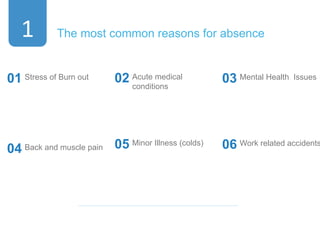
01 Stress of Burn out 02 Acute medical
conditions
03 Mental Health Issues
1
04 Back and muscle pain 05 Minor Illness (colds) 06 Work related accidents
The most common reasons for absence
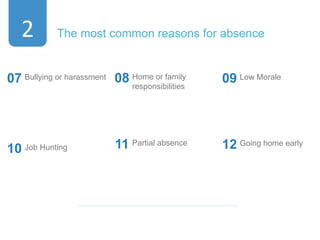
The most common reasons for absence2
07 Bullying or harassment 08 Home or family
responsibilities
09 Low Morale
10 Job Hunting 11 Partial absence 12 Going home early
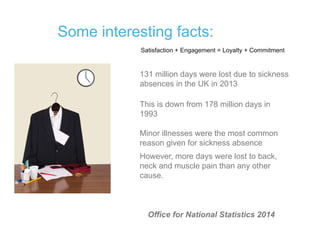
Satisfaction + Engagement = Loyalty + Commitment
Office for National Statistics 2014
Some interesting facts:
131 million days were lost due to sickness
absences in the UK in 2013
This is down from 178 million days in
1993
Minor illnesses were the most common
reason given for sickness absence
However, more days were lost to back,
neck and muscle pain than any other
cause.
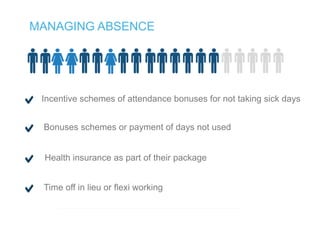
MANAGING ABSENCE
Incentive schemes of attendance bonuses for not taking sick days
Bonuses schemes or payment of days not used
Health insurance as part of their package
Time off in lieu or flexi working
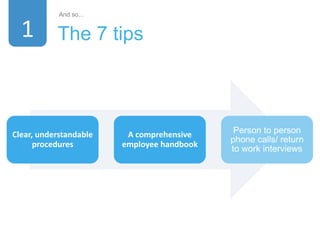
Clear, understandable
procedures
A comprehensive
employee handbook
Person to person
phone calls/ return
to work interviews
The 7 tips
And so...
1
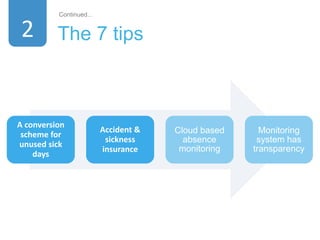
A conversion
scheme for
unused sick
days
Accident &
sickness
insurance
Cloud based
absence
monitoring
Monitoring
system has
transparency
The 7 tips
Continued...
2
1 2
What can help us?
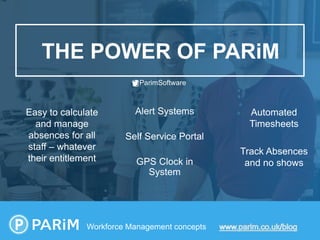
THE POWER OF PARiM
Workforce Management concepts
@ParimSoftware
Easy to calculate
and manage
absences for all
staff – whatever
their entitlement
Alert Systems
Self Service Portal
GPS Clock in
System
Automated
Timesheets
Track Absences
and no shows

7 ways to reduce staff absence

  • 1.
    7 Tips toreduce staff absence
  • 2.
    We will be discussing absenteeism andhow to manage and control it Also, how we consider absenteeism to be the deliberate, unauthorised, repetitive or habitual absence from work by an employee
  • 3.
    Most employers expect staffto take or miss a certain number of days through absence per year The Consequences of Absenteeism The disruption is acutely felt by SME’s (Small – Medium Enterprises)
  • 4.
    The most commonreasons for absence
  • 5.
    01 Stress ofBurn out 02 Acute medical conditions 03 Mental Health Issues 1 04 Back and muscle pain 05 Minor Illness (colds) 06 Work related accidents The most common reasons for absence
  • 6.
    The most commonreasons for absence2 07 Bullying or harassment 08 Home or family responsibilities 09 Low Morale 10 Job Hunting 11 Partial absence 12 Going home early
  • 7.
    Satisfaction + Engagement= Loyalty + Commitment Office for National Statistics 2014 Some interesting facts: 131 million days were lost due to sickness absences in the UK in 2013 This is down from 178 million days in 1993 Minor illnesses were the most common reason given for sickness absence However, more days were lost to back, neck and muscle pain than any other cause.
  • 8.
    MANAGING ABSENCE Incentive schemesof attendance bonuses for not taking sick days Bonuses schemes or payment of days not used Health insurance as part of their package Time off in lieu or flexi working
  • 9.
    Clear, understandable procedures A comprehensive employeehandbook Person to person phone calls/ return to work interviews The 7 tips And so... 1
  • 10.
    A conversion scheme for unusedsick days Accident & sickness insurance Cloud based absence monitoring Monitoring system has transparency The 7 tips Continued... 2
  • 11.
    1 2 What canhelp us?
  • 12.
    THE POWER OFPARiM Workforce Management concepts @ParimSoftware Easy to calculate and manage absences for all staff – whatever their entitlement Alert Systems Self Service Portal GPS Clock in System Automated Timesheets Track Absences and no shows