Attendance Management Policy
BACKGROUND INFORMATION
PART ONE
INTRODUCTION AND PURPOSE
Section 1
Attendance Management Policy
• PROMPT – headline statistics, facts to make an
initial impact
• Nothing new about this – we are only
implementing what most other large
organisations have been doing for many years
• DMU is unusual in NOT having a policy on
Attendance Management
• Assumes all absence is genuine but even so
this needs to be managed
Introduction and Purpose
• Designed to improve employee attendance
• Part of DMU’s commitment to employee
wellbeing
• Applies to all DMU employees
• Policy supported by a toolkit
– Guidance
– Checklists
– Relevant forms
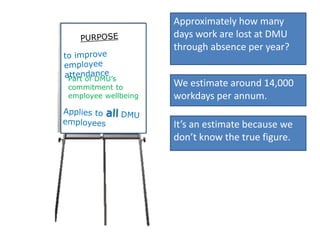
Approximately how many
days work are lost at DMU
through absence per year?
We estimate around 14,000
workdays per annum.
It’s an estimate because we
don’t know the true figure.
Part of DMU’s
commitment to
employee wellbeing
Guiding Principles
1. Good attendance is valued
2. All sickness absence is assumed to be
genuine but a limit on how much is
acceptable
3. Employee absence dealt with consistently
within the ethos of equality and diversity
4. Some absence is inevitable but there may be
times when absence is a cause for concern
Framework
• Policy provides a framework for staff
attendance to be managed:
– in a fair and consistent manner
– Early so appropriate action and support can be
put in place
• System in place to provide accurate
management data to enable managers to act
ROLES AND RESPONSIBILITIES
Section 2
Manager
Accountable for managing attendance in their
area of responsibility
Expected to:
– intervene early to secure an improvement
– prioritise management of individual cases
– keep in touch with absent employees
– conduct risk assessments (and manage risk where
necessary)
– ensure absence is accurately recorded
Employees
Required to carry out duties unless unable to
Expected to:
– comply with DMU absence reporting and
attendance management procedures
– alert their manager if they feel their job is making
them ill or contributing to illness
– co-operate fully with Occupational Health and
associated support
People and Organisation Development
Responsible for working collaboratively with
managers
Expected to:
– provide on-going guidance, support and advice
– ensure policy applied fairly and consistently
across DMU
– provide management data and reports
(ii)
• Occupational Health and Wellbeing (OHW)
– Assist managers to take a proactive approach
– Support early intervention – preventing conditions
worsening
• Employee Assistance Programme (EAP)
– Provides support and resources for staff and
managers
MONITORING AND REPORTING
Section 3
Monitoring and Reporting
• Essential to consistently follow processes for:
– notifying
– recording
– monitoring
– reporting
• Data will be published periodically
• EB and the Board will scrutinise and make
recommendations for improvements in
attendance levels
WHAT HAPPENS WHEN AN EMPLOYEE
IS ABSENT FROM WORK?
Part Two
NOTIFICATION
Stage 1
Notification
• Employees TELEPHONE within 1 hour of normal
start time
– Not email, text or third party
– Contact should be ASAP if cover needed
• When telephoning, employees must provide:
– Reason
– Expected date of return
• Manager determines when further contact might
be required and discusses this with the employee
• Employee may submit self-certification or fit note
if absence more than 7 days
RECORDING
Stage 2
Fit Notes
• TEST???
• Slide shows an example of a fit note
Recording
• Complete part A of the Absence Record and
Return To Work Discussion Form when
notified of absence
• Complete part B of the form once RTW
discussion has happened
• Manager record on the absence management
system
MONITORING
Stage 3
Monitoring
• Need to know when and how best to support
staff to manage their attendance
• Informal element for every period of absence
– Return to Work Discussion
• System will monitor and ’trigger’ the need to
escalate
• Formal stage
• Absence Management Meeting
ACTIVITY - RTW
• Discuss in your group what you consider would
make an effective informal return to work
discussion following a period of absence
• Consider:
– When it’s done
– What it consists of
– How it’s done
– Where it’s done
– Who is involved
– Why we do them
RTW Activity De-brief
1. Informal RTW discussion
– normally within 48 hours after every period of
absence that has not been agreed in advance
– If not able to do so within 48 hours must do so
within 5 working days
– No right to be accompanied
2. Character of the meeting is supporting the
employee upon their return
– Support can be many and varied
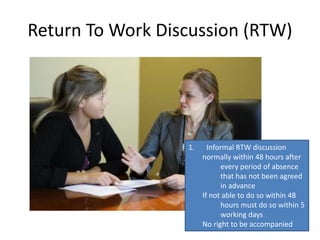
Return To Work Discussion (RTW)
1. Informal RTW discussion
normally within 48 hours after
every period of absence
that has not been agreed
in advance
If not able to do so within 48
hours must do so within 5
working days
No right to be accompanied
RTW Discussion Form Activity
• In small groups discuss Part B and identify any
potential issues you anticipate may come out
of the discussion
• Consider how this might be captured in Part B
Trigger points
• Moving from informal to formal
• Attendance Management Meeting triggered by:
1. 4 separate periods of absence in a rolling 12
month period
or
2. 10 days (74 hours) consecutive or non-
consecutive absence in a rolling 12 month
period (pro rata for part time employees)
or
3. Any other recurring, recognisable patterns
– Friday-Monday
– Before/after school/public holidays
Attendance Management Meetings
(AMM)
7 considerations:
1. When to hold an AMM
2. How to prepare for an AMM
3. What to consider at the AMM
4. Issuing a warning for unsatisfactory attendance
5. Issuing a warning for disability-related absence
6. Confirming the outcome of the AMM
7. Appeals against a warning
When to hold an AMM
• System triggers to managers a need to initiate an
AMM
• Usually carried out within 2 weeks of their return
to work
• Right to be accompanied (TU or DMU colleague)
– Employee’s choice should not usually delay by more
than 5 working days
• Give reasonable notice (min 3 working days)
• AMM only to take place once employee returns
to work
How to prepare for an AMM
• Consider absence record over past 12 months
• Identify discernable patterns
– Monday/Fridays
– School holidays
• Ensure you have completed a RTW discussion form for
EACH absence period under consideration
• Check any live warnings on file (e.g. misconduct or
poor performance)
• Review a blank AMM form and guidance notes to get
you ready for the meeting
What to consider at the AMM
• Investigate and discuss underlying reasons for absences
• Exploring any external causes
– Personal or family problems
• You should be supportive and show empathy whilst explaining
frequent absences from work are unacceptable
– “It may not be your fault but it is your problem”
• Explore if absences are work-related
– Take action if necessary
• Seek medical advice
– E.g. Consider involving Occupational Health
• If employee has a further absence between the trigger and the
AMM, wait until they return to work and have had the RTW
discussion for that absence and include that absence in the AMM
Activity 40 mins
1. Familiarise yourself with the AMM form
template (5mins)
2. Working individually, think of an example within
your area of responsibility of someone
triggering the need for an AMM and use that
example to think through the process and write
down key activities, considerations and issues at
each stage. (Focus on what might arise at the
meeting) (15 mins)
3. Compare your thoughts with your colleagues
and make a list of learning points
Issuing a warning for unsatisfactory attendance
• Default is to issue
– Unless there is a compelling reason why this
would be inappropriate
• Purpose of warning to flag that:
– their absence is of concern
– will lead to further action if improvements not
made
– May lead to dismissal while a stage three written
warning is live
• Right to withdraw right to self-certificate
Warnings
Three stages:
1. Formal oral warning
– Will remain live for six months
2. Formal written warning
– Will remain live for 12 months
3. Final written warning
– Will remain live for 18 months
– If employee triggers this policy whilst stage 3 warning is
live the manager may consider moving to dismissal stage.
Consult with HR
University’s right to extend periods where abuse of the
policy is suspected
Consideration of Dismissal
• Dismissal will be considered under this policy
where:
1. Unacceptable levels of absence where there is an
underlying health condition (Ill health capability)
2. Long term sickness absence – no foreseeable return
to work date (ill health capability)
3. Employee is at work but not performing full range of
duties because of an underlying health condition (Ill
health capability)
4. Unacceptable levels of absence where there is no
underlying health condition (a dismissal may be for
some other substantial reason)
When it is not appropriate to issue a warning
• Pregnancy
• Bereavement
• Serious isolated event or health condition
– Not part of an overall pattern of poor attendance
– Recovery is expected and a return to pre-
condition absence record is likely to return
following a period of convalescence
AMM - Confirming the outcome
• Write to employee normally within 5 days of
the AMM
– Use AMM outcome letter template
– Include agreed actions
• Employee should be advised of any delay
caused by either seeking a view from HR or
OH
• Employee should be notified as soon as
reasonably possible and without undue delay
AMM – Appeals against a warning
• Employee may appeal against a warning
– In writing to their manager within 5 working days
of receipt of written decision
• Manager will arrange
LONG TERM SICKNESS ABSENCE
What is ‘Long-term sick’
• Trigger = 4 weeks continuous absence or more
• Discuss with HR
• ‘Case management’ approach
• Contact with employee
– When you should have it
– How you should have it
– Where you should have it
• Seek medical advice
• Transfer to incapability on grounds of ill-health
policy
DISABILITY-RELATED ABSENCE
Disability-Related Absence (1)
• Equality Act 2010 requirement to eliminate
discrimination against disabled people at all
levels
“A person is disabled for the purposes of the Act if
they have a “physical or mental impairment that
has a substantial and long-term effect on their
ability to carry out normal day-to-day activities”
– “Long term” lasts or likely to last for at least 12
months
– “Substantial and adverse” means more than minor
and trivial and takes into account the time taken to
carry out the activities
Disability-related absence (2)
• AMM triggered as per policy
• Conduct AMM
– Level and reasons for absence
– Whether some or all of the absence is due to a
disability
– Consider the impact on the relevant work area
(specific examples)
– If due to disability, what reasonable adjustments
• Discuss with HR before any decision on whether
to issue a warning
AMM – CONSIDERATION OF
DISMISSAL
Data protection and confidentiality
• DMU adhere/consider to DP Act 1998
– Requesting
– Recording
– Monitoring
• Fraser Marshall to advise and provide appropriate example
• All staff with access to confidential and sensitive data about
and employee’s health are required to treat information
confidentially
– DPA 1998
– Access to Medical Records Act 1988
• Failure to adhere to our standards of DP fall within the
DMU code of conduct may result in disciplinary action up to
and including dismissal
REPORTING
Stage 4
Reporting
• Updates relating to employee absence
published and communicated periodically
• Statistical data only and monitored by EB and
BOG with recommendations for
improvements

Attendance management policy slide deck march15

  • 1.
  • 2.
  • 3.
  • 4.
    Attendance Management Policy •PROMPT – headline statistics, facts to make an initial impact • Nothing new about this – we are only implementing what most other large organisations have been doing for many years • DMU is unusual in NOT having a policy on Attendance Management • Assumes all absence is genuine but even so this needs to be managed
  • 5.
    Introduction and Purpose •Designed to improve employee attendance • Part of DMU’s commitment to employee wellbeing • Applies to all DMU employees • Policy supported by a toolkit – Guidance – Checklists – Relevant forms
  • 6.
    Approximately how many dayswork are lost at DMU through absence per year? We estimate around 14,000 workdays per annum. It’s an estimate because we don’t know the true figure. Part of DMU’s commitment to employee wellbeing
  • 7.
    Guiding Principles 1. Goodattendance is valued 2. All sickness absence is assumed to be genuine but a limit on how much is acceptable 3. Employee absence dealt with consistently within the ethos of equality and diversity 4. Some absence is inevitable but there may be times when absence is a cause for concern
  • 8.
    Framework • Policy providesa framework for staff attendance to be managed: – in a fair and consistent manner – Early so appropriate action and support can be put in place • System in place to provide accurate management data to enable managers to act
  • 9.
  • 10.
    Manager Accountable for managingattendance in their area of responsibility Expected to: – intervene early to secure an improvement – prioritise management of individual cases – keep in touch with absent employees – conduct risk assessments (and manage risk where necessary) – ensure absence is accurately recorded
  • 11.
    Employees Required to carryout duties unless unable to Expected to: – comply with DMU absence reporting and attendance management procedures – alert their manager if they feel their job is making them ill or contributing to illness – co-operate fully with Occupational Health and associated support
  • 12.
    People and OrganisationDevelopment Responsible for working collaboratively with managers Expected to: – provide on-going guidance, support and advice – ensure policy applied fairly and consistently across DMU – provide management data and reports
  • 13.
    (ii) • Occupational Healthand Wellbeing (OHW) – Assist managers to take a proactive approach – Support early intervention – preventing conditions worsening • Employee Assistance Programme (EAP) – Provides support and resources for staff and managers
  • 14.
  • 15.
    Monitoring and Reporting •Essential to consistently follow processes for: – notifying – recording – monitoring – reporting • Data will be published periodically • EB and the Board will scrutinise and make recommendations for improvements in attendance levels
  • 16.
    WHAT HAPPENS WHENAN EMPLOYEE IS ABSENT FROM WORK? Part Two
  • 17.
  • 18.
    Notification • Employees TELEPHONEwithin 1 hour of normal start time – Not email, text or third party – Contact should be ASAP if cover needed • When telephoning, employees must provide: – Reason – Expected date of return • Manager determines when further contact might be required and discusses this with the employee • Employee may submit self-certification or fit note if absence more than 7 days
  • 19.
  • 20.
    Fit Notes • TEST??? •Slide shows an example of a fit note
  • 21.
    Recording • Complete partA of the Absence Record and Return To Work Discussion Form when notified of absence • Complete part B of the form once RTW discussion has happened • Manager record on the absence management system
  • 22.
  • 23.
    Monitoring • Need toknow when and how best to support staff to manage their attendance • Informal element for every period of absence – Return to Work Discussion • System will monitor and ’trigger’ the need to escalate • Formal stage • Absence Management Meeting
  • 24.
    ACTIVITY - RTW •Discuss in your group what you consider would make an effective informal return to work discussion following a period of absence • Consider: – When it’s done – What it consists of – How it’s done – Where it’s done – Who is involved – Why we do them
  • 25.
    RTW Activity De-brief 1.Informal RTW discussion – normally within 48 hours after every period of absence that has not been agreed in advance – If not able to do so within 48 hours must do so within 5 working days – No right to be accompanied 2. Character of the meeting is supporting the employee upon their return – Support can be many and varied
  • 26.
    Return To WorkDiscussion (RTW) 1. Informal RTW discussion normally within 48 hours after every period of absence that has not been agreed in advance If not able to do so within 48 hours must do so within 5 working days No right to be accompanied
  • 27.
    RTW Discussion FormActivity • In small groups discuss Part B and identify any potential issues you anticipate may come out of the discussion • Consider how this might be captured in Part B
  • 28.
    Trigger points • Movingfrom informal to formal • Attendance Management Meeting triggered by: 1. 4 separate periods of absence in a rolling 12 month period or 2. 10 days (74 hours) consecutive or non- consecutive absence in a rolling 12 month period (pro rata for part time employees) or 3. Any other recurring, recognisable patterns – Friday-Monday – Before/after school/public holidays
  • 29.
    Attendance Management Meetings (AMM) 7considerations: 1. When to hold an AMM 2. How to prepare for an AMM 3. What to consider at the AMM 4. Issuing a warning for unsatisfactory attendance 5. Issuing a warning for disability-related absence 6. Confirming the outcome of the AMM 7. Appeals against a warning
  • 30.
    When to holdan AMM • System triggers to managers a need to initiate an AMM • Usually carried out within 2 weeks of their return to work • Right to be accompanied (TU or DMU colleague) – Employee’s choice should not usually delay by more than 5 working days • Give reasonable notice (min 3 working days) • AMM only to take place once employee returns to work
  • 31.
    How to preparefor an AMM • Consider absence record over past 12 months • Identify discernable patterns – Monday/Fridays – School holidays • Ensure you have completed a RTW discussion form for EACH absence period under consideration • Check any live warnings on file (e.g. misconduct or poor performance) • Review a blank AMM form and guidance notes to get you ready for the meeting
  • 32.
    What to considerat the AMM • Investigate and discuss underlying reasons for absences • Exploring any external causes – Personal or family problems • You should be supportive and show empathy whilst explaining frequent absences from work are unacceptable – “It may not be your fault but it is your problem” • Explore if absences are work-related – Take action if necessary • Seek medical advice – E.g. Consider involving Occupational Health • If employee has a further absence between the trigger and the AMM, wait until they return to work and have had the RTW discussion for that absence and include that absence in the AMM
  • 33.
    Activity 40 mins 1.Familiarise yourself with the AMM form template (5mins) 2. Working individually, think of an example within your area of responsibility of someone triggering the need for an AMM and use that example to think through the process and write down key activities, considerations and issues at each stage. (Focus on what might arise at the meeting) (15 mins) 3. Compare your thoughts with your colleagues and make a list of learning points
  • 34.
    Issuing a warningfor unsatisfactory attendance • Default is to issue – Unless there is a compelling reason why this would be inappropriate • Purpose of warning to flag that: – their absence is of concern – will lead to further action if improvements not made – May lead to dismissal while a stage three written warning is live • Right to withdraw right to self-certificate
  • 35.
    Warnings Three stages: 1. Formaloral warning – Will remain live for six months 2. Formal written warning – Will remain live for 12 months 3. Final written warning – Will remain live for 18 months – If employee triggers this policy whilst stage 3 warning is live the manager may consider moving to dismissal stage. Consult with HR University’s right to extend periods where abuse of the policy is suspected
  • 36.
    Consideration of Dismissal •Dismissal will be considered under this policy where: 1. Unacceptable levels of absence where there is an underlying health condition (Ill health capability) 2. Long term sickness absence – no foreseeable return to work date (ill health capability) 3. Employee is at work but not performing full range of duties because of an underlying health condition (Ill health capability) 4. Unacceptable levels of absence where there is no underlying health condition (a dismissal may be for some other substantial reason)
  • 37.
    When it isnot appropriate to issue a warning • Pregnancy • Bereavement • Serious isolated event or health condition – Not part of an overall pattern of poor attendance – Recovery is expected and a return to pre- condition absence record is likely to return following a period of convalescence
  • 38.
    AMM - Confirmingthe outcome • Write to employee normally within 5 days of the AMM – Use AMM outcome letter template – Include agreed actions • Employee should be advised of any delay caused by either seeking a view from HR or OH • Employee should be notified as soon as reasonably possible and without undue delay
  • 39.
    AMM – Appealsagainst a warning • Employee may appeal against a warning – In writing to their manager within 5 working days of receipt of written decision • Manager will arrange
  • 40.
  • 41.
    What is ‘Long-termsick’ • Trigger = 4 weeks continuous absence or more • Discuss with HR • ‘Case management’ approach • Contact with employee – When you should have it – How you should have it – Where you should have it • Seek medical advice • Transfer to incapability on grounds of ill-health policy
  • 42.
  • 43.
    Disability-Related Absence (1) •Equality Act 2010 requirement to eliminate discrimination against disabled people at all levels “A person is disabled for the purposes of the Act if they have a “physical or mental impairment that has a substantial and long-term effect on their ability to carry out normal day-to-day activities” – “Long term” lasts or likely to last for at least 12 months – “Substantial and adverse” means more than minor and trivial and takes into account the time taken to carry out the activities
  • 44.
    Disability-related absence (2) •AMM triggered as per policy • Conduct AMM – Level and reasons for absence – Whether some or all of the absence is due to a disability – Consider the impact on the relevant work area (specific examples) – If due to disability, what reasonable adjustments • Discuss with HR before any decision on whether to issue a warning
  • 45.
  • 46.
    Data protection andconfidentiality • DMU adhere/consider to DP Act 1998 – Requesting – Recording – Monitoring • Fraser Marshall to advise and provide appropriate example • All staff with access to confidential and sensitive data about and employee’s health are required to treat information confidentially – DPA 1998 – Access to Medical Records Act 1988 • Failure to adhere to our standards of DP fall within the DMU code of conduct may result in disciplinary action up to and including dismissal
  • 47.
  • 48.
    Reporting • Updates relatingto employee absence published and communicated periodically • Statistical data only and monitored by EB and BOG with recommendations for improvements

Editor's Notes

  • #5 We need some approved headline stats (RG??)
  • #11 Lay it on thick – it is the managers responsibility to make this policy work.
  • #21 We need a short test to help people understand about fit notes and issue the Fit Notes Guidance Notes
  • #22 Manager can delegate a nominated other to input into system.
  • #24 Attendance system will email managers when an employee has triggered and attach a template letter.
  • #26 Refer to table.
  • #27 Emphasise no right to be accompanied – it’s an informal discussion between line manager and employee.
  • #28 This is about people identifying possible issues when having RTW discussions and in particular how they capture them in Part B Advice about approach if an employee does not agree with what the manager is saying.
  • #29 Need to confirm if we are temp increasing the trigger points.
  • #30 Signpost to Constructive Conversations and Handling Difficult Conversations.
  • #31 Re-emphasise that system will send the line manager relevant letters to send and previous 12 months absence record
  • #33 Expand on supportive and show empathy
  • #37 Sickness absence should not normally be dealt with as a conduct issue unless there is clear evidence that the employee’s absence is not for a genuine reason – this procedure is consistent with the procedure for handling incapability on the grounds of ill health which provides for excessive intermittent absence to be treated as a disciplinary matter where there is no satisfactory medical evidence
  • #38 Case example to demonstrate
  • #39 Explain ‘reasonably possible” – make the point HR will not be doing this – you will
  • #40 Manager will arrange for the appeal to be heard when reasonably practicable Reasonably practicable where a more senior manager is available without causing undue delay. In the rare circumstance that this is not RP, it will be heard by a different manager who is AT LEAST the same level as the manager that gave the initial warning – i.e. YOU!
  • #42 Tell participants to read the guidance notes “Case management approach” = consider each individual case on its merits Keeping in contact OH referral Return to work plans Reduced or changed hours/working practices Medical redeployment Reasonable adjustment Funding private treatment MOVE TO  Incapability on Grounds of Ill Health procedure