Dr.M.Siva Kumar Reddy MD
Department of Biochemistry
Sri venkateswara medical college
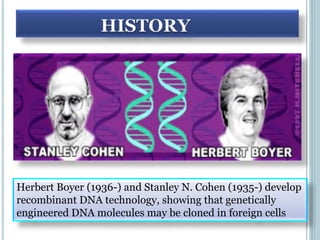
Herbert Boyer (1936-) and Stanley N. Cohen (1935-) develop
recombinant DNA technology, showing that genetically
engineered DNA molecules may be cloned in foreign cells
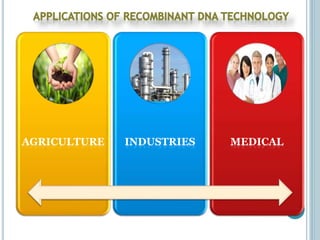
AGRICULTURE INDUSTRIES MEDICAL
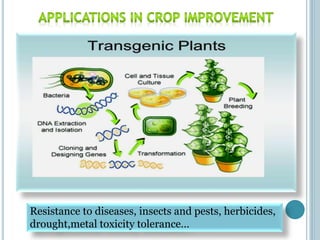
Resistance to diseases, insects and pests, herbicides,
drought,metal toxicity tolerance…
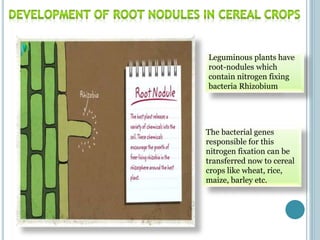
Leguminous plants have
root-nodules which
contain nitrogen fixing
bacteria Rhizobium
The bacterial genes
responsible for this
nitrogen fixation can be
transferred now to cereal
crops like wheat, rice,
maize, barley etc.
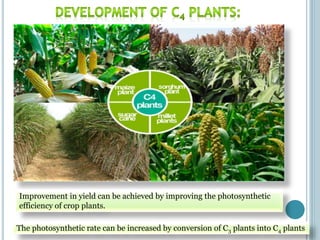
Improvement in yield can be achieved by improving the photosynthetic
efficiency of crop plants.
The photosynthetic rate can be increased by conversion of C3 plants into C4 plants
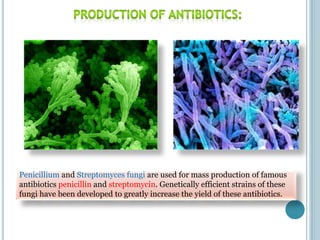
Penicillium and Streptomyces fungi are used for mass production of famous
antibiotics penicillin and streptomycin. Genetically efficient strains of these
fungi have been developed to greatly increase the yield of these antibiotics.
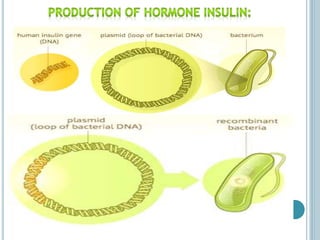
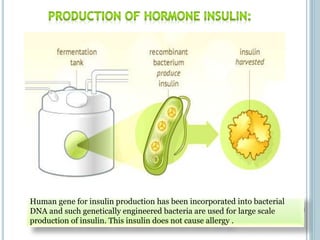
Human gene for insulin production has been incorporated into bacterial
DNA and such genetically engineered bacteria are used for large scale
production of insulin. This insulin does not cause allergy .
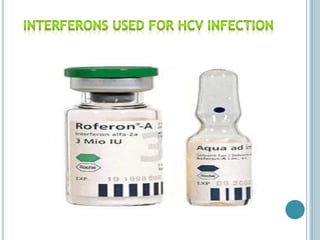
 Interferon was named for its ability to interfere
with viral proliferation.
 Interferon’s are virus-induced proteins produced by
virus-infected cells.
 Interferon are antiviral in action and act as first line
of defense against viruses causing serious
infections, including breast cancer and lymph nodes
malignancy.
 Natural interferon is produced in very small quality
from human blood cells.
 It is very costly.
 It is now possible to produce interferon by
recombinant DNA technology at much cheaper rate.
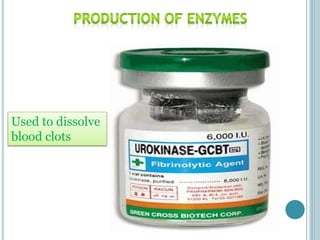
Used to dissolve
blood clots
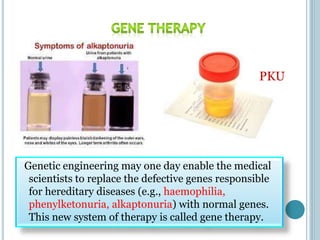
Genetic engineering may one day enable the medical
scientists to replace the defective genes responsible
for hereditary diseases (e.g., haemophilia,
phenylketonuria, alkaptonuria) with normal genes.
This new system of therapy is called gene therapy.
PKU
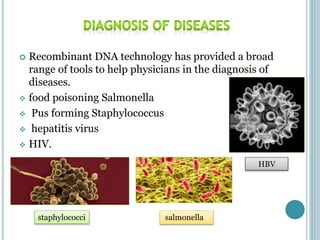
 Recombinant DNA technology has provided a broad
range of tools to help physicians in the diagnosis of
diseases.
 food poisoning Salmonella
 Pus forming Staphylococcus
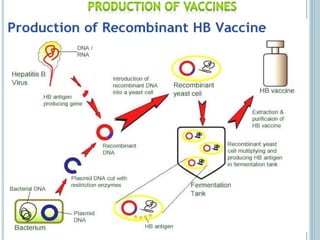
 hepatitis virus
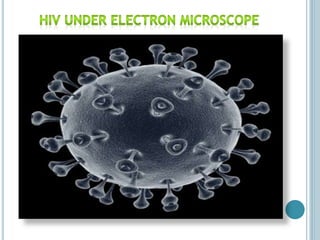
 HIV.
HBV
staphylococci salmonella
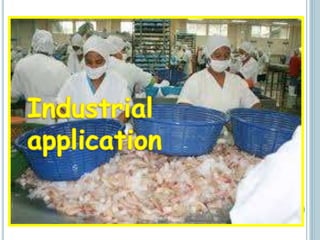
 In industries, recombinant DNA technique will help in
the production of chemical compounds of commercial
importance.
 Improvement of existing fermentation processes and
production of proteins from wastes.
 This can be achieved by developing more efficient
strains of microorganisms.
 Specially developed microorganisms may be used even
to clean up the pollutants.
 Biotechnology, especially recombinant DNA technology
has many useful applications in crop improvement,
medicines and industry.
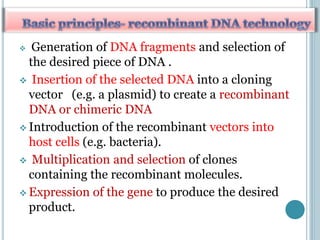
 Generation of DNA fragments and selection of
the desired piece of DNA .
 Insertion of the selected DNA into a cloning
vector (e.g. a plasmid) to create a recombinant
DNA or chimeric DNA
 Introduction of the recombinant vectors into
host cells (e.g. bacteria).
 Multiplication and selection of clones
containing the recombinant molecules.
 Expression of the gene to produce the desired
product.
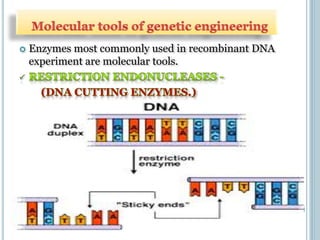
 Enzymes most commonly used in recombinant DNA
experiment are molecular tools.
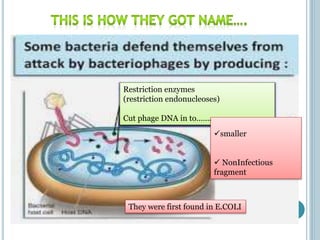
They were first found in E.COLI
Restriction enzymes
(restriction endonucleoses)
Cut phage DNA in to…….
smaller
 NonInfectious
fragment
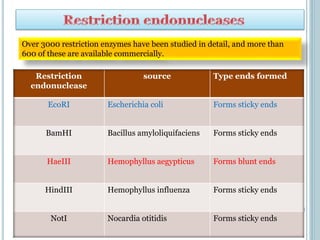
Restriction
endonuclease
source Type ends formed
EcoRI Escherichia coli Forms sticky ends
BamHI Bacillus amyloliquifaciens Forms sticky ends
HaeIII Hemophyllus aegypticus Forms blunt ends
HindIII Hemophyllus influenza Forms sticky ends
NotI Nocardia otitidis Forms sticky ends
Over 3000 restriction enzymes have been studied in detail, and more than
600 of these are available commercially.
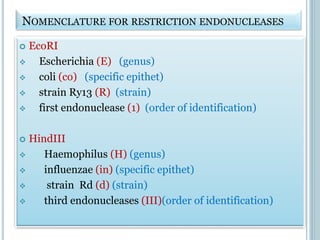
NOMENCLATURE FOR RESTRICTION ENDONUCLEASES
 EcoRI
 Escherichia (E) (genus)
 coli (co) (specific epithet)
 strain Ry13 (R) (strain)
 first endonuclease (1) (order of identification)
 HindIII
 Haemophilus (H) (genus)
 influenzae (in) (specific epithet)
 strain Rd (d) (strain)
 third endonucleases (III)(order of identification)
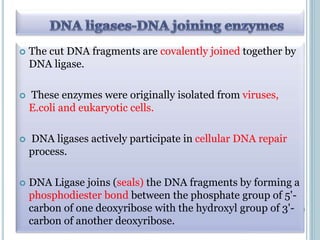
 The cut DNA fragments are covalently joined together by
DNA ligase.
 These enzymes were originally isolated from viruses,
E.coli and eukaryotic cells.
 DNA ligases actively participate in cellular DNA repair
process.
 DNA Ligase joins (seals) the DNA fragments by forming a
phosphodiester bond between the phosphate group of 5'-
carbon of one deoxyribose with the hydroxyl group of 3'-
carbon of another deoxyribose.
 The hosts are the living systems or cells in which the
carrier of recombinant DNA molecule or vector can he
propagated.
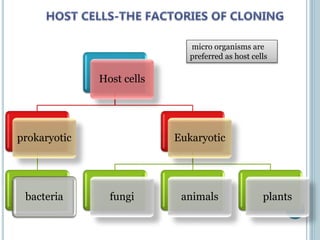
Host cells
prokaryotic
bacteria
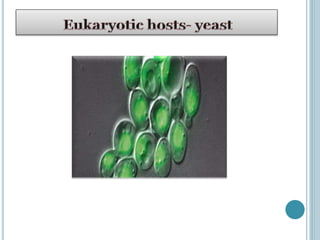
Eukaryotic
fungi animals plants
micro organisms are
preferred as host cells
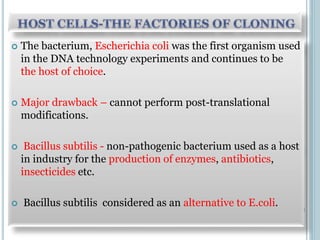
 The bacterium, Escherichia coli was the first organism used
in the DNA technology experiments and continues to be
the host of choice.
 Major drawback – cannot perform post-translational
modifications.
 Bacillus subtilis - non-pathogenic bacterium used as a host
in industry for the production of enzymes, antibiotics,
insecticides etc.
 Bacillus subtilis considered as an alternative to E.coli.
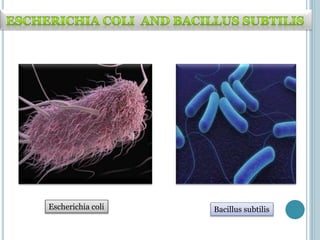
Escherichia coli Bacillus subtilis
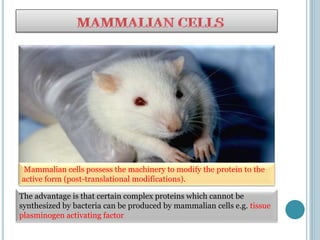
The advantage is that certain complex proteins which cannot be
synthesized by bacteria can be produced by mammalian cells e.g. tissue
plasminogen activating factor
Mammalian cells possess the machinery to modify the protein to the
active form (post-translational modifications).
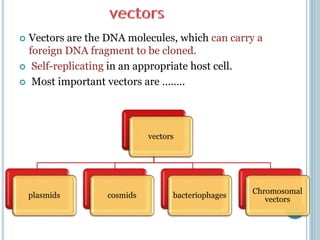
 Vectors are the DNA molecules, which can carry a
foreign DNA fragment to be cloned.
 Self-replicating in an appropriate host cell.
 Most important vectors are ……..
vectors
plasmids cosmids bacteriophages
Chromosomal
vectors
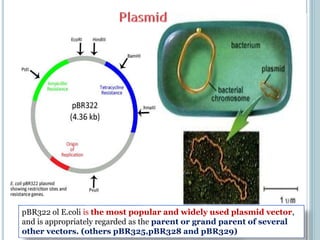
pBR322 ol E.coli is the most popular and widely used plasmid vector,
and is appropriately regarded as the parent or grand parent of several
other vectors. (others pBR325,pBR328 and pBR329)
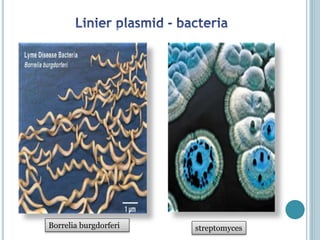
Borrelia burgdorferi streptomyces
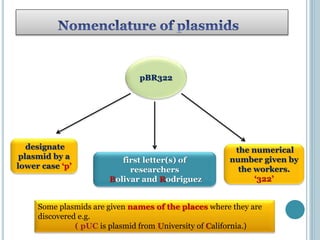
pBR322
designate
plasmid by a
lower case ‘p’
first letter(s) of
researchers
Bolivar and Rodriguez
the numerical
number given by
the workers.
‘322’
Some plasmids are given names of the places where they are
discovered e.g.
( pUC is plasmid from University of California.)
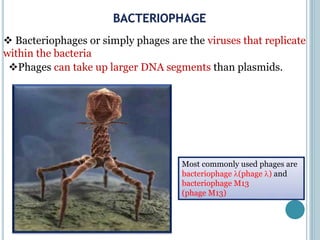
 Bacteriophages or simply phages are the viruses that replicate
within the bacteria
Phages can take up larger DNA segments than plasmids.
Most commonly used phages are
bacteriophage (phage ) and
bacteriophage M13
(phage M13)
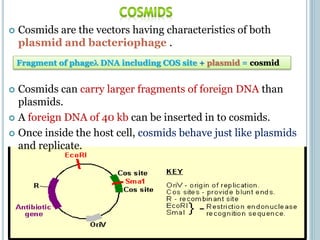
Fragment of phage DNA including COS site + plasmid = cosmid
 Cosmids are the vectors having characteristics of both
plasmid and bacteriophage .
 Cosmids can carry larger fragments of foreign DNA than
plasmids.
 A foreign DNA of 40 kb can be inserted in to cosmids.
 Once inside the host cell, cosmids behave just like plasmids
and replicate.
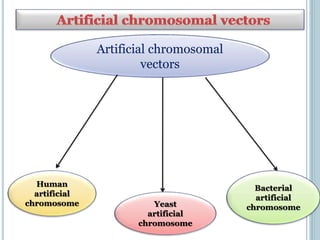
Artificial chromosomal
vectors
Human
artificial
chromosome Yeast
artificial
chromosome
Bacterial
artificial
chromosome
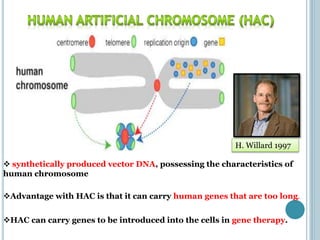
 synthetically produced vector DNA, possessing the characteristics of
human chromosome
Advantage with HAC is that it can carry human genes that are too long.
HAC can carry genes to be introduced into the cells in gene therapy.
H. Willard 1997
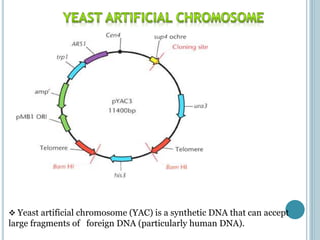
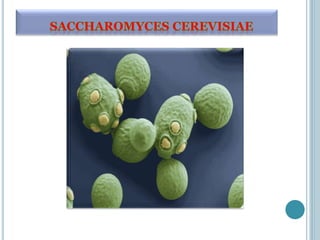
 Yeast artificial chromosome (YAC) is a synthetic DNA that can accept
large fragments of foreign DNA (particularly human DNA).
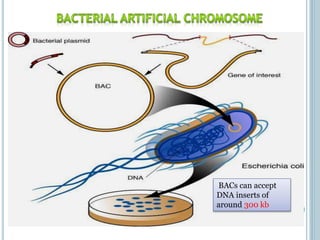
BACs can accept
DNA inserts of
around 300 kb
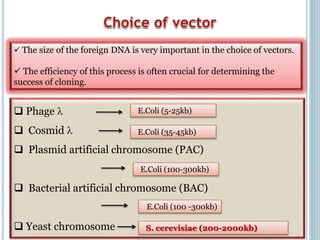
 Phage 
 Cosmid 
 Plasmid artificial chromosome (PAC)
 Bacterial artificial chromosome (BAC)
 Yeast chromosome
E.Coli (5-25kb)
E.Coli (35-45kb)
E.Coli (100-300kb)
E.Coli (100 -300kb)
S. cerevisiae (200-2000kb)
 The size of the foreign DNA is very important in the choice of vectors.
 The efficiency of this process is often crucial for determining the
success of cloning.
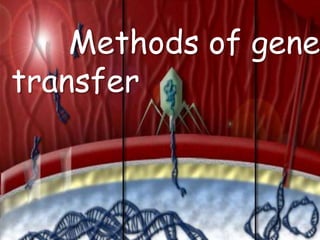
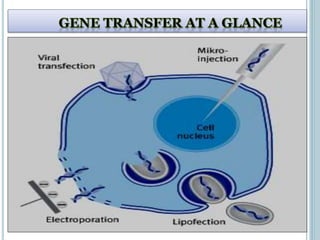
Methods of gene
transfer
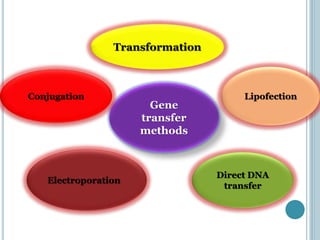
Gene
transfer
methods
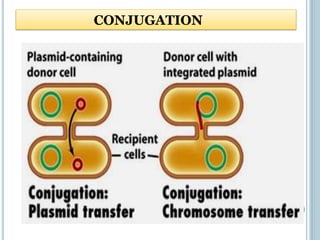
Conjugation
Transformation
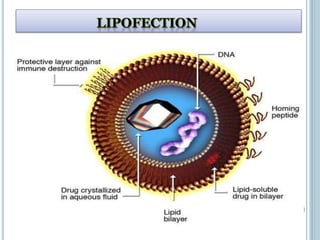
Lipofection
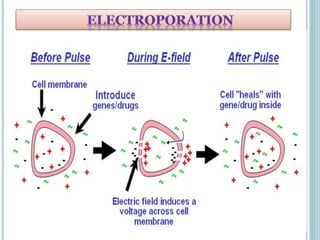
Electroporation
Direct DNA
transfer
CONJUGATION
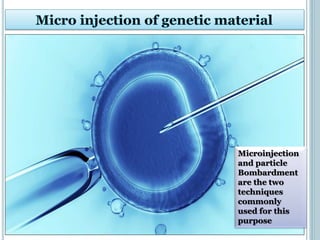
Microinjection
and particle
Bombardment
are the two
techniques
commonly
used for this
purpose
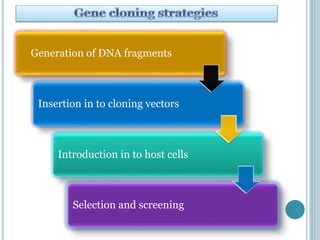
Generation of DNA fragments
Insertion in to cloning vectors
Introduction in to host cells
Selection and screening
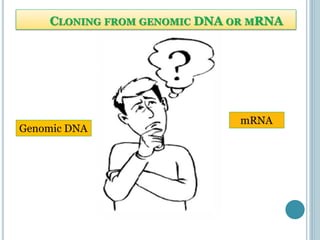
CLONING FROM GENOMIC DNA OR MRNA
Genomic DNA
mRNA
GENOMIC DNA
 DNA represents the complete genetic material
of an organism which is referred to as genome.
 Theoretically speaking, cloning from genomic
DNA is supposed to be ideal.
o But the DNA Contains non-coding sequences
( introns),control regions and repetitive
sequences This complicates the cloning strategies.
hence DNA as a source material is not preferred.
MESSENGER RNA
 The use of mRNA in cloning is preferred for
following reasons…….
 mRNA represents the actual genetic information
being expressed.
 Selection and isolation mRNA are easy.
 As introns are removed during processing , mRNA
reflects the coding sequence of the Gene.
 The synthesis of recombinant protein is much
easier with mRNA cloning.
Thank

RECOMBINANT DNA TECHNOLOGY FOR MEDICAL STUDENTS

  • 1.
    Dr.M.Siva Kumar ReddyMD Department of Biochemistry Sri venkateswara medical college
  • 2.
    Herbert Boyer (1936-)and Stanley N. Cohen (1935-) develop recombinant DNA technology, showing that genetically engineered DNA molecules may be cloned in foreign cells
  • 3.
  • 4.
    Resistance to diseases,insects and pests, herbicides, drought,metal toxicity tolerance…
  • 5.
    Leguminous plants have root-noduleswhich contain nitrogen fixing bacteria Rhizobium The bacterial genes responsible for this nitrogen fixation can be transferred now to cereal crops like wheat, rice, maize, barley etc.
  • 6.
    Improvement in yieldcan be achieved by improving the photosynthetic efficiency of crop plants. The photosynthetic rate can be increased by conversion of C3 plants into C4 plants
  • 8.
    Penicillium and Streptomycesfungi are used for mass production of famous antibiotics penicillin and streptomycin. Genetically efficient strains of these fungi have been developed to greatly increase the yield of these antibiotics.
  • 10.
    Human gene forinsulin production has been incorporated into bacterial DNA and such genetically engineered bacteria are used for large scale production of insulin. This insulin does not cause allergy .
  • 12.
     Interferon wasnamed for its ability to interfere with viral proliferation.  Interferon’s are virus-induced proteins produced by virus-infected cells.  Interferon are antiviral in action and act as first line of defense against viruses causing serious infections, including breast cancer and lymph nodes malignancy.  Natural interferon is produced in very small quality from human blood cells.  It is very costly.  It is now possible to produce interferon by recombinant DNA technology at much cheaper rate.
  • 14.
  • 15.
    Genetic engineering mayone day enable the medical scientists to replace the defective genes responsible for hereditary diseases (e.g., haemophilia, phenylketonuria, alkaptonuria) with normal genes. This new system of therapy is called gene therapy. PKU
  • 17.
     Recombinant DNAtechnology has provided a broad range of tools to help physicians in the diagnosis of diseases.  food poisoning Salmonella  Pus forming Staphylococcus  hepatitis virus  HIV. HBV staphylococci salmonella
  • 25.
     In industries,recombinant DNA technique will help in the production of chemical compounds of commercial importance.  Improvement of existing fermentation processes and production of proteins from wastes.  This can be achieved by developing more efficient strains of microorganisms.  Specially developed microorganisms may be used even to clean up the pollutants.  Biotechnology, especially recombinant DNA technology has many useful applications in crop improvement, medicines and industry.
  • 26.
     Generation ofDNA fragments and selection of the desired piece of DNA .  Insertion of the selected DNA into a cloning vector (e.g. a plasmid) to create a recombinant DNA or chimeric DNA  Introduction of the recombinant vectors into host cells (e.g. bacteria).  Multiplication and selection of clones containing the recombinant molecules.  Expression of the gene to produce the desired product.
  • 27.
     Enzymes mostcommonly used in recombinant DNA experiment are molecular tools.
  • 28.
    They were firstfound in E.COLI Restriction enzymes (restriction endonucleoses) Cut phage DNA in to……. smaller  NonInfectious fragment
  • 29.
    Restriction endonuclease source Type endsformed EcoRI Escherichia coli Forms sticky ends BamHI Bacillus amyloliquifaciens Forms sticky ends HaeIII Hemophyllus aegypticus Forms blunt ends HindIII Hemophyllus influenza Forms sticky ends NotI Nocardia otitidis Forms sticky ends Over 3000 restriction enzymes have been studied in detail, and more than 600 of these are available commercially.
  • 30.
    NOMENCLATURE FOR RESTRICTIONENDONUCLEASES  EcoRI  Escherichia (E) (genus)  coli (co) (specific epithet)  strain Ry13 (R) (strain)  first endonuclease (1) (order of identification)  HindIII  Haemophilus (H) (genus)  influenzae (in) (specific epithet)  strain Rd (d) (strain)  third endonucleases (III)(order of identification)
  • 31.
     The cutDNA fragments are covalently joined together by DNA ligase.  These enzymes were originally isolated from viruses, E.coli and eukaryotic cells.  DNA ligases actively participate in cellular DNA repair process.  DNA Ligase joins (seals) the DNA fragments by forming a phosphodiester bond between the phosphate group of 5'- carbon of one deoxyribose with the hydroxyl group of 3'- carbon of another deoxyribose.
  • 32.
     The hostsare the living systems or cells in which the carrier of recombinant DNA molecule or vector can he propagated.
  • 33.
    Host cells prokaryotic bacteria Eukaryotic fungi animalsplants micro organisms are preferred as host cells
  • 34.
     The bacterium,Escherichia coli was the first organism used in the DNA technology experiments and continues to be the host of choice.  Major drawback – cannot perform post-translational modifications.  Bacillus subtilis - non-pathogenic bacterium used as a host in industry for the production of enzymes, antibiotics, insecticides etc.  Bacillus subtilis considered as an alternative to E.coli.
  • 35.
  • 38.
    The advantage isthat certain complex proteins which cannot be synthesized by bacteria can be produced by mammalian cells e.g. tissue plasminogen activating factor Mammalian cells possess the machinery to modify the protein to the active form (post-translational modifications).
  • 39.
     Vectors arethe DNA molecules, which can carry a foreign DNA fragment to be cloned.  Self-replicating in an appropriate host cell.  Most important vectors are …….. vectors plasmids cosmids bacteriophages Chromosomal vectors
  • 40.
    pBR322 ol E.coliis the most popular and widely used plasmid vector, and is appropriately regarded as the parent or grand parent of several other vectors. (others pBR325,pBR328 and pBR329)
  • 41.
  • 42.
    pBR322 designate plasmid by a lowercase ‘p’ first letter(s) of researchers Bolivar and Rodriguez the numerical number given by the workers. ‘322’ Some plasmids are given names of the places where they are discovered e.g. ( pUC is plasmid from University of California.)
  • 43.
     Bacteriophages orsimply phages are the viruses that replicate within the bacteria Phages can take up larger DNA segments than plasmids. Most commonly used phages are bacteriophage (phage ) and bacteriophage M13 (phage M13)
  • 44.
    Fragment of phageDNA including COS site + plasmid = cosmid  Cosmids are the vectors having characteristics of both plasmid and bacteriophage .  Cosmids can carry larger fragments of foreign DNA than plasmids.  A foreign DNA of 40 kb can be inserted in to cosmids.  Once inside the host cell, cosmids behave just like plasmids and replicate.
  • 45.
  • 46.
     synthetically producedvector DNA, possessing the characteristics of human chromosome Advantage with HAC is that it can carry human genes that are too long. HAC can carry genes to be introduced into the cells in gene therapy. H. Willard 1997
  • 47.
     Yeast artificialchromosome (YAC) is a synthetic DNA that can accept large fragments of foreign DNA (particularly human DNA).
  • 48.
    BACs can accept DNAinserts of around 300 kb
  • 49.
     Phage  Cosmid   Plasmid artificial chromosome (PAC)  Bacterial artificial chromosome (BAC)  Yeast chromosome E.Coli (5-25kb) E.Coli (35-45kb) E.Coli (100-300kb) E.Coli (100 -300kb) S. cerevisiae (200-2000kb)  The size of the foreign DNA is very important in the choice of vectors.  The efficiency of this process is often crucial for determining the success of cloning.
  • 50.
  • 51.
  • 53.
  • 56.
    Microinjection and particle Bombardment are thetwo techniques commonly used for this purpose
  • 58.
    Generation of DNAfragments Insertion in to cloning vectors Introduction in to host cells Selection and screening
  • 59.
    CLONING FROM GENOMICDNA OR MRNA Genomic DNA mRNA
  • 60.
    GENOMIC DNA  DNArepresents the complete genetic material of an organism which is referred to as genome.  Theoretically speaking, cloning from genomic DNA is supposed to be ideal. o But the DNA Contains non-coding sequences ( introns),control regions and repetitive sequences This complicates the cloning strategies. hence DNA as a source material is not preferred.
  • 61.
    MESSENGER RNA  Theuse of mRNA in cloning is preferred for following reasons…….  mRNA represents the actual genetic information being expressed.  Selection and isolation mRNA are easy.  As introns are removed during processing , mRNA reflects the coding sequence of the Gene.  The synthesis of recombinant protein is much easier with mRNA cloning.
  • 63.