Batteries
Periyanayaga Kristy.A,
Ph.D. Research Scholar
SRM Universtiy
Chennai
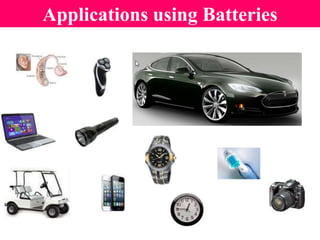
Applications using Batteries
• Convert stored chemical
energy into electrical energy
• Reaction between chemicals
take place
• Consisting of electrochemical
cells
• Contains
– Electrodes
– Electrolyte
Battery
• Cathode
– Positive terminal
– Chemical reduction occurs (gain electrons)
• Anode
– Negative terminal
– Chemical oxidation occurs (lose electrons)
• Electrolytes allow:
– Separation of ionic transport and electrical transport
– Ions to move between electrodes and terminals
– Current to flow out of the battery to perform work
Electrodes and Electrolytes
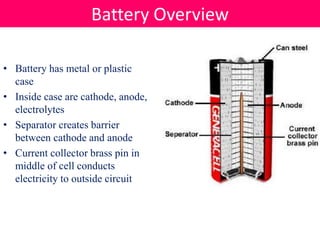
• Battery has metal or plastic
case
• Inside case are cathode, anode,
electrolytes
• Separator creates barrier
between cathode and anode
• Current collector brass pin in
middle of cell conducts
electricity to outside circuit
Battery Overview
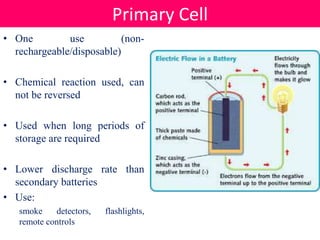
• One use (non-
rechargeable/disposable)
• Chemical reaction used, can
not be reversed
• Used when long periods of
storage are required
• Lower discharge rate than
secondary batteries
• Use:
smoke detectors, flashlights,
remote controls
Primary Cell
• Alkaline batteries name came from the electrolyte in an alkane
• Anode: zinc powder form
• Cathode: manganese dioxide
• Electrolyte: potassium hydroxide
• The half-reactions are:
Zn(s) + 2OH−
(aq) → ZnO(s) + H2O(l) + 2e− [e° = -1.28 V]
2MnO2(s) + H2O(l) + 2e− → Mn2O3(s) + 2OH−
(aq) [e° = 0.15 V]
• Overall reaction:
Zn(s) + 2MnO2(s) → ZnO(s) + Mn2O3(s) [e° = 1.43 V]
Alkaline Battery
• Anode: zinc metal body (Zn)
• Cathode: manganese dioxide (MnO2)
• Electrolyte: paste of zinc chloride and ammonium chloride dissolved in water
• The half-reactions are:
Zn(s) → Zn2+(aq) + 2e- [e° = -0.763 V]
2NH4
+(aq) + 2MnO2(s) + 2e- → Mn2O3(s) + H2O(l) + 2NH3(aq) + 2Cl- [e° = 0.50 V]
• Overall reaction:
Zn(s) + 2MnO2(s) + 2NH4Cl(aq) → Mn2O3(s) + Zn(NH3)2Cl2 (aq) + H2O(l) [e° = 1.3 V]a
Zinc-Carbon Battery
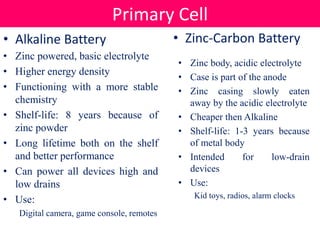
• Alkaline Battery
• Zinc powered, basic electrolyte
• Higher energy density
• Functioning with a more stable
chemistry
• Shelf-life: 8 years because of
zinc powder
• Long lifetime both on the shelf
and better performance
• Can power all devices high and
low drains
• Use:
Digital camera, game console, remotes
• Zinc-Carbon Battery
• Zinc body, acidic electrolyte
• Case is part of the anode
• Zinc casing slowly eaten
away by the acidic electrolyte
• Cheaper then Alkaline
• Shelf-life: 1-3 years because
of metal body
• Intended for low-drain
devices
• Use:
Kid toys, radios, alarm clocks
Primary Cell
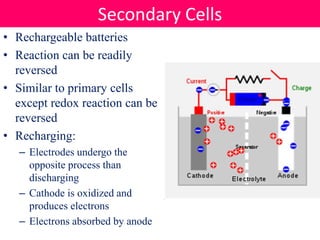
• Rechargeable batteries
• Reaction can be readily
reversed
• Similar to primary cells
except redox reaction can be
reversed
• Recharging:
– Electrodes undergo the
opposite process than
discharging
– Cathode is oxidized and
produces electrons
– Electrons absorbed by anode
Secondary Cells
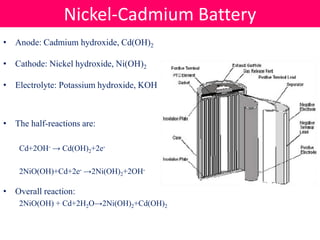
• Anode: Cadmium hydroxide, Cd(OH)2
• Cathode: Nickel hydroxide, Ni(OH)2
• Electrolyte: Potassium hydroxide, KOH
• The half-reactions are:
Cd+2OH- → Cd(OH)2+2e-
2NiO(OH)+Cd+2e- →2Ni(OH)2+2OH-
• Overall reaction:
2NiO(OH) + Cd+2H2O→2Ni(OH)2+Cd(OH)2
Nickel-Cadmium Battery
• Maintain a steady voltage of 1.2v per cell until completely
depleted
• Have ability to deliver full power output until end of cycle
• Have consistent powerful delivery throughout the entire
application
• Very low internal resistance
• Lower voltage per cell
Nickel-Cadmium Battery
• Advantages:
– This chemistry is reliable
– Operate in a range of temperatures
– Tolerates abuse well and performs well after long periods
of storage
• Disadvantages:
– It is three to five times more expensive than lead-acid
– Its materials are toxic and the recycling infrastructure for
larger nickel-cadmium batteries is very limited
Nickel-Cadmium Battery
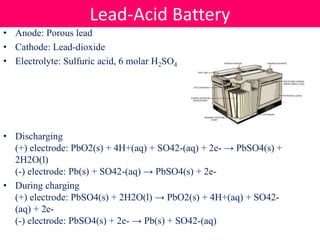
• Anode: Porous lead
• Cathode: Lead-dioxide
• Electrolyte: Sulfuric acid, 6 molar H2SO4
• Discharging
(+) electrode: PbO2(s) + 4H+(aq) + SO42-(aq) + 2e- → PbSO4(s) +
2H2O(l)
(-) electrode: Pb(s) + SO42-(aq) → PbSO4(s) + 2e-
• During charging
(+) electrode: PbSO4(s) + 2H2O(l) → PbO2(s) + 4H+(aq) + SO42-
(aq) + 2e-
(-) electrode: PbSO4(s) + 2e- → Pb(s) + SO42-(aq)
Lead-Acid Battery
• The lead-acid cells in automobile batteries are wet
cells
• Deliver short burst of high power, to start the engine
• Battery supplies power to the starter and ignition
system to start the engine
• Battery acts as a voltage stabilizer in the electrical
system
• Supplies the extra power necessary when the
vehicle's electrical load exceeds the supply from the
charging system
Lead-Acid Battery
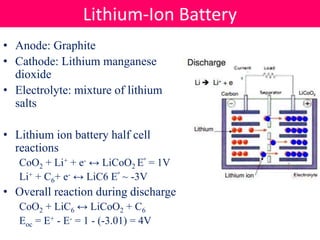
• Anode: Graphite
• Cathode: Lithium manganese
dioxide
• Electrolyte: mixture of lithium
salts
• Lithium ion battery half cell
reactions
CoO2 + Li+ + e- ↔ LiCoO2 Eº = 1V
Li+ + C6+ e- ↔ LiC6 Eº ~ -3V
• Overall reaction during discharge
CoO2 + LiC6 ↔ LiCoO2 + C6
Eoc = E+ - E- = 1 - (-3.01) = 4V
Lithium-Ion Battery
• Advantages:
– It has a high specific energy (number of hours of operation for
a given weight)
– Huge success for mobile applications such as phones and
notebook computers
• Disadvantages:
– Cost differential
• Not as apparent with small batteries (phones and computers)
• Automotive batteries are larger, cost becomes more significant
– Cell temperature is monitored to prevent temperature extremes
– No established system for recycling large lithium-ion batteries
Lithium-Ion Battery
• High energy density - potential for yet higher
capacities
• Relatively low self-discharge, less than half of
nickel-based batteries
• Low Maintenance
– No periodic discharge needed
– No memory
• Energy density of lithium-ion is three times of the
standard lead acid
• Cost of battery
– Almost twice of standard nickel-cadmium (40%)
– Five times that of the standard lead acid
Lithium Rechargeable Batteries and Tesla
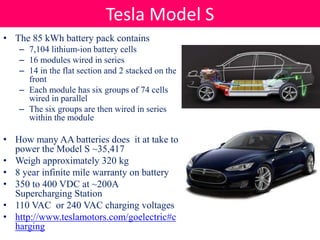
• The 85 kWh battery pack contains
– 7,104 lithium-ion battery cells
– 16 modules wired in series
– 14 in the flat section and 2 stacked on the
front
– Each module has six groups of 74 cells
wired in parallel
– The six groups are then wired in series
within the module
• How many AA batteries does it at take to
power the Model S ~35,417
• Weigh approximately 320 kg
• 8 year infinite mile warranty on battery
• 350 to 400 VDC at ~200A
Supercharging Station
• 110 VAC or 240 VAC charging voltages
• http://www.teslamotors.com/goelectric#c
harging
Tesla Model S
• Companies or researchers are improving batteries
– Reduced charging time
– Increase amount of energy stored for size and weight
– Increase life span, number of charges
– Reduce Cost
• Any predictions on where we might be in the future vs
today?
– Toyota’s goal 4X today battery energy density, and 600 mile
range for 2020
• What cars, like Tesla, might be able to do in the future?
– Higher performance cars
– Faster re-charge time
– Increased mileage range on a charge
– Higher convenience level, similar to gas powered cars, more
affordable
Conclusion

Batteries

  • 1.
  • 2.
  • 3.
    • Convert storedchemical energy into electrical energy • Reaction between chemicals take place • Consisting of electrochemical cells • Contains – Electrodes – Electrolyte Battery
  • 4.
    • Cathode – Positiveterminal – Chemical reduction occurs (gain electrons) • Anode – Negative terminal – Chemical oxidation occurs (lose electrons) • Electrolytes allow: – Separation of ionic transport and electrical transport – Ions to move between electrodes and terminals – Current to flow out of the battery to perform work Electrodes and Electrolytes
  • 5.
    • Battery hasmetal or plastic case • Inside case are cathode, anode, electrolytes • Separator creates barrier between cathode and anode • Current collector brass pin in middle of cell conducts electricity to outside circuit Battery Overview
  • 6.
    • One use(non- rechargeable/disposable) • Chemical reaction used, can not be reversed • Used when long periods of storage are required • Lower discharge rate than secondary batteries • Use: smoke detectors, flashlights, remote controls Primary Cell
  • 7.
    • Alkaline batteriesname came from the electrolyte in an alkane • Anode: zinc powder form • Cathode: manganese dioxide • Electrolyte: potassium hydroxide • The half-reactions are: Zn(s) + 2OH− (aq) → ZnO(s) + H2O(l) + 2e− [e° = -1.28 V] 2MnO2(s) + H2O(l) + 2e− → Mn2O3(s) + 2OH− (aq) [e° = 0.15 V] • Overall reaction: Zn(s) + 2MnO2(s) → ZnO(s) + Mn2O3(s) [e° = 1.43 V] Alkaline Battery
  • 8.
    • Anode: zincmetal body (Zn) • Cathode: manganese dioxide (MnO2) • Electrolyte: paste of zinc chloride and ammonium chloride dissolved in water • The half-reactions are: Zn(s) → Zn2+(aq) + 2e- [e° = -0.763 V] 2NH4 +(aq) + 2MnO2(s) + 2e- → Mn2O3(s) + H2O(l) + 2NH3(aq) + 2Cl- [e° = 0.50 V] • Overall reaction: Zn(s) + 2MnO2(s) + 2NH4Cl(aq) → Mn2O3(s) + Zn(NH3)2Cl2 (aq) + H2O(l) [e° = 1.3 V]a Zinc-Carbon Battery
  • 9.
    • Alkaline Battery •Zinc powered, basic electrolyte • Higher energy density • Functioning with a more stable chemistry • Shelf-life: 8 years because of zinc powder • Long lifetime both on the shelf and better performance • Can power all devices high and low drains • Use: Digital camera, game console, remotes • Zinc-Carbon Battery • Zinc body, acidic electrolyte • Case is part of the anode • Zinc casing slowly eaten away by the acidic electrolyte • Cheaper then Alkaline • Shelf-life: 1-3 years because of metal body • Intended for low-drain devices • Use: Kid toys, radios, alarm clocks Primary Cell
  • 10.
    • Rechargeable batteries •Reaction can be readily reversed • Similar to primary cells except redox reaction can be reversed • Recharging: – Electrodes undergo the opposite process than discharging – Cathode is oxidized and produces electrons – Electrons absorbed by anode Secondary Cells
  • 11.
    • Anode: Cadmiumhydroxide, Cd(OH)2 • Cathode: Nickel hydroxide, Ni(OH)2 • Electrolyte: Potassium hydroxide, KOH • The half-reactions are: Cd+2OH- → Cd(OH)2+2e- 2NiO(OH)+Cd+2e- →2Ni(OH)2+2OH- • Overall reaction: 2NiO(OH) + Cd+2H2O→2Ni(OH)2+Cd(OH)2 Nickel-Cadmium Battery
  • 12.
    • Maintain asteady voltage of 1.2v per cell until completely depleted • Have ability to deliver full power output until end of cycle • Have consistent powerful delivery throughout the entire application • Very low internal resistance • Lower voltage per cell Nickel-Cadmium Battery
  • 13.
    • Advantages: – Thischemistry is reliable – Operate in a range of temperatures – Tolerates abuse well and performs well after long periods of storage • Disadvantages: – It is three to five times more expensive than lead-acid – Its materials are toxic and the recycling infrastructure for larger nickel-cadmium batteries is very limited Nickel-Cadmium Battery
  • 14.
    • Anode: Porouslead • Cathode: Lead-dioxide • Electrolyte: Sulfuric acid, 6 molar H2SO4 • Discharging (+) electrode: PbO2(s) + 4H+(aq) + SO42-(aq) + 2e- → PbSO4(s) + 2H2O(l) (-) electrode: Pb(s) + SO42-(aq) → PbSO4(s) + 2e- • During charging (+) electrode: PbSO4(s) + 2H2O(l) → PbO2(s) + 4H+(aq) + SO42- (aq) + 2e- (-) electrode: PbSO4(s) + 2e- → Pb(s) + SO42-(aq) Lead-Acid Battery
  • 15.
    • The lead-acidcells in automobile batteries are wet cells • Deliver short burst of high power, to start the engine • Battery supplies power to the starter and ignition system to start the engine • Battery acts as a voltage stabilizer in the electrical system • Supplies the extra power necessary when the vehicle's electrical load exceeds the supply from the charging system Lead-Acid Battery
  • 16.
    • Anode: Graphite •Cathode: Lithium manganese dioxide • Electrolyte: mixture of lithium salts • Lithium ion battery half cell reactions CoO2 + Li+ + e- ↔ LiCoO2 Eº = 1V Li+ + C6+ e- ↔ LiC6 Eº ~ -3V • Overall reaction during discharge CoO2 + LiC6 ↔ LiCoO2 + C6 Eoc = E+ - E- = 1 - (-3.01) = 4V Lithium-Ion Battery
  • 17.
    • Advantages: – Ithas a high specific energy (number of hours of operation for a given weight) – Huge success for mobile applications such as phones and notebook computers • Disadvantages: – Cost differential • Not as apparent with small batteries (phones and computers) • Automotive batteries are larger, cost becomes more significant – Cell temperature is monitored to prevent temperature extremes – No established system for recycling large lithium-ion batteries Lithium-Ion Battery
  • 18.
    • High energydensity - potential for yet higher capacities • Relatively low self-discharge, less than half of nickel-based batteries • Low Maintenance – No periodic discharge needed – No memory • Energy density of lithium-ion is three times of the standard lead acid • Cost of battery – Almost twice of standard nickel-cadmium (40%) – Five times that of the standard lead acid Lithium Rechargeable Batteries and Tesla
  • 19.
    • The 85kWh battery pack contains – 7,104 lithium-ion battery cells – 16 modules wired in series – 14 in the flat section and 2 stacked on the front – Each module has six groups of 74 cells wired in parallel – The six groups are then wired in series within the module • How many AA batteries does it at take to power the Model S ~35,417 • Weigh approximately 320 kg • 8 year infinite mile warranty on battery • 350 to 400 VDC at ~200A Supercharging Station • 110 VAC or 240 VAC charging voltages • http://www.teslamotors.com/goelectric#c harging Tesla Model S
  • 20.
    • Companies orresearchers are improving batteries – Reduced charging time – Increase amount of energy stored for size and weight – Increase life span, number of charges – Reduce Cost • Any predictions on where we might be in the future vs today? – Toyota’s goal 4X today battery energy density, and 600 mile range for 2020 • What cars, like Tesla, might be able to do in the future? – Higher performance cars – Faster re-charge time – Increased mileage range on a charge – Higher convenience level, similar to gas powered cars, more affordable Conclusion