Enerji Depolama Sistemlerinin Elektrik Taşıtlardaki Uygulamaları
Supervisor :Yrd.Doç.Dr. Şule KUŞDOĞAN
Submitted by : Mohamed Babe
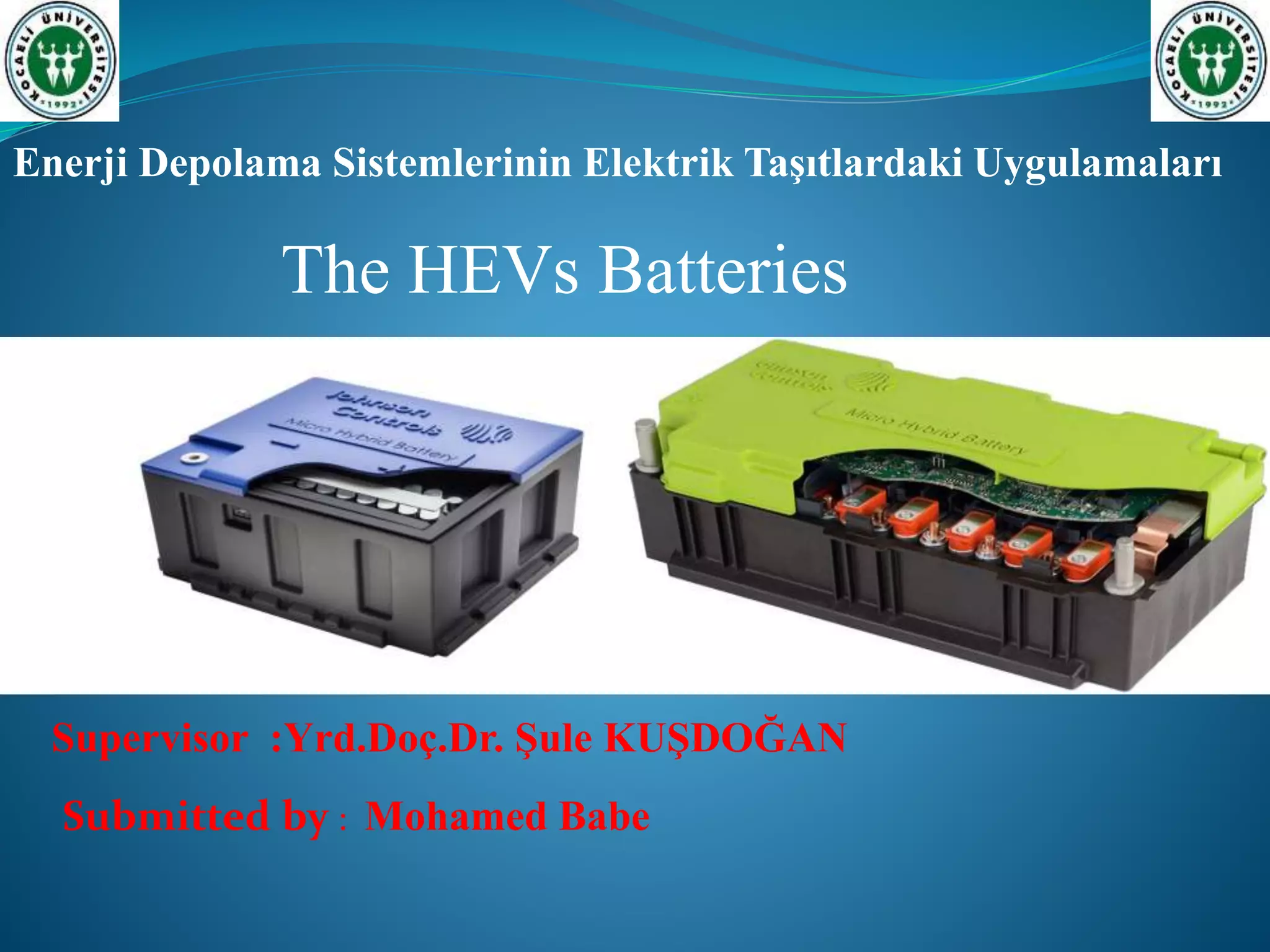
The HEVs Batteries
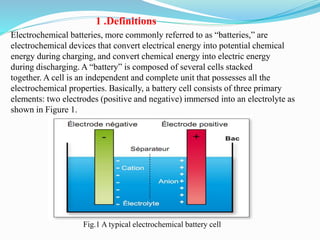
Electrochemical batteries, more commonly referred to as “batteries,” are
electrochemical devices that convert electrical energy into potential chemical
energy during charging, and convert chemical energy into electric energy
during discharging. A “battery” is composed of several cells stacked
together. A cell is an independent and complete unit that possesses all the
electrochemical properties. Basically, a battery cell consists of three primary
elements: two electrodes (positive and negative) immersed into an electrolyte as
shown in Figure 1.
Fig.1 A typical electrochemical battery cell
1 .Definitions
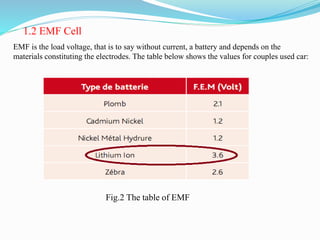
EMF is the load voltage, that is to say without current, a battery and depends on the
materials constituting the electrodes. The table below shows the values for couples used car:
1.2 EMF Cell
Fig.2 The table of EMF
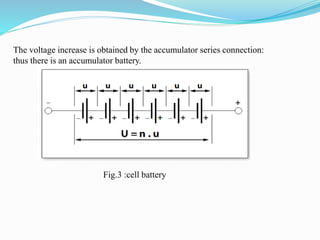
The voltage increase is obtained by the accumulator series connection:
thus there is an accumulator battery.
Fig.3 :cell battery
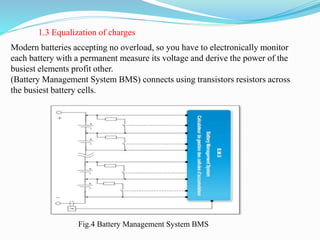
Modern batteries accepting no overload, so you have to electronically monitor
each battery with a permanent measure its voltage and derive the power of the
busiest elements profit other.
(Battery Management System BMS) connects using transistors resistors across
the busiest battery cells.
1.3 Equalization of charges
Fig.4 Battery Management System BMS
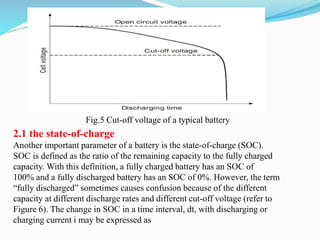
 Battery manufacturers usually specify the battery with coulometric
capacity (amp-hours), which is defined as the number of amp-hours gained
when discharging the battery from a fully charged state until the terminal
voltage drops to its cut-off voltage, as shown in Figure 5. It should be noted
that the same battery usually has a different number of amp-hours at different
discharging current rates. Generally, the capacity will become smaller with a
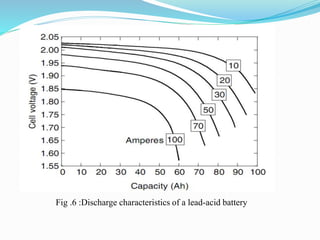
large discharge current rate, as shown in Figure 6. Battery manufacturers
usually specify a battery with a number of amp-hours along with a current
rate. For example, a battery labeled 100 Ah at C5 rate has a 100 amp-hour
capacity at 5 hours discharge rate (discharging current 100/5=20 A).
2. The Parameters principals of HEVS batteries
2.1 the state-of-charge
Another important parameter of a battery is the state-of-charge (SOC).
SOC is defined as the ratio of the remaining capacity to the fully charged
capacity. With this definition, a fully charged battery has an SOC of
100% and a fully discharged battery has an SOC of 0%. However, the term
“fully discharged” sometimes causes confusion because of the different
capacity at different discharge rates and different cut-off voltage (refer to
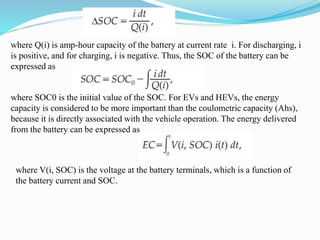
Figure 6). The change in SOC in a time interval, dt, with discharging or
charging current i may be expressed as
Fig.5 Cut-off voltage of a typical battery
where Q(i) is amp-hour capacity of the battery at current rate i. For discharging, i
is positive, and for charging, i is negative. Thus, the SOC of the battery can be
expressed as
where SOC0 is the initial value of the SOC. For EVs and HEVs, the energy
capacity is considered to be more important than the coulometric capacity (Ahs),
because it is directly associated with the vehicle operation. The energy delivered
from the battery can be expressed as
where V(i, SOC) is the voltage at the battery terminals, which is a function of
the battery current and SOC.
Fig .6 :Discharge characteristics of a lead-acid battery
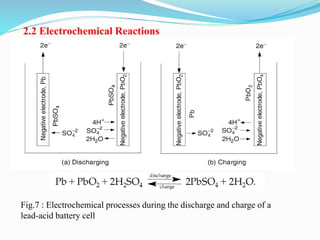
2.2 Electrochemical Reactions
Fig.7 : Electrochemical processes during the discharge and charge of a
lead-acid battery cell
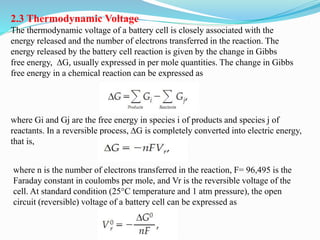
2.3 Thermodynamic Voltage
The thermodynamic voltage of a battery cell is closely associated with the
energy released and the number of electrons transferred in the reaction. The
energy released by the battery cell reaction is given by the change in Gibbs
free energy, ∆G, usually expressed in per mole quantities. The change in Gibbs
free energy in a chemical reaction can be expressed as
where Gi and Gj are the free energy in species i of products and species j of
reactants. In a reversible process, ∆G is completely converted into electric energy,
that is,
where n is the number of electrons transferred in the reaction, F= 96,495 is the
Faraday constant in coulombs per mole, and Vr is the reversible voltage of the
cell. At standard condition (25°C temperature and 1 atm pressure), the open
circuit (reversible) voltage of a battery cell can be expressed as
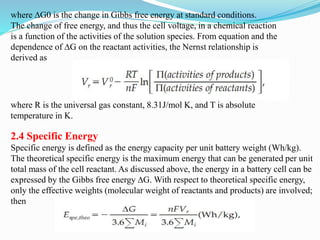
where ∆G0 is the change in Gibbs free energy at standard conditions.
The change of free energy, and thus the cell voltage, in a chemical reaction
is a function of the activities of the solution species. From equation and the
dependence of ∆G on the reactant activities, the Nernst relationship is
derived as
where R is the universal gas constant, 8.31J/mol K, and T is absolute
temperature in K.
2.4 Specific Energy
Specific energy is defined as the energy capacity per unit battery weight (Wh/kg).
The theoretical specific energy is the maximum energy that can be generated per unit
total mass of the cell reactant. As discussed above, the energy in a battery cell can be
expressed by the Gibbs free energy ∆G. With respect to theoretical specific energy,
only the effective weights (molecular weight of reactants and products) are involved;
then
where Σmi is the sum of the molecular weight of the individual species
involved in the battery reaction. Taking the lead-acid battery as an example,
Vr=2.03 V, n=2, and ΣMi=642 g; then Espe,the=170 Wh/kg.
2.5 Specific Power
Specific power is defined as the maximum power of per unit battery
weight that the battery can produce in a short period. Specific power is
important in the reduction of battery weight, especially in high power
demand applications, such as HEVs. The specific power of a chemical battery
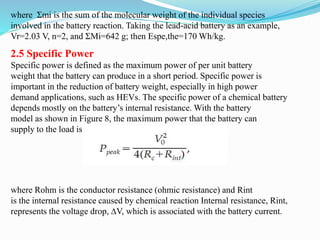
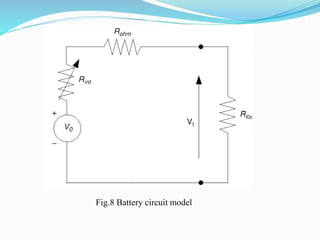
depends mostly on the battery’s internal resistance. With the battery
model as shown in Figure 8, the maximum power that the battery can
supply to the load is
where Rohm is the conductor resistance (ohmic resistance) and Rint
is the internal resistance caused by chemical reaction Internal resistance, Rint,
represents the voltage drop, ∆V, which is associated with the battery current.
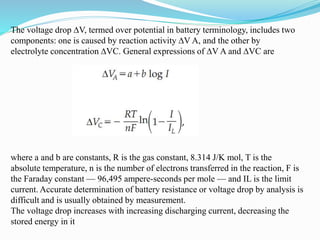
The voltage drop ∆V, termed over potential in battery terminology, includes two
components: one is caused by reaction activity ∆V A, and the other by
electrolyte concentration ∆VC. General expressions of ∆V A and ∆VC are
where a and b are constants, R is the gas constant, 8.314 J/K mol, T is the
absolute temperature, n is the number of electrons transferred in the reaction, F is
the Faraday constant — 96,495 ampere-seconds per mole — and IL is the limit
current. Accurate determination of battery resistance or voltage drop by analysis is
difficult and is usually obtained by measurement.
The voltage drop increases with increasing discharging current, decreasing the
stored energy in it
Fig.8 Battery circuit model
2.6 Energy Efficiency
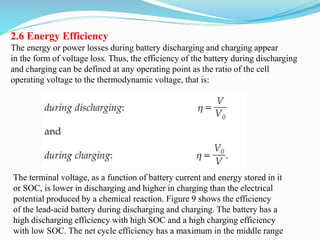
The energy or power losses during battery discharging and charging appear
in the form of voltage loss. Thus, the efficiency of the battery during discharging
and charging can be defined at any operating point as the ratio of the cell
operating voltage to the thermodynamic voltage, that is:
The terminal voltage, as a function of battery current and energy stored in it
or SOC, is lower in discharging and higher in charging than the electrical
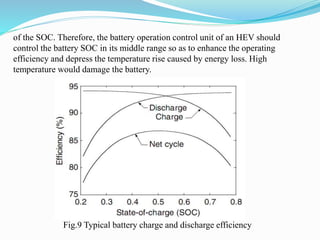
potential produced by a chemical reaction. Figure 9 shows the efficiency
of the lead-acid battery during discharging and charging. The battery has a
high discharging efficiency with high SOC and a high charging efficiency
with low SOC. The net cycle efficiency has a maximum in the middle range
of the SOC. Therefore, the battery operation control unit of an HEV should
control the battery SOC in its middle range so as to enhance the operating
efficiency and depress the temperature rise caused by energy loss. High
temperature would damage the battery.
Fig.9 Typical battery charge and discharge efficiency
3 . Battery Technologies
The viable EV and HEV batteries consist of the lead-acid battery, nickel-based
batteries such as nickel/iron, nickel/cadmium, and nickel–metal hydride batteries,
and lithium-based batteries such as lithium polymer and lithium-ion batteries.3 In
the near term, it seems that lead-acid batteries will still be the major type due to its
many advantages. However, in the middle and long term, it seems that cadmium-
and lithium-based batteries will be major candidates for EVs and HEVs.
3.1 Lead-Acid Batteries
The lead-acid battery has been a successful commercial product for over a
century and is still widely used as electrical energy storage in the automotive field
and other applications. Its advantages are its low cost, mature technology, relative
high power capability, and good cycle. These advantages are attractive for its
application in HEVs where high power is the first consideration.
these disadvantages. The specific energy has been increased through the reduction
of inactive materials such as the casing, current collector, separators, etc.
The lifetime has been increased by over 50% — at the expense of cost, however.
The safety issue has been addressed and improved, with electrochemical processes
designed to absorb the parasitic releases o f hydrogen and oxygen.
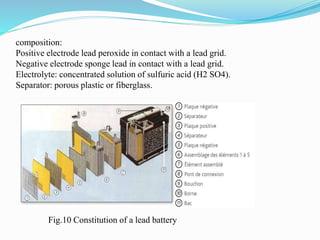
composition:
Positive electrode lead peroxide in contact with a lead grid.
Negative electrode sponge lead in contact with a lead grid.
Electrolyte: concentrated solution of sulfuric acid (H2 SO4).
Separator: porous plastic or fiberglass.
Fig.10 Constitution of a lead battery
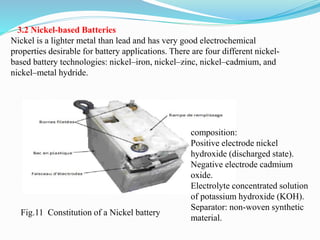
3.2 Nickel-based Batteries
Nickel is a lighter metal than lead and has very good electrochemical
properties desirable for battery applications. There are four different nickel-
based battery technologies: nickel–iron, nickel–zinc, nickel–cadmium, and
nickel–metal hydride.
composition:
Positive electrode nickel
hydroxide (discharged state).
Negative electrode cadmium
oxide.
Electrolyte concentrated solution
of potassium hydroxide (KOH).
Separator: non-woven synthetic
material.
Fig.11 Constitution of a Nickel battery
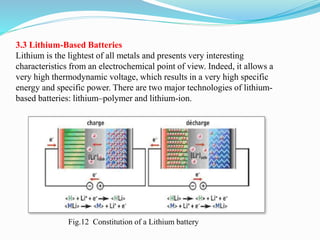
3.3 Lithium-Based Batteries
Lithium is the lightest of all metals and presents very interesting
characteristics from an electrochemical point of view. Indeed, it allows a
very high thermodynamic voltage, which results in a very high specific
energy and specific power. There are two major technologies of lithium-
based batteries: lithium–polymer and lithium-ion.
Fig.12 Constitution of a Lithium battery
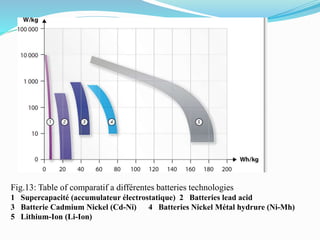
Fig.13: Table of comparatif a différentes batteries technologies
1 Supercapacité (accumulateur électrostatique) 2 Batteries lead acid
3 Batterie Cadmium Nickel (Cd-Ni) 4 Batteries Nickel Métal hydrure (Ni-Mh)
5 Lithium-Ion (Li-Ion)
References
1. les Véhicules électriques et hybrides alfa dossier technique .
2. Study the Performance of Battery Models for Hybrid Electric Vehicles
IEEE 2014 .
3 . Modern Electric,Hybrid Electric, and Fuel Cell Vehicles 2004 edition .
4. A Study of Lead Acid Battery Self-discharge Characteristics .
Batteries

Batteries

  • 1.
    Enerji Depolama SistemlerininElektrik Taşıtlardaki Uygulamaları Supervisor :Yrd.Doç.Dr. Şule KUŞDOĞAN Submitted by : Mohamed Babe The HEVs Batteries
  • 2.
    Electrochemical batteries, morecommonly referred to as “batteries,” are electrochemical devices that convert electrical energy into potential chemical energy during charging, and convert chemical energy into electric energy during discharging. A “battery” is composed of several cells stacked together. A cell is an independent and complete unit that possesses all the electrochemical properties. Basically, a battery cell consists of three primary elements: two electrodes (positive and negative) immersed into an electrolyte as shown in Figure 1. Fig.1 A typical electrochemical battery cell 1 .Definitions
  • 3.
    EMF is theload voltage, that is to say without current, a battery and depends on the materials constituting the electrodes. The table below shows the values for couples used car: 1.2 EMF Cell Fig.2 The table of EMF
  • 4.
    The voltage increaseis obtained by the accumulator series connection: thus there is an accumulator battery. Fig.3 :cell battery
  • 5.
    Modern batteries acceptingno overload, so you have to electronically monitor each battery with a permanent measure its voltage and derive the power of the busiest elements profit other. (Battery Management System BMS) connects using transistors resistors across the busiest battery cells. 1.3 Equalization of charges Fig.4 Battery Management System BMS
  • 6.
     Battery manufacturersusually specify the battery with coulometric capacity (amp-hours), which is defined as the number of amp-hours gained when discharging the battery from a fully charged state until the terminal voltage drops to its cut-off voltage, as shown in Figure 5. It should be noted that the same battery usually has a different number of amp-hours at different discharging current rates. Generally, the capacity will become smaller with a large discharge current rate, as shown in Figure 6. Battery manufacturers usually specify a battery with a number of amp-hours along with a current rate. For example, a battery labeled 100 Ah at C5 rate has a 100 amp-hour capacity at 5 hours discharge rate (discharging current 100/5=20 A). 2. The Parameters principals of HEVS batteries
  • 7.
    2.1 the state-of-charge Anotherimportant parameter of a battery is the state-of-charge (SOC). SOC is defined as the ratio of the remaining capacity to the fully charged capacity. With this definition, a fully charged battery has an SOC of 100% and a fully discharged battery has an SOC of 0%. However, the term “fully discharged” sometimes causes confusion because of the different capacity at different discharge rates and different cut-off voltage (refer to Figure 6). The change in SOC in a time interval, dt, with discharging or charging current i may be expressed as Fig.5 Cut-off voltage of a typical battery
  • 8.
    where Q(i) isamp-hour capacity of the battery at current rate i. For discharging, i is positive, and for charging, i is negative. Thus, the SOC of the battery can be expressed as where SOC0 is the initial value of the SOC. For EVs and HEVs, the energy capacity is considered to be more important than the coulometric capacity (Ahs), because it is directly associated with the vehicle operation. The energy delivered from the battery can be expressed as where V(i, SOC) is the voltage at the battery terminals, which is a function of the battery current and SOC.
  • 9.
    Fig .6 :Dischargecharacteristics of a lead-acid battery
  • 10.
    2.2 Electrochemical Reactions Fig.7: Electrochemical processes during the discharge and charge of a lead-acid battery cell
  • 11.
    2.3 Thermodynamic Voltage Thethermodynamic voltage of a battery cell is closely associated with the energy released and the number of electrons transferred in the reaction. The energy released by the battery cell reaction is given by the change in Gibbs free energy, ∆G, usually expressed in per mole quantities. The change in Gibbs free energy in a chemical reaction can be expressed as where Gi and Gj are the free energy in species i of products and species j of reactants. In a reversible process, ∆G is completely converted into electric energy, that is, where n is the number of electrons transferred in the reaction, F= 96,495 is the Faraday constant in coulombs per mole, and Vr is the reversible voltage of the cell. At standard condition (25°C temperature and 1 atm pressure), the open circuit (reversible) voltage of a battery cell can be expressed as
  • 12.
    where ∆G0 isthe change in Gibbs free energy at standard conditions. The change of free energy, and thus the cell voltage, in a chemical reaction is a function of the activities of the solution species. From equation and the dependence of ∆G on the reactant activities, the Nernst relationship is derived as where R is the universal gas constant, 8.31J/mol K, and T is absolute temperature in K. 2.4 Specific Energy Specific energy is defined as the energy capacity per unit battery weight (Wh/kg). The theoretical specific energy is the maximum energy that can be generated per unit total mass of the cell reactant. As discussed above, the energy in a battery cell can be expressed by the Gibbs free energy ∆G. With respect to theoretical specific energy, only the effective weights (molecular weight of reactants and products) are involved; then
  • 13.
    where Σmi isthe sum of the molecular weight of the individual species involved in the battery reaction. Taking the lead-acid battery as an example, Vr=2.03 V, n=2, and ΣMi=642 g; then Espe,the=170 Wh/kg. 2.5 Specific Power Specific power is defined as the maximum power of per unit battery weight that the battery can produce in a short period. Specific power is important in the reduction of battery weight, especially in high power demand applications, such as HEVs. The specific power of a chemical battery depends mostly on the battery’s internal resistance. With the battery model as shown in Figure 8, the maximum power that the battery can supply to the load is where Rohm is the conductor resistance (ohmic resistance) and Rint is the internal resistance caused by chemical reaction Internal resistance, Rint, represents the voltage drop, ∆V, which is associated with the battery current.
  • 14.
    The voltage drop∆V, termed over potential in battery terminology, includes two components: one is caused by reaction activity ∆V A, and the other by electrolyte concentration ∆VC. General expressions of ∆V A and ∆VC are where a and b are constants, R is the gas constant, 8.314 J/K mol, T is the absolute temperature, n is the number of electrons transferred in the reaction, F is the Faraday constant — 96,495 ampere-seconds per mole — and IL is the limit current. Accurate determination of battery resistance or voltage drop by analysis is difficult and is usually obtained by measurement. The voltage drop increases with increasing discharging current, decreasing the stored energy in it
  • 15.
  • 16.
    2.6 Energy Efficiency Theenergy or power losses during battery discharging and charging appear in the form of voltage loss. Thus, the efficiency of the battery during discharging and charging can be defined at any operating point as the ratio of the cell operating voltage to the thermodynamic voltage, that is: The terminal voltage, as a function of battery current and energy stored in it or SOC, is lower in discharging and higher in charging than the electrical potential produced by a chemical reaction. Figure 9 shows the efficiency of the lead-acid battery during discharging and charging. The battery has a high discharging efficiency with high SOC and a high charging efficiency with low SOC. The net cycle efficiency has a maximum in the middle range
  • 17.
    of the SOC.Therefore, the battery operation control unit of an HEV should control the battery SOC in its middle range so as to enhance the operating efficiency and depress the temperature rise caused by energy loss. High temperature would damage the battery. Fig.9 Typical battery charge and discharge efficiency
  • 18.
    3 . BatteryTechnologies The viable EV and HEV batteries consist of the lead-acid battery, nickel-based batteries such as nickel/iron, nickel/cadmium, and nickel–metal hydride batteries, and lithium-based batteries such as lithium polymer and lithium-ion batteries.3 In the near term, it seems that lead-acid batteries will still be the major type due to its many advantages. However, in the middle and long term, it seems that cadmium- and lithium-based batteries will be major candidates for EVs and HEVs.
  • 19.
    3.1 Lead-Acid Batteries Thelead-acid battery has been a successful commercial product for over a century and is still widely used as electrical energy storage in the automotive field and other applications. Its advantages are its low cost, mature technology, relative high power capability, and good cycle. These advantages are attractive for its application in HEVs where high power is the first consideration. these disadvantages. The specific energy has been increased through the reduction of inactive materials such as the casing, current collector, separators, etc. The lifetime has been increased by over 50% — at the expense of cost, however. The safety issue has been addressed and improved, with electrochemical processes designed to absorb the parasitic releases o f hydrogen and oxygen.
  • 20.
    composition: Positive electrode leadperoxide in contact with a lead grid. Negative electrode sponge lead in contact with a lead grid. Electrolyte: concentrated solution of sulfuric acid (H2 SO4). Separator: porous plastic or fiberglass. Fig.10 Constitution of a lead battery
  • 21.
    3.2 Nickel-based Batteries Nickelis a lighter metal than lead and has very good electrochemical properties desirable for battery applications. There are four different nickel- based battery technologies: nickel–iron, nickel–zinc, nickel–cadmium, and nickel–metal hydride. composition: Positive electrode nickel hydroxide (discharged state). Negative electrode cadmium oxide. Electrolyte concentrated solution of potassium hydroxide (KOH). Separator: non-woven synthetic material. Fig.11 Constitution of a Nickel battery
  • 22.
    3.3 Lithium-Based Batteries Lithiumis the lightest of all metals and presents very interesting characteristics from an electrochemical point of view. Indeed, it allows a very high thermodynamic voltage, which results in a very high specific energy and specific power. There are two major technologies of lithium- based batteries: lithium–polymer and lithium-ion. Fig.12 Constitution of a Lithium battery
  • 23.
    Fig.13: Table ofcomparatif a différentes batteries technologies 1 Supercapacité (accumulateur électrostatique) 2 Batteries lead acid 3 Batterie Cadmium Nickel (Cd-Ni) 4 Batteries Nickel Métal hydrure (Ni-Mh) 5 Lithium-Ion (Li-Ion)
  • 24.
    References 1. les Véhiculesélectriques et hybrides alfa dossier technique . 2. Study the Performance of Battery Models for Hybrid Electric Vehicles IEEE 2014 . 3 . Modern Electric,Hybrid Electric, and Fuel Cell Vehicles 2004 edition . 4. A Study of Lead Acid Battery Self-discharge Characteristics .