What is the traditional notion of literacy?
• Reading
• Writing
• Speaking & Listening
• Spelling
• Phonics
• Grammar
• This represents a ‘skills based’ approach to literacy
The English language
The English language is a hybrid language…it
is made up of Celtic – Latin – Saxon –
French – and other elements.
English is phonetically irregular
English has many dialects (e.g. Australian-
English)
English is a global lingua franca
What does a skills based approach mean for
your subject area?
maths
• How do you remember key
mathematical terms?
• What text do you have to read
to understand the maths
problem?
• How do you explain your maths
answer in words?
• What is the correct
pronunciation of maths terms?
history
• What is the most important
historical terminology?
• How do we write good essays in
history?
• What are the reading
requirements for history?
• How do you construct good oral
language sessions in history?
What are the problems with the ‘skills based’
approach?
• Everything is in English: i.e. it promotes monolingualism
• Language issues become paramount: e.g. understanding terminology
or representing ideas in language…
• The curriculum becomes comparable to a language test
• Textual analysis is consequently the most important aspect of
schooling
• Learners with high English language support in their homes are
unfairly advantaged
• Learners who struggle with English skills are disadvantaged…
What are the alternatives to a ‘skills based’
approach to literacy?
1) Multiliteracies
2) New literacies
3) Multiple Literacies
• These approaches recognise a diversity of means to express and
communicate knowledge; including through different languages and the
electronic mediation of language through ICT.
• Multiliteracies, new literacies and multiple literacies support the continued
‘skills based’ development in literacy skills…
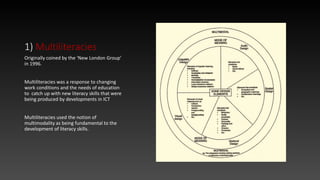
1) Multiliteracies
Originally coined by the ‘New London Group’
in 1996.
Multiliteracies was a response to changing
work conditions and the needs of education
to catch up with new literacy skills that were
being produced by developments in ICT
Multiliteracies used the notion of
multimodality as being fundamental to the
development of literacy skills.
The pedagogy of multiliteracies
• Situated practice: draws on progressive pedagogies such as whole
language and process writing and engages and immerses students in
literate practices and topics that form part of their community
context
• Overt instruction: explicit and focused learning episodes which draw
upon teacher-centred transmission pedagogies such as traditional
grammar and direct instruction
• Critical framing: pedagogy that draws upon the paradigm of critical
literacy
• Transformed practice: pedagogy that focuses upon the transfer of
strategies from one context to another.
Cope & Kalantzis (2000)
4 resource model of literacy
• This is useful in the preparation and delivery of multiliteracies units
of work…
1. Code breaker: what do the pupils have to do in order to ‘break the
code’ of the text?
2. Meaning maker: what are the meanings that the pupils will get
from the text and how will they make meaning?
3. Text user: what are the real life applications of the text and how
well do the pupils understand this use?
4. Text analyst: what modes of questioning will the text inspire and
add to your classroom?
Luke & Freebody (1999)
Multiliteracies in
Motion
Multiliteracies must now take account of
new social media such as Facebook and
mobile technology devices
Multiliteracies can be used as a framing
method and approach for every knowledge
area and interdisciplinarity
Questions about language should be asked in
all knowledge areas and not only as English
but as multilingualism
Multiliteracies is a flexible approach that
shows how literacy skills continue to change
under pressure from technology
Cole, DR & Pullen, DL, Multiliteracies in Motion: Current Theory and
Practice, Routledge (2010)
Multiliteracies and
technology enhanced
education
Access to technology can be an equity issue
for educationalists to address
Multiliteracies helps us to produce new
models of education and teaching and
learning as technology continues to develop
Teachers can become out of touch with
students needs if they do not keep up with
developments in learning technology
Technology redefines the ‘classroom’
Pullen, DL & Cole, DR, Multiliteracies and Technology Enhanced
Education: Social Practice and the Global Classroom, IGI Global
Publications (2010)
Critical Literacy
• Examining meaning within texts
• Considering the purpose for the text and the composer’s motives
• Understanding that texts are not neutral, that they represent particular views, that they may silence other
points of view and influence people’s ideas
• Questioning and challenging the ways in which texts have been constructed
• Analysing the power of language in contemporary society
• Emphasising multiple readings of texts. (Because people interpret texts in the light of their own beliefs and
values, texts will have different meanings to different people.)
• Having students take a stance on issues
• Providing students with opportunities to consider and clarify their own attitudes and values
• Providing students with opportunities to take social action.
Unit of work on critical literacy
• You may use these headings to divide up the process of planning your
unit of work using critical literacy:
• Immersion
• Prediction
• Deconstruction
• Reconstruction
• Taking social action
Adapted from: Millard & Adams (1998).
• One of the most famous commentators on critical literacy, Allan Luke
said:
• “The single most important theoretical and practical classroom effect
(of critical literacy) is its shift in emphasis from the traditional view of
literacy as skills, knowledges and cognitions inside the human subject
– quite literally as something in students’ heads – to a vision of
literacy as visible social practices with language, text and discourse”.
Luke (2000), p. 450
How does multiliteracies affect your practice?
science
• How can science concepts be
represented in ICT?
• What are the design elements
involved with science?
• What is the meaning making and
multimodality of science?
• How does ICT change my
understanding and
implementation of experiments?
pdhpe
• What pdhpe programs are there
that are represented through ICT
or on the internet?
• What ICT can we use to improve
learning in pdhpe?
• What is the relationship
between ICTs and health?
• How can pdhpe be a
‘transformed practice’?
New Literacies
• Socio-cultural theory of literacy
• New literacies are about more than ICT and literacy
• Importantly the new literacies include questions about identity,
society and change
• Development from and complementary to multiliteracies
• Opens up textual practice in terms of questioning and representing
everyday life
• Political and social consequences of education can be explored and
negotiated through literacies…
• First, new technologies (such as the internet) and the novel literacy
tasks that pertain to these new technologies require new skills and
strategies to effectively use them. Second, new literacies are a critical
component of full participation—civic, economic, and personal—in
our increasingly global society. A third component to this approach is
new literacies are deictic—that is, they change regularly as new
technology emerges and older technologies fade away. With this in
mind, “what may be important in reading instruction and literacy
education is not to teach any single set of new literacies, but rather to
teach students how to learn continuously new literacies that will
appear during their lifetime.” Finally, new literacies are “multiple,
multimodal, and multifaceted,” and as such, multiple points of view
will be most beneficial in attempting to comprehensively analyze
them (Leu et al., 2007, p.43).
New literacies and knowledge areas
geography
• How is space represented in the
media and in contemporary
society?
• What challenges our viewpoint
about an urban or rural landscape?
• What is human geography in post-
industrial society?
• How is space managed and
controlled in our everyday lives?
arts
• What can we do with digital
technologies in the arts?
• How does art practice expose
and relate to various
assumptions about society?
• How is the figure of the human
changing?
• How do the arts contribute to
learning?
Multiple Literacies
• Literacies as fully multiple and not under the rubrics of the new
literacies or multiliteracies
• Complementary approach to literacies across the curriculum that
includes all aspects of the learners functioning in the classroom: i.e.
sociological and psychological
• The curriculum consists of many complex and inter-related minor
literacies: i.e. statistical literacy, economics literacy, visual literacy,
bodily literacy, historical literacy, etc…
• Everything is not text
• Literacies are actualized according to a particular context in time and
in space in which they operate. Given the nomadic tendencies of
literacies; they are not wed to a context, but are taken up in
unpredictable ways across various contexts. Reading is both intensive
(disruptive) and immanent. Literacies involve constant movement in
the process of becoming other. There is potentiality in releasing
literacy from its privileged position as the printed word by not
allowing it to govern all other literacies. In this way, literacies open
themselves to what is not already given. In short, literacies are about
reading, reading the world, and self as texts (Masny, n.p.).
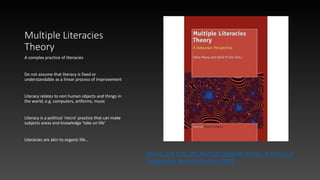
Multiple Literacies
Theory
A complex practice of literacies
Do not assume that literacy is fixed or
understandable as a linear process of improvement
Literacy relates to non human objects and things in
the world, e.g. computers, artforms, music
Literacy is a political ‘micro’ practice that can make
subjects areas and knowledge ‘take on life’
Literacies are akin to organic life…
Masny, D & Cole, DR, Multiple Literacies Theory: A Deleuzian
Perspective, Sense Publishers (2009)
Mapping Multiple
Literacies
Teachers and students can map literacies
The mapping of literacies should take
account of: affect, power, group dynamics,
digital technology, etc…
Multiple literacies will increase the
affordances and opportunities that the
subject areas represent
The mapping of multiple literacies is cross-
disciplinary, e.g. using mathematics to
understand music.
Masny, D & Cole, DR, Mapping Multiple Literacies: An
Introduction to Deleuzian Literacy Studies, Continuum (2012)
Multiple literacies and the secondary subjects
tas
• What are the ways in which technical
drawing can represent a complex
figure; e.g. a Möbius strip?
• What are the technological solutions
to social problems, e.g. global
warming?
• What are the limitations and
consequences of technological
progression?
• How does the application of
technology affect belief?
languages
• How do more than one language
relate to one another, e.g. Chinese
and English?
• What are the sociological
assumptions in language learning?
• How is the language being learnt in
a formal and non formal way?
• How can the native learner learn
from the non-native learner?
Affective literacy
• Definition: The term affective literacy locates a broad range of
somatic, emotive responses to reading a text. Affective literacy seeks
out the life principle, messy and complex, threading through reading
activities and gestures toward bodily economies of reading and
transacting texts
Amsler (2004) online.
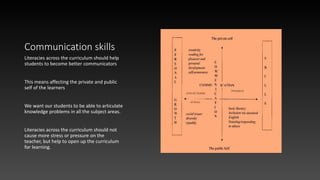
Communication skills
Literacies across the curriculum should help
students to become better communicators
This means affecting the private and public
self of the learners
We want our students to be able to articulate
knowledge problems in all the subject areas.
Literacies across the curriculum should not
cause more stress or pressure on the
teacher, but help to open up the curriculum
for learning.
References
• Amsler, M. (2004). Affective literacy: Gestures of reading in the Later Middle Ages.
University of Wisconsin-Milwaukee, retrieved October 11, 2005, from
http://muse.jhu.edu/journals/ essays_in_medieval_studies/v018/18.1amsler.html
• Cope, B., & Kalantzis, M. (2000). Multiliteracies: Literacy Learning and the Design of
Social Futures. London: Macmillan.
• Leu et al. (2007). What is new about the new literacies of online reading comprehension?
In L.S. Rush, A.J. Eakle & A. Berger (Eds.), Secondary School Literacy (pp. 32-50). Urbana,
Il: NCTE.
• Luke, A. (2000). Critical literacy in Australia: A matter of context and standpoint. Journal
of Adolescent and Adult Literacy. 43, 448-461.
• Luke, A., & Freebody, P. (1999). Further notes on the Four Resource Model. Online at:
http://www.readingonline.org/research/lukefreebody.html
• Millard, C., & Adams, P. (Eds.) (1998). Texts: The Heart of the English Curriculum (Series
2). Adelaide: Department of Education, Training and Employment.

Literacies across the curriculum

  • 2.
    What is thetraditional notion of literacy? • Reading • Writing • Speaking & Listening • Spelling • Phonics • Grammar • This represents a ‘skills based’ approach to literacy
  • 3.
    The English language TheEnglish language is a hybrid language…it is made up of Celtic – Latin – Saxon – French – and other elements. English is phonetically irregular English has many dialects (e.g. Australian- English) English is a global lingua franca
  • 4.
    What does askills based approach mean for your subject area? maths • How do you remember key mathematical terms? • What text do you have to read to understand the maths problem? • How do you explain your maths answer in words? • What is the correct pronunciation of maths terms? history • What is the most important historical terminology? • How do we write good essays in history? • What are the reading requirements for history? • How do you construct good oral language sessions in history?
  • 5.
    What are theproblems with the ‘skills based’ approach? • Everything is in English: i.e. it promotes monolingualism • Language issues become paramount: e.g. understanding terminology or representing ideas in language… • The curriculum becomes comparable to a language test • Textual analysis is consequently the most important aspect of schooling • Learners with high English language support in their homes are unfairly advantaged • Learners who struggle with English skills are disadvantaged…
  • 6.
    What are thealternatives to a ‘skills based’ approach to literacy? 1) Multiliteracies 2) New literacies 3) Multiple Literacies • These approaches recognise a diversity of means to express and communicate knowledge; including through different languages and the electronic mediation of language through ICT. • Multiliteracies, new literacies and multiple literacies support the continued ‘skills based’ development in literacy skills…
  • 7.
    1) Multiliteracies Originally coinedby the ‘New London Group’ in 1996. Multiliteracies was a response to changing work conditions and the needs of education to catch up with new literacy skills that were being produced by developments in ICT Multiliteracies used the notion of multimodality as being fundamental to the development of literacy skills.
  • 8.
    The pedagogy ofmultiliteracies • Situated practice: draws on progressive pedagogies such as whole language and process writing and engages and immerses students in literate practices and topics that form part of their community context • Overt instruction: explicit and focused learning episodes which draw upon teacher-centred transmission pedagogies such as traditional grammar and direct instruction • Critical framing: pedagogy that draws upon the paradigm of critical literacy • Transformed practice: pedagogy that focuses upon the transfer of strategies from one context to another. Cope & Kalantzis (2000)
  • 9.
    4 resource modelof literacy • This is useful in the preparation and delivery of multiliteracies units of work… 1. Code breaker: what do the pupils have to do in order to ‘break the code’ of the text? 2. Meaning maker: what are the meanings that the pupils will get from the text and how will they make meaning? 3. Text user: what are the real life applications of the text and how well do the pupils understand this use? 4. Text analyst: what modes of questioning will the text inspire and add to your classroom? Luke & Freebody (1999)
  • 10.
    Multiliteracies in Motion Multiliteracies mustnow take account of new social media such as Facebook and mobile technology devices Multiliteracies can be used as a framing method and approach for every knowledge area and interdisciplinarity Questions about language should be asked in all knowledge areas and not only as English but as multilingualism Multiliteracies is a flexible approach that shows how literacy skills continue to change under pressure from technology Cole, DR & Pullen, DL, Multiliteracies in Motion: Current Theory and Practice, Routledge (2010)
  • 11.
    Multiliteracies and technology enhanced education Accessto technology can be an equity issue for educationalists to address Multiliteracies helps us to produce new models of education and teaching and learning as technology continues to develop Teachers can become out of touch with students needs if they do not keep up with developments in learning technology Technology redefines the ‘classroom’ Pullen, DL & Cole, DR, Multiliteracies and Technology Enhanced Education: Social Practice and the Global Classroom, IGI Global Publications (2010)
  • 12.
    Critical Literacy • Examiningmeaning within texts • Considering the purpose for the text and the composer’s motives • Understanding that texts are not neutral, that they represent particular views, that they may silence other points of view and influence people’s ideas • Questioning and challenging the ways in which texts have been constructed • Analysing the power of language in contemporary society • Emphasising multiple readings of texts. (Because people interpret texts in the light of their own beliefs and values, texts will have different meanings to different people.) • Having students take a stance on issues • Providing students with opportunities to consider and clarify their own attitudes and values • Providing students with opportunities to take social action.
  • 13.
    Unit of workon critical literacy • You may use these headings to divide up the process of planning your unit of work using critical literacy: • Immersion • Prediction • Deconstruction • Reconstruction • Taking social action Adapted from: Millard & Adams (1998).
  • 14.
    • One ofthe most famous commentators on critical literacy, Allan Luke said: • “The single most important theoretical and practical classroom effect (of critical literacy) is its shift in emphasis from the traditional view of literacy as skills, knowledges and cognitions inside the human subject – quite literally as something in students’ heads – to a vision of literacy as visible social practices with language, text and discourse”. Luke (2000), p. 450
  • 15.
    How does multiliteraciesaffect your practice? science • How can science concepts be represented in ICT? • What are the design elements involved with science? • What is the meaning making and multimodality of science? • How does ICT change my understanding and implementation of experiments? pdhpe • What pdhpe programs are there that are represented through ICT or on the internet? • What ICT can we use to improve learning in pdhpe? • What is the relationship between ICTs and health? • How can pdhpe be a ‘transformed practice’?
  • 16.
    New Literacies • Socio-culturaltheory of literacy • New literacies are about more than ICT and literacy • Importantly the new literacies include questions about identity, society and change • Development from and complementary to multiliteracies • Opens up textual practice in terms of questioning and representing everyday life • Political and social consequences of education can be explored and negotiated through literacies…
  • 17.
    • First, newtechnologies (such as the internet) and the novel literacy tasks that pertain to these new technologies require new skills and strategies to effectively use them. Second, new literacies are a critical component of full participation—civic, economic, and personal—in our increasingly global society. A third component to this approach is new literacies are deictic—that is, they change regularly as new technology emerges and older technologies fade away. With this in mind, “what may be important in reading instruction and literacy education is not to teach any single set of new literacies, but rather to teach students how to learn continuously new literacies that will appear during their lifetime.” Finally, new literacies are “multiple, multimodal, and multifaceted,” and as such, multiple points of view will be most beneficial in attempting to comprehensively analyze them (Leu et al., 2007, p.43).
  • 18.
    New literacies andknowledge areas geography • How is space represented in the media and in contemporary society? • What challenges our viewpoint about an urban or rural landscape? • What is human geography in post- industrial society? • How is space managed and controlled in our everyday lives? arts • What can we do with digital technologies in the arts? • How does art practice expose and relate to various assumptions about society? • How is the figure of the human changing? • How do the arts contribute to learning?
  • 19.
    Multiple Literacies • Literaciesas fully multiple and not under the rubrics of the new literacies or multiliteracies • Complementary approach to literacies across the curriculum that includes all aspects of the learners functioning in the classroom: i.e. sociological and psychological • The curriculum consists of many complex and inter-related minor literacies: i.e. statistical literacy, economics literacy, visual literacy, bodily literacy, historical literacy, etc… • Everything is not text
  • 20.
    • Literacies areactualized according to a particular context in time and in space in which they operate. Given the nomadic tendencies of literacies; they are not wed to a context, but are taken up in unpredictable ways across various contexts. Reading is both intensive (disruptive) and immanent. Literacies involve constant movement in the process of becoming other. There is potentiality in releasing literacy from its privileged position as the printed word by not allowing it to govern all other literacies. In this way, literacies open themselves to what is not already given. In short, literacies are about reading, reading the world, and self as texts (Masny, n.p.).
  • 21.
    Multiple Literacies Theory A complexpractice of literacies Do not assume that literacy is fixed or understandable as a linear process of improvement Literacy relates to non human objects and things in the world, e.g. computers, artforms, music Literacy is a political ‘micro’ practice that can make subjects areas and knowledge ‘take on life’ Literacies are akin to organic life… Masny, D & Cole, DR, Multiple Literacies Theory: A Deleuzian Perspective, Sense Publishers (2009)
  • 22.
    Mapping Multiple Literacies Teachers andstudents can map literacies The mapping of literacies should take account of: affect, power, group dynamics, digital technology, etc… Multiple literacies will increase the affordances and opportunities that the subject areas represent The mapping of multiple literacies is cross- disciplinary, e.g. using mathematics to understand music. Masny, D & Cole, DR, Mapping Multiple Literacies: An Introduction to Deleuzian Literacy Studies, Continuum (2012)
  • 23.
    Multiple literacies andthe secondary subjects tas • What are the ways in which technical drawing can represent a complex figure; e.g. a Möbius strip? • What are the technological solutions to social problems, e.g. global warming? • What are the limitations and consequences of technological progression? • How does the application of technology affect belief? languages • How do more than one language relate to one another, e.g. Chinese and English? • What are the sociological assumptions in language learning? • How is the language being learnt in a formal and non formal way? • How can the native learner learn from the non-native learner?
  • 24.
    Affective literacy • Definition:The term affective literacy locates a broad range of somatic, emotive responses to reading a text. Affective literacy seeks out the life principle, messy and complex, threading through reading activities and gestures toward bodily economies of reading and transacting texts Amsler (2004) online.
  • 25.
    Communication skills Literacies acrossthe curriculum should help students to become better communicators This means affecting the private and public self of the learners We want our students to be able to articulate knowledge problems in all the subject areas. Literacies across the curriculum should not cause more stress or pressure on the teacher, but help to open up the curriculum for learning.
  • 26.
    References • Amsler, M.(2004). Affective literacy: Gestures of reading in the Later Middle Ages. University of Wisconsin-Milwaukee, retrieved October 11, 2005, from http://muse.jhu.edu/journals/ essays_in_medieval_studies/v018/18.1amsler.html • Cope, B., & Kalantzis, M. (2000). Multiliteracies: Literacy Learning and the Design of Social Futures. London: Macmillan. • Leu et al. (2007). What is new about the new literacies of online reading comprehension? In L.S. Rush, A.J. Eakle & A. Berger (Eds.), Secondary School Literacy (pp. 32-50). Urbana, Il: NCTE. • Luke, A. (2000). Critical literacy in Australia: A matter of context and standpoint. Journal of Adolescent and Adult Literacy. 43, 448-461. • Luke, A., & Freebody, P. (1999). Further notes on the Four Resource Model. Online at: http://www.readingonline.org/research/lukefreebody.html • Millard, C., & Adams, P. (Eds.) (1998). Texts: The Heart of the English Curriculum (Series 2). Adelaide: Department of Education, Training and Employment.