Reading: Meaning and Nature
•Reading is the process of understanding and interpreting written
information.
•It is a complex cognitive process of decoding symbols to derive
meaning that involves the interaction between the reader and the text.
•It involves decoding symbols (letters) into words, comprehending their
meaning, and connecting the text to existing knowledge.
•It is a way to communicate with the author through their written words.
•It is a means of language acquisition, communication, and sharing
information and ideas.
•It's more than just decoding symbols; it's about constructing meaning.
Concept of reading
•Interactive Process: Reading is a dynamic exchange between the reader and
the text. The reader brings their own experiences, knowledge, and beliefs to
the reading process, which influences their interpretation.
•Meaning Construction: Readers actively construct meaning by connecting
the text to their prior knowledge. This is a collaborative effort between the
author and the reader.
•Strategic: Effective readers use a variety of strategies to comprehend text,
such as predicting, questioning, visualizing, and summarizing
•Multidimensional: Reading involves multiple cognitive processes, including
word recognition, fluency, vocabulary, comprehension, and critical thinking.
Components of Reading
Reading is a fundamental skill that plays a critical role in communication, learning,
and personal development. It involves more than just recognizing words on a page.
It is a dynamic process that engages multiple cognitive skills and strategies to
extract meaning, interpret information, and critically analyze the content. Reading
encompasses various components that work together to enable understanding and
interpretation of written texts. Here are the primary components:
1. Decoding:
o Letter Recognition: Identifying and understanding the symbols (letters) that make
up the text.
o Phonemic Awareness: Understanding the relationship between letters and sounds,
which helps in sounding out words.
2. Comprehension:
o Understanding Meaning: Grasping the explicit meaning of words, sentences, and paragraphs.
o Inference: Drawing conclusions and making interpretations that go beyond the literal text.
o Contextual Understanding: Using the surrounding text and prior knowledge to understand unfamiliar
words or concepts.
3. Fluency:
o Speed and Accuracy: Reading text smoothly and quickly without sacrificing comprehension.
o Expression: Reading with proper intonation and rhythm, which reflects an understanding of the text’s
meaning.
4. Critical Thinking:
o Analysis: Evaluating and analyzing the text to understand its deeper meanings, themes, and
implications.
o Evaluation: Judging the quality, accuracy, and relevance of the text.
5. Engagement:
o Interest and Motivation: Engaging with the text, which enhances comprehension and retention.
o Connection: Relating the text to personal experiences, other readings, or broader world knowledge.
Purpose of Reading:
o Information Gathering: Reading to acquire new knowledge or stay
informed.
o Entertainment: Reading for pleasure and enjoyment.
o Skill Development: Reading to improve language skills, such as
vocabulary and comprehension.
o Critical Engagement: Reading to critically engage with ideas,
arguments, and perspectives.
•Reading is not a passive activity; it involves active engagement with the text,
where the reader decodes, comprehends, interprets, and critically analyzes the
material to gain understanding and meaning. It is a vital skill that underpins
much of education and daily life.
Nature of Reading
•The nature of reading refers to the fundamental characteristics and processes that define what reading is and how
it functions as a cognitive and communicative activity. Understanding the nature of reading involves exploring its
complexity, its role in learning and communication, and the mental processes it engages. Here’s an overview:
•1. Cognitive Process:
 Decoding and Word Recognition: Reading involves recognizing and interpreting written symbols. This
begins with decoding, where letters and words are translated into sounds or meanings. Efficient readers
quickly recognize words as whole units, reducing the cognitive load on decoding and allowing more focus on
comprehension.
 Comprehension: Beyond decoding, reading is about understanding the text. This involves processing words,
sentences, and paragraphs to extract meaning, infer context, and grasp the overall message. Comprehension
requires integrating new information with existing knowledge.
 Memory and Recall: Reading engages both short-term and long-term memory. Readers hold pieces of
information in their working memory as they process the text and connect it with prior knowledge stored in
long-term memory.
•2. Interactive and Constructive Process:
 Interaction with the Text: Reading is an active process where the reader interacts with the text,
constantly predicting, questioning, and revising their understanding as they progress through the
material.
 Constructing Meaning: Readers do not passively receive information; they construct meaning by
integrating the text with their background knowledge, experiences, and personal interpretations.
This construction of meaning makes reading a subjective experience.
•3. Multidimensional Activity:
 Visual, Auditory, and Cognitive Dimensions: Reading is a multi-sensory experience. While
primarily a visual activity, it can also involve auditory processes, especially in early reading stages
or when reading aloud. Cognitively, it requires the coordination of various mental processes such
as attention, memory, and reasoning.
 Language and Cultural Dimensions: Reading is deeply connected to language and culture. It
involves understanding the language in which the text is written, as well as the cultural context,
idioms, and references that may shape the text's meaning.
•4. Developmental and Learning Process:
 Skill Development: Reading is a skill that develops over time, beginning with basic phonics
and word recognition in early childhood and advancing to complex comprehension and critical
analysis. This development is influenced by education, practice, and exposure to different types
of texts.
 Metacognition: Skilled readers use metacognitive strategies, such as self-monitoring and self-
regulation, to improve their understanding. They are aware of when they do not understand
something and employ strategies to overcome comprehension challenges.
•5. Purpose-Driven Activity:
 Varied Purposes: The nature of reading is also shaped by its purpose. People read for different
reasons, including learning, entertainment, problem-solving, and communication. The purpose
influences how one approaches and engages with the text.
 Goal-Oriented: Readers often have specific goals, such as answering a question, forming an
opinion, or enjoying a story. These goals guide the reading process and affect the strategies
used.
•6. Social and Communicative Aspect:
 Sharing and Discussing Texts: Reading is not only an individual activity but also a social one.
People discuss, share, and analyze texts in group settings, which can deepen understanding and
provide multiple perspectives.
 Literacy as a Social Skill: Literacy, the ability to read and write, is a fundamental social skill that
enables participation in society. It connects people to information, culture, and communication
networks.
•7. Emotional and Psychological Impact:
 Emotional Engagement: Reading can evoke emotions, influence moods, and impact psychological
states. It can be a source of comfort, inspiration, or even challenge preconceived notions.
 Identity Formation: Through reading, individuals explore different perspectives and ideas, which
can contribute to their personal growth and identity formation.
In summary, the nature of reading is complex and multifaceted, involving cognitive, emotional,
social, and cultural dimensions. It is an active, interactive, and purpose-driven process that plays a
crucial role in learning, communication, and personal development.
Levels of reading
Reading a text involves engaging with it at various levels, each
requiring a different degree of comprehension and analysis. The levels
of reading can be broadly categorized as follows:
1. Elementary Reading (Basic or Literal Reading):
Objective: Understanding the basic meaning of the text.
Skills Involved:
oRecognizing words and sentences.
oIdentifying explicit facts and details.
oUnderstanding the literal meaning of the words and sentences.
2. Inspectional Reading (Skimming and Scanning):
Objective: Getting a general overview or gist of the text.
Skills Involved:
oSkimming through the text to understand its structure and main
ideas.
oScanning for specific information, such as names, dates, or key
terms.
oPreviewing headings, subheadings, and summaries to grasp the
content quickly.
Example: Flipping through a book's chapters to understand its main arguments without
reading every word.
3. Analytical Reading (Inferential Reading):
Objective: Deeply understanding and interpreting the text.
Skills Involved:
oAnalyzing the text’s arguments, structure, and purpose.
oMaking inferences and drawing conclusions from the text.
oIdentifying underlying themes, symbols, and patterns.
oAsking critical questions about the text’s meaning and
implications.
Example: Reading a novel and analyzing character development or
the significance of recurring motifs.
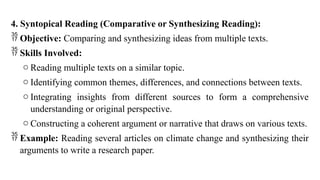
4. Syntopical Reading (Comparative or Synthesizing Reading):
 Objective: Comparing and synthesizing ideas from multiple texts.
 Skills Involved:
o Reading multiple texts on a similar topic.
o Identifying common themes, differences, and connections between texts.
o Integrating insights from different sources to form a comprehensive
understanding or original perspective.
o Constructing a coherent argument or narrative that draws on various texts.
 Example: Reading several articles on climate change and synthesizing their
arguments to write a research paper.
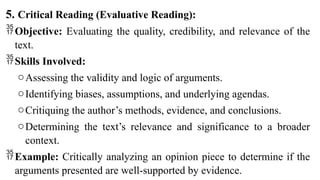
5. Critical Reading (Evaluative Reading):
Objective: Evaluating the quality, credibility, and relevance of the
text.
Skills Involved:
oAssessing the validity and logic of arguments.
oIdentifying biases, assumptions, and underlying agendas.
oCritiquing the author’s methods, evidence, and conclusions.
oDetermining the text’s relevance and significance to a broader
context.
Example: Critically analyzing an opinion piece to determine if the
arguments presented are well-supported by evidence.
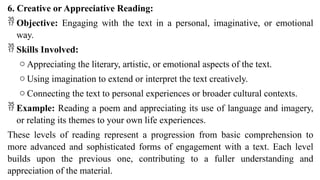
6. Creative or Appreciative Reading:
 Objective: Engaging with the text in a personal, imaginative, or emotional
way.
 Skills Involved:
o Appreciating the literary, artistic, or emotional aspects of the text.
o Using imagination to extend or interpret the text creatively.
o Connecting the text to personal experiences or broader cultural contexts.
 Example: Reading a poem and appreciating its use of language and imagery,
or relating its themes to your own life experiences.
These levels of reading represent a progression from basic comprehension to
more advanced and sophisticated forms of engagement with a text. Each level
builds upon the previous one, contributing to a fuller understanding and
appreciation of the material.
1.1 Reading and reflection on text 👨🏻‍🏫/

1.1 Reading and reflection on text 👨🏻‍🏫/

  • 1.
    Reading: Meaning andNature •Reading is the process of understanding and interpreting written information. •It is a complex cognitive process of decoding symbols to derive meaning that involves the interaction between the reader and the text. •It involves decoding symbols (letters) into words, comprehending their meaning, and connecting the text to existing knowledge. •It is a way to communicate with the author through their written words. •It is a means of language acquisition, communication, and sharing information and ideas. •It's more than just decoding symbols; it's about constructing meaning.
  • 2.
    Concept of reading •InteractiveProcess: Reading is a dynamic exchange between the reader and the text. The reader brings their own experiences, knowledge, and beliefs to the reading process, which influences their interpretation. •Meaning Construction: Readers actively construct meaning by connecting the text to their prior knowledge. This is a collaborative effort between the author and the reader. •Strategic: Effective readers use a variety of strategies to comprehend text, such as predicting, questioning, visualizing, and summarizing •Multidimensional: Reading involves multiple cognitive processes, including word recognition, fluency, vocabulary, comprehension, and critical thinking.
  • 3.
    Components of Reading Readingis a fundamental skill that plays a critical role in communication, learning, and personal development. It involves more than just recognizing words on a page. It is a dynamic process that engages multiple cognitive skills and strategies to extract meaning, interpret information, and critically analyze the content. Reading encompasses various components that work together to enable understanding and interpretation of written texts. Here are the primary components: 1. Decoding: o Letter Recognition: Identifying and understanding the symbols (letters) that make up the text. o Phonemic Awareness: Understanding the relationship between letters and sounds, which helps in sounding out words.
  • 4.
    2. Comprehension: o UnderstandingMeaning: Grasping the explicit meaning of words, sentences, and paragraphs. o Inference: Drawing conclusions and making interpretations that go beyond the literal text. o Contextual Understanding: Using the surrounding text and prior knowledge to understand unfamiliar words or concepts. 3. Fluency: o Speed and Accuracy: Reading text smoothly and quickly without sacrificing comprehension. o Expression: Reading with proper intonation and rhythm, which reflects an understanding of the text’s meaning. 4. Critical Thinking: o Analysis: Evaluating and analyzing the text to understand its deeper meanings, themes, and implications. o Evaluation: Judging the quality, accuracy, and relevance of the text. 5. Engagement: o Interest and Motivation: Engaging with the text, which enhances comprehension and retention. o Connection: Relating the text to personal experiences, other readings, or broader world knowledge.
  • 5.
    Purpose of Reading: oInformation Gathering: Reading to acquire new knowledge or stay informed. o Entertainment: Reading for pleasure and enjoyment. o Skill Development: Reading to improve language skills, such as vocabulary and comprehension. o Critical Engagement: Reading to critically engage with ideas, arguments, and perspectives. •Reading is not a passive activity; it involves active engagement with the text, where the reader decodes, comprehends, interprets, and critically analyzes the material to gain understanding and meaning. It is a vital skill that underpins much of education and daily life.
  • 6.
    Nature of Reading •Thenature of reading refers to the fundamental characteristics and processes that define what reading is and how it functions as a cognitive and communicative activity. Understanding the nature of reading involves exploring its complexity, its role in learning and communication, and the mental processes it engages. Here’s an overview: •1. Cognitive Process:  Decoding and Word Recognition: Reading involves recognizing and interpreting written symbols. This begins with decoding, where letters and words are translated into sounds or meanings. Efficient readers quickly recognize words as whole units, reducing the cognitive load on decoding and allowing more focus on comprehension.  Comprehension: Beyond decoding, reading is about understanding the text. This involves processing words, sentences, and paragraphs to extract meaning, infer context, and grasp the overall message. Comprehension requires integrating new information with existing knowledge.  Memory and Recall: Reading engages both short-term and long-term memory. Readers hold pieces of information in their working memory as they process the text and connect it with prior knowledge stored in long-term memory.
  • 7.
    •2. Interactive andConstructive Process:  Interaction with the Text: Reading is an active process where the reader interacts with the text, constantly predicting, questioning, and revising their understanding as they progress through the material.  Constructing Meaning: Readers do not passively receive information; they construct meaning by integrating the text with their background knowledge, experiences, and personal interpretations. This construction of meaning makes reading a subjective experience. •3. Multidimensional Activity:  Visual, Auditory, and Cognitive Dimensions: Reading is a multi-sensory experience. While primarily a visual activity, it can also involve auditory processes, especially in early reading stages or when reading aloud. Cognitively, it requires the coordination of various mental processes such as attention, memory, and reasoning.  Language and Cultural Dimensions: Reading is deeply connected to language and culture. It involves understanding the language in which the text is written, as well as the cultural context, idioms, and references that may shape the text's meaning.
  • 8.
    •4. Developmental andLearning Process:  Skill Development: Reading is a skill that develops over time, beginning with basic phonics and word recognition in early childhood and advancing to complex comprehension and critical analysis. This development is influenced by education, practice, and exposure to different types of texts.  Metacognition: Skilled readers use metacognitive strategies, such as self-monitoring and self- regulation, to improve their understanding. They are aware of when they do not understand something and employ strategies to overcome comprehension challenges. •5. Purpose-Driven Activity:  Varied Purposes: The nature of reading is also shaped by its purpose. People read for different reasons, including learning, entertainment, problem-solving, and communication. The purpose influences how one approaches and engages with the text.  Goal-Oriented: Readers often have specific goals, such as answering a question, forming an opinion, or enjoying a story. These goals guide the reading process and affect the strategies used.
  • 9.
    •6. Social andCommunicative Aspect:  Sharing and Discussing Texts: Reading is not only an individual activity but also a social one. People discuss, share, and analyze texts in group settings, which can deepen understanding and provide multiple perspectives.  Literacy as a Social Skill: Literacy, the ability to read and write, is a fundamental social skill that enables participation in society. It connects people to information, culture, and communication networks. •7. Emotional and Psychological Impact:  Emotional Engagement: Reading can evoke emotions, influence moods, and impact psychological states. It can be a source of comfort, inspiration, or even challenge preconceived notions.  Identity Formation: Through reading, individuals explore different perspectives and ideas, which can contribute to their personal growth and identity formation. In summary, the nature of reading is complex and multifaceted, involving cognitive, emotional, social, and cultural dimensions. It is an active, interactive, and purpose-driven process that plays a crucial role in learning, communication, and personal development.
  • 10.
    Levels of reading Readinga text involves engaging with it at various levels, each requiring a different degree of comprehension and analysis. The levels of reading can be broadly categorized as follows: 1. Elementary Reading (Basic or Literal Reading): Objective: Understanding the basic meaning of the text. Skills Involved: oRecognizing words and sentences. oIdentifying explicit facts and details. oUnderstanding the literal meaning of the words and sentences.
  • 11.
    2. Inspectional Reading(Skimming and Scanning): Objective: Getting a general overview or gist of the text. Skills Involved: oSkimming through the text to understand its structure and main ideas. oScanning for specific information, such as names, dates, or key terms. oPreviewing headings, subheadings, and summaries to grasp the content quickly. Example: Flipping through a book's chapters to understand its main arguments without reading every word.
  • 12.
    3. Analytical Reading(Inferential Reading): Objective: Deeply understanding and interpreting the text. Skills Involved: oAnalyzing the text’s arguments, structure, and purpose. oMaking inferences and drawing conclusions from the text. oIdentifying underlying themes, symbols, and patterns. oAsking critical questions about the text’s meaning and implications. Example: Reading a novel and analyzing character development or the significance of recurring motifs.
  • 13.
    4. Syntopical Reading(Comparative or Synthesizing Reading):  Objective: Comparing and synthesizing ideas from multiple texts.  Skills Involved: o Reading multiple texts on a similar topic. o Identifying common themes, differences, and connections between texts. o Integrating insights from different sources to form a comprehensive understanding or original perspective. o Constructing a coherent argument or narrative that draws on various texts.  Example: Reading several articles on climate change and synthesizing their arguments to write a research paper.
  • 14.
    5. Critical Reading(Evaluative Reading): Objective: Evaluating the quality, credibility, and relevance of the text. Skills Involved: oAssessing the validity and logic of arguments. oIdentifying biases, assumptions, and underlying agendas. oCritiquing the author’s methods, evidence, and conclusions. oDetermining the text’s relevance and significance to a broader context. Example: Critically analyzing an opinion piece to determine if the arguments presented are well-supported by evidence.
  • 15.
    6. Creative orAppreciative Reading:  Objective: Engaging with the text in a personal, imaginative, or emotional way.  Skills Involved: o Appreciating the literary, artistic, or emotional aspects of the text. o Using imagination to extend or interpret the text creatively. o Connecting the text to personal experiences or broader cultural contexts.  Example: Reading a poem and appreciating its use of language and imagery, or relating its themes to your own life experiences. These levels of reading represent a progression from basic comprehension to more advanced and sophisticated forms of engagement with a text. Each level builds upon the previous one, contributing to a fuller understanding and appreciation of the material.