BOTTOM-UP
READING MODEL
 It is a reading model that
 emphasizes the written or
 printed text.
 It emphasizes the ability to
 decode or put into sound what
 is seen in the text.
 Readers derive meaning in a
 linear manner.
TOP-DOWN
READING MODEL
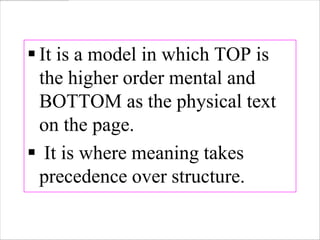
 It is a model in which TOP is
  the higher order mental and
  BOTTOM as the physical text
  on the page.
 It is where meaning takes
  precedence over structure.
INTERACTIVE
READING MODEL
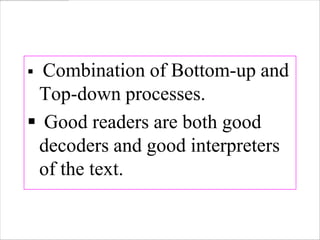
 Combination of Bottom-up and
 Top-down processes.
 Good readers are both good
 decoders and good interpreters
 of the text.
RUMELHART MODEL
     (1977)
 States that successful reading is both a
 PERCEPTUAL and a COGNITIVE
 process.
    - Orthographic knowledge
    - Lexical, Syntactic and Semantic
      knowledge
STANOVICH MODEL
     (1980)
 Interactive-compensatory reading
  model.
 Readers who rely on both Bottom-up
  and Top-down processes are depending
  on:
     - reading purpose
     - motivation
     - schema
     - knowledge of the subject
ANDERSON and
PEARSON SCHEMA-
 THEORETIC VIEW
 It focuses on the role of schemata
 (knowledge stored in memory) in
 text comprehension.
 SCHEMA THEORY
 a. relationships among components
 b. role of inference
 c. reliance on knowledge of the
     content
PEARSON and
TIERNEY R/W
   MODEL
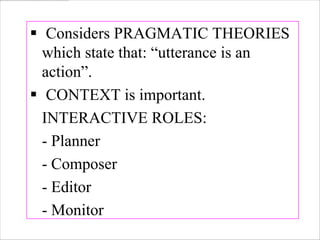
 Considers PRAGMATIC THEORIES
  which state that: “utterance is an
  action”.
 CONTEXT is important.
  INTERACTIVE ROLES:
  - Planner
  - Composer
  - Editor
  - Monitor
MATHEWSON’S
MODEL OF ATTITUDE
   INFLUENCE
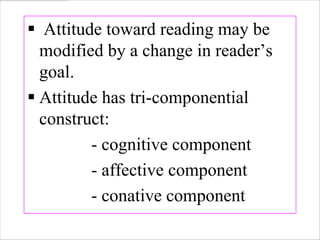
 Attitude toward reading may be
  modified by a change in reader’s
  goal.
 Attitude has tri-componential
  construct:
         - cognitive component
         - affective component
         - conative component
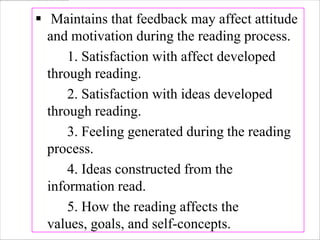
 Maintains that feedback may affect attitude
  and motivation during the reading process.
      1. Satisfaction with affect developed
  through reading.
      2. Satisfaction with ideas developed
  through reading.
      3. Feeling generated during the reading
  process.
      4. Ideas constructed from the
  information read.
      5. How the reading affects the
  values, goals, and self-concepts.

Reading models

  • 2.
  • 3.
     It isa reading model that emphasizes the written or printed text.  It emphasizes the ability to decode or put into sound what is seen in the text.  Readers derive meaning in a linear manner.
  • 4.
  • 5.
     It isa model in which TOP is the higher order mental and BOTTOM as the physical text on the page.  It is where meaning takes precedence over structure.
  • 6.
  • 7.
     Combination ofBottom-up and Top-down processes.  Good readers are both good decoders and good interpreters of the text.
  • 9.
  • 10.
     States thatsuccessful reading is both a PERCEPTUAL and a COGNITIVE process. - Orthographic knowledge - Lexical, Syntactic and Semantic knowledge
  • 11.
  • 12.
     Interactive-compensatory reading model.  Readers who rely on both Bottom-up and Top-down processes are depending on: - reading purpose - motivation - schema - knowledge of the subject
  • 13.
  • 14.
     It focuseson the role of schemata (knowledge stored in memory) in text comprehension.  SCHEMA THEORY a. relationships among components b. role of inference c. reliance on knowledge of the content
  • 15.
  • 16.
     Considers PRAGMATICTHEORIES which state that: “utterance is an action”.  CONTEXT is important. INTERACTIVE ROLES: - Planner - Composer - Editor - Monitor
  • 17.
  • 18.
     Attitude towardreading may be modified by a change in reader’s goal.  Attitude has tri-componential construct: - cognitive component - affective component - conative component
  • 19.
     Maintains thatfeedback may affect attitude and motivation during the reading process. 1. Satisfaction with affect developed through reading. 2. Satisfaction with ideas developed through reading. 3. Feeling generated during the reading process. 4. Ideas constructed from the information read. 5. How the reading affects the values, goals, and self-concepts.