Purposes of Reading


    Ahmad Sofwan
    sofwan1589@yahoo.com
Purposes of Reading
• To search for simple information
• To skim quickly
• To learn from texts
• To integrate information
• To write (or search for information needed for
  writing)
• To critique texts
• For general comprehension
To search for simple
             information & to skim
• Typically scan the text for a specific information
  or a specific word (e.g. a telephone directory to
  find key information)
• To skim sampling segments of the text for general
  understanding
• A combination of strategies to find the location of
  the information and use basic reading
  comprehension skills to obtain a general idea
  about the text
To learn from texts
• Typically occurs in academic/professional
  contexts to learn a considerable amount of
  information from a text.
• To remember main ideas & details of the main and
  supporting ideas in the text
• Recognize and form rhetorical frames
• Link the text to the reader’s knowledge base
• Carried out at a slower reading rate
• Makes stronger inferencing demands to connect
  the text information with background knowledge
To integrate information,
          write & critique texts
• Requires critical evaluation of the
  information to decide what information to
  integrate and how to integrate it for the
  reader’s goal
• Requires abilities to compose, select &
  critique information from a text
For general comprehension
• Requires very rapid and automatic
  processing of words, strong skills in
  forming a general meaning representation
  of main ideas, efficient coordination of
  many processes
Reading Strategies
•   Specifying a purpose of reading
•   Planning what to do/what steps to take
•   Previewing the text
•   Predicting the contents of the text or section of text
•   Checking predictions
•   Posing questions about the text
•   Finding asnwers to posed questions
•   Connecting one part of the text to another
•   Paying attention to text structure
Reading Strategies
•   Rereading
•   Guessing the meaning of a new word from context
•   Using discourse markers to see relationships
•   Checking comprehension
•   Critiquing the author
•   Critiquing the text
•   Judging how well objectives were met
•   Reflecting on what has been learned from the text
Processes in fluent reading
               comprehension
•  a rapid process
  (200-300 words per minute)
• an efficient process
  (coordinated & carried out automatically)
• an interactive process
  (recognizing words & analyzing sentence structure to find
  clause-level meaning, finding main ideas, monitoring
  comprehension, etc; linguistic information from the text
  and background knowledge)
THE EXAMPLES

• John is willing to help
• John is difficult to help

• John is willing to help someone
• John is difficult for someone to help
Processes in fluent reading
             comprehension
• a strategic process
  (recognize processing difficulties, address imbalances
  between text information & reader knowledge, & make
  decisions for monitoring comprehension and shifting goals
  for reading)
• a flexible process
  (adjust with the changing purposes and ongoing
  monitoring of comprehension)
• an evaluating process
  (must decide if the information is coherent and matches the
  purposes of reading; reader’s motivation, attitudes,
  feelings, expectation
Processes in fluent reading
             comprehension
• a purposeful process
  (different ways based on different purposes; motivation is
  triggered by individual tasks or purposes)
• a comprehending process
  (to understand a text)
• a learning process
  (to learn new information through reading)
• a linguistic process
  (not a reasoning process, understanding linguistic elements
  is important for text comprehension)
Reading processes
  occurring each & every two
            seconds we read
• Focus on and access 8 to 10 word meanings
• Parse a clause for information and form a meaning unit
• Figure out how to connect a new meaning unit into the
  growing text model
• Check interpretation of the information according to their
  purposes, feelings, attitudes, and background expectations,
  as needed
• Monitor their comprehension, make appropriate
  inferences, shift strategies and repair misunderstanding, as
  needed
• Resolve ambiguities, address difficulties and critique text
  information, as needed
Models of reading
Metaphorical models of reading
• Bottom-up models
• Top-down models
• Interactive models

Specific models of reading
• Psycholinguistic Guessing Game Model
• Interactive Compensatory Model
• Word recognition models
• Simple View of reading Model
Bottom-up models
• All readings follows a mechanical pattern in
  which the reader creates a piece-by-piece mental
  translation of the information in the text, with little
  inference from the reader’s own background
  knowledge.
• The reader processes each word letter-by-letter,
  each sentence word-by-word, and each text
  sentence-by-sentence in a linear fashion.
Top-down models
• Primarily directed by reader goals and
  expectations.
• The reader has a sets of expectation about text
  information & samples enough information from
  the text to confirm or reject.
• The reader directs eyes to the most likely places in
  the text to find useful information
Interactive models
• Take useful ideas from a bottom-up perspective
  and combine them with key ideas from a top-down
  view.
• Word recognition needs to be fast and efficient,
  but background knowledge is a major contributor
  to text understanding.
• Highlight the number of processes, particularly
  automatic processes, being carried out primarily in
  a bottom-up manner with little interference from
  other processing levels or knowledge resources.
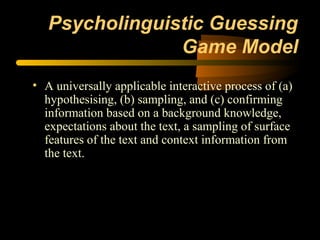
Psycholinguistic Guessing
                Game Model
• A universally applicable interactive process of (a)
  hypothesising, (b) sampling, and (c) confirming
  information based on a background knowledge,
  expectations about the text, a sampling of surface
  features of the text and context information from
  the text.
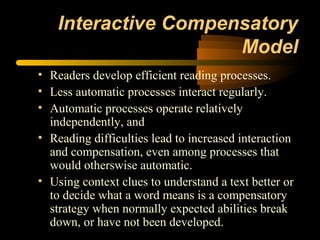
Interactive Compensatory
                      Model
• Readers develop efficient reading processes.
• Less automatic processes interact regularly.
• Automatic processes operate relatively
  independently, and
• Reading difficulties lead to increased interaction
  and compensation, even among processes that
  would otherswise automatic.
• Using context clues to understand a text better or
  to decide what a word means is a compensatory
  strategy when normally expected abilities break
  down, or have not been developed.

Purposes of-reading

  • 1.
    Purposes of Reading Ahmad Sofwan sofwan1589@yahoo.com
  • 2.
    Purposes of Reading •To search for simple information • To skim quickly • To learn from texts • To integrate information • To write (or search for information needed for writing) • To critique texts • For general comprehension
  • 3.
    To search forsimple information & to skim • Typically scan the text for a specific information or a specific word (e.g. a telephone directory to find key information) • To skim sampling segments of the text for general understanding • A combination of strategies to find the location of the information and use basic reading comprehension skills to obtain a general idea about the text
  • 4.
    To learn fromtexts • Typically occurs in academic/professional contexts to learn a considerable amount of information from a text. • To remember main ideas & details of the main and supporting ideas in the text • Recognize and form rhetorical frames • Link the text to the reader’s knowledge base • Carried out at a slower reading rate • Makes stronger inferencing demands to connect the text information with background knowledge
  • 5.
    To integrate information, write & critique texts • Requires critical evaluation of the information to decide what information to integrate and how to integrate it for the reader’s goal • Requires abilities to compose, select & critique information from a text
  • 6.
    For general comprehension •Requires very rapid and automatic processing of words, strong skills in forming a general meaning representation of main ideas, efficient coordination of many processes
  • 7.
    Reading Strategies • Specifying a purpose of reading • Planning what to do/what steps to take • Previewing the text • Predicting the contents of the text or section of text • Checking predictions • Posing questions about the text • Finding asnwers to posed questions • Connecting one part of the text to another • Paying attention to text structure
  • 8.
    Reading Strategies • Rereading • Guessing the meaning of a new word from context • Using discourse markers to see relationships • Checking comprehension • Critiquing the author • Critiquing the text • Judging how well objectives were met • Reflecting on what has been learned from the text
  • 9.
    Processes in fluentreading comprehension • a rapid process (200-300 words per minute) • an efficient process (coordinated & carried out automatically) • an interactive process (recognizing words & analyzing sentence structure to find clause-level meaning, finding main ideas, monitoring comprehension, etc; linguistic information from the text and background knowledge)
  • 10.
    THE EXAMPLES • Johnis willing to help • John is difficult to help • John is willing to help someone • John is difficult for someone to help
  • 11.
    Processes in fluentreading comprehension • a strategic process (recognize processing difficulties, address imbalances between text information & reader knowledge, & make decisions for monitoring comprehension and shifting goals for reading) • a flexible process (adjust with the changing purposes and ongoing monitoring of comprehension) • an evaluating process (must decide if the information is coherent and matches the purposes of reading; reader’s motivation, attitudes, feelings, expectation
  • 12.
    Processes in fluentreading comprehension • a purposeful process (different ways based on different purposes; motivation is triggered by individual tasks or purposes) • a comprehending process (to understand a text) • a learning process (to learn new information through reading) • a linguistic process (not a reasoning process, understanding linguistic elements is important for text comprehension)
  • 13.
    Reading processes occurring each & every two seconds we read • Focus on and access 8 to 10 word meanings • Parse a clause for information and form a meaning unit • Figure out how to connect a new meaning unit into the growing text model • Check interpretation of the information according to their purposes, feelings, attitudes, and background expectations, as needed • Monitor their comprehension, make appropriate inferences, shift strategies and repair misunderstanding, as needed • Resolve ambiguities, address difficulties and critique text information, as needed
  • 14.
    Models of reading Metaphoricalmodels of reading • Bottom-up models • Top-down models • Interactive models Specific models of reading • Psycholinguistic Guessing Game Model • Interactive Compensatory Model • Word recognition models • Simple View of reading Model
  • 15.
    Bottom-up models • Allreadings follows a mechanical pattern in which the reader creates a piece-by-piece mental translation of the information in the text, with little inference from the reader’s own background knowledge. • The reader processes each word letter-by-letter, each sentence word-by-word, and each text sentence-by-sentence in a linear fashion.
  • 16.
    Top-down models • Primarilydirected by reader goals and expectations. • The reader has a sets of expectation about text information & samples enough information from the text to confirm or reject. • The reader directs eyes to the most likely places in the text to find useful information
  • 17.
    Interactive models • Takeuseful ideas from a bottom-up perspective and combine them with key ideas from a top-down view. • Word recognition needs to be fast and efficient, but background knowledge is a major contributor to text understanding. • Highlight the number of processes, particularly automatic processes, being carried out primarily in a bottom-up manner with little interference from other processing levels or knowledge resources.
  • 18.
    Psycholinguistic Guessing Game Model • A universally applicable interactive process of (a) hypothesising, (b) sampling, and (c) confirming information based on a background knowledge, expectations about the text, a sampling of surface features of the text and context information from the text.
  • 19.
    Interactive Compensatory Model • Readers develop efficient reading processes. • Less automatic processes interact regularly. • Automatic processes operate relatively independently, and • Reading difficulties lead to increased interaction and compensation, even among processes that would otherswise automatic. • Using context clues to understand a text better or to decide what a word means is a compensatory strategy when normally expected abilities break down, or have not been developed.