This document provides an overview of strategies to use before, during, and after reading to improve content area literacy. It discusses activating prior knowledge through anticipation guides and chapter walks before reading. During reading, it recommends strategies like note-taking, graphic organizers, and questioning to monitor comprehension. After reading, the document describes having students apply their new knowledge through activities like RAFTs, last word, and rating scales. The objective is to effectively use these strategies to accelerate and improve student learning.
Welcome to Content Area Reading Strategies and Vocabulary Development
2.
Do you… teacharound the reading in your content? blame earlier grades for not preparing the students? tell students what to read and test/quiz to see if they actually read it? feel like some students will never “get it”? This workshop can help!
3.
If not me,then who? Teaching literacy skills is every teacher’s responsibility. If a student is not taught the skills to access the text within a content area, he will remain unable to access the information within that subject. It has very little to do with homework completion. It has everything to do with literacy competency.
4.
from Meeting the Challenge of Adolescent Literacy… “ Teachers of each content area are in the strongest position to help student successfully meet those challenges. Content area teachers know their subject matter and the standards they should be meeting. They also understand the literacy demands of their content; how to read the different kinds of text, how to write in the formats associated with each subject, how to recognize key concepts and vocabulary terms…”
5.
Teaching reading inthe content areas is NOT so much about teaching students basic reading skills as it is about teaching students how to use reading as a tool for thinking and learning. -Billmeyer & Barton 1998 Reading in the Content Areas
6.
Objective- To effectivelyuse before, during, and after reading strategies within the classroom to accelerate and improve student learning. Before Reading Strategies Vocabulary Development Strategies During Reading Strategies After Reading Strategies
7.
Before Reading StrategiesThe most powerful time to support reading is BEFORE students begin to read. Before reading strategies activate prior knowledge and focuses attention on the purpose of the reading.
8.
Before Reading Linknew information to prior knowledge Clarify misconceptions Relate new vocabulary to known concepts Provide information about the organization of the content Generate questions about the topic Make predictions about what might be learned
9.
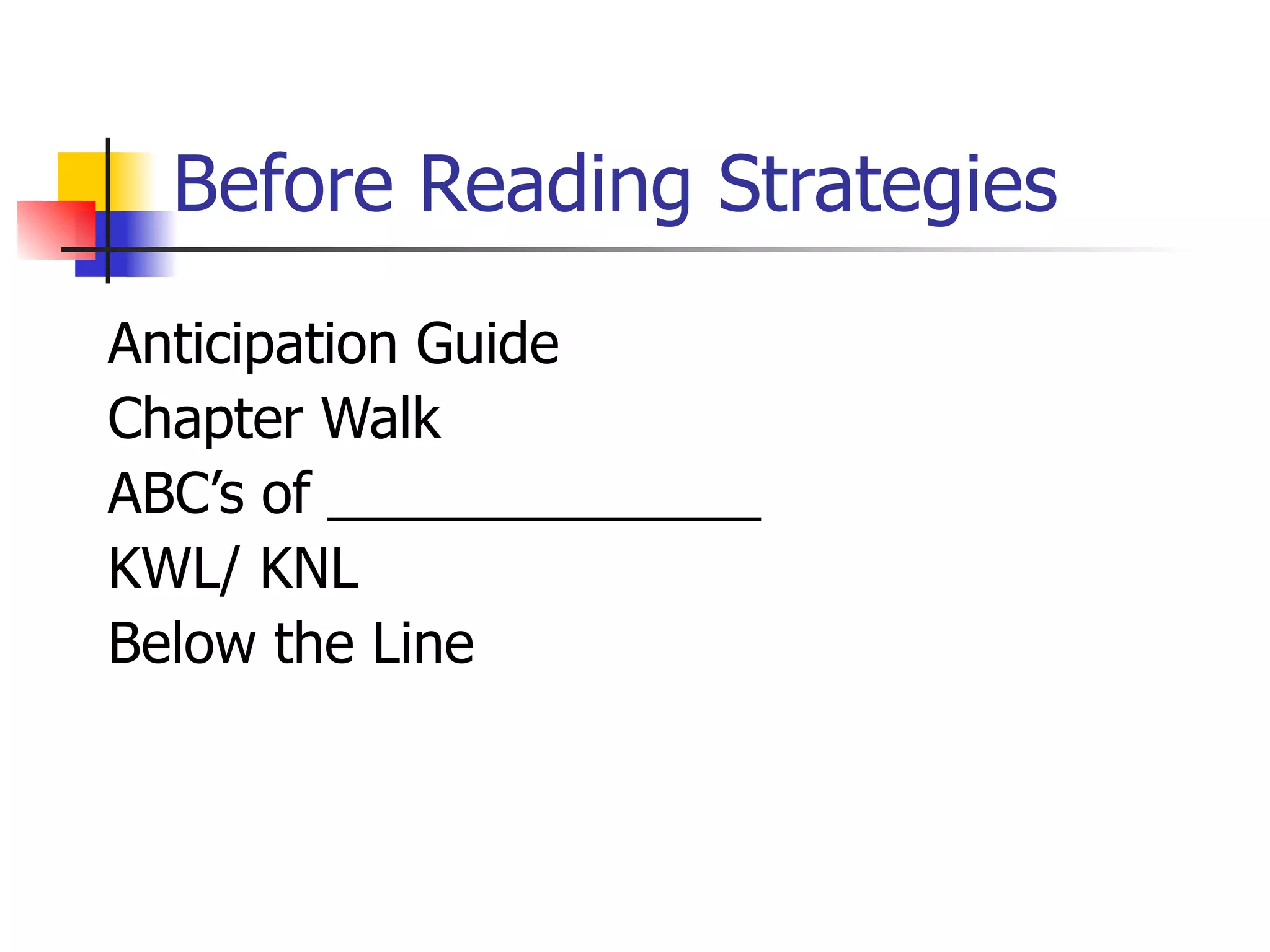
Before Reading StrategiesAnticipation Guide Chapter Walk ABC’s of ______________ KWL/ KNL Below the Line
10.
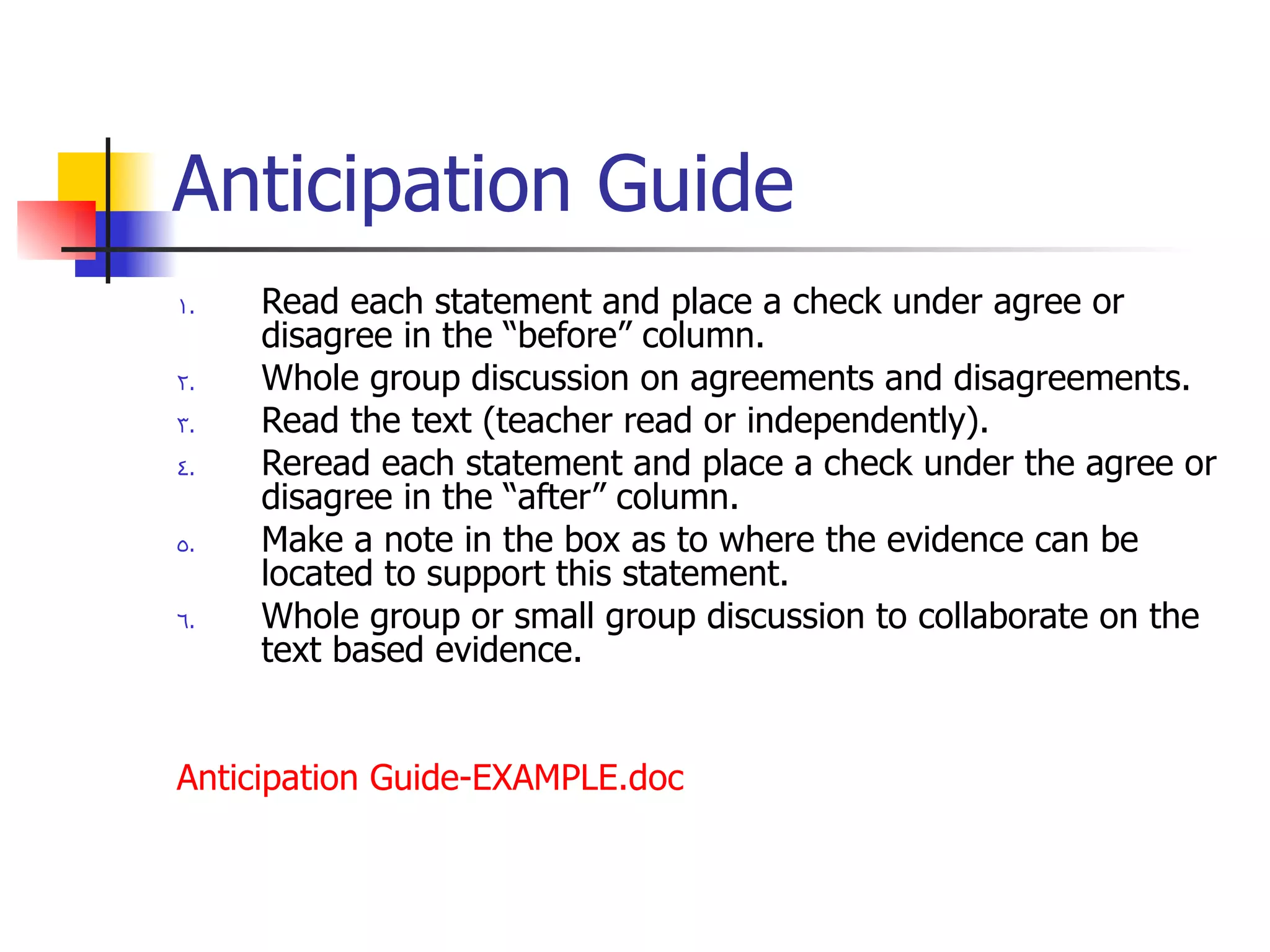
Anticipation Guide Readeach statement and place a check under agree or disagree in the “before” column. Whole group discussion on agreements and disagreements. Read the text (teacher read or independently). Reread each statement and place a check under the agree or disagree in the “after” column. Make a note in the box as to where the evidence can be located to support this statement. Whole group or small group discussion to collaborate on the text based evidence. Anticipation Guide- EXAMPLE.doc
11.
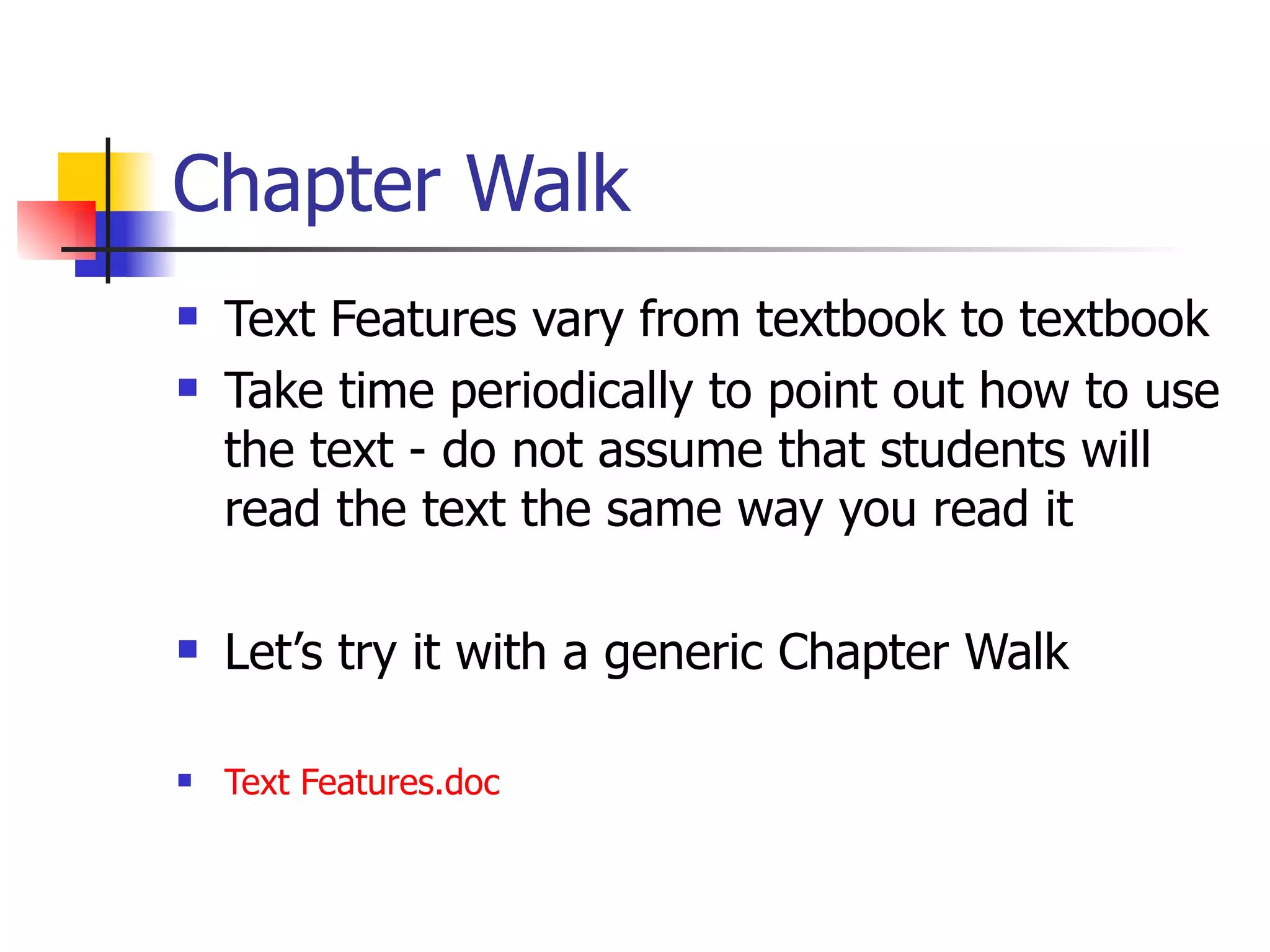
Chapter Walk TextFeatures vary from textbook to textbook Take time periodically to point out how to use the text - do not assume that students will read the text the same way you read it Let’s try it with a generic Chapter Walk Text Features.doc
12.
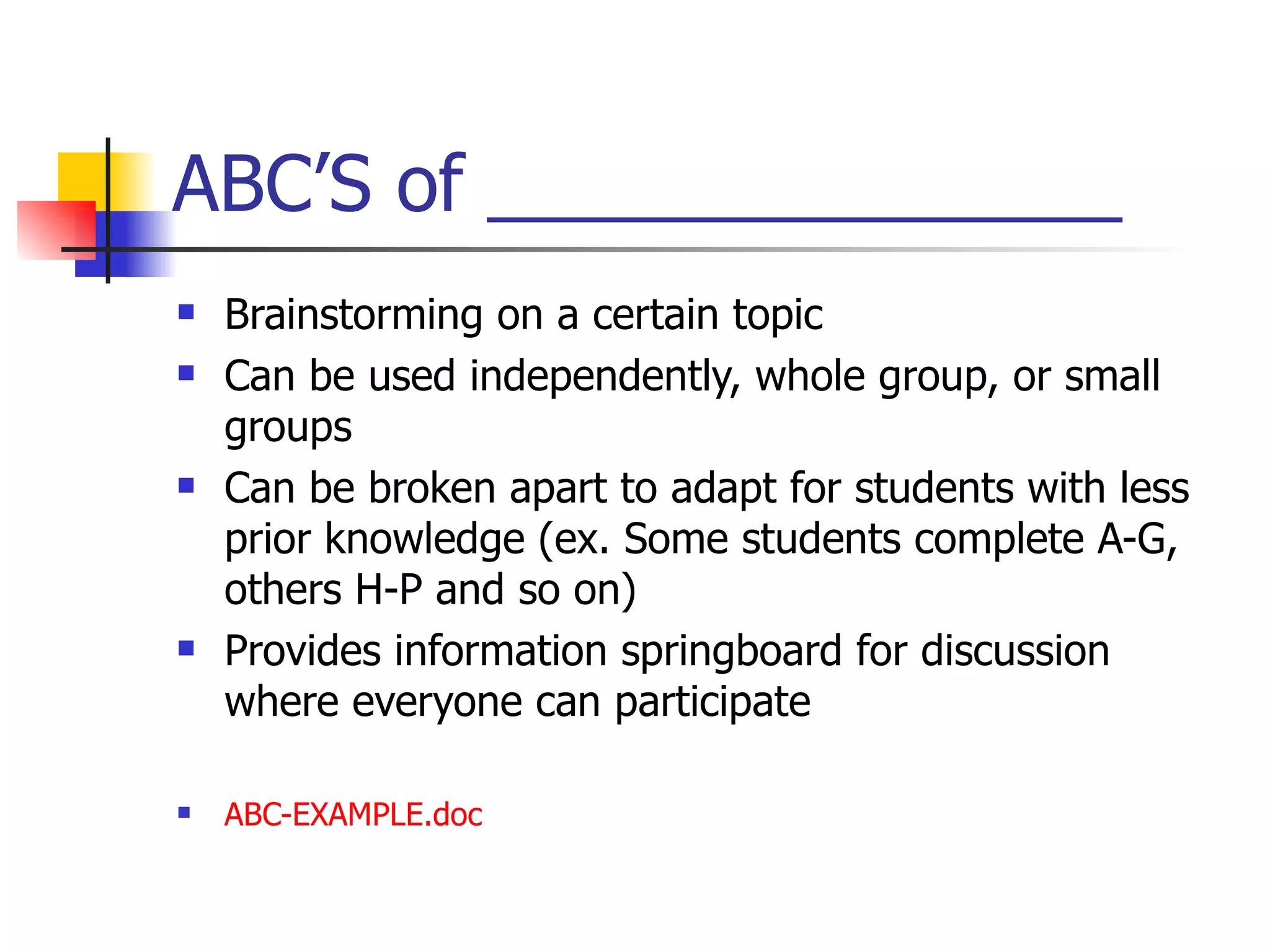
ABC’S of _______________Brainstorming on a certain topic Can be used independently, whole group, or small groups Can be broken apart to adapt for students with less prior knowledge (ex. Some students complete A-G, others H-P and so on) Provides information springboard for discussion where everyone can participate ABC- EXAMPLE.doc
13.
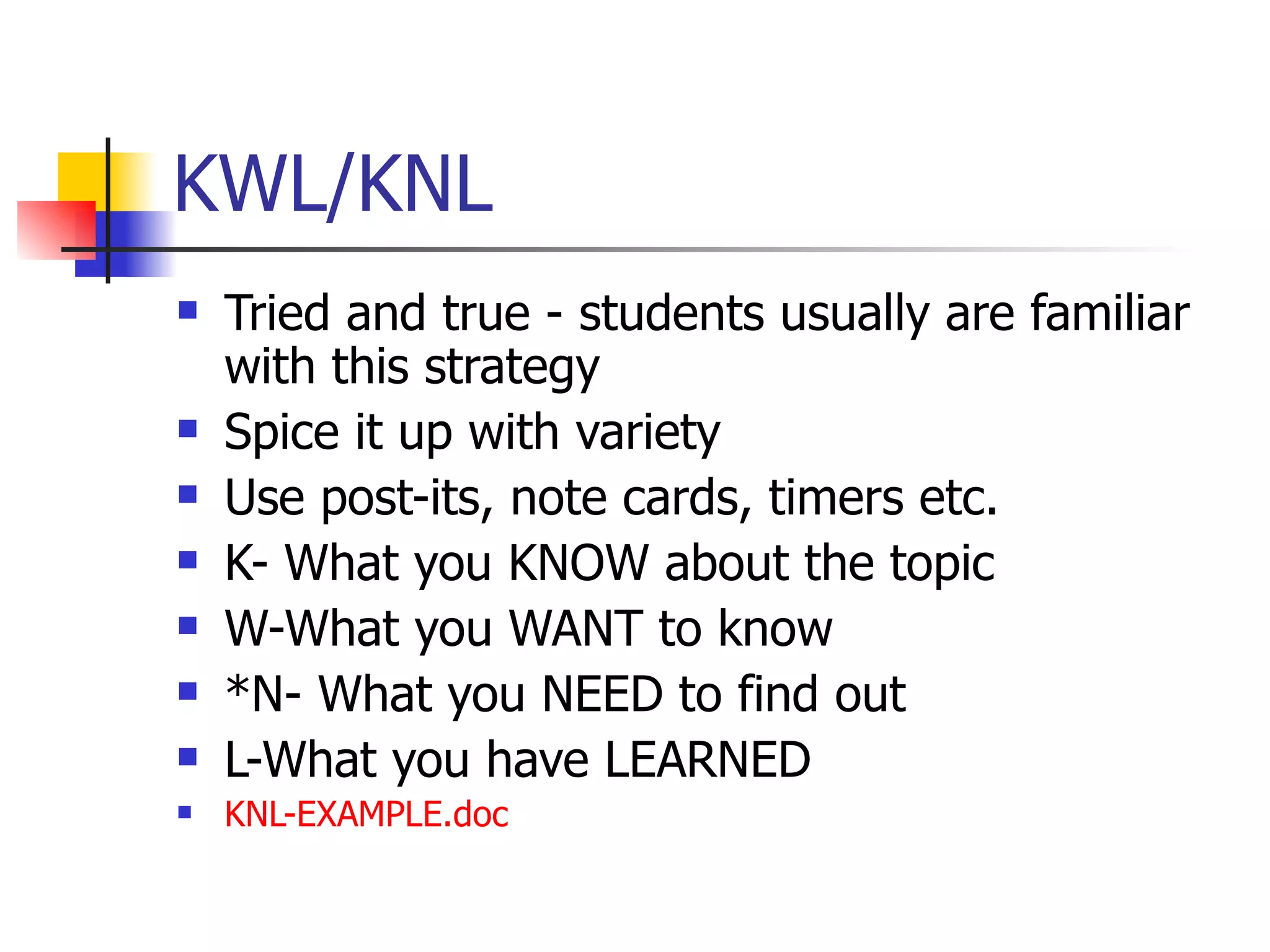
KWL/KNL Tried andtrue - students usually are familiar with this strategy Spice it up with variety Use post-its, note cards, timers etc. K- What you KNOW about the topic W-What you WANT to know *N- What you NEED to find out L-What you have LEARNED KNL- EXAMPLE.doc
14.
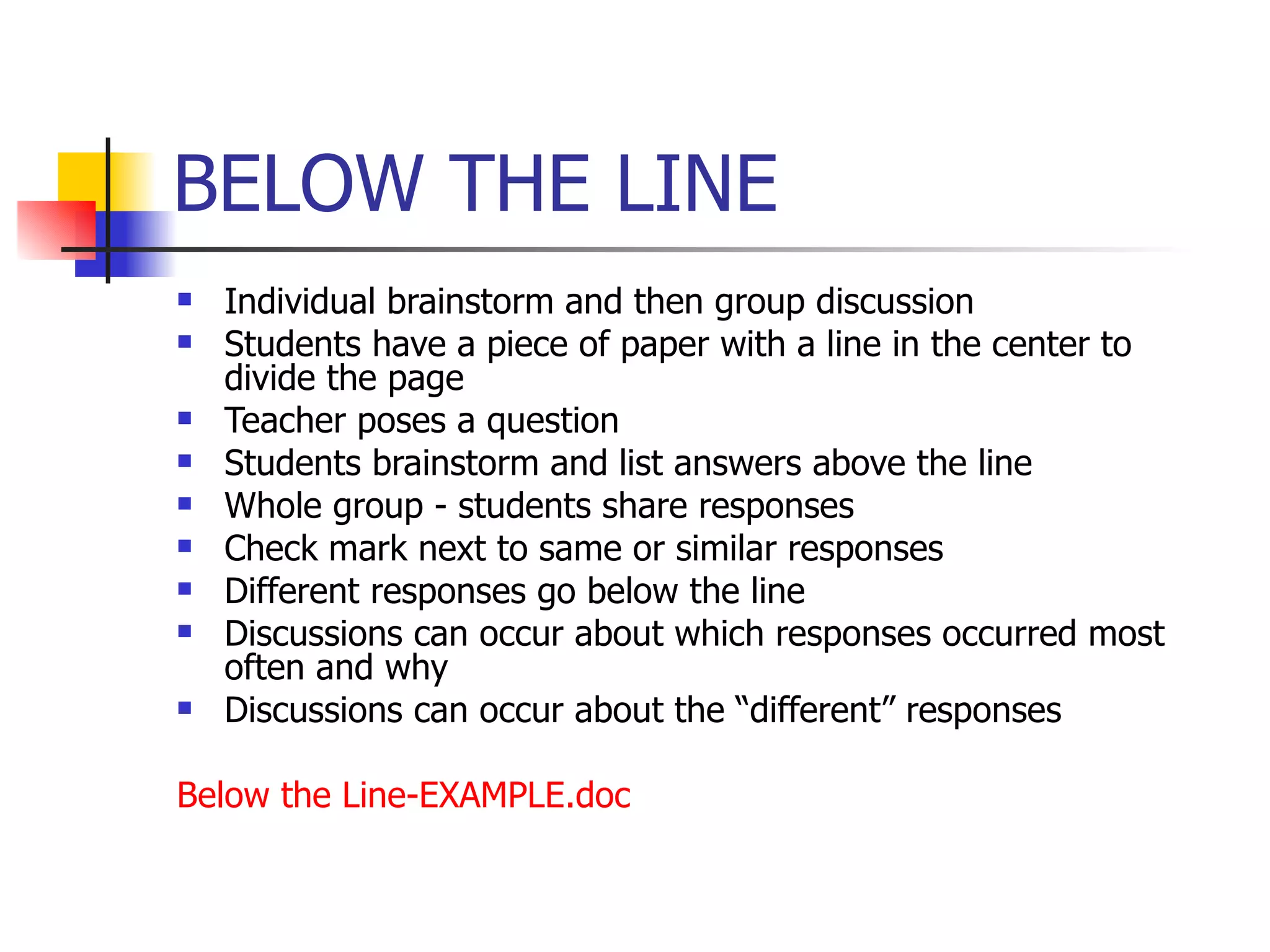
BELOW THE LINE Individual brainstorm and then group discussion Students have a piece of paper with a line in the center to divide the page Teacher poses a question Students brainstorm and list answers above the line Whole group - students share responses Check mark next to same or similar responses Different responses go below the line Discussions can occur about which responses occurred most often and why Discussions can occur about the “different” responses Below the Line- EXAMPLE.doc
15.
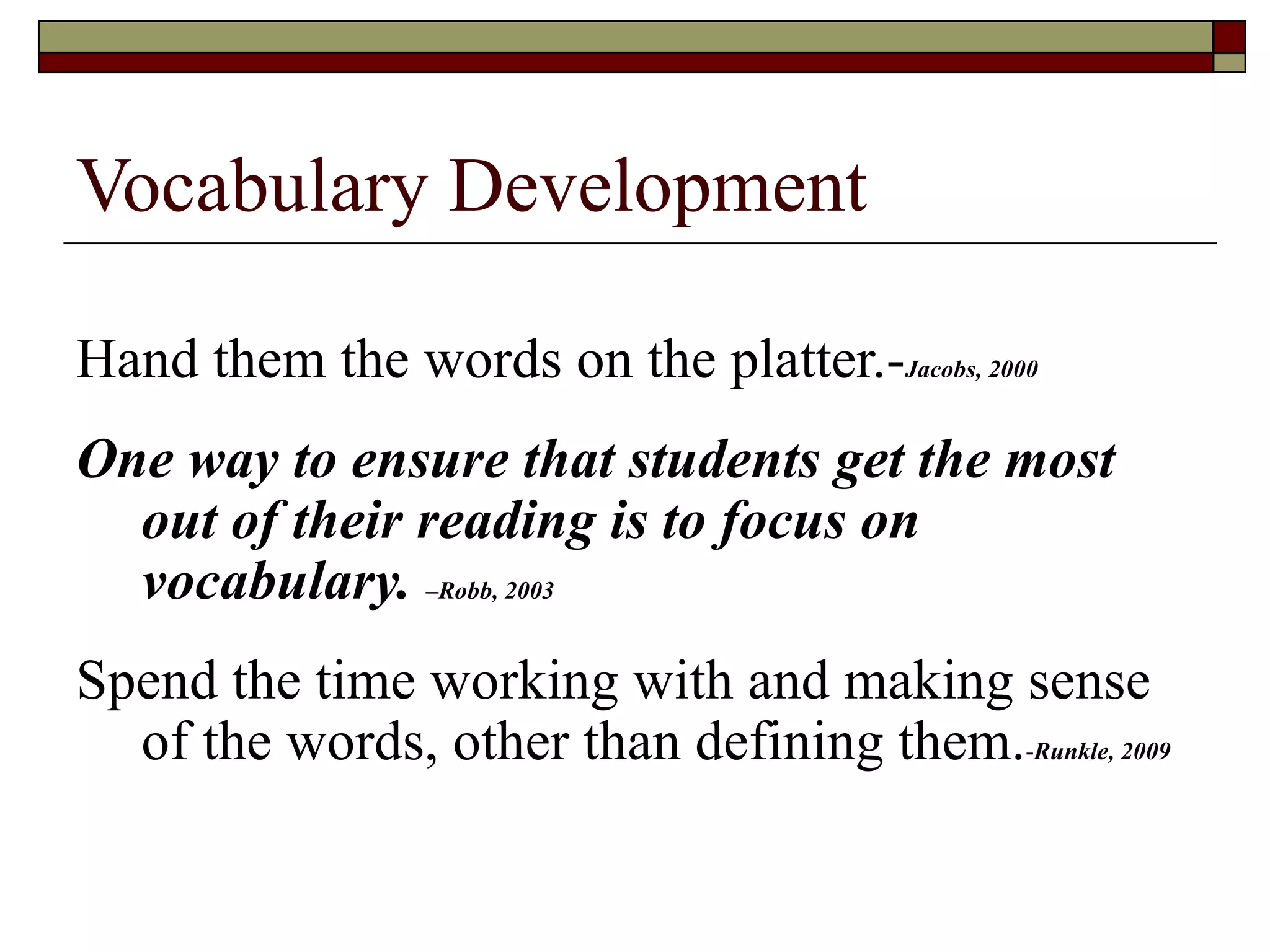
Vocabulary Development Handthem the words on the platter.- Jacobs, 2000 One way to ensure that students get the most out of their reading is to focus on vocabulary. –Robb, 2003 Spend the time working with and making sense of the words, other than defining them. - Runkle, 2009
16.
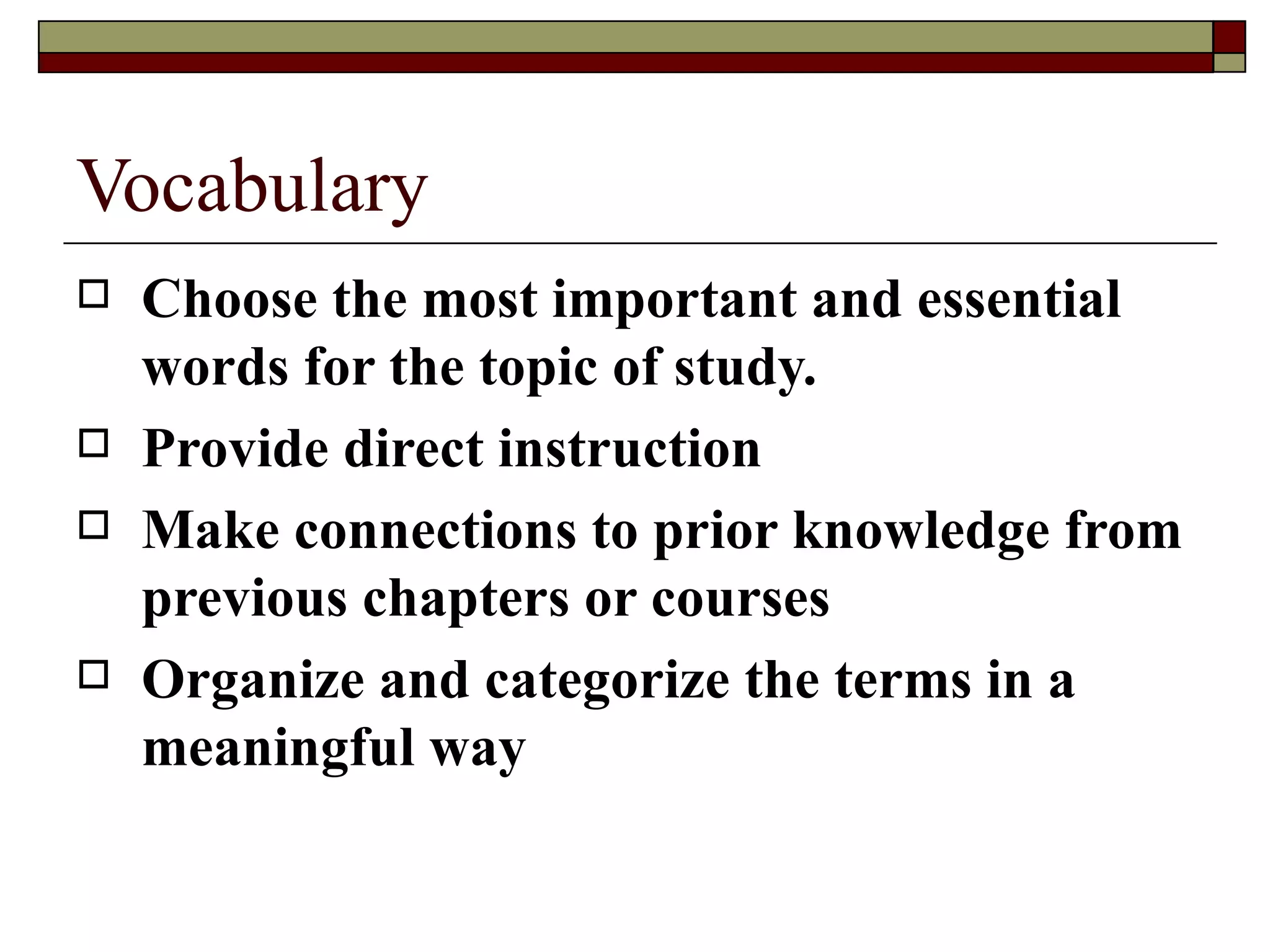
Vocabulary Choose themost important and essential words for the topic of study. Provide direct instruction Make connections to prior knowledge from previous chapters or courses Organize and categorize the terms in a meaningful way
WORD SORTS Placevocabulary terms onto small cards, one word per card. Individually, or in groups, students then sort the words into categories. “ Closed Sort”- categories provided by teacher “ Open Sort”- students create and label categories discovered of their own making Students write their list for each category with a brief explanation of why these words are included together in that particular category. Completing VOCABULARY SORTS in small groups using textbooks and class notes for reference provides opportunities for in-depth discussion as students consider the word from many aspects. - Billmeyer and Baron, 1998 Word Sort- EXAMPLE.doc
19.
VOCABULARY CONCEPT CIRCLESTeacher puts all four words in the circle – students explain how they are connected. Teacher puts words in three sections – student adds a fourth and explains why. Teacher selects four words based on “relatedness” – students shade words that go together, or shade a word that doesn’t fit, etc. Students choose all four vocabulary words to put in the circle and then write what they have learned about the topic using the words. Flanigan, K. & Greenwood, S.C. (2007). Effective content vocabulary instruction in the middle: Matching students, purposes, words, and strategies. Journal of Asolescent & Adult Literacy, 51,226-238. VOCABULARY CONCEPT CIRCLES.doc
20.
Vocabulary Concept Circles- cont. Can be used with whole groups, small groups or individually Provide the definitions of the words that you want them to know (dictionaries and glossaries often include several definitions) VOCABULARY CONCEPT CIRCLE- EGYPT EXAMPLE.doc
21.
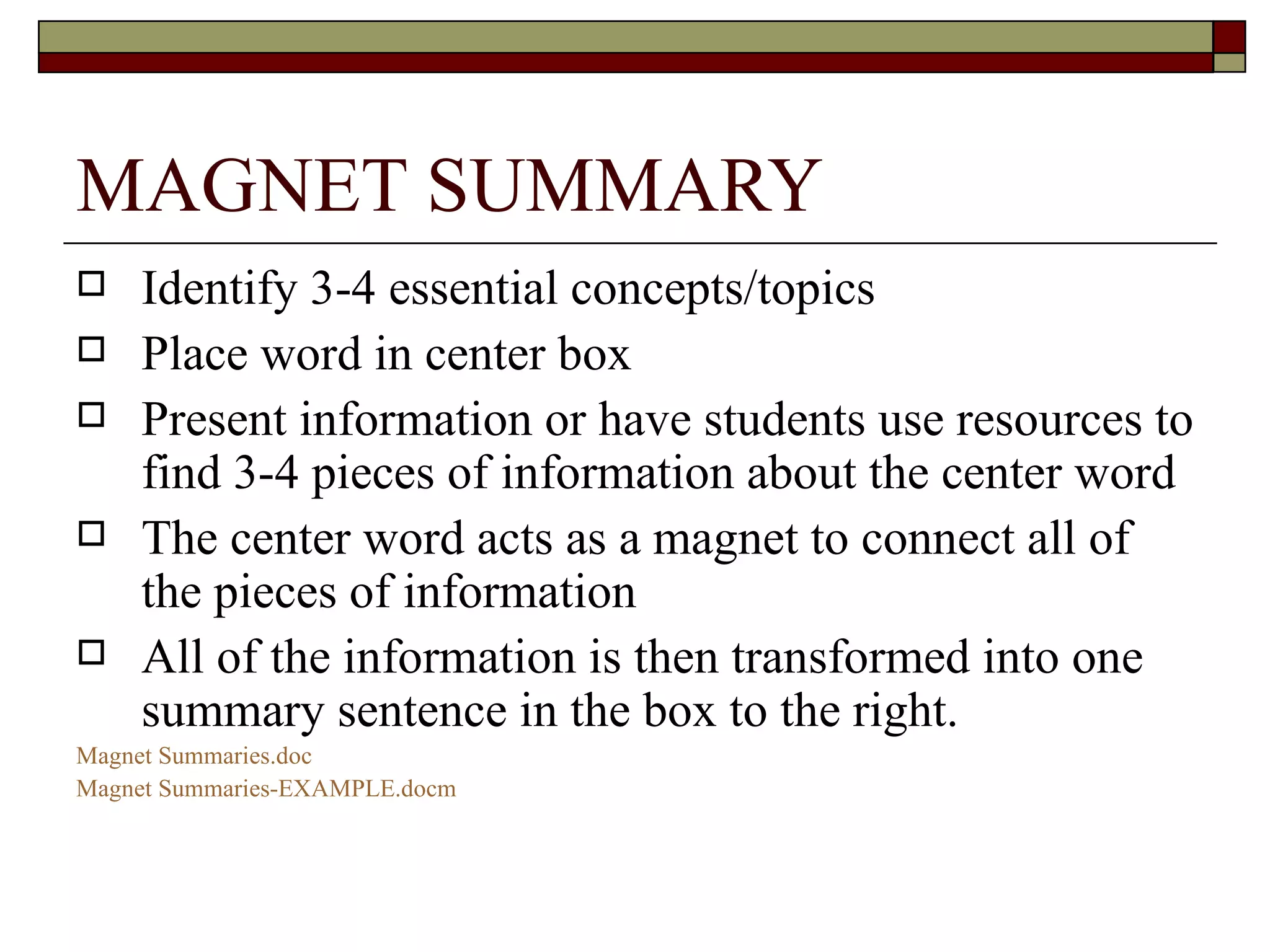
MAGNET SUMMARY Identify3-4 essential concepts/topics Place word in center box Present information or have students use resources to find 3-4 pieces of information about the center word The center word acts as a magnet to connect all of the pieces of information All of the information is then transformed into one summary sentence in the box to the right. Magnet Summaries.doc Magnet Summaries- EXAMPLE.docm
22.
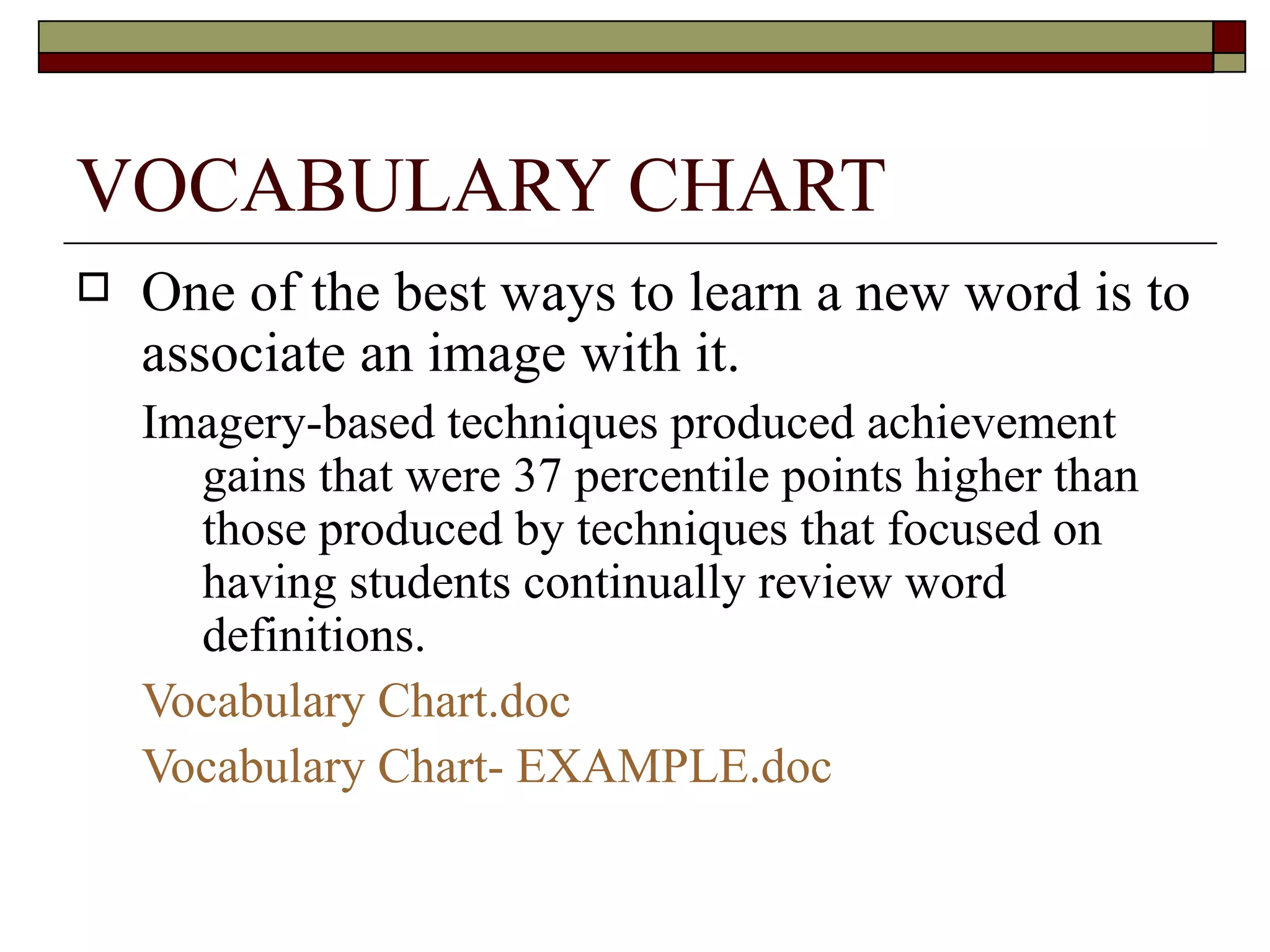
VOCABULARY CHART Oneof the best ways to learn a new word is to associate an image with it. Imagery-based techniques produced achievement gains that were 37 percentile points higher than those produced by techniques that focused on having students continually review word definitions. Vocabulary Chart.doc Vocabulary Chart- EXAMPLE.doc
23.
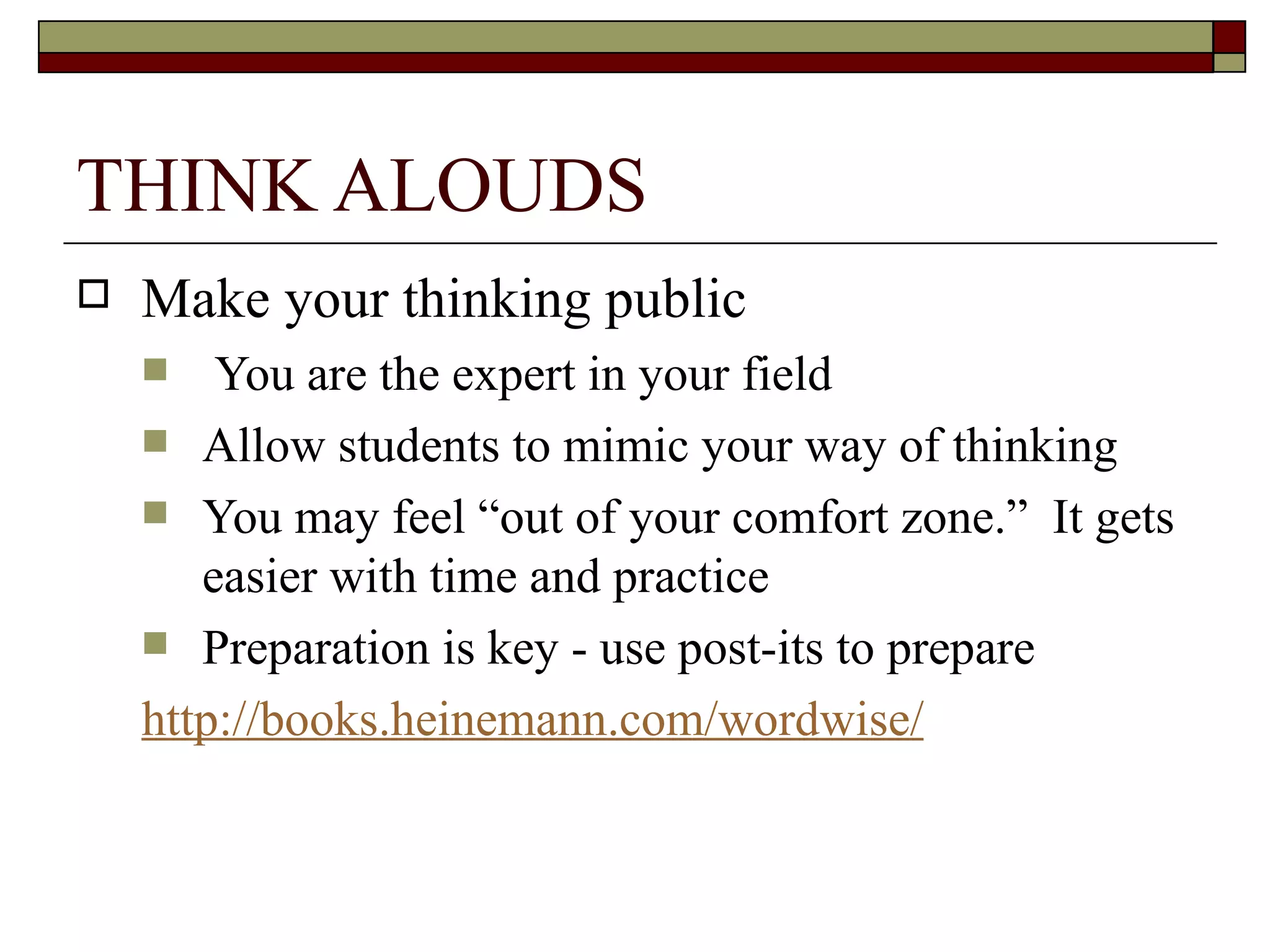
THINK ALOUDS Makeyour thinking public You are the expert in your field Allow students to mimic your way of thinking You may feel “out of your comfort zone.” It gets easier with time and practice Preparation is key - use post-its to prepare http://books.heinemann.com/wordwise/
24.
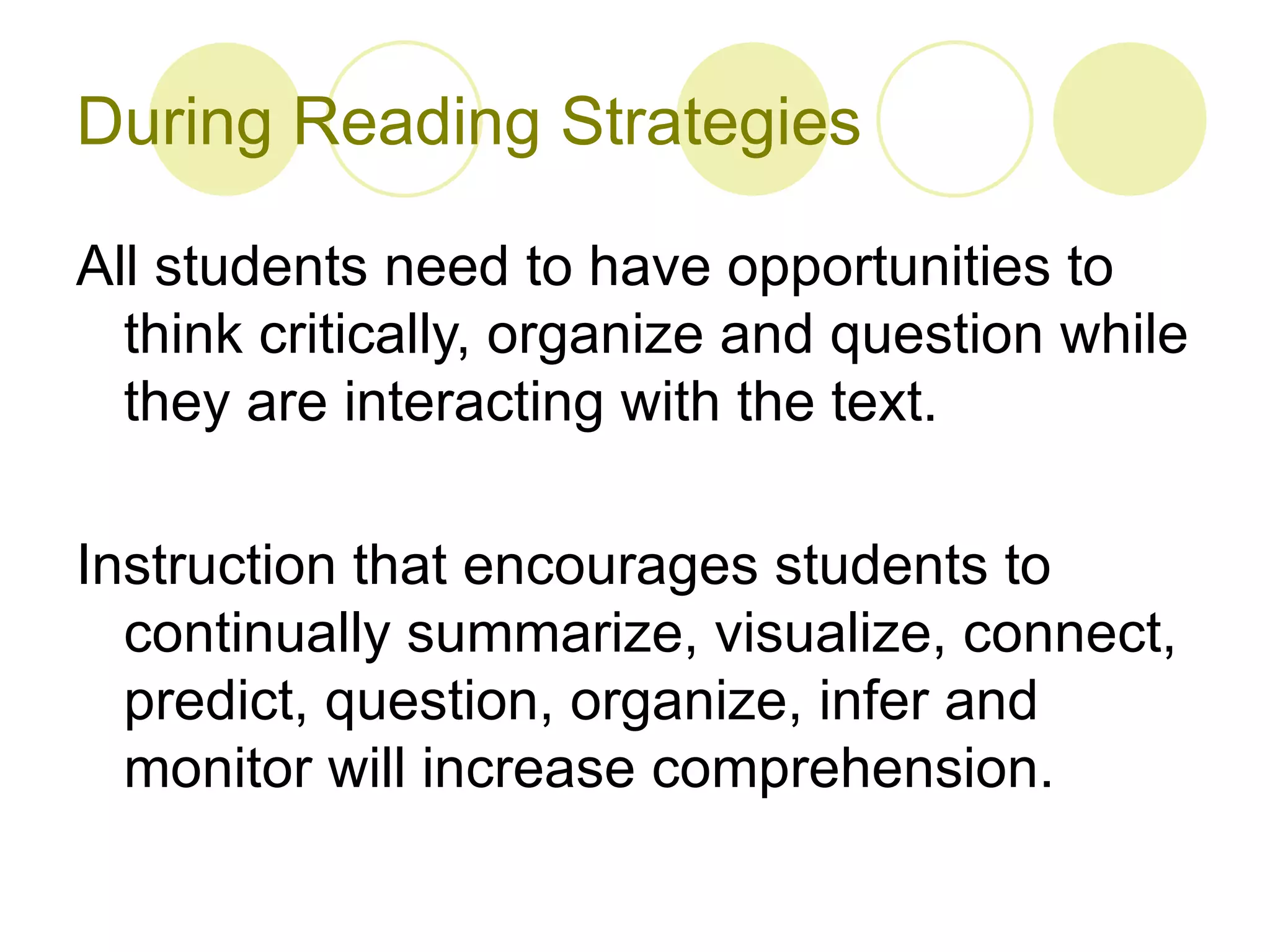
During Reading StrategiesAll students need to have opportunities to think critically, organize and question while they are interacting with the text. Instruction that encourages students to continually summarize, visualize, connect, predict, question, organize, infer and monitor will increase comprehension.
25.
DURING Monitor comprehensionto adjust pacing or ask questions Maintain mental activity through connecting, predicting, summarizing, etc. Organize and integrate new information on graphic organizers Verify/ adjust predictions to categorize new information
26.
DURING READING STRATEGIES4 Square Reading 2 Column Note-Taking Note-Taking with codes Extract/React Graphic Organizers specific to text Venn Diagram Cause and Effect Cycle Organizer
27.
4 SQUARE READINGDivide text into 4 sections Divide students into groups of 4 Assign each student a different role Summarizer Connector Visualizer Predictor/ Questioner Students will read one section of the text in group Each student completes his/her role Discussion of the completed roles Rotate roles Repeat steps 4-7 until all boxes are complete FOUR SQUARE.doc
28.
2 Column Note-TakingCornell Note-Taking Topic with Sub-Topics Summary at the end is key Cornell notetaking.doc
29.
Note-Taking with CodesFinding key pieces of information from text Identifying personal knowledge Coding the facts Content notes with codes.docm
30.
Extract/React Note-Taking Extractingspecific information Placing a mental hook or a personal reaction to the information Summary at the end is key. Extract React.doc Extract React- EXAMPLE.doc
31.
Graphic Organizers Chooseand use the organizer that works best for the text and the information Venn Diagram Cause and Effect Cycle Organizer Textbook publishers often send supplemental guides with graphic organizers.
32.
After Reading StrategiesTo consolidate their learning, effective learners reflect on new information and integrate it into previous understandings by personalizing and applying the new concepts.- Buehl, 2001 Have the students use the new information in a meaningful way that they can apply prior knowledge and skills.- Runkle, 2009
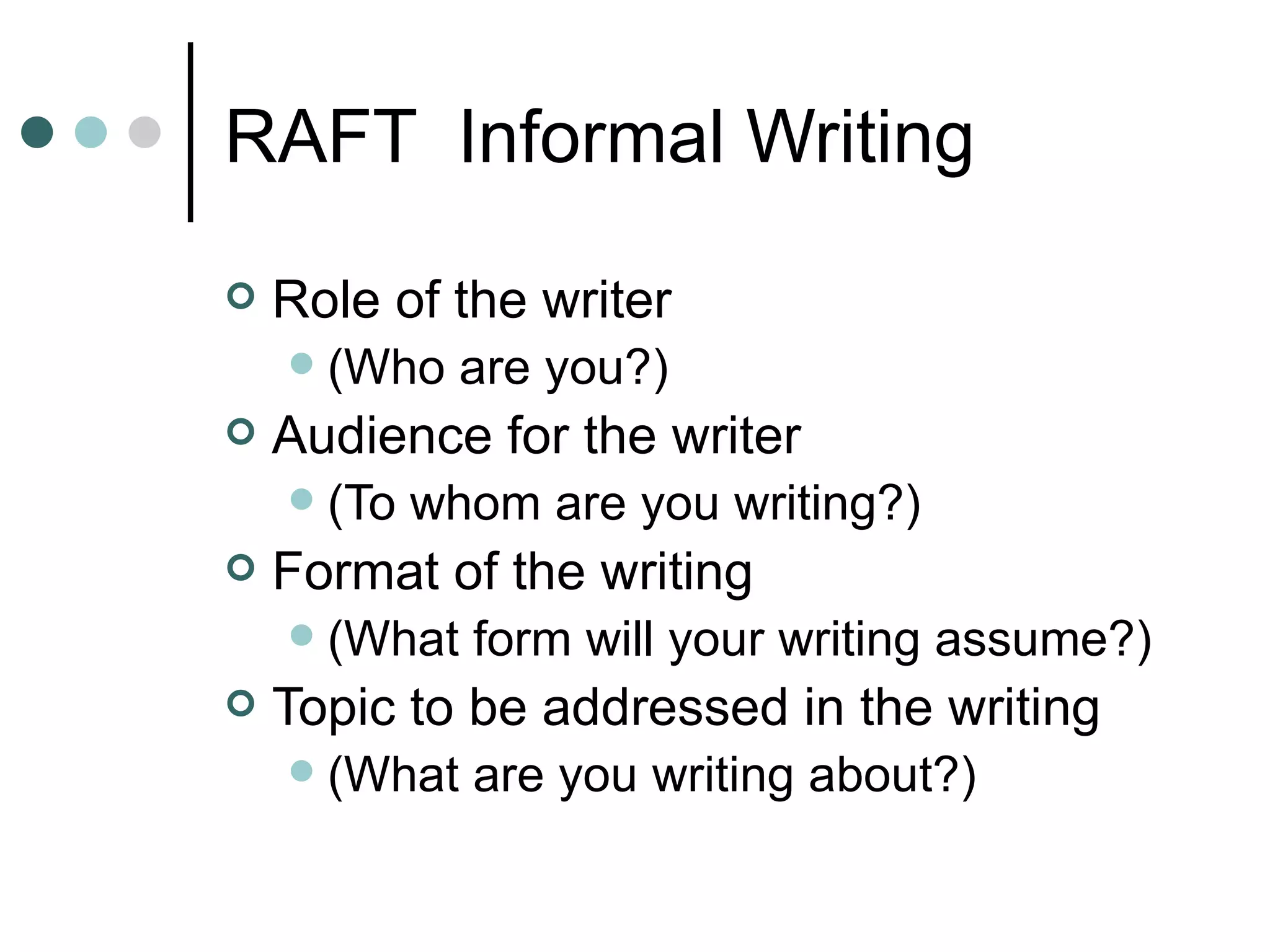
RAFT InformalWriting Role of the writer (Who are you?) Audience for the writer (To whom are you writing?) Format of the writing (What form will your writing assume?) Topic to be addressed in the writing (What are you writing about?)
35.
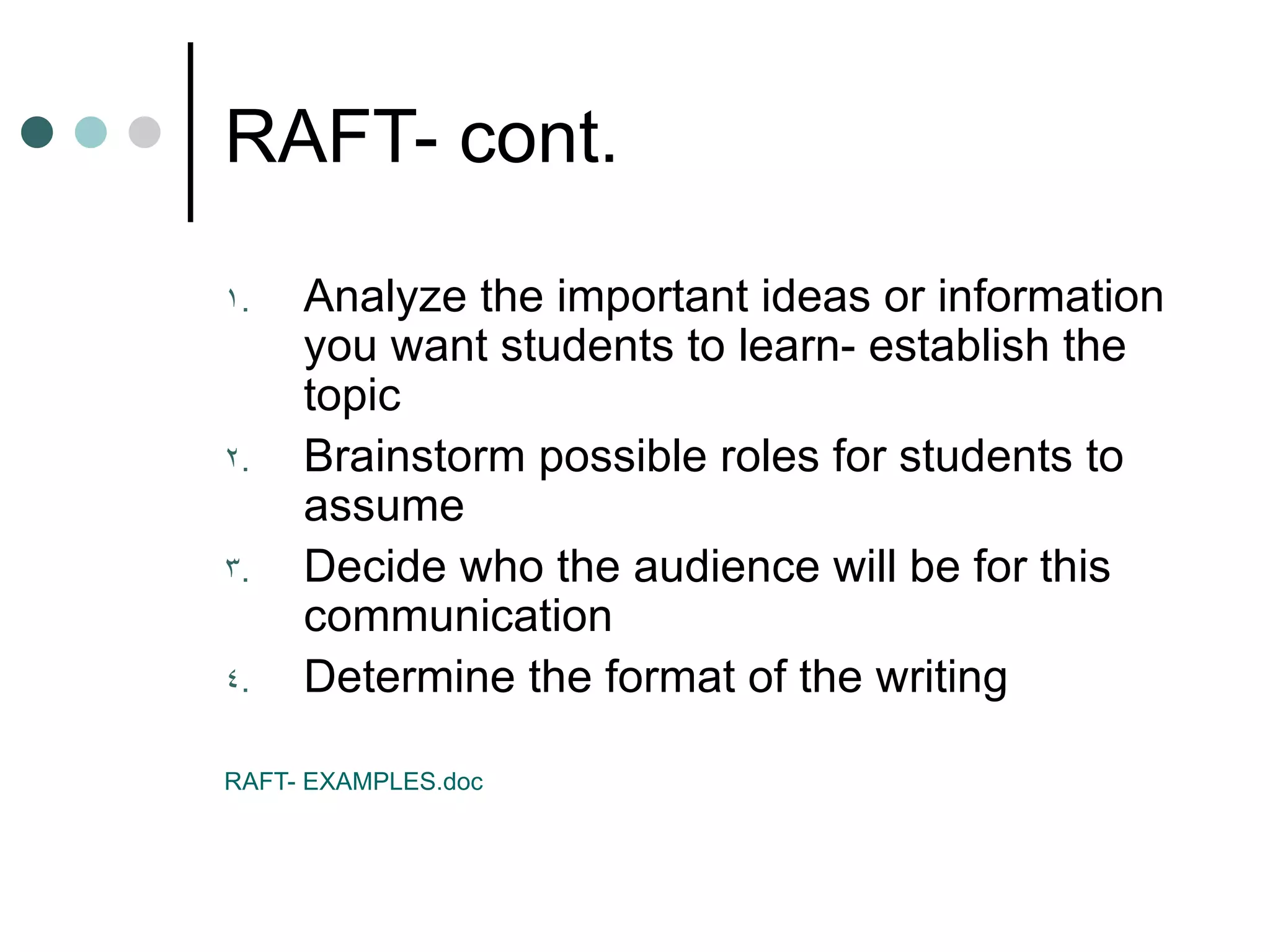
RAFT- cont. Analyzethe important ideas or information you want students to learn- establish the topic Brainstorm possible roles for students to assume Decide who the audience will be for this communication Determine the format of the writing RAFT- EXAMPLES.doc
36.
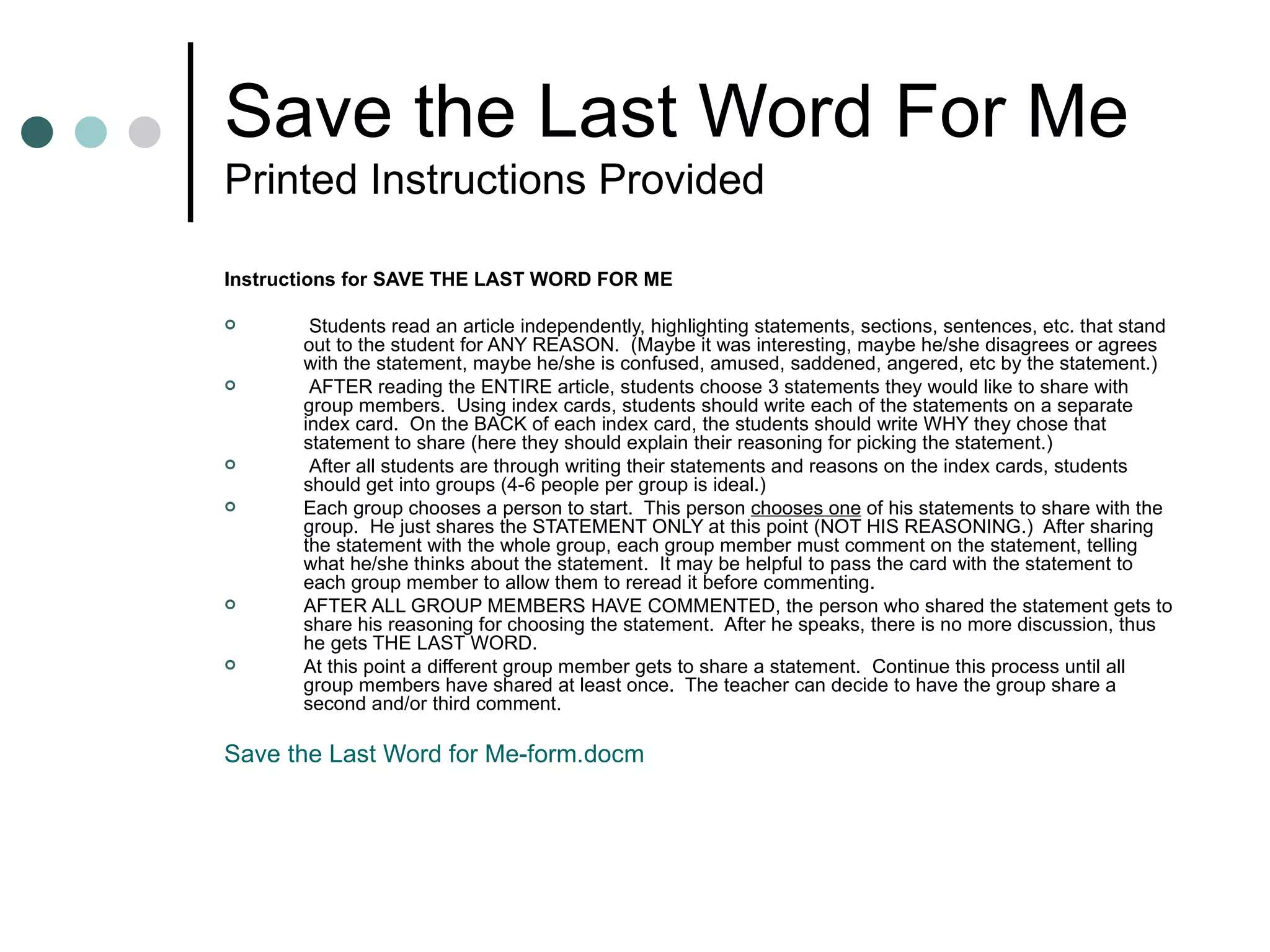
Save the LastWord For Me Printed Instructions Provided Instructions for SAVE THE LAST WORD FOR ME Students read an article independently, highlighting statements, sections, sentences, etc. that stand out to the student for ANY REASON. (Maybe it was interesting, maybe he/she disagrees or agrees with the statement, maybe he/she is confused, amused, saddened, angered, etc by the statement.) AFTER reading the ENTIRE article, students choose 3 statements they would like to share with group members. Using index cards, students should write each of the statements on a separate index card. On the BACK of each index card, the students should write WHY they chose that statement to share (here they should explain their reasoning for picking the statement.) After all students are through writing their statements and reasons on the index cards, students should get into groups (4-6 people per group is ideal.) Each group chooses a person to start. This person chooses one of his statements to share with the group. He just shares the STATEMENT ONLY at this point (NOT HIS REASONING.) After sharing the statement with the whole group, each group member must comment on the statement, telling what he/she thinks about the statement. It may be helpful to pass the card with the statement to each group member to allow them to reread it before commenting. AFTER ALL GROUP MEMBERS HAVE COMMENTED, the person who shared the statement gets to share his reasoning for choosing the statement. After he speaks, there is no more discussion, thus he gets THE LAST WORD. At this point a different group member gets to share a statement. Continue this process until all group members have shared at least once. The teacher can decide to have the group share a second and/or third comment. Save the Last Word for Me- form.docm
37.
Rating Scale Studentsmust identify important facts or topic Students will then “rank” them in order of importance – thinking critically about the topic Students must then explain the rankings Rating Scale.DOC Rating Scale-EXAMPLE.DOC
38.
3-2-1- quickstrategy for the end of any lesson, vary the response 3 - new facts that you have learned over the past two days 2 - strategies that you will definitely use this school year 1 - question that you still have about content area literacy
Editor's Notes
#2 8:00-8:30 collect materials from classrooms. Begin at 8:30 sharp NEED 6 copies of student texts from any subject
#3 Why are we here? Any other concerns to discuss about students literacy needs. share PSSA reading scores--- they are all of our responsibilities, not just English teachers.
#4 Secondary teachers have not “signed up” to teach reading, but reality has hit that literacy skills are the make or break. We are training students for jobs that have not yet been created. Not only is it important to have them learn the content, but to think critically and have the ability to read, write and respond to a variety of text.
#5 Fighting your expertise and knowledge is difficult, I do believe that all students can learn maybe not to the extent of the top, but when given the skills they can be part of the class and the knowledge shared in that class.
#7 Referred to as B D A’s, the cognitive learning process, activating prior knowledge (before reading strategies, graphic organizers for during strategies, note-taking etc. After strategies can include summarization, but many other creative ways for students to show and share what knowledge they gained and questions they still have.
#32 See Handouts and teacher editions of textbooks. Swine flu vs. flu
#37 Printed instructions--- I use forms instead of notecards- either are fine -- article from anticipation guide “Rethinking the Problem: crisis…” handout form for STLWFM
#38 Using the article from the during activity Four Square –why a schoolwide literacy focus is critical?