READ! READ! READ!
A newspaper is better than a magazine. A
seashore is a better place than the street. At first
it is better to run than to walk. You may have to
try several times. It takes some skill but is easy to
learn. Even young children can enjoy it. Once
successful, complications are minimal. Birds
seldom get too close. Rain, however, soaks in
very fast. Too many people doing the same thing
can also cause problems. One needs lots of room.
If there are no complications it can be very
peaceful. A rock will serve as an anchor. If things
break loose from it, however, you will not get a
second chance.
Reading is…
• “…the transaction with a text. The reader
brings meaning to a text in order to create
meaning from it.” (Galda, 1993)
• “…to comprehend the meaning of something
written, or printed by looking at or
interpreting the printed or written characters.”
(Hank, 1983)
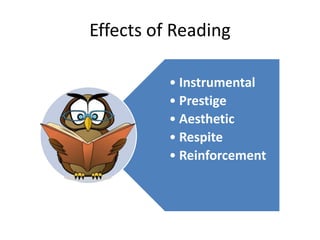
Effects of Reading
• Instrumental
• Prestige
• Aesthetic
• Respite
• Reinforcement
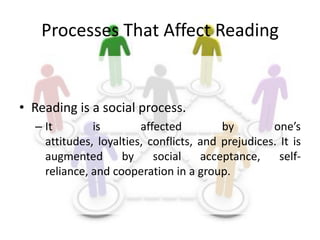
Processes That Affect Reading
• Reading is a social process.
– It is affected by one’s
attitudes, loyalties, conflicts, and prejudices. It is
augmented by social acceptance, self-
reliance, and cooperation in a group.
• Reading is a psychological process.
– How he feels about oneself and about others
affects the reading process. Emotional stability
determines one’s comfort in the reading situation.
• Reading is a physiological process.
– One needs skills in auditory and visual
discrimination, verbal expression, syntactical
maturity, eye-hand coordination, and motor skills
to execute all the mechanical skills associated with
reading.
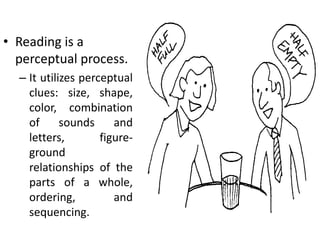
• Reading is a
perceptual process.
– It utilizes perceptual
clues: size, shape,
color, combination
of sounds and
letters, figure-
ground
relationships of the
parts of a whole,
ordering, and
sequencing.
• Reading is a linguistic process.
– It requires sound-symbol
relationships, understanding of
intonation, stress, rhythm, pausing, and tone
sequences.
– It is dependent on contextual meanings and
grasping ideas in whole thought units.
• Reading is an intellectual
process.
– It is dependent on
vocabulary, memory, verb
al reasoning, perceiving
relationships, generalizing
, critical judgment, and
accommodation to
extreme individual
differences.
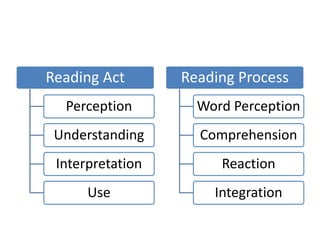
Reading Act
Perception
Understanding
Interpretation
Use
Reading Process
Word Perception
Comprehension
Reaction
Integration
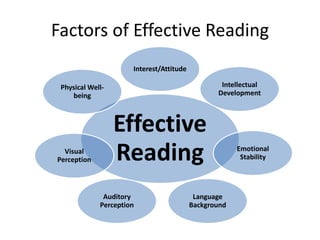
Factors of Effective Reading
Effective
Reading
Interest/Attitude
Intellectual
Development
Emotional
Stability
Language
Background
Auditory
Perception
Visual
Perception
Physical Well-
being
Skimming and Scanning
• Skimming
– Means reading only small parts of a text in order
to get an overview of the organization of the text
and its main idea.
How to Skim
• Make sure that you know what information
you are looking for, ask yourself a question,
and look for a keyword.
• Move your eyes quickly from line to line, and
from sentence to sentence.
• When you think you have found what you are
looking for, stop.
• Read slowly the part of the line or sentence
that tells you what you want to know.
• Think about the question you were trying to
answer.
• Does the information you found answer the
question? If not, quickly read the passage
again to look for the information you need.
• Jot down the answer to the question you’ve
asked.
• Scanning
– Involves looking quickly through a text to find a
specific word or piece of information. Instead of
reading every word on a page, readers move eyes
quickly, searching for what is needed.
Guidelines for Scanning
• Understand the organization of the material
• Stay focused on what you are looking for
• Use whatever clues are available to speed
your search
• Confirm your information
• The procedure is actually quite simple. First you arrange
things into groups. Of course, one pile may be sufficient
depending on how much there is to do. If you have to go
somewhere else due to lack of facilities, that is the next step;
otherwise you are pretty well set. It is important not to
overdo things. That is, it is better to do too few things at once
than too many. In the short run this may not seem
important, but complications can arise. A mistake can prove
expensive as well. At first the whole procedure will seem
complicated. Soon, however, it will become just another facet
of life. It is difficult to foresee any end to the necessity for this
task in the immediate future, but one can never tell. After the
procedure is completed, one arranges the materials into
different groups again. Then they can be put into their
appropriate places. Eventually they will all be used once
more, and the whole cycle will have to be repeated.
However, that is part of life.

All About Reading

  • 1.
    READ! READ! READ! Anewspaper is better than a magazine. A seashore is a better place than the street. At first it is better to run than to walk. You may have to try several times. It takes some skill but is easy to learn. Even young children can enjoy it. Once successful, complications are minimal. Birds seldom get too close. Rain, however, soaks in very fast. Too many people doing the same thing can also cause problems. One needs lots of room. If there are no complications it can be very peaceful. A rock will serve as an anchor. If things break loose from it, however, you will not get a second chance.
  • 3.
    Reading is… • “…thetransaction with a text. The reader brings meaning to a text in order to create meaning from it.” (Galda, 1993) • “…to comprehend the meaning of something written, or printed by looking at or interpreting the printed or written characters.” (Hank, 1983)
  • 4.
    Effects of Reading •Instrumental • Prestige • Aesthetic • Respite • Reinforcement
  • 6.
    Processes That AffectReading • Reading is a social process. – It is affected by one’s attitudes, loyalties, conflicts, and prejudices. It is augmented by social acceptance, self- reliance, and cooperation in a group.
  • 7.
    • Reading isa psychological process. – How he feels about oneself and about others affects the reading process. Emotional stability determines one’s comfort in the reading situation.
  • 8.
    • Reading isa physiological process. – One needs skills in auditory and visual discrimination, verbal expression, syntactical maturity, eye-hand coordination, and motor skills to execute all the mechanical skills associated with reading.
  • 9.
    • Reading isa perceptual process. – It utilizes perceptual clues: size, shape, color, combination of sounds and letters, figure- ground relationships of the parts of a whole, ordering, and sequencing.
  • 10.
    • Reading isa linguistic process. – It requires sound-symbol relationships, understanding of intonation, stress, rhythm, pausing, and tone sequences. – It is dependent on contextual meanings and grasping ideas in whole thought units.
  • 11.
    • Reading isan intellectual process. – It is dependent on vocabulary, memory, verb al reasoning, perceiving relationships, generalizing , critical judgment, and accommodation to extreme individual differences.
  • 12.
  • 13.
    Factors of EffectiveReading Effective Reading Interest/Attitude Intellectual Development Emotional Stability Language Background Auditory Perception Visual Perception Physical Well- being
  • 14.
    Skimming and Scanning •Skimming – Means reading only small parts of a text in order to get an overview of the organization of the text and its main idea.
  • 15.
    How to Skim •Make sure that you know what information you are looking for, ask yourself a question, and look for a keyword. • Move your eyes quickly from line to line, and from sentence to sentence. • When you think you have found what you are looking for, stop. • Read slowly the part of the line or sentence that tells you what you want to know.
  • 16.
    • Think aboutthe question you were trying to answer. • Does the information you found answer the question? If not, quickly read the passage again to look for the information you need. • Jot down the answer to the question you’ve asked.
  • 17.
    • Scanning – Involveslooking quickly through a text to find a specific word or piece of information. Instead of reading every word on a page, readers move eyes quickly, searching for what is needed.
  • 18.
    Guidelines for Scanning •Understand the organization of the material • Stay focused on what you are looking for • Use whatever clues are available to speed your search • Confirm your information
  • 19.
    • The procedureis actually quite simple. First you arrange things into groups. Of course, one pile may be sufficient depending on how much there is to do. If you have to go somewhere else due to lack of facilities, that is the next step; otherwise you are pretty well set. It is important not to overdo things. That is, it is better to do too few things at once than too many. In the short run this may not seem important, but complications can arise. A mistake can prove expensive as well. At first the whole procedure will seem complicated. Soon, however, it will become just another facet of life. It is difficult to foresee any end to the necessity for this task in the immediate future, but one can never tell. After the procedure is completed, one arranges the materials into different groups again. Then they can be put into their appropriate places. Eventually they will all be used once more, and the whole cycle will have to be repeated. However, that is part of life.