DR.N.G.P.INSTITUTE OF TECHNOLOGY (An Autonomous Institution)
Approved by AICTE , New Delhi and affiliated to Anna University , Chennai
Recognised by NAAC with A++Grade and Accrediated by NBA(BME,CSE,ECE,EEE,MECH)
MEMORY
DEVICES
22UIT202-DIGITAL PRINCIPLES AND SYSTEM DESIGN
BY
MEGANATH N
● Memories are made up of registers.
● Each register in the memory is one storage location also called
memory location.
● Each memory location is identified by an address.
● The number of storage locations can vary from a few in some
memories to hundreds of thousand in others.
● Each location can accommodate one or more bits.
● Generally, the total number of bits that a memory can store is its
capacity.
● Most of the types the capacity is specified in terms of bytes (group
of eight bits).
BASIC MEMORY ELEMENTS
 Each register consists of storage elements (flip-flops capacitors in
semiconductor memories and magnetic domain in magnetic storage), each of
which stores one bit of data.
 A storage element is called a cell.
 The data stored in a memory by a process called writing and are retrieved
from the memory by a process called reading.
 A memory unit stores binary information in groups of bits called words.
 A word having group of 8-bits is called a byte.
 Most computer memories use words that are multiples of eight bits in length.
Thus, a 16-bit word contains two bytes, and a 32-bit word is made of 4-bytes
BASIC MEMORY ELEMENTS
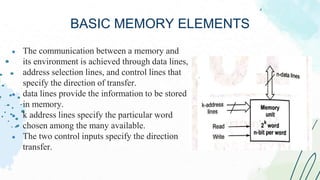
● The communication between a memory and
its environment is achieved through data lines,
address selection lines, and control lines that
specify the direction of transfer.
● data lines provide the information to be stored
in memory.
● k address lines specify the particular word
chosen among the many available.
● The two control inputs specify the direction
transfer.
BASIC MEMORY ELEMENTS
VOLATILE MEMORY
● Volatile memory is a type of memory that maintains its data only
while the device is powered.
● If the power is interrupted for any reason, the data is lost.
● A few common examples include the cache, RAM of the computer,
etc.
NON-VOLATILE MEMORY
● It can hold the data even the power is turned off.
● A few common examples are optical storage discs, hard discs,
secondary storage like ROM, flash memory, etc.
CLASSIFICATION OF SEMICONDUCTOR
MEMORIES
● ROM is used only for performing Read operation.
● ROM is a non-volatile memory i.e., the information stored on the memory will not get
erased even after power is turned off.
● That's why we have permanent programs (e.g.: Operating System programs) in
ROM. Therefore, ROM is called as program memory.
● For ROM data lines are always output lines because it performs only Read operation.
● Chip Select (CS) or Memory Enable (MEN) input is used to select a ROM IC.
● If CS=0, n-data lines will be in a high impedance state.
ROM(READ ONLY MEMORY)
● Programmable read-only memory (PROM) .
● It is a form of digital memory where the contents can be changed
once after manufacture of the device.
● The data is then permanent and cannot be changed.
● It is one type of read-only memory (ROM).
● It is an external programming device.
● The PROM chip comes 'blank' and can be programmed only once by
a user.
● The PROMs are one time programmable. Once programmed, the
information stored is permanent.
PROM
● In EPROM, we cannot erase selective
information, once something gets erased the
entire information is lost.
● The chip can be reprogrammed.
● EPROM is ideally suitable for products and
college laboratories since this chip can be
reused many times. In EPROM, it is possible
to program any location at any time, either
individually, sequentially, or at random.
EPROM
● EPROMs use MOS circuitry.
● 0s and 1s are stored as a packet of charge
inside a buried layer of the IC chip. EPROM
chips can be erased and rewritten a no. of
times.
● Stored data in the EPROM can be erased by
exposing the chip to ultraviolet light through
its quartz window for 15 to 20 minutes
(before erasing the data we have to remove
the IC from its socket.)
EPROM
● EEPROM stands for Electrically Erasable Programmable Read-
Only Memory.
● EEPROM is like EPROM except that the previously programmed
connections can be erased with an electrical signal instead of
ultraviolet light.
● EEPROM is a type of non-volatile primary memory and modified
version of EPROM (Erasable Programmable Read-Only Memory).
● It is used as a chip in computers to store the digital data.
● The advantage of EEPROM over EPROM is that the device can be
erased without removing it from the socket.
● EEPROMs are most expensive and the least dense ROMs.
● Its information can be erased by using high voltage current.
EEPROM
● EAPROM is an acronym for Electrically Alterable
Programmable Read-Only Memory.
● It is a non-volatile read only memory.
● It is a form of PROM in which the contents of
selected memory locations can be changed by
applying suitable electrical signals without removing
the EAPROM from the printed circuit board.
EAPROM
Advantages of EAPROM
● We can selectively program or can selectively erase EAPROM.
● Erasing time is 5 to 10 ms and programming time 250 µs to 1 ms for
a particular location. This time is and programming time is quite low.
Disadvantages of EAPROM .
● It is expensive.
● It is not available from a variety of source.
● It is not popular as this technology is still not matured.
EAPROM
● RAM is called "Random Access Memory" because through it any storage location can
be accessed directly. RAM belongs to the class of volatile memory which means if the
power supplied to the system goes OFF, then data stored inside the RAM will get lost,
that is why RAM is generally used to store only temporary data. Hence, RAM is also
known as data memory.
• Memory Write operation can be defined as the process of storing new information into
memory.
• Memory Read operation can be defined as the process of transferring the stored
information out of memory.
• A RAM is capable of performing both Read and Write operations that is why it is also
called Read/Write
● Integrated RAM chips are available in two form:
1. SRAM(Static RAM)
2. DRAM(Dynamic RAM)
RAM(RANDOM ACCESS MEMORY)
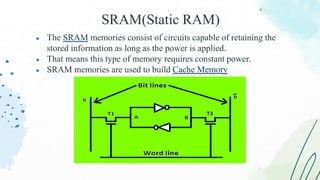
● The SRAM memories consist of circuits capable of retaining the
stored information as long as the power is applied.
● That means this type of memory requires constant power.
● SRAM memories are used to build Cache Memory.
SRAM(Static RAM)
● For Read operation, the word line is activated by the address input
to the address decoder. The activated word line closes both the
transistors (switches) T1 and T2. Then the bit values at points A and
B can transmit to their respective bit lines. The sense/write circuit at
the end of the bit lines sends the output to the processor.
For Write operation, the address provided to the decoder activates
the word line to close both the switches. Then the bit value that is to
be written into the cell is provided through the sense/write circuit and
the signals in bit lines are then stored in the cell.
SRAM(Static RAM)
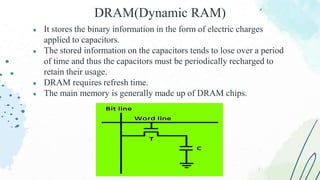
● It stores the binary information in the form of electric charges
applied to capacitors.
● The stored information on the capacitors tends to lose over a period
of time and thus the capacitors must be periodically recharged to
retain their usage.
● DRAM requires refresh time.
● The main memory is generally made up of DRAM chips.
DRAM(Dynamic RAM)
THANK YOU

DPSD MEMORY DEVICES UNIT memory device 4.pptx

  • 1.
    DR.N.G.P.INSTITUTE OF TECHNOLOGY(An Autonomous Institution) Approved by AICTE , New Delhi and affiliated to Anna University , Chennai Recognised by NAAC with A++Grade and Accrediated by NBA(BME,CSE,ECE,EEE,MECH) MEMORY DEVICES 22UIT202-DIGITAL PRINCIPLES AND SYSTEM DESIGN BY MEGANATH N
  • 2.
    ● Memories aremade up of registers. ● Each register in the memory is one storage location also called memory location. ● Each memory location is identified by an address. ● The number of storage locations can vary from a few in some memories to hundreds of thousand in others. ● Each location can accommodate one or more bits. ● Generally, the total number of bits that a memory can store is its capacity. ● Most of the types the capacity is specified in terms of bytes (group of eight bits). BASIC MEMORY ELEMENTS
  • 3.
     Each registerconsists of storage elements (flip-flops capacitors in semiconductor memories and magnetic domain in magnetic storage), each of which stores one bit of data.  A storage element is called a cell.  The data stored in a memory by a process called writing and are retrieved from the memory by a process called reading.  A memory unit stores binary information in groups of bits called words.  A word having group of 8-bits is called a byte.  Most computer memories use words that are multiples of eight bits in length. Thus, a 16-bit word contains two bytes, and a 32-bit word is made of 4-bytes BASIC MEMORY ELEMENTS
  • 4.
    ● The communicationbetween a memory and its environment is achieved through data lines, address selection lines, and control lines that specify the direction of transfer. ● data lines provide the information to be stored in memory. ● k address lines specify the particular word chosen among the many available. ● The two control inputs specify the direction transfer. BASIC MEMORY ELEMENTS
  • 5.
    VOLATILE MEMORY ● Volatilememory is a type of memory that maintains its data only while the device is powered. ● If the power is interrupted for any reason, the data is lost. ● A few common examples include the cache, RAM of the computer, etc. NON-VOLATILE MEMORY ● It can hold the data even the power is turned off. ● A few common examples are optical storage discs, hard discs, secondary storage like ROM, flash memory, etc. CLASSIFICATION OF SEMICONDUCTOR MEMORIES
  • 6.
    ● ROM isused only for performing Read operation. ● ROM is a non-volatile memory i.e., the information stored on the memory will not get erased even after power is turned off. ● That's why we have permanent programs (e.g.: Operating System programs) in ROM. Therefore, ROM is called as program memory. ● For ROM data lines are always output lines because it performs only Read operation. ● Chip Select (CS) or Memory Enable (MEN) input is used to select a ROM IC. ● If CS=0, n-data lines will be in a high impedance state. ROM(READ ONLY MEMORY)
  • 7.
    ● Programmable read-onlymemory (PROM) . ● It is a form of digital memory where the contents can be changed once after manufacture of the device. ● The data is then permanent and cannot be changed. ● It is one type of read-only memory (ROM). ● It is an external programming device. ● The PROM chip comes 'blank' and can be programmed only once by a user. ● The PROMs are one time programmable. Once programmed, the information stored is permanent. PROM
  • 8.
    ● In EPROM,we cannot erase selective information, once something gets erased the entire information is lost. ● The chip can be reprogrammed. ● EPROM is ideally suitable for products and college laboratories since this chip can be reused many times. In EPROM, it is possible to program any location at any time, either individually, sequentially, or at random. EPROM
  • 9.
    ● EPROMs useMOS circuitry. ● 0s and 1s are stored as a packet of charge inside a buried layer of the IC chip. EPROM chips can be erased and rewritten a no. of times. ● Stored data in the EPROM can be erased by exposing the chip to ultraviolet light through its quartz window for 15 to 20 minutes (before erasing the data we have to remove the IC from its socket.) EPROM
  • 10.
    ● EEPROM standsfor Electrically Erasable Programmable Read- Only Memory. ● EEPROM is like EPROM except that the previously programmed connections can be erased with an electrical signal instead of ultraviolet light. ● EEPROM is a type of non-volatile primary memory and modified version of EPROM (Erasable Programmable Read-Only Memory). ● It is used as a chip in computers to store the digital data. ● The advantage of EEPROM over EPROM is that the device can be erased without removing it from the socket. ● EEPROMs are most expensive and the least dense ROMs. ● Its information can be erased by using high voltage current. EEPROM
  • 11.
    ● EAPROM isan acronym for Electrically Alterable Programmable Read-Only Memory. ● It is a non-volatile read only memory. ● It is a form of PROM in which the contents of selected memory locations can be changed by applying suitable electrical signals without removing the EAPROM from the printed circuit board. EAPROM
  • 12.
    Advantages of EAPROM ●We can selectively program or can selectively erase EAPROM. ● Erasing time is 5 to 10 ms and programming time 250 µs to 1 ms for a particular location. This time is and programming time is quite low. Disadvantages of EAPROM . ● It is expensive. ● It is not available from a variety of source. ● It is not popular as this technology is still not matured. EAPROM
  • 13.
    ● RAM iscalled "Random Access Memory" because through it any storage location can be accessed directly. RAM belongs to the class of volatile memory which means if the power supplied to the system goes OFF, then data stored inside the RAM will get lost, that is why RAM is generally used to store only temporary data. Hence, RAM is also known as data memory. • Memory Write operation can be defined as the process of storing new information into memory. • Memory Read operation can be defined as the process of transferring the stored information out of memory. • A RAM is capable of performing both Read and Write operations that is why it is also called Read/Write ● Integrated RAM chips are available in two form: 1. SRAM(Static RAM) 2. DRAM(Dynamic RAM) RAM(RANDOM ACCESS MEMORY)
  • 14.
    ● The SRAMmemories consist of circuits capable of retaining the stored information as long as the power is applied. ● That means this type of memory requires constant power. ● SRAM memories are used to build Cache Memory. SRAM(Static RAM)
  • 15.
    ● For Readoperation, the word line is activated by the address input to the address decoder. The activated word line closes both the transistors (switches) T1 and T2. Then the bit values at points A and B can transmit to their respective bit lines. The sense/write circuit at the end of the bit lines sends the output to the processor. For Write operation, the address provided to the decoder activates the word line to close both the switches. Then the bit value that is to be written into the cell is provided through the sense/write circuit and the signals in bit lines are then stored in the cell. SRAM(Static RAM)
  • 16.
    ● It storesthe binary information in the form of electric charges applied to capacitors. ● The stored information on the capacitors tends to lose over a period of time and thus the capacitors must be periodically recharged to retain their usage. ● DRAM requires refresh time. ● The main memory is generally made up of DRAM chips. DRAM(Dynamic RAM)
  • 18.