26/04/2017 1
Presentation
TOPIC:
Conventional Transition State Theory
Asked by Sir AR Memon
Given by Rahat Inayat Ali (14CH23)
226/04/2017
Introduction
• In 1930 while studying on Quantam Mechanics the
two scientists namely EYRING and POLANYI gave this
theory.
• Transition state theory (TST) explains the reaction
rates of elementary chemical reactions.
• The theory assumes a special type of chemical
equilibrium (quasi-equilibrium)
between reactants and activated transition
state complexes.
326/04/2017
•TST is used primarily to understand qualitatively how
chemical reactions take place.
• it has been successful in calculating the
standard enthalpy of activation (Δ‡Hɵ), the
standard entropy of activation (Δ‡Sɵ), and the
standard Gibbs energy of activation (Δ‡Gɵ) for a
particular reaction if its rate constant has been
experimentally determined.
• TST is also referred to as "activated-complex theory,"
"absolute-rate theory," and "theory of absolute reaction
rates.
426/04/2017
Continue..
• Before the development of TST, the Arrhenius rate law
was widely used to determine energies for the
reaction barrier.
• An intermediate stage lies between thereactants and
the products is
transition state.
• The transitional species with partial bonds is
activated complex.
526/04/2017
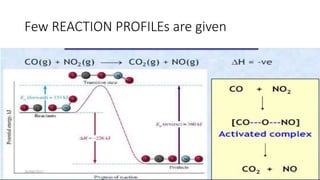
Few REACTION PROFILEs are given
626/04/2017
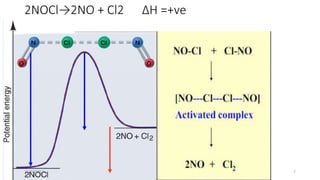
2NOCl→2NO + Cl2 ∆H =+ve
726/04/2017
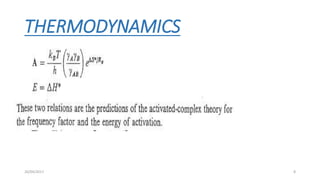
THERMODYNAMICS
826/04/2017
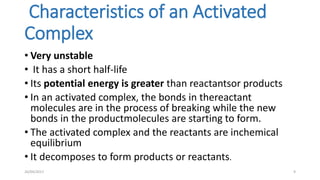
Characteristics of an Activated
Complex
• Very unstable
• It has a short half-life
• Its potential energy is greater than reactantsor products
• In an activated complex, the bonds in thereactant
molecules are in the process of breaking while the new
bonds in the productmolecules are starting to form.
• The activated complex and the reactants are inchemical
equilibrium
• It decomposes to form products or reactants.
926/04/2017
Is a transition state stable?
•All chemical reactions must go through the transition
state to form a product from a substrate molecule. It has
more free energy in comparison to the substrate or
product; thus, it is the least stable state.
•What is the transition state of an enzyme?
•The enzyme's ability to make the reaction faster depends
on the fact that it stabilizes the transition state.
The transition state's energy or, in terms of a reaction,
the activation energy is the minimum energy that is
needed to break certain bonds of the reactants so as to
turn them into products.
1026/04/2017
TST postulates three major factors that
determine whether or not a reaction will occur.
These factors are:
• The concentration of the activated complex.
• The rate at which the activated complex breaks apart.
• The mechanism by which the activated complex
breaks apart; it can either be converted into products,
or it can "revert" back to reactants.
1126/04/2017
Difference Between Collision
Theory and CTST
•Collision theory is only for reaction involving gaseous
reactants .....while transition state theory can be
applied to reactions taking place in solution as well as
in the gas phase.
• In the collision theory reaction occurs when two
molecules collide, but only if the collision is
sufficiently vigorous
•transition state theory is used to explain in detail what
happens when reactant molecules come together in a
collision . 1226/04/2017
APPLICATION
• Application of TST is important in terms of deriving an
extended form of rate equation,
which can be used to understand even mpst
complicated or complex reactions in qualitative way
1326/04/2017

Conventional transition state theory

  • 1.
  • 2.
    Presentation TOPIC: Conventional Transition StateTheory Asked by Sir AR Memon Given by Rahat Inayat Ali (14CH23) 226/04/2017
  • 3.
    Introduction • In 1930while studying on Quantam Mechanics the two scientists namely EYRING and POLANYI gave this theory. • Transition state theory (TST) explains the reaction rates of elementary chemical reactions. • The theory assumes a special type of chemical equilibrium (quasi-equilibrium) between reactants and activated transition state complexes. 326/04/2017
  • 4.
    •TST is usedprimarily to understand qualitatively how chemical reactions take place. • it has been successful in calculating the standard enthalpy of activation (Δ‡Hɵ), the standard entropy of activation (Δ‡Sɵ), and the standard Gibbs energy of activation (Δ‡Gɵ) for a particular reaction if its rate constant has been experimentally determined. • TST is also referred to as "activated-complex theory," "absolute-rate theory," and "theory of absolute reaction rates. 426/04/2017
  • 5.
    Continue.. • Before thedevelopment of TST, the Arrhenius rate law was widely used to determine energies for the reaction barrier. • An intermediate stage lies between thereactants and the products is transition state. • The transitional species with partial bonds is activated complex. 526/04/2017
  • 6.
    Few REACTION PROFILEsare given 626/04/2017
  • 7.
    2NOCl→2NO + Cl2∆H =+ve 726/04/2017
  • 8.
  • 9.
    Characteristics of anActivated Complex • Very unstable • It has a short half-life • Its potential energy is greater than reactantsor products • In an activated complex, the bonds in thereactant molecules are in the process of breaking while the new bonds in the productmolecules are starting to form. • The activated complex and the reactants are inchemical equilibrium • It decomposes to form products or reactants. 926/04/2017
  • 10.
    Is a transitionstate stable? •All chemical reactions must go through the transition state to form a product from a substrate molecule. It has more free energy in comparison to the substrate or product; thus, it is the least stable state. •What is the transition state of an enzyme? •The enzyme's ability to make the reaction faster depends on the fact that it stabilizes the transition state. The transition state's energy or, in terms of a reaction, the activation energy is the minimum energy that is needed to break certain bonds of the reactants so as to turn them into products. 1026/04/2017
  • 11.
    TST postulates threemajor factors that determine whether or not a reaction will occur. These factors are: • The concentration of the activated complex. • The rate at which the activated complex breaks apart. • The mechanism by which the activated complex breaks apart; it can either be converted into products, or it can "revert" back to reactants. 1126/04/2017
  • 12.
    Difference Between Collision Theoryand CTST •Collision theory is only for reaction involving gaseous reactants .....while transition state theory can be applied to reactions taking place in solution as well as in the gas phase. • In the collision theory reaction occurs when two molecules collide, but only if the collision is sufficiently vigorous •transition state theory is used to explain in detail what happens when reactant molecules come together in a collision . 1226/04/2017
  • 13.
    APPLICATION • Application ofTST is important in terms of deriving an extended form of rate equation, which can be used to understand even mpst complicated or complex reactions in qualitative way 1326/04/2017