Energy Changes and
Chemical Reactions
Chapter 9.3
p 317-323
Energy Changes
• To propel a space shuttle, scientists use
rocket fuel.
• The shuttle’s main engines burn almost 2
million L of liquid hydrogen and liquid oxygen.
• The reaction produces water vapor and a lot
of energy.
• The heat energy causes the water vapor to
heat to high temperatures.
• The rapidly expanding water vapor pushes
the shuttle.
Chemical Energy in Bonds
• Chemical bond contain a form of energy
called chemical energy
– Breaking a bond absorbs energy from the
surroundings.
– The formation of a bond releases energy to the
surroundings.
– Some chemical reactions release more energy
then they absorb.
– Others absorb more than they release
– You can detect these energy changes by
recording the temperature of the surroundings.
Endothermic Reactions –
Energy Absorbed
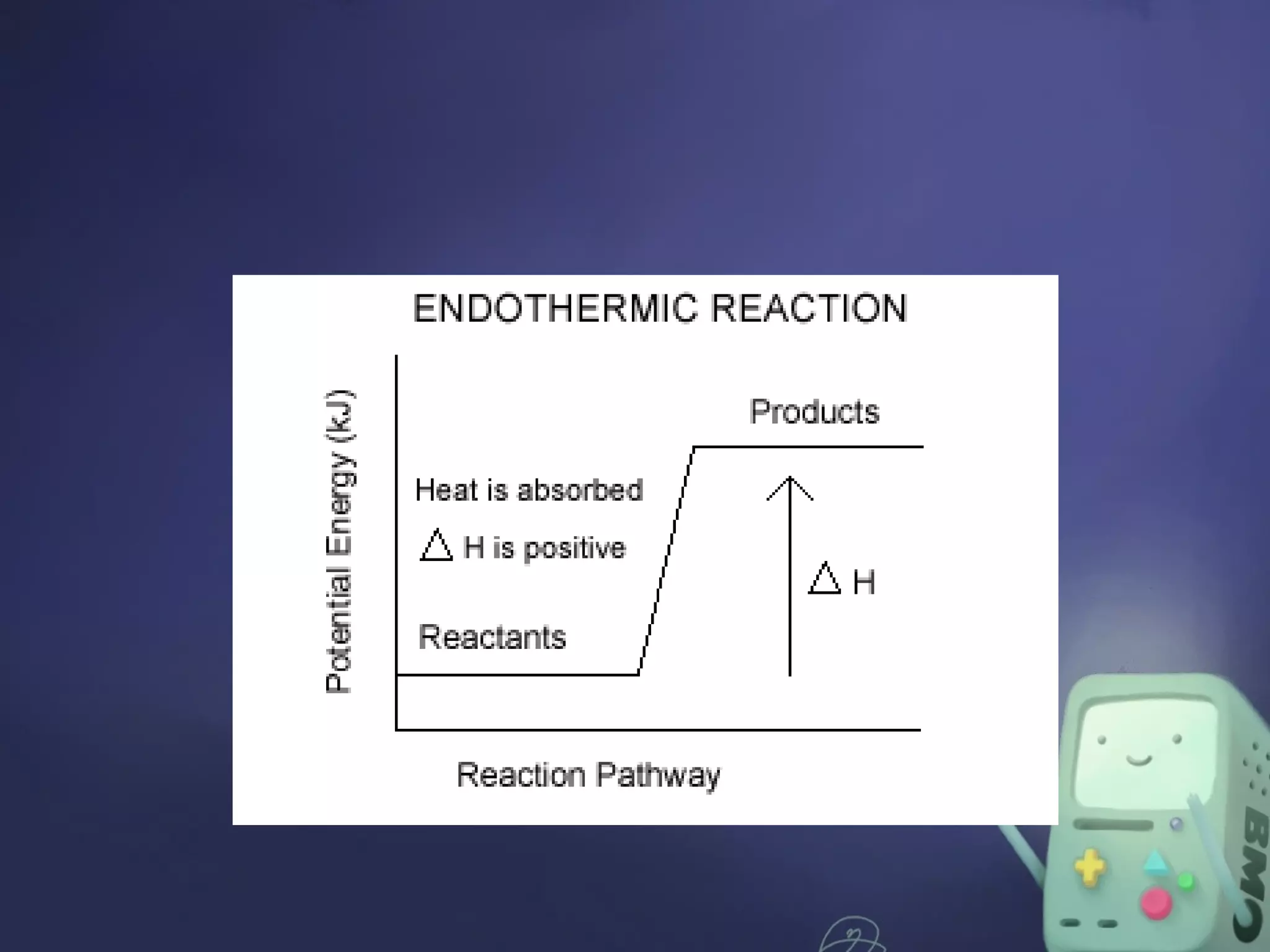
• Chemical reactions that absorb thermal
energy are endothermic reactions
• For an endothermic reaction to continue,
energy must be constantly added.
• In these reactions more energy is required
to break bonds of the reactant than is
released when the products form.
• Therefore, the overall reaction absorbs
energy.
Exothermic Reactions – Energy
Released
• An exothermic reaction is a chemical
reaction that releases thermal energy
• In an exothermic reaction, more energy is
released when the products form than is
required to break the bonds in the
reactants.
• Therefore, the overall reaction releases
energy
Activation Energy
Activation Energy
• Many reactions do not start by themselves.
– Paper does not burn when it touches oxygen. Fire
is required.

• All reactions require energy to start the
breaking of bonds.
• This is called activation energy.
• Activation energy is the minimum amount of
energy needed to start a chemical reaction.
– Different reactions require different activation
energies
Activation Energy
• The rusting of iron is a reaction that has a low
activation energy.
– The energy in the surroundings is enough to start
the process.

• Other reactions require more energy and
have high activation energy
– The burning of wood requires the energy of a
flame.
– Once the reaction starts, the reaction itself
releases enough energy to keep the reaction
going.
Reaction Rates
• Some reactions happen quickly, while others
happen very slowly
– Fireworks explode in seconds
– The rate of reaction is the speed at which it
occurs.

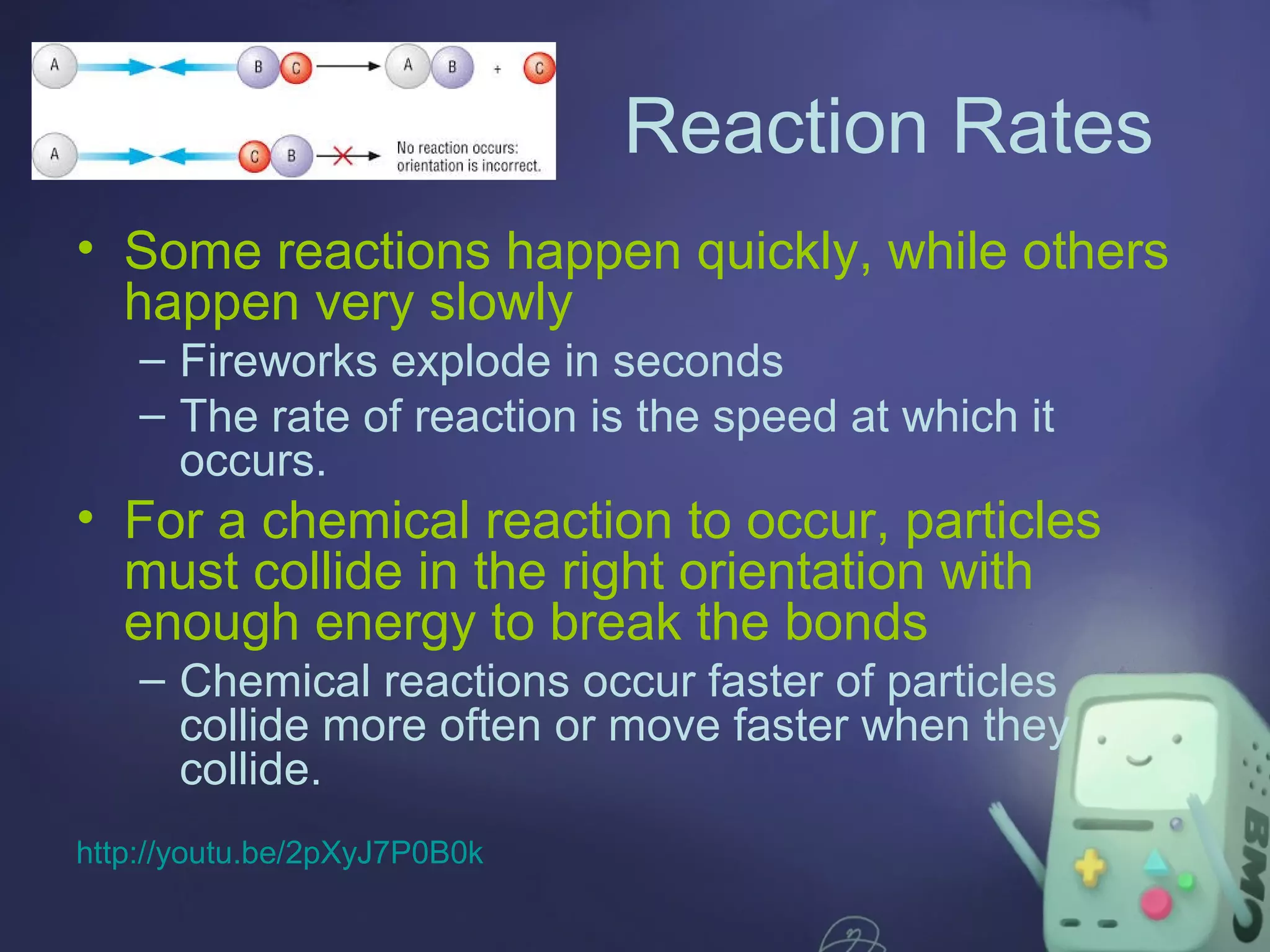
• For a chemical reaction to occur, particles
must collide in the right orientation with
enough energy to break the bonds
– Chemical reactions occur faster of particles
collide more often or move faster when they
collide.
http://youtu.be/2pXyJ7P0B0k
Several Factors Affect Reaction
Rates
•
•
•
•
•

Surface Area
Temperature
Concentration and Pressure
Catalysts
Inhibitors
Surface Area
• Surface area is the amount of exposed,
outer area of a solid.
• Increased surface area increases reaction
rate because more particles on the
surface if a solid come into contact with
the particles of another substance.
– Consider a piece of chalk versus the same
amount of chalk powder.
http://youtu.be/FJtwkum_QAY?t=1m3s
Temperature
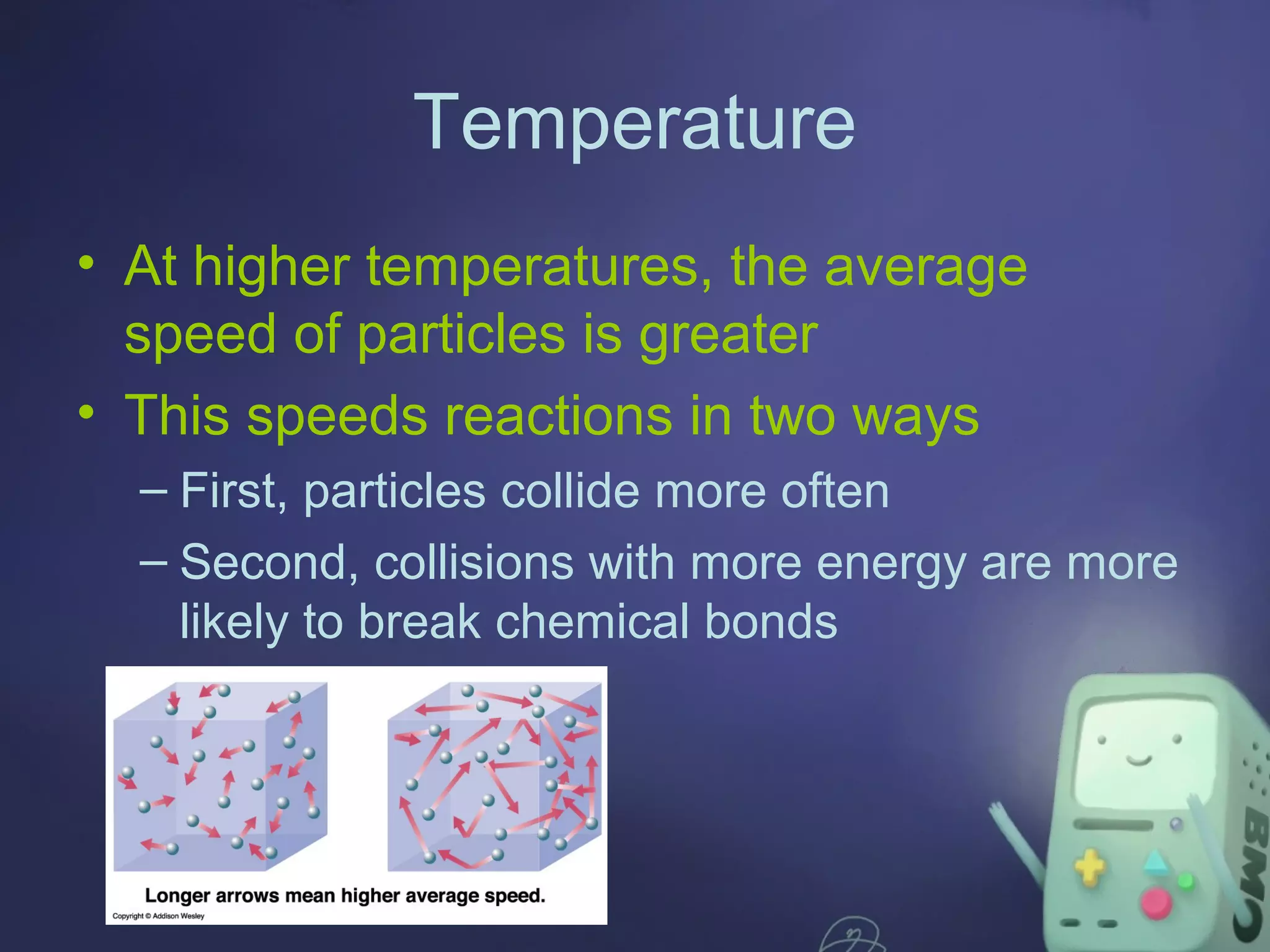
• At higher temperatures, the average
speed of particles is greater
• This speeds reactions in two ways
– First, particles collide more often
– Second, collisions with more energy are more
likely to break chemical bonds
Concentration and Pressure
• Increasing the concentration of one or
more reactants increases collisions
between particles.
• More collisions results in a faster reaction
rate.
• In gases an increase in pressure pushes
gas particles closer together
• When they are close, more collisions
occur
Catalysts
• A catalyst is a substance that increases
reaction rate by lowering the activation
energy of a reaction.
– One way catalysts speed reactions is by helping
reactant particles contact each other more often
– A catalyst isn’t changed in a reaction, and it
doesn’t change the reactants or products
– A catalyst doesn’t increase the amount of
reactant used or the amount of product that is
made.
Catalyst
• Catalyst are not changed, so they are not
considered reactants
• Your body is filled with catalysts called
enzymes.
• An enzyme is a catalyst that speeds up
chemical reactions in living cells.
– The enzyme protease breaks the protein
molecules that can be absorbed by your intestine.
– Without protease the reaction would occur too
slowly and we could not survive.
Inhibitors
• An inhibitor is a substance that slows, or
even stops, a chemical reaction caused by
an enzyme.
• Inhibitor are often used on our foods.
Preservatives are inhibitors that slow the
processes that cause food to spoil.
http://www.youtube.com/watch?v=OttRV5ykP7A

Ch 9.3: Energy Changes and Chemical Reactions

  • 1.
    Energy Changes and ChemicalReactions Chapter 9.3 p 317-323
  • 2.
    Energy Changes • Topropel a space shuttle, scientists use rocket fuel. • The shuttle’s main engines burn almost 2 million L of liquid hydrogen and liquid oxygen. • The reaction produces water vapor and a lot of energy. • The heat energy causes the water vapor to heat to high temperatures. • The rapidly expanding water vapor pushes the shuttle.
  • 3.
    Chemical Energy inBonds • Chemical bond contain a form of energy called chemical energy – Breaking a bond absorbs energy from the surroundings. – The formation of a bond releases energy to the surroundings. – Some chemical reactions release more energy then they absorb. – Others absorb more than they release – You can detect these energy changes by recording the temperature of the surroundings.
  • 4.
    Endothermic Reactions – EnergyAbsorbed • Chemical reactions that absorb thermal energy are endothermic reactions • For an endothermic reaction to continue, energy must be constantly added. • In these reactions more energy is required to break bonds of the reactant than is released when the products form. • Therefore, the overall reaction absorbs energy.
  • 6.
    Exothermic Reactions –Energy Released • An exothermic reaction is a chemical reaction that releases thermal energy • In an exothermic reaction, more energy is released when the products form than is required to break the bonds in the reactants. • Therefore, the overall reaction releases energy
  • 9.
  • 10.
    Activation Energy • Manyreactions do not start by themselves. – Paper does not burn when it touches oxygen. Fire is required. • All reactions require energy to start the breaking of bonds. • This is called activation energy. • Activation energy is the minimum amount of energy needed to start a chemical reaction. – Different reactions require different activation energies
  • 11.
    Activation Energy • Therusting of iron is a reaction that has a low activation energy. – The energy in the surroundings is enough to start the process. • Other reactions require more energy and have high activation energy – The burning of wood requires the energy of a flame. – Once the reaction starts, the reaction itself releases enough energy to keep the reaction going.
  • 13.
    Reaction Rates • Somereactions happen quickly, while others happen very slowly – Fireworks explode in seconds – The rate of reaction is the speed at which it occurs. • For a chemical reaction to occur, particles must collide in the right orientation with enough energy to break the bonds – Chemical reactions occur faster of particles collide more often or move faster when they collide. http://youtu.be/2pXyJ7P0B0k
  • 14.
    Several Factors AffectReaction Rates • • • • • Surface Area Temperature Concentration and Pressure Catalysts Inhibitors
  • 15.
    Surface Area • Surfacearea is the amount of exposed, outer area of a solid. • Increased surface area increases reaction rate because more particles on the surface if a solid come into contact with the particles of another substance. – Consider a piece of chalk versus the same amount of chalk powder. http://youtu.be/FJtwkum_QAY?t=1m3s
  • 17.
    Temperature • At highertemperatures, the average speed of particles is greater • This speeds reactions in two ways – First, particles collide more often – Second, collisions with more energy are more likely to break chemical bonds
  • 18.
    Concentration and Pressure •Increasing the concentration of one or more reactants increases collisions between particles. • More collisions results in a faster reaction rate. • In gases an increase in pressure pushes gas particles closer together • When they are close, more collisions occur
  • 20.
    Catalysts • A catalystis a substance that increases reaction rate by lowering the activation energy of a reaction. – One way catalysts speed reactions is by helping reactant particles contact each other more often – A catalyst isn’t changed in a reaction, and it doesn’t change the reactants or products – A catalyst doesn’t increase the amount of reactant used or the amount of product that is made.
  • 22.
    Catalyst • Catalyst arenot changed, so they are not considered reactants • Your body is filled with catalysts called enzymes. • An enzyme is a catalyst that speeds up chemical reactions in living cells. – The enzyme protease breaks the protein molecules that can be absorbed by your intestine. – Without protease the reaction would occur too slowly and we could not survive.
  • 23.
    Inhibitors • An inhibitoris a substance that slows, or even stops, a chemical reaction caused by an enzyme. • Inhibitor are often used on our foods. Preservatives are inhibitors that slow the processes that cause food to spoil.
  • 24.