RATE OF REACTION
CHAPTER 1
In this chapter, you will learn to:


               Analyse the rate of reaction.
       Synthesise factors affecting the rate of reaction.
     Synthesise ideas on the collision theory
Learn about practising scientific knowledge to enhance quality
                             of life.
1.3 SYNTHESISE IDEAS ON
 THE COLLISION THEORY
LEARNING OUTCOMES
Relate reaction with energy produced by movement and
 effective collision of particles,
Describe activation energy
Sketch and describe energy profile diagram,
Relate the frequency of effective collision with the rate of
 reaction,
Relate the frequency of effective collision with factors
 influencing the rate of reaction,
Describe how a certain factor affects the collision of particles
 in a reaction.
(1) INTRODUCTION
The five factors which affect the rate of reaction are:
       The size of reactants (or surface area)
       Concentration of reactants
       Temperature
       Catalyst
       Pressure
All these factors can be explained by using the collision theory.
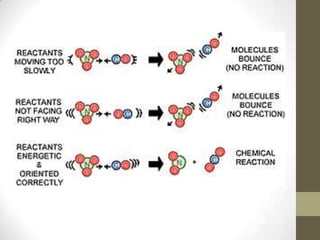
According to the collision theory, a reaction only occurs when:
      a) The particles of reactants collide with one another during the
         reaction.
      b) The reacting particles possess a minimum energy termed activation
         energy.
      c) The reacting particles collide in the correct orientation.
Continue…
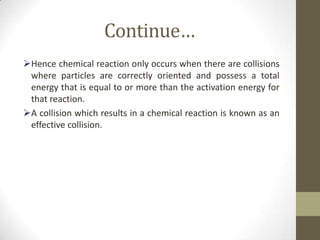
Hence chemical reaction only occurs when there are collisions
 where particles are correctly oriented and possess a total
 energy that is equal to or more than the activation energy for
 that reaction.
A collision which results in a chemical reaction is known as an
 effective collision.
(2) ACTIVATION ENERGY (Ea)
This is the minimum energy that is required by colliding
 reactants for a chemical reaction to take place.
The activation energy can be considered as an energy barrier
 or resistance that has to be overcome in order to produce a
 reaction.
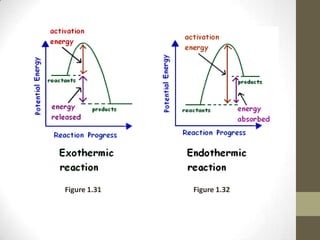
Figure 1.31 shows the energy profile diagram of a reaction
 where: A + B  C + D. The reaction produces heat energy and
 therefore called an exothermic reaction. In the energy profile
 diagram, the x-axis represents the progress of the reaction
 while the y-axis indicates the energy level of the reactants and
 products of the reaction.
Figure 1.32 is the energy profile diagram for an endothermic
 reaction where heat energy is absorbed during a chemical
 reaction.
Figure 1.31   Figure 1.32
(3) RATE OF REACTIONS AND
  THE COLLISION THEORY
According to the collision theory, two important factors
 determine the rate of a reaction:
      The frequency of collisions
      The magnitude of the activation energy
If the number or frequency of collisions in a reaction is high,
 then the frequency of effective collisions also increase. This
 leads to an increase in the rate of reaction.
Magnitude of activation energy refers to how high or low the
 activation energy is. A chemical reaction with a high activation
 energy will progress at a low rate because only small number
 of particles will contain enough energy to react. On the other
 hand, a reaction with a low activation energy will occur at a
 faster rate because a larger number of particles contain
 enough energy to overcome the activation energy level of that
 reaction. Thus, more particles are able to react affectively.
(A) Surface Area and Collision
           Theory
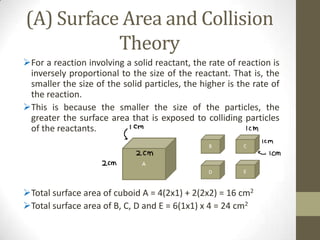
For a reaction involving a solid reactant, the rate of reaction is
 inversely proportional to the size of the reactant. That is, the
 smaller the size of the solid particles, the higher is the rate of
 the reaction.
This is because the smaller the size of the particles, the
 greater the surface area that is exposed to colliding particles
 of the reactants.


Total surface area of cuboid A = 4(2x1) + 2(2x2) = 16 cm2
Total surface area of B, C, D and E = 6(1x1) x 4 = 24 cm2
(B) Concentration and Rate of
         Reaction
In the reaction between zinc and dilute hydrochloric acid, the
 rate of reaction increases if the concentration of the acid is
 increased.
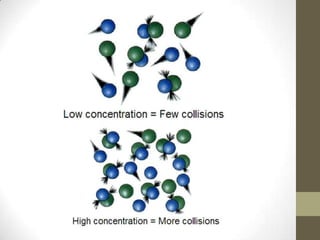
This is because when the concentration of the solution
 increases, the number of particles per unit volume also
 increases.
As a result, the frequency of collisions increase, leading to a
 high frequency of effective collisions.
Thus, the rate of reaction increases.
(C) Temperature and Rate of
          Reaction
 When the temperature of the reactant or reactants is increased, the
  rate of reaction increases too. This is because the kinetic energy of
  particles increase with an increase in temperature.
 In the reaction between marble chips and hydrochloric acid, the acid
  particles absorb the excess energy that is produced when the
  temperature of the acid is increased. This causes the kinetic energy
  to increase.
 When the kinetic energy increases, the reacting particles move more
  rapidly. The number of particles which attain activation energy also
  increases.
 This mean that the frequency of collisions between reactants is
  higher. Therefore the frequency of effective collisions also increases,
  leading to a higher rate of reaction.
 For many reactions, an increase in temperature of 10 oC will result in
  an increase in the rate of reaction by two times.
(D) Catalyst and Rate of
             Reaction
In the decomposition of hydrogen peroxide, a catalyst
 (manganese(IV) oxide or Iron(III) oxide) may be used to speed
 up the reaction.
During the reaction, the H2O2 particles decompose when they
 collide with one another. If there is a catalyst, the H2O2
 molecules collide with the catalyst as well as with one
 another. Therefore, the particles react in a different manner.
 Depending on the type of catalyst used, the activation energy
 is either increased or decreased.
Continue…
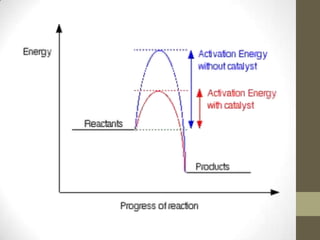
In the presence of a catalyst which increases the rate of
 reaction, an alternative pathway is created during the
 reaction. This pathway requires lower activation energy than
 the reaction without a catalyst.
When the activation energy is lowered, the number of
 collisions which are able to overcome the lower activation
 energy will increase.
As such, the frequency of effective collisions increase.
Therefore, the rate of reaction too increases.
(E) Pressure and Rate of
              Reaction
Pressure influences the rate of reactions involving gaseous
 reactants and products only.
Pressure increases when the volume of the gases is reduced.
When this occurs, the rate of reaction increases.
This is because when volume decreases, the gas particles
 occupy a smaller volume.
Thus, the number of gas particles per unit volume increases or
 the concentration of gaseous reactants is higher at higher
 pressure.
The frequency of collisions increase and consequently, the
 frequency of effective collisions increases too, resulting in a
 higher rate of reaction.

Rate of reaction3

  • 1.
  • 2.
    In this chapter,you will learn to: Analyse the rate of reaction. Synthesise factors affecting the rate of reaction. Synthesise ideas on the collision theory Learn about practising scientific knowledge to enhance quality of life.
  • 3.
    1.3 SYNTHESISE IDEASON THE COLLISION THEORY
  • 4.
    LEARNING OUTCOMES Relate reactionwith energy produced by movement and effective collision of particles, Describe activation energy Sketch and describe energy profile diagram, Relate the frequency of effective collision with the rate of reaction, Relate the frequency of effective collision with factors influencing the rate of reaction, Describe how a certain factor affects the collision of particles in a reaction.
  • 5.
    (1) INTRODUCTION The fivefactors which affect the rate of reaction are:  The size of reactants (or surface area)  Concentration of reactants  Temperature  Catalyst  Pressure All these factors can be explained by using the collision theory. According to the collision theory, a reaction only occurs when: a) The particles of reactants collide with one another during the reaction. b) The reacting particles possess a minimum energy termed activation energy. c) The reacting particles collide in the correct orientation.
  • 7.
    Continue… Hence chemical reactiononly occurs when there are collisions where particles are correctly oriented and possess a total energy that is equal to or more than the activation energy for that reaction. A collision which results in a chemical reaction is known as an effective collision.
  • 8.
    (2) ACTIVATION ENERGY(Ea) This is the minimum energy that is required by colliding reactants for a chemical reaction to take place. The activation energy can be considered as an energy barrier or resistance that has to be overcome in order to produce a reaction. Figure 1.31 shows the energy profile diagram of a reaction where: A + B  C + D. The reaction produces heat energy and therefore called an exothermic reaction. In the energy profile diagram, the x-axis represents the progress of the reaction while the y-axis indicates the energy level of the reactants and products of the reaction. Figure 1.32 is the energy profile diagram for an endothermic reaction where heat energy is absorbed during a chemical reaction.
  • 9.
    Figure 1.31 Figure 1.32
  • 10.
    (3) RATE OFREACTIONS AND THE COLLISION THEORY According to the collision theory, two important factors determine the rate of a reaction:  The frequency of collisions  The magnitude of the activation energy If the number or frequency of collisions in a reaction is high, then the frequency of effective collisions also increase. This leads to an increase in the rate of reaction. Magnitude of activation energy refers to how high or low the activation energy is. A chemical reaction with a high activation energy will progress at a low rate because only small number of particles will contain enough energy to react. On the other hand, a reaction with a low activation energy will occur at a faster rate because a larger number of particles contain enough energy to overcome the activation energy level of that reaction. Thus, more particles are able to react affectively.
  • 11.
    (A) Surface Areaand Collision Theory For a reaction involving a solid reactant, the rate of reaction is inversely proportional to the size of the reactant. That is, the smaller the size of the solid particles, the higher is the rate of the reaction. This is because the smaller the size of the particles, the greater the surface area that is exposed to colliding particles of the reactants. Total surface area of cuboid A = 4(2x1) + 2(2x2) = 16 cm2 Total surface area of B, C, D and E = 6(1x1) x 4 = 24 cm2
  • 12.
    (B) Concentration andRate of Reaction In the reaction between zinc and dilute hydrochloric acid, the rate of reaction increases if the concentration of the acid is increased. This is because when the concentration of the solution increases, the number of particles per unit volume also increases. As a result, the frequency of collisions increase, leading to a high frequency of effective collisions. Thus, the rate of reaction increases.
  • 14.
    (C) Temperature andRate of Reaction  When the temperature of the reactant or reactants is increased, the rate of reaction increases too. This is because the kinetic energy of particles increase with an increase in temperature.  In the reaction between marble chips and hydrochloric acid, the acid particles absorb the excess energy that is produced when the temperature of the acid is increased. This causes the kinetic energy to increase.  When the kinetic energy increases, the reacting particles move more rapidly. The number of particles which attain activation energy also increases.  This mean that the frequency of collisions between reactants is higher. Therefore the frequency of effective collisions also increases, leading to a higher rate of reaction.  For many reactions, an increase in temperature of 10 oC will result in an increase in the rate of reaction by two times.
  • 15.
    (D) Catalyst andRate of Reaction In the decomposition of hydrogen peroxide, a catalyst (manganese(IV) oxide or Iron(III) oxide) may be used to speed up the reaction. During the reaction, the H2O2 particles decompose when they collide with one another. If there is a catalyst, the H2O2 molecules collide with the catalyst as well as with one another. Therefore, the particles react in a different manner. Depending on the type of catalyst used, the activation energy is either increased or decreased.
  • 16.
    Continue… In the presenceof a catalyst which increases the rate of reaction, an alternative pathway is created during the reaction. This pathway requires lower activation energy than the reaction without a catalyst. When the activation energy is lowered, the number of collisions which are able to overcome the lower activation energy will increase. As such, the frequency of effective collisions increase. Therefore, the rate of reaction too increases.
  • 18.
    (E) Pressure andRate of Reaction Pressure influences the rate of reactions involving gaseous reactants and products only. Pressure increases when the volume of the gases is reduced. When this occurs, the rate of reaction increases. This is because when volume decreases, the gas particles occupy a smaller volume. Thus, the number of gas particles per unit volume increases or the concentration of gaseous reactants is higher at higher pressure. The frequency of collisions increase and consequently, the frequency of effective collisions increases too, resulting in a higher rate of reaction.