Goals, Processes and Rationality: 
A Parable and a Framework 
Marc Le Menestrel 
marc.lemenestrel@upf.edu
Session’s Menu 
The parable of the Sadhu (discussion) 
A Methodological Framework (lecture)
The Parable of the Sadhu 
 Attainment of goal is threatened by 
unexpected event 
 Adverse decision-making conditions 
 Ethical dilemma between attainment of a 
major goal and respect of a moral obligation 
 Human conflict in intensity of moral values 
 Difficulty in the (re)assessment of the goal 
 Breach of leadership responsibility
Goals and Success 
 Sometimes, goals are attained but reward 
is not there… 
 Sometimes, goals are not attained but 
experience is gained and happiness is 
felt… 
 What is in success but beyond goals? 
What is the rational path towards 
genuine success?
What is Behavior? 
 It comes from an actor: an individual or a 
group of individuals (e.g. a company); 
 It is a transformation of the world: an action 
or a process; 
 It has an outcome: a consequence. 
A Behavior is an Action with its 
Consequences
What is Rational Behavior? 
 It is a behavior that is chosen intentionally 
and purposefully by the actor; 
 Among the available behaviors, the 
rational behavior is the preferred one. 
How does an actor choose the 
rational behavior?
The Consequence of choice 
 For each available action, the actor evaluates the 
consequences for him/her; 
 The best consequence is identified, from the 
point of view of the self-interest of the actor. 
Is the action with the best 
consequence for the actor the one 
to be rationally chosen?
A Word from Common Sense 
The end does not justify the means
The Process of choice 
 The actor may also prefer an action relatively to another, 
because: 
 of some intrinsic pleasure in the action itself (virtue) 
 of some ethical principle that the action respects (deontology) 
 of the consequences of the action for others or for the 
environment (altruistic consequences) 
 Ethical values help to identify and make explicit intrinsic 
preferences over actions, as ends in themselves, beyond the 
self-interest of their consequences.
? 
Ethical 
analysis of 
actions 
Dual Analysis 
Self-interest 
analysis of 
consequence 
s 
The distinction between self-interest (of consequences) and ethics (of actions) is 
somehow conventional 
But it acknowledges the importance of self-interest as a motivation 
And connects with the model of economic rationality
A Framework of Open Rationality 
1. Economic Analysis 
2. Ethical Analysis 
3. Ethical Dilemma 
4. Dynamic Analysis
1. Economic Analysis 
Step 1: What is the action that leads to the best consequence for you? 
Interest of the consequence 
? 
The rational actor (you, the team, the firm) 
1. Anticipates the consequences of the available actions 
2. Evaluates these consequences according to their interest for the actor 
3. Identify the action that leads to the best consequence
2. Ethical Analysis 
Step 2: What is the ethics of the action that leads to the best consequence for you? 
To which extent is it ethical? 
 Emotions/Virtue: 
Do I feel good? 
Is this a natural way to act? 
 Deontology/Idealism: 
What sort of principle, rule or norm do I 
respect? 
What happens if everybody does the same? 
What happens if I always act like this? 
 Utilitarianism/Consequentialism: 
What are the good consequences for others? 
Would I like these consequences for myself? 
What are the good consequences for the 
environment? 
Would the children of my children like these 
consequences? 
To which extent is it unethical? 
 Emotions/Virtue: 
Do I feel bad? 
Is this an unnatural way to act? 
 Deontology/Idealism: 
What sort of principle, rule or norm do I violate? 
What happens if everybody does the same? 
What happens if I always act like this? 
 Utilitarianism/Consequentialism: 
What are the bad consequences for others? 
Would I suffer these consequences for myself? 
What are the bad consequences for the 
environment? 
Would the children of my children dislike these 
consequences? 
? 
Here you raise an ethical 
dilemma! 
Here you justify your interest!
3. Ethical Dilemma 
Step 3: Facing the extent to which there is a dilemma 
Prudence: Could the unethical aspects lead to unexpected negative 
consequences? 
? 
Unethical 
aspects of 
behavior 
More ethical 
alternative 
Vision: Can you find a more ethical alternative? 
Imagination: If the consequences of the alternative affect your interest, 
cannot they be improved? 
? 
?
The Dilemma of Buzz Mc Coy 
Leave the 
Sadhu 
Bring the 
Sadhu to his 
monastery 
? 
? 
Attain his goal 
Feel guilt 
all his life 
Fail his goal 
Discover 
Buddhism 
Prudence: Could Buzz have anticipated the reaction of Steven and the 
guilt he will feel? 
Vision: Could Buzz have envisioned bringing the Sadhu back? 
Imagination: Could Buzz have realized that this was an opportunity?
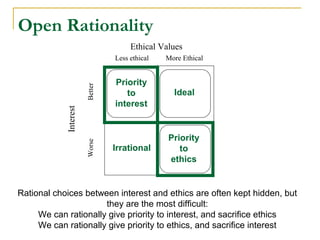
Open Rationality 
Less ethical More Ethical 
Worse Better 
Ethical Values 
Interest 
Ideal 
Priority 
to 
interest 
Irrational 
Priority 
to 
ethics 
Rational choices between interest and ethics are often kept hidden, but 
they are the most difficult: 
We can rationally give priority to interest, and sacrifice ethics 
We can rationally give priority to ethics, and sacrifice interest
4. Dynamics Analysis 
Increasing demands (legal, social) 
Credibility ambiguous 
Contentment, lack of vigilance 
Unawareness, rationalization 
Ideal 
If you are in the 
ideal position, 
you may not be 
lucky for very 
long 
Priority 
to 
interest 
Irrational 
Priority 
to 
ethics 
Lack of transparency 
Legal pressure 
Liabilities 
Bad Reputation 
PR costs 
Negative motivation 
Managerial inertia 
Transparency 
Social involvement & support 
New scope of activities 
New business processes 
Long term thinking 
Strategic investment 
Positive motivation 
Learning process 
If you give priority to 
interest, you will 
need reactive 
strategies to survive 
If you give priority to 
ethics, you may find 
help for your 
proactive strategies
A Difficult Strategy… 
Ideal 
Priority 
to 
interest 
Irrational 
Priority 
to 
ethics 
Few ones are going to believe it, 
Outside or inside the company…
A Reactive Strategy… 
Ideal 
Priority 
to 
interest 
Irrational 
Priority 
to 
ethics 
We wait for change to become necessary 
But it can be very dangerous…
A Proactive Strategy… 
Ideal 
Priority 
to 
interest 
Irrational 
Priority 
to 
ethics 
We are likely to be more credible, 
And more motivated for change… 
Visionary Leaders Welcome!
Conclusions 
 It is easy not to see ethical dilemmas: you just have to 
find a good justification for the action leading to the 
best consequence! 
 It is not easy to see ethical dilemmas: it questions 
ourselves and it does not look fun… 
 It can be rational to be ethical sacrificing your interest, 
or to sacrifice ethics for your interest: the choice 
remains yours 
 It is difficult, but helpful, to search for ethical dilemmas 
beforehand if you want to have a chance not to be 
trapped by them and anticipate their dynamics
Next session 
Accounting Practices: the Enron Collapse 
Preparation: 
What do you think of S. Watkins attitude and 
behaviour? How would you blow the whistle? 
Reading: 
• Watkins, S.S. “Ethical Conflicts at Enron: Moral 
Responsibility in Corporate Capitalism” 
• Currall, S.C. & Epstein, M.J. , “Lessons from the 
Rise and Fall of Enron “

Rationality

  • 1.
    Goals, Processes andRationality: A Parable and a Framework Marc Le Menestrel marc.lemenestrel@upf.edu
  • 2.
    Session’s Menu Theparable of the Sadhu (discussion) A Methodological Framework (lecture)
  • 3.
    The Parable ofthe Sadhu  Attainment of goal is threatened by unexpected event  Adverse decision-making conditions  Ethical dilemma between attainment of a major goal and respect of a moral obligation  Human conflict in intensity of moral values  Difficulty in the (re)assessment of the goal  Breach of leadership responsibility
  • 4.
    Goals and Success  Sometimes, goals are attained but reward is not there…  Sometimes, goals are not attained but experience is gained and happiness is felt…  What is in success but beyond goals? What is the rational path towards genuine success?
  • 5.
    What is Behavior?  It comes from an actor: an individual or a group of individuals (e.g. a company);  It is a transformation of the world: an action or a process;  It has an outcome: a consequence. A Behavior is an Action with its Consequences
  • 6.
    What is RationalBehavior?  It is a behavior that is chosen intentionally and purposefully by the actor;  Among the available behaviors, the rational behavior is the preferred one. How does an actor choose the rational behavior?
  • 7.
    The Consequence ofchoice  For each available action, the actor evaluates the consequences for him/her;  The best consequence is identified, from the point of view of the self-interest of the actor. Is the action with the best consequence for the actor the one to be rationally chosen?
  • 8.
    A Word fromCommon Sense The end does not justify the means
  • 9.
    The Process ofchoice  The actor may also prefer an action relatively to another, because:  of some intrinsic pleasure in the action itself (virtue)  of some ethical principle that the action respects (deontology)  of the consequences of the action for others or for the environment (altruistic consequences)  Ethical values help to identify and make explicit intrinsic preferences over actions, as ends in themselves, beyond the self-interest of their consequences.
  • 10.
    ? Ethical analysisof actions Dual Analysis Self-interest analysis of consequence s The distinction between self-interest (of consequences) and ethics (of actions) is somehow conventional But it acknowledges the importance of self-interest as a motivation And connects with the model of economic rationality
  • 11.
    A Framework ofOpen Rationality 1. Economic Analysis 2. Ethical Analysis 3. Ethical Dilemma 4. Dynamic Analysis
  • 12.
    1. Economic Analysis Step 1: What is the action that leads to the best consequence for you? Interest of the consequence ? The rational actor (you, the team, the firm) 1. Anticipates the consequences of the available actions 2. Evaluates these consequences according to their interest for the actor 3. Identify the action that leads to the best consequence
  • 13.
    2. Ethical Analysis Step 2: What is the ethics of the action that leads to the best consequence for you? To which extent is it ethical?  Emotions/Virtue: Do I feel good? Is this a natural way to act?  Deontology/Idealism: What sort of principle, rule or norm do I respect? What happens if everybody does the same? What happens if I always act like this?  Utilitarianism/Consequentialism: What are the good consequences for others? Would I like these consequences for myself? What are the good consequences for the environment? Would the children of my children like these consequences? To which extent is it unethical?  Emotions/Virtue: Do I feel bad? Is this an unnatural way to act?  Deontology/Idealism: What sort of principle, rule or norm do I violate? What happens if everybody does the same? What happens if I always act like this?  Utilitarianism/Consequentialism: What are the bad consequences for others? Would I suffer these consequences for myself? What are the bad consequences for the environment? Would the children of my children dislike these consequences? ? Here you raise an ethical dilemma! Here you justify your interest!
  • 14.
    3. Ethical Dilemma Step 3: Facing the extent to which there is a dilemma Prudence: Could the unethical aspects lead to unexpected negative consequences? ? Unethical aspects of behavior More ethical alternative Vision: Can you find a more ethical alternative? Imagination: If the consequences of the alternative affect your interest, cannot they be improved? ? ?
  • 15.
    The Dilemma ofBuzz Mc Coy Leave the Sadhu Bring the Sadhu to his monastery ? ? Attain his goal Feel guilt all his life Fail his goal Discover Buddhism Prudence: Could Buzz have anticipated the reaction of Steven and the guilt he will feel? Vision: Could Buzz have envisioned bringing the Sadhu back? Imagination: Could Buzz have realized that this was an opportunity?
  • 16.
    Open Rationality Lessethical More Ethical Worse Better Ethical Values Interest Ideal Priority to interest Irrational Priority to ethics Rational choices between interest and ethics are often kept hidden, but they are the most difficult: We can rationally give priority to interest, and sacrifice ethics We can rationally give priority to ethics, and sacrifice interest
  • 17.
    4. Dynamics Analysis Increasing demands (legal, social) Credibility ambiguous Contentment, lack of vigilance Unawareness, rationalization Ideal If you are in the ideal position, you may not be lucky for very long Priority to interest Irrational Priority to ethics Lack of transparency Legal pressure Liabilities Bad Reputation PR costs Negative motivation Managerial inertia Transparency Social involvement & support New scope of activities New business processes Long term thinking Strategic investment Positive motivation Learning process If you give priority to interest, you will need reactive strategies to survive If you give priority to ethics, you may find help for your proactive strategies
  • 18.
    A Difficult Strategy… Ideal Priority to interest Irrational Priority to ethics Few ones are going to believe it, Outside or inside the company…
  • 19.
    A Reactive Strategy… Ideal Priority to interest Irrational Priority to ethics We wait for change to become necessary But it can be very dangerous…
  • 20.
    A Proactive Strategy… Ideal Priority to interest Irrational Priority to ethics We are likely to be more credible, And more motivated for change… Visionary Leaders Welcome!
  • 21.
    Conclusions  Itis easy not to see ethical dilemmas: you just have to find a good justification for the action leading to the best consequence!  It is not easy to see ethical dilemmas: it questions ourselves and it does not look fun…  It can be rational to be ethical sacrificing your interest, or to sacrifice ethics for your interest: the choice remains yours  It is difficult, but helpful, to search for ethical dilemmas beforehand if you want to have a chance not to be trapped by them and anticipate their dynamics
  • 23.
    Next session AccountingPractices: the Enron Collapse Preparation: What do you think of S. Watkins attitude and behaviour? How would you blow the whistle? Reading: • Watkins, S.S. “Ethical Conflicts at Enron: Moral Responsibility in Corporate Capitalism” • Currall, S.C. & Epstein, M.J. , “Lessons from the Rise and Fall of Enron “