J.S. Mill, Utilitarianism (1863)
PHIL 102, UBC
Christina Hendricks
Except parts noted otherwise, this presentation is licensed CC-BY 4.0
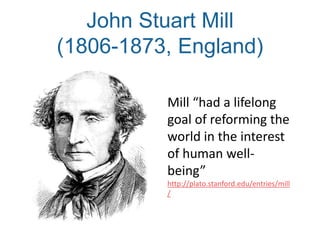
John Stuart Mill
(1806-1873, England)
Mill “had a lifelong
goal of reforming the
world in the interest
of human well-
being”
http://plato.stanford.edu/entries/mill
/
Image of JS Mill from Wikimedia Commons, public domain
Groups on moral questions
http://is.gd/PHIL102Mill
Read the question assigned to your group
(see instructions on the doc) and write down:
• Your own answers to the question
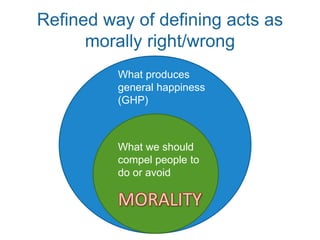
• What you think a utilitarian who agrees
with Mill would say about it
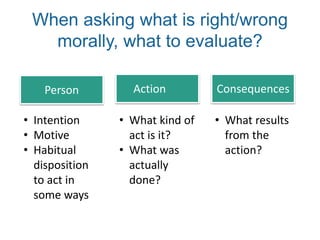
When asking what is right/wrong
morally, what to evaluate?
Person Action Consequences
• Intention
• Motive
• Habitual
disposition
to act in
some ways
• What kind of
act is it?
• What was
actually
done?
• What results
from the
action?
Mill focuses here
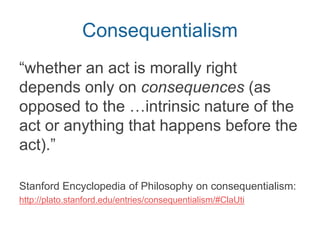
Consequentialism
“whether an act is morally right
depends only on consequences (as
opposed to the …intrinsic nature of the
act or anything that happens before the
act).”
Stanford Encyclopedia of Philosophy on consequentialism:
http://plato.stanford.edu/entries/consequentialism/#ClaUti
Hedonistic consequentialism
• Value hedonism: “all and only pleasure is
intrinsically valuable and all and only pain
is intrinsically disvaluable.”
-- Internet Encycl. of Philosophy:
http://www.iep.utm.edu/hedonism/#SH1b
• Hedonistic consequentialism: we can
determine the moral value of
consequences, and therefore of acts, by
how much pleasure/pain produced
Utilitarianism, Chpt 1
“There ought either to be some one
fundamental principle or law, at the root of
all morality, or if there be several, there
should be a determinate order of
precedence among them…” (1).
What is that principle, for Mill?
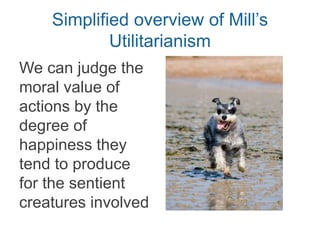
Simplified overview of Mill’s
Utilitarianism
We can judge the
moral value of
actions by the
degree of
happiness they
tend to produce
for the sentient
creatures involved
Greatest Happiness Principle
“actions are [morally] right in proportion as
they tend to promote happiness, [morally]
wrong as they tend to produce the reverse
of happiness” (Mill, Chpt. 2, p. 2).
• “happiness” is defined in terms of
pleasure and reduction or absence of
pain
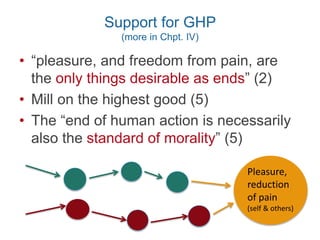
Support for GHP
(more in Chpt. IV)
• “pleasure, and freedom from pain, are
the only things desirable as ends” (2)
• Mill on the highest good (5)
• The “end of human action is necessarily
also the standard of morality” (5)
Pleasure,
reduction
of pain
(self & others)
goal
goal
goal
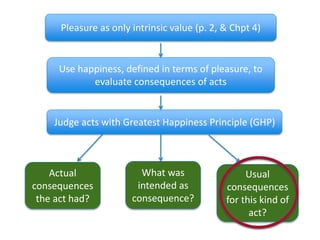
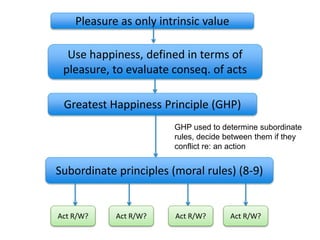
Pleasure as only intrinsic value (p. 2, & Chpt 4)
Use happiness, defined in terms of pleasure, to
evaluate consequences of acts
Decide if acts moral/immoral with Greatest
Happiness Principle (GHP)
Actual
consequences
the act had?
What was
intended as
consequence?
Usual
consequences
for this kind of
act?
S
o
S
o
Which consequences to look at to do so?
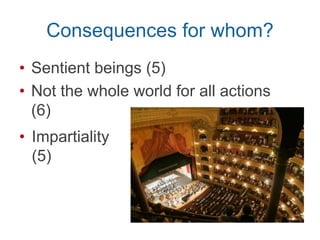
Consequences for whom?
• Sentient beings (5)
• Not the whole world for all actions
(6)
• Impartiality
(5)
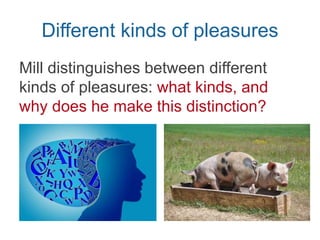
Different kinds of pleasures
Mill distinguishes between different
kinds of pleasures in Chpt. 2:
intellectual & sensual
Which kind of pleasure is best, and
why?
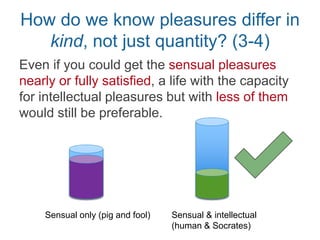
Those who have experienced both prefer
the “higher,” ”intellectual” pleasures (3-5)
A “pig satisfied” A “Socrates dissatisfied”
Sensual
pleasures
only
Sensual &
intellectual
Do we have to calculate
consequences each time we act?
• No; we can use “subordinate
principles” from the “fundamental
principle” (GHP) (8)
• These are drawn from human
experience of which kinds of actions
tend to promote more/less pleasure &
pain (7-8)
Greatest Happiness Principle
(GHP): acts are morally right as
they tend to produce happiness
Subordinate rules (7-8)
e.g., lying is usually wrong (7)
Act R/W?Act R/W? Act R/W? Act R/W?
Use GHP to determine subordinate
rules by asking about usual
tendencies of kinds of actions
Chpt IV: Argument for GHP
(optional reading)
1. Pleasure/happiness is the only thing desirable
as an end goal of human action: the only
intrinsically good thing
2. We should use the only intrinsically good thing
to decide which acts are morally right/wrong
3. More of what is intrinsically good is better than
less
Therefore, we can judge which acts are morally
right/wrong by how much happiness they produce
for all involved
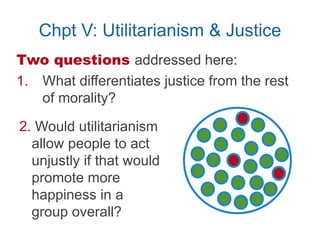
Chpt V: Utilitarianism & Justice
Two questions addressed here:
1. What differentiates justice from the rest
of morality?
2. Would utilitarianism
allow people to act
unjustly if that would
promote more
happiness in a
group overall?
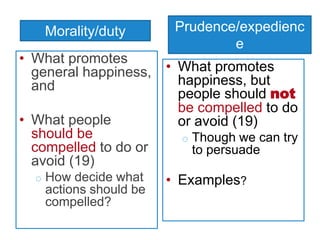
What produces
happiness
What we should
compel people to
do or avoid (14)
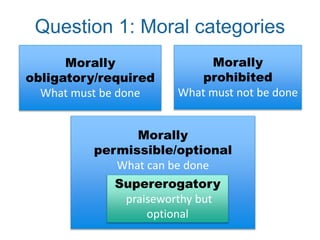
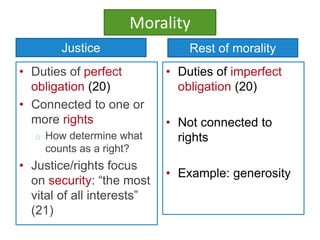
Morality
What people have
a right to (15)
-- what protects
security (16)Justice
Be
generous
Avoid
theft
Study for
exams
Examples
Question 2:
Would utilitarianism allow people to act
unjustly if that would promote more
happiness in a group overall?
Still…
Even rules of justice can be overridden
sometimes by other moral duties (17).
Act vs Rule utilitarianism
A distinction that didn’t exist when Mill was
writing
• AU: moral value of acts judged by utility
of consequences of those (kinds of) acts
• RU: moral value of acts judged by
whether they follow rules; rules judged by
utility of their consequences if generally
accepted and/or followed
Act utilitarianism Rule utilitarianism
Principle of utility
(e.g., Mill’s GHP)
Act R/W?
Principle of utility
(e.g., Mill’s GHP)
Act R/W? Act R/W?
Rules with high
acceptance and/or
obedience utility
Act R/W? Act R/W? Act R/W?

J.S. Mill, Utilitarianism

  • 1.
    J.S. Mill, Utilitarianism(1863) PHIL 102, UBC Christina Hendricks Except parts noted otherwise, this presentation is licensed CC-BY 4.0
  • 2.
    John Stuart Mill (1806-1873,England) Mill “had a lifelong goal of reforming the world in the interest of human well- being” http://plato.stanford.edu/entries/mill / Image of JS Mill from Wikimedia Commons, public domain
  • 3.
    Groups on moralquestions http://is.gd/PHIL102Mill Read the question assigned to your group (see instructions on the doc) and write down: • Your own answers to the question • What you think a utilitarian who agrees with Mill would say about it
  • 4.
    When asking whatis right/wrong morally, what to evaluate? Person Action Consequences • Intention • Motive • Habitual disposition to act in some ways • What kind of act is it? • What was actually done? • What results from the action? Mill focuses here
  • 5.
    Consequentialism “whether an actis morally right depends only on consequences (as opposed to the …intrinsic nature of the act or anything that happens before the act).” Stanford Encyclopedia of Philosophy on consequentialism: http://plato.stanford.edu/entries/consequentialism/#ClaUti
  • 6.
    Hedonistic consequentialism • Valuehedonism: “all and only pleasure is intrinsically valuable and all and only pain is intrinsically disvaluable.” -- Internet Encycl. of Philosophy: http://www.iep.utm.edu/hedonism/#SH1b • Hedonistic consequentialism: we can determine the moral value of consequences, and therefore of acts, by how much pleasure/pain produced
  • 7.
    Utilitarianism, Chpt 1 “Thereought either to be some one fundamental principle or law, at the root of all morality, or if there be several, there should be a determinate order of precedence among them…” (1). What is that principle, for Mill?
  • 8.
    Simplified overview ofMill’s Utilitarianism We can judge the moral value of actions by the degree of happiness they tend to produce for the sentient creatures involved
  • 9.
    Greatest Happiness Principle “actionsare [morally] right in proportion as they tend to promote happiness, [morally] wrong as they tend to produce the reverse of happiness” (Mill, Chpt. 2, p. 2). • “happiness” is defined in terms of pleasure and reduction or absence of pain
  • 10.
    Support for GHP (morein Chpt. IV) • “pleasure, and freedom from pain, are the only things desirable as ends” (2) • Mill on the highest good (5) • The “end of human action is necessarily also the standard of morality” (5) Pleasure, reduction of pain (self & others) goal goal goal
  • 11.
    Pleasure as onlyintrinsic value (p. 2, & Chpt 4) Use happiness, defined in terms of pleasure, to evaluate consequences of acts Decide if acts moral/immoral with Greatest Happiness Principle (GHP) Actual consequences the act had? What was intended as consequence? Usual consequences for this kind of act? S o S o Which consequences to look at to do so?
  • 12.
    Consequences for whom? •Sentient beings (5) • Not the whole world for all actions (6) • Impartiality (5)
  • 13.
    Different kinds ofpleasures Mill distinguishes between different kinds of pleasures in Chpt. 2: intellectual & sensual
  • 14.
    Which kind ofpleasure is best, and why? Those who have experienced both prefer the “higher,” ”intellectual” pleasures (3-5) A “pig satisfied” A “Socrates dissatisfied” Sensual pleasures only Sensual & intellectual
  • 15.
    Do we haveto calculate consequences each time we act? • No; we can use “subordinate principles” from the “fundamental principle” (GHP) (8) • These are drawn from human experience of which kinds of actions tend to promote more/less pleasure & pain (7-8)
  • 16.
    Greatest Happiness Principle (GHP):acts are morally right as they tend to produce happiness Subordinate rules (7-8) e.g., lying is usually wrong (7) Act R/W?Act R/W? Act R/W? Act R/W? Use GHP to determine subordinate rules by asking about usual tendencies of kinds of actions
  • 17.
    Chpt IV: Argumentfor GHP (optional reading) 1. Pleasure/happiness is the only thing desirable as an end goal of human action: the only intrinsically good thing 2. We should use the only intrinsically good thing to decide which acts are morally right/wrong 3. More of what is intrinsically good is better than less Therefore, we can judge which acts are morally right/wrong by how much happiness they produce for all involved
  • 18.
    Chpt V: Utilitarianism& Justice Two questions addressed here: 1. What differentiates justice from the rest of morality? 2. Would utilitarianism allow people to act unjustly if that would promote more happiness in a group overall?
  • 19.
    What produces happiness What weshould compel people to do or avoid (14) Morality What people have a right to (15) -- what protects security (16)Justice Be generous Avoid theft Study for exams Examples
  • 20.
    Question 2: Would utilitarianismallow people to act unjustly if that would promote more happiness in a group overall?
  • 21.
    Still… Even rules ofjustice can be overridden sometimes by other moral duties (17).
  • 22.
    Act vs Ruleutilitarianism A distinction that didn’t exist when Mill was writing • AU: moral value of acts judged by utility of consequences of those (kinds of) acts • RU: moral value of acts judged by whether they follow rules; rules judged by utility of their consequences if generally accepted and/or followed
  • 23.
    Act utilitarianism Ruleutilitarianism Principle of utility (e.g., Mill’s GHP) Act R/W? Principle of utility (e.g., Mill’s GHP) Act R/W? Act R/W? Rules with high acceptance and/or obedience utility Act R/W? Act R/W? Act R/W?

Editor's Notes