Ethical Decision Making in
      Organizations
built – in values from school, home, religion…
ethics: rules of conduct
practiced in a particular culture


morals: rules of individual behavior

  Moral dilemmas: disagreements
about ethical principles in a situation
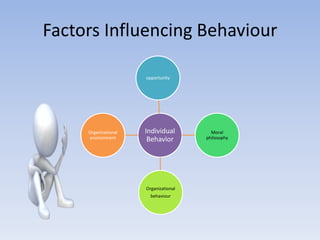
Factors Influencing Behaviour

                      opportunity


     Organizational   Individual         Moral
     environment       Behavior        philosophy


                      Organizational
                        behaviour
How are they Made?
•   End –the outcome sought
•   Means – the methods employed
•   Motive- the urge in making the decisions
•   Foreseeable consequences
The Role of Moral Philosophies in
           Decision making
Moral Philosophy
A set of principles setting forth what is believed to
   be the right way to behave
Role
It is something that is moral conforms to a standard
   of acceptability
Philosophy
A study of the general principles of a subject such
   as morality
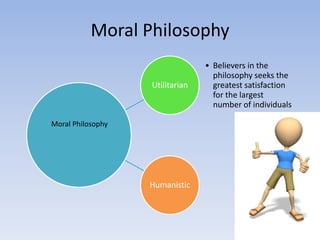
Moral Philosophy
                                 • Believers in the
                                   philosophy seeks the
                   Utilitarian     greatest satisfaction
                                   for the largest
                                   number of individuals

Moral Philosophy


                   Humanistic
Suggestions for ethical Decision
                 Making
•   Top Management can improve behaviour
•   Codes of ethics improve decision making
•   Interaction with peers and other colleagues
•   Control system
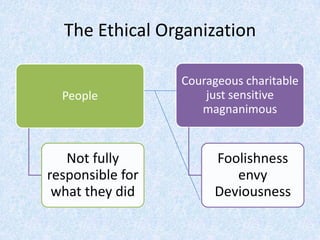
The Ethical Organization

                  Courageous charitable
  People              just sensitive
                     magnanimous


   Not fully           Foolishness
responsible for           envy
 what they did         Deviousness
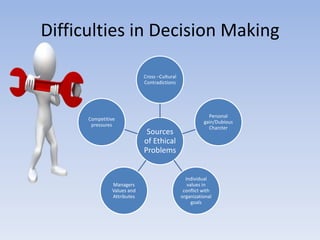
Difficulties in Decision Making

                            Cross –Cultural
                            Contradictions


                                                          Personal
      Competitive
                                                        gain/Dubious
       pressures
                                                          Charcter
                             Sources
                            of Ethical
                            Problems


                                                Individual
               Managers                          values in
               Values and                      conflict with
               Attributes                     organizational
                                                   goals
Difficulties in Decision Making
• Cross –Cultural Contradictions
 Some of the knottiest ethical problems occur as
  corporations do business in other societies
  where ethical standards differ from those at
  home
• Competitive Pressures
   When companies are squeezed by severe
  competition, managers sometimes engage in
  unethical activities to beat out a competitors
Difficulties in Decision Making

• Managers Values and Attributes
Managers are the key people to investigate
  whether a company will act ethically or
  unethically. As major decision makers and
  policy makers, that have more opportunities
  than others to set an ethical time for their
  company
Difficulties in Decision Making

• Individual values in conflict with organizational goals
Ethical conflicts in business frequently occur
  when a company pursues goals or uses
  methods that are not acceptable to some of
  its employees
Difficulties in Decision Making
• Personal gain/Dubious Character
Personal gain or even greed, causes some ethical
  problems. Business sometimes employs
  people whose personal values are less than
  desirable
How to use Ethical Reasoning?
• Identify the nature of the ethical problem
• Decide which course of action is likely to
  produce the most ethical results
Three methods
• Utilitarian
• Rights
• justice
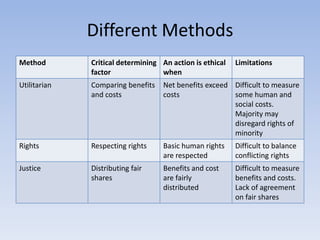
Different Methods
Method        Critical determining An action is ethical   Limitations
              factor               when
Utilitarian   Comparing benefits   Net benefits exceed Difficult to measure
              and costs            costs               some human and
                                                       social costs.
                                                       Majority may
                                                       disregard rights of
                                                       minority
Rights        Respecting rights    Basic human rights     Difficult to balance
                                   are respected          conflicting rights
Justice       Distributing fair    Benefits and cost      Difficult to measure
              shares               are fairly             benefits and costs.
                                   distributed            Lack of agreement
                                                          on fair shares
Levels of Decision Making
• Levels of the individual
• Levels of the organization
• Levels of the business system
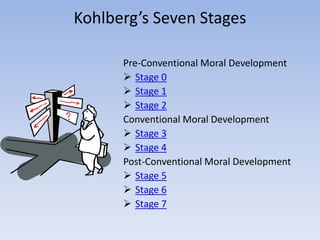
Kohlberg’s Seven Stages

      Pre-Conventional Moral Development
       Stage 0
       Stage 1
       Stage 2
      Conventional Moral Development
       Stage 3
       Stage 4
      Post-Conventional Moral Development
       Stage 5
       Stage 6
       Stage 7
Stage 0
At this stage, the individual:
• Avoids pain and seeks pleasure
• Has no sense of obligation to anyone else
• Is self-absorbed (unaware or anyone’s needs other than
   those that are self-serving)
• Does what he/she wants to do
• Is amoral
• Is totally egocentric in assuming that the world revolves
   around his/her needs and desires
• Has thus no sense of cause-effect
• Is typically between the ages of 0-7
Stage 1
At this stage, the individual:
• Obeys rules in order to avoid punishment
• Determines a sense of right and wrong by what is
   punished and what is not punished
• Obeys superior authority and allows that authority to
   make the rules, especially if that authority has the power
   to inflict pain
• Is responsive to rules that will affect his/her physical
   well-being
• Is usually over the age of 7
Stage 2
At this stage, the individual:
• Is motivated by vengeance or “an eye for an eye”
   philosophy
• Is self-absorbed while assuming that he/she is generous
• Believes in equal sharing in that everyone gets the same,
   regardless of need
• Believes that the end justifies the means
• Will do a favor only to get a favor
• Expects to be rewarded for every non-selfish deed
   he/she does
• Is usually over the age of 10
Stage 3
At this stage, the individual:
• Finds peer approval very important
• Makes moral decisions on the basis of what will please a
   limited group and make the person feel included
• Thus models behavior on that of the “majority” which is
   the behavior of the “in crowd” or peer group
• Feels that intensions are as important as deeds and expects
   others to accept intentions or promises in place of deeds
• Begins to put himself/herself in another’s shoes and think
   from another perspective
• May continue to be in this stage until him/her has reached
   the 20s in age
Stage 4
At this stage, the individual:
• Continues past actions and behaviors in tradition since
   the maintenance of law and order is supremely
   important
• Is a duty doer who believes in rigid rules that should not
   be changed
• Respects authority and obeys it without question
• Supports the rights of the majority or majority rule
   without concern for those in the minority
• Is part of about 80% of the population that does not
   progress past stage 4
Stage 5
At this stage, the individual:
• Is motivated by the belief in the greatest amount of good
   for the greatest number of people
• Believes in contracts in which both parties compromise and
   yet both receive benefits
• Believes in consensus (everyone agrees), rather than in
   majority rule
• Respects the rights of the minority especially the rights of
   the individual
• Believes that change in the law is possible but only through
   the system
• Has reached the same stage as the official morality of the
   nation
Stage 6
At this stage, the individual:
• Loses the ability to compromise high principles and thus may
   forfeit his/her life in order to uphold them
• Believes that there are high moral principles than those
   represented by social rules and customs
• Obeys these self-chosen high moral principles
• Is willing to accept the consequences for disobedience of the
   social rule he/she has rejected
• Uses only passive resistance and has no use for violence in
   any form
• Believes in granting justice and dignity to all human beings as
   inalienable human rights
• Respects justice for its moral nature and its legal nature
• Believes that the dignity of humanity is sacred and that all
   humans have value
Stage 7
At this stage, the individual:
• Is a “seeker of justice in an unjust world”
• Has a cosmic perspective of life
• Neglects any consideration for self
• Focuses not on the individual but on the whole, a view of
   self as part of the infinite whole and not as an individual
   part that is significant
• Thus is plagued with despair and sees a world of woe that
   he/she is inadequate to repair
• Possesses an altruism that is difficult for the world to
   comprehend and consequently his/her forgiveness and
   compassion often runs afoul of the world’s sense of justice
   I.e. moral level
7 step moral reasoning model
1. relevant facts
2. ethical issues - broad systemic, corporate and
   personal issues
3. primary stakeholders affected by the ethical
   decision
4. possible alternatives
5. ethics of each alternative How will each affect
   stakeholders? Apply the philosophies here
6. practical constraints that limit implementation
7. which alternative should be taken?
Influences of Ethical Decision Making
• Work place ethics
• Nature of ethical issues
• Personal values and ethical decision making
1. Trustworthiness
2. Respect
3. Responsibility
4. Fairness
5. Caring
6. citizenship
CONTINUED
• Corporate values and ethical Decision making
• Role of corporate governance in ensuring
  ethics in work place
Frame work of Ethical decision making
• Take choices seriously
• Good decisions are both ethical and effective
• Discernment and discipline
PROCESS OF MAKING GOOD ETHICAL
            DECISIONS
• Recognize and identify the kind of issue needed
  to resolve
• Pause and think
• Make sure of goals
• Get your facts right
• Evaluate the choices from diferent ethical
  perspectives
• Consider consequences
• Make a decision
• Act, then reflect on the decision later
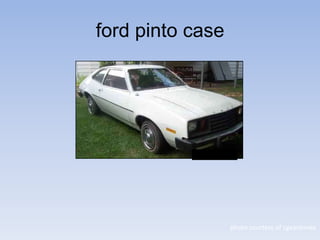
ford pinto case


                  photo courtesy of cgearannex

Becg 2 2

  • 1.
    Ethical Decision Makingin Organizations
  • 2.
    built – invalues from school, home, religion…
  • 3.
    ethics: rules ofconduct practiced in a particular culture morals: rules of individual behavior Moral dilemmas: disagreements about ethical principles in a situation
  • 4.
    Factors Influencing Behaviour opportunity Organizational Individual Moral environment Behavior philosophy Organizational behaviour
  • 5.
    How are theyMade? • End –the outcome sought • Means – the methods employed • Motive- the urge in making the decisions • Foreseeable consequences
  • 6.
    The Role ofMoral Philosophies in Decision making Moral Philosophy A set of principles setting forth what is believed to be the right way to behave Role It is something that is moral conforms to a standard of acceptability Philosophy A study of the general principles of a subject such as morality
  • 7.
    Moral Philosophy • Believers in the philosophy seeks the Utilitarian greatest satisfaction for the largest number of individuals Moral Philosophy Humanistic
  • 8.
    Suggestions for ethicalDecision Making • Top Management can improve behaviour • Codes of ethics improve decision making • Interaction with peers and other colleagues • Control system
  • 9.
    The Ethical Organization Courageous charitable People just sensitive magnanimous Not fully Foolishness responsible for envy what they did Deviousness
  • 10.
    Difficulties in DecisionMaking Cross –Cultural Contradictions Personal Competitive gain/Dubious pressures Charcter Sources of Ethical Problems Individual Managers values in Values and conflict with Attributes organizational goals
  • 11.
    Difficulties in DecisionMaking • Cross –Cultural Contradictions Some of the knottiest ethical problems occur as corporations do business in other societies where ethical standards differ from those at home • Competitive Pressures When companies are squeezed by severe competition, managers sometimes engage in unethical activities to beat out a competitors
  • 12.
    Difficulties in DecisionMaking • Managers Values and Attributes Managers are the key people to investigate whether a company will act ethically or unethically. As major decision makers and policy makers, that have more opportunities than others to set an ethical time for their company
  • 13.
    Difficulties in DecisionMaking • Individual values in conflict with organizational goals Ethical conflicts in business frequently occur when a company pursues goals or uses methods that are not acceptable to some of its employees
  • 14.
    Difficulties in DecisionMaking • Personal gain/Dubious Character Personal gain or even greed, causes some ethical problems. Business sometimes employs people whose personal values are less than desirable
  • 15.
    How to useEthical Reasoning? • Identify the nature of the ethical problem • Decide which course of action is likely to produce the most ethical results Three methods • Utilitarian • Rights • justice
  • 16.
    Different Methods Method Critical determining An action is ethical Limitations factor when Utilitarian Comparing benefits Net benefits exceed Difficult to measure and costs costs some human and social costs. Majority may disregard rights of minority Rights Respecting rights Basic human rights Difficult to balance are respected conflicting rights Justice Distributing fair Benefits and cost Difficult to measure shares are fairly benefits and costs. distributed Lack of agreement on fair shares
  • 17.
    Levels of DecisionMaking • Levels of the individual • Levels of the organization • Levels of the business system
  • 18.
    Kohlberg’s Seven Stages Pre-Conventional Moral Development  Stage 0  Stage 1  Stage 2 Conventional Moral Development  Stage 3  Stage 4 Post-Conventional Moral Development  Stage 5  Stage 6  Stage 7
  • 19.
    Stage 0 At thisstage, the individual: • Avoids pain and seeks pleasure • Has no sense of obligation to anyone else • Is self-absorbed (unaware or anyone’s needs other than those that are self-serving) • Does what he/she wants to do • Is amoral • Is totally egocentric in assuming that the world revolves around his/her needs and desires • Has thus no sense of cause-effect • Is typically between the ages of 0-7
  • 20.
    Stage 1 At thisstage, the individual: • Obeys rules in order to avoid punishment • Determines a sense of right and wrong by what is punished and what is not punished • Obeys superior authority and allows that authority to make the rules, especially if that authority has the power to inflict pain • Is responsive to rules that will affect his/her physical well-being • Is usually over the age of 7
  • 21.
    Stage 2 At thisstage, the individual: • Is motivated by vengeance or “an eye for an eye” philosophy • Is self-absorbed while assuming that he/she is generous • Believes in equal sharing in that everyone gets the same, regardless of need • Believes that the end justifies the means • Will do a favor only to get a favor • Expects to be rewarded for every non-selfish deed he/she does • Is usually over the age of 10
  • 22.
    Stage 3 At thisstage, the individual: • Finds peer approval very important • Makes moral decisions on the basis of what will please a limited group and make the person feel included • Thus models behavior on that of the “majority” which is the behavior of the “in crowd” or peer group • Feels that intensions are as important as deeds and expects others to accept intentions or promises in place of deeds • Begins to put himself/herself in another’s shoes and think from another perspective • May continue to be in this stage until him/her has reached the 20s in age
  • 23.
    Stage 4 At thisstage, the individual: • Continues past actions and behaviors in tradition since the maintenance of law and order is supremely important • Is a duty doer who believes in rigid rules that should not be changed • Respects authority and obeys it without question • Supports the rights of the majority or majority rule without concern for those in the minority • Is part of about 80% of the population that does not progress past stage 4
  • 24.
    Stage 5 At thisstage, the individual: • Is motivated by the belief in the greatest amount of good for the greatest number of people • Believes in contracts in which both parties compromise and yet both receive benefits • Believes in consensus (everyone agrees), rather than in majority rule • Respects the rights of the minority especially the rights of the individual • Believes that change in the law is possible but only through the system • Has reached the same stage as the official morality of the nation
  • 25.
    Stage 6 At thisstage, the individual: • Loses the ability to compromise high principles and thus may forfeit his/her life in order to uphold them • Believes that there are high moral principles than those represented by social rules and customs • Obeys these self-chosen high moral principles • Is willing to accept the consequences for disobedience of the social rule he/she has rejected • Uses only passive resistance and has no use for violence in any form • Believes in granting justice and dignity to all human beings as inalienable human rights • Respects justice for its moral nature and its legal nature • Believes that the dignity of humanity is sacred and that all humans have value
  • 26.
    Stage 7 At thisstage, the individual: • Is a “seeker of justice in an unjust world” • Has a cosmic perspective of life • Neglects any consideration for self • Focuses not on the individual but on the whole, a view of self as part of the infinite whole and not as an individual part that is significant • Thus is plagued with despair and sees a world of woe that he/she is inadequate to repair • Possesses an altruism that is difficult for the world to comprehend and consequently his/her forgiveness and compassion often runs afoul of the world’s sense of justice I.e. moral level
  • 27.
    7 step moralreasoning model 1. relevant facts 2. ethical issues - broad systemic, corporate and personal issues 3. primary stakeholders affected by the ethical decision 4. possible alternatives 5. ethics of each alternative How will each affect stakeholders? Apply the philosophies here 6. practical constraints that limit implementation 7. which alternative should be taken?
  • 28.
    Influences of EthicalDecision Making • Work place ethics • Nature of ethical issues • Personal values and ethical decision making 1. Trustworthiness 2. Respect 3. Responsibility 4. Fairness 5. Caring 6. citizenship
  • 29.
    CONTINUED • Corporate valuesand ethical Decision making • Role of corporate governance in ensuring ethics in work place
  • 30.
    Frame work ofEthical decision making • Take choices seriously • Good decisions are both ethical and effective • Discernment and discipline
  • 31.
    PROCESS OF MAKINGGOOD ETHICAL DECISIONS • Recognize and identify the kind of issue needed to resolve • Pause and think • Make sure of goals • Get your facts right • Evaluate the choices from diferent ethical perspectives • Consider consequences • Make a decision • Act, then reflect on the decision later
  • 32.
    ford pinto case photo courtesy of cgearannex