Shahzad Ahmed
Public Policy & Public Administration
Central University of Jammu
It’s a rejection of metaphysics (abstract truths, nature of
existence etc.)
It is a position that holds that the goal of knowledge is simply to describe
the phenomena that we experience.
Positivism is the philosophy of science that information derived from
logical and mathematical treatments and reports of sensory experience.
Positivism holds that society, like the physical world, operates according
to general laws. Introspective and intuitive knowledge is rejected.
Positivism is a philosophical system deeply rooted in science and mathematics.
It’s based on the view that whatever exists can be verified through
experiments, observation, and mathematical/logical proof.
Positivists hold that since the purpose of science is simply to stick to what we can
observe and measure, knowledge of anything beyond that is impossible.
The world and the universe are operated by laws of cause and effect.
The positivists believed in empiricism – the idea that observation and
measurement was the core of the scientific endeavor.
That the key approach of the scientific method is the experiment, the attempt to
discern natural laws through direct manipulation and observation.
A strong form of empiricism, especially as established in the philosophical system
of Comte, that rejects metaphysics and theology as seeking knowledge beyond the
scope of experience, and holds that experimental investigation and observation
are the only sources of substantial knowledge.
Although the positivist approach has been a recurrent
theme in the history of western thought, the modern sense of the approach
was developed by the philosopher and founding sociologist Auguste Comte in
the early 19th century. Comte argued that, much as the physical world operates
according to gravity and other absolute laws, so also does society.
4
The scientific process according to
positivists
• Observation: data gathering (fact finding).
• Generalization: formulating laws
(induction).
• Verification: finding / searching for new
facts.
• Explanation: subsuming new facts
(deduction).
"Logical Positivism" is a name for a method, not f or a certain
kind of result. A philosopher is a logical positivist if he holds
that there is no special way of knowing that is peculiar to
philosophy, but that questions of fact can only be decided by
the empirical methods of science, while questions that can be
decided without appeal to experience are either mathematical
of linguistic.
Logical positivism (later and more accurately called logical
empiricism) is a school of philosophy that combines
empiricism, the idea that observational evidence is
indispensable for knowledge of the world, with a version of
rationalism, the idea that our knowledge includes a
component that is not derived from observation.
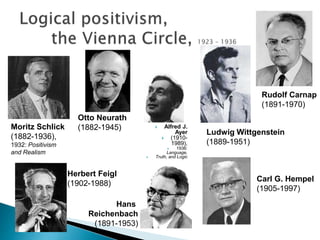
 Alfred J.
Ayer
 (1910-
1989),
 1936:
Language,
 Truth, and Logic
Moritz Schlick
(1882-1936),
1932: Positivism
and Realism
Otto Neurath
(1882-1945)
Rudolf Carnap
(1891-1970)
Ludwig Wittgenstein
(1889-1951)
Herbert Feigl
(1902-1988)
Hans
Reichenbach
(1891-1953)
Carl G. Hempel
(1905-1997)
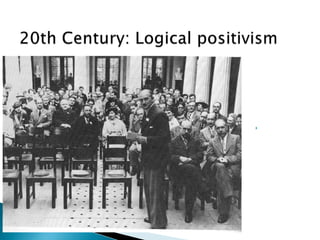
 The
Second
International
Congress for
the Unity of
Science,
København,
June 21.-26.,
1936
A.J. Ayer
One of the most important Logical Positivists was A. J. Ayer who,
in 1936, released his groundbreaking book, ‘Language, Truth and Logic’.
– The main tenet of logical positivism is that language causes many illusions. When we
properly analyze a proposition, we find that some are literally nonsense.
They can be neither true nor false, and are thus grammatical trickery.
This too applies to questions: some are meaningless (e.g. “Does God exist?”)
Language, Truth and Logic (1936)
– Ayer begins his book by accusing metaphysicians of making sentences which have no
meaning.
– He says that for a sentence to be literally significant, meaningful, it must conform to
certain criteria.
Ayer goes on to formulate this criteria, he calls it the criterion of verifiability:
– ‘We say that a sentence is factually significant [meaningful] … if, and only if, he knows
how to verify the proposition which it purports to express – that is, if he knows what
observations would lead him, under certain conditions, to accept the proposition as being
true, or reject it as being false.’ (p.16)
i.e. a sentence only has meaning if it can be proved true or false by observation.
– Thus, a question is genuine only if it can be observed true or false.
– It is important to note that a sentence’s observation should at least be possible in
principle. This gives it genuiness: verifiable in principle.
 Ayer’s example is the proposition ‘that there are
mountains on the farther side of the moon.’ (p.17)
 Although (at the time) that proposition was not
observed/verified, it was still verifiable in principle: it was
a possibility that the farther side of the moon could be
observed.
◦ Therefore the proposition was meaningful: it was in principle able
to give a truth or falsity, even though it had not done so at the
time. It was verifiable in principle, if not in practice.
 – An example of a proposition that is meaningless
would be, say, “God works in mysterious ways.”
 This proposition is not verifiable even in principle.
 What observations could prove it either true or false?
None. It is therefore a meaningless proposition.
 Further qualifying his verification principle, Ayer
distinguishes between strong and weak verifiability.
 ‘A proposition is said to be verifiable, in the strong sense
of the term, if, and only if, its truth could be conclusively
established in experience. But it is verifiable, in the weak
sense, if it is possible for experience to render it
probable.’ (p. 18)
 Logical Positivist thinkers proposed that philosophy should
dismiss any statements or beliefs that were not verifiable or, at
least, confirmable by observation or experiment. This became
known as the Principal of Verification and was formulated by A.
J. Ayer.
 According to Ayer, a principal only had meaning if it could be
logically verified. Therefore, the only statements and ideas that
were of any use were those that were based on logic and
scientific thought or based on observations of the natural
world, i.e. experiments. As such, philosophy had no business
engaging in discussions of morality, religious beliefs, and
metaphysics, and such avenues were of no meaning because
they could not be verified.
 A forerunner to logical positivism:
Mach held that scientific laws are summaries of experimental
events, constructed for the purpose of human comprehension of
complex data. Thus scientific laws have more to do with the mind
than with reality as it exists apart from the mind.
”The goal which it
[physical science] has set
itself is the simplest and
most economical abstract
expression of facts” (from
the Essay ”The economical
nature of physical inquiry” ).
Ernst Mach (1838-1916)
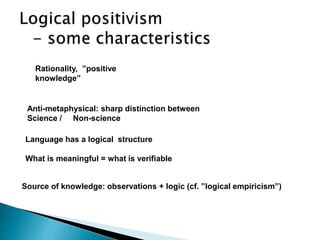
Rationality, ”positive
knowledge”
Anti-metaphysical: sharp distinction between
Science / Non-science
Language has a logical structure
What is meaningful = what is verifiable
Source of knowledge: observations + logic (cf. ”logical empiricism”)
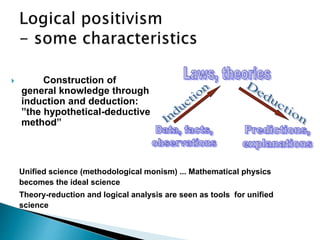
 Construction of
general knowledge through
induction and deduction:
”the hypothetical-deductive
method”
Unified science (methodological monism) ... Mathematical physics
becomes the ideal science
Theory-reduction and logical analysis are seen as tools for unified
science
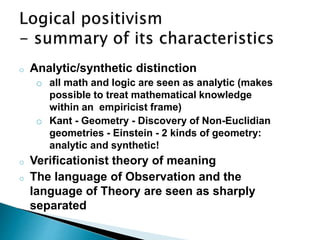
o Analytic/synthetic distinction
o all math and logic are seen as analytic (makes
possible to treat mathematical knowledge
within an empiricist frame)
o Kant - Geometry - Discovery of Non-Euclidian
geometries - Einstein - 2 kinds of geometry:
analytic and synthetic!
o Verificationist theory of meaning
o The language of Observation and the
language of Theory are seen as sharply
separated
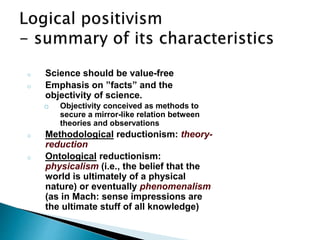
o Science should be value-free
o Emphasis on ”facts” and the
objectivity of science.
o Objectivity conceived as methods to
secure a mirror-like relation between
theories and observations
o Methodological reductionism: theory-
reduction
o Ontological reductionism:
physicalism (i.e., the belief that the
world is ultimately of a physical
nature) or eventually phenomenalism
(as in Mach: sense impressions are
the ultimate stuff of all knowledge)
16
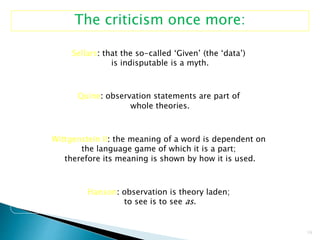
Sellars: that the so-called ‘Given’ (the ‘data’)
is indisputable is a myth.
Quine: observation statements are part of
whole theories.
Wittgenstein II: the meaning of a word is dependent on
the language game of which it is a part;
therefore its meaning is shown by how it is used.
Hanson: observation is theory laden;
to see is to see as.
The criticism once more:
17
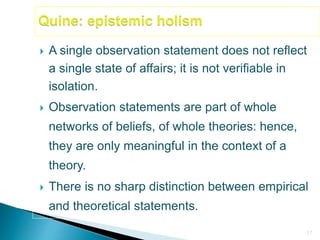
 A single observation statement does not reflect
a single state of affairs; it is not verifiable in
isolation.
 Observation statements are part of whole
networks of beliefs, of whole theories: hence,
they are only meaningful in the context of a
theory.
 There is no sharp distinction between empirical
and theoretical statements.
18
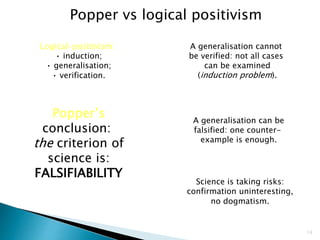
Logical-positivism:
• induction;
• generalisation;
• verification.
Popper vs logical positivism
A generalisation cannot
be verified: not all cases
can be examined
(induction problem).
A generalisation can be
falsified: one counter-
example is enough.
Science is taking risks:
confirmation uninteresting,
no dogmatism.
Popper’s
conclusion:
the criterion of
science is:
FALSIFIABILITY
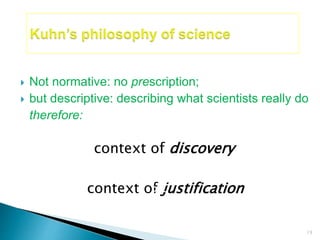
 Not normative: no prescription;
 but descriptive: describing what scientists really do
therefore:
19
context of discovery
context of justification
Logical positivism

Logical positivism

  • 1.
    Shahzad Ahmed Public Policy& Public Administration Central University of Jammu
  • 2.
    It’s a rejectionof metaphysics (abstract truths, nature of existence etc.) It is a position that holds that the goal of knowledge is simply to describe the phenomena that we experience. Positivism is the philosophy of science that information derived from logical and mathematical treatments and reports of sensory experience. Positivism holds that society, like the physical world, operates according to general laws. Introspective and intuitive knowledge is rejected. Positivism is a philosophical system deeply rooted in science and mathematics. It’s based on the view that whatever exists can be verified through experiments, observation, and mathematical/logical proof.
  • 3.
    Positivists hold thatsince the purpose of science is simply to stick to what we can observe and measure, knowledge of anything beyond that is impossible. The world and the universe are operated by laws of cause and effect. The positivists believed in empiricism – the idea that observation and measurement was the core of the scientific endeavor. That the key approach of the scientific method is the experiment, the attempt to discern natural laws through direct manipulation and observation. A strong form of empiricism, especially as established in the philosophical system of Comte, that rejects metaphysics and theology as seeking knowledge beyond the scope of experience, and holds that experimental investigation and observation are the only sources of substantial knowledge. Although the positivist approach has been a recurrent theme in the history of western thought, the modern sense of the approach was developed by the philosopher and founding sociologist Auguste Comte in the early 19th century. Comte argued that, much as the physical world operates according to gravity and other absolute laws, so also does society.
  • 4.
    4 The scientific processaccording to positivists • Observation: data gathering (fact finding). • Generalization: formulating laws (induction). • Verification: finding / searching for new facts. • Explanation: subsuming new facts (deduction).
  • 5.
    "Logical Positivism" isa name for a method, not f or a certain kind of result. A philosopher is a logical positivist if he holds that there is no special way of knowing that is peculiar to philosophy, but that questions of fact can only be decided by the empirical methods of science, while questions that can be decided without appeal to experience are either mathematical of linguistic. Logical positivism (later and more accurately called logical empiricism) is a school of philosophy that combines empiricism, the idea that observational evidence is indispensable for knowledge of the world, with a version of rationalism, the idea that our knowledge includes a component that is not derived from observation.
  • 6.
     Alfred J. Ayer (1910- 1989),  1936: Language,  Truth, and Logic Moritz Schlick (1882-1936), 1932: Positivism and Realism Otto Neurath (1882-1945) Rudolf Carnap (1891-1970) Ludwig Wittgenstein (1889-1951) Herbert Feigl (1902-1988) Hans Reichenbach (1891-1953) Carl G. Hempel (1905-1997)
  • 7.
     The Second International Congress for theUnity of Science, København, June 21.-26., 1936
  • 8.
    A.J. Ayer One ofthe most important Logical Positivists was A. J. Ayer who, in 1936, released his groundbreaking book, ‘Language, Truth and Logic’. – The main tenet of logical positivism is that language causes many illusions. When we properly analyze a proposition, we find that some are literally nonsense. They can be neither true nor false, and are thus grammatical trickery. This too applies to questions: some are meaningless (e.g. “Does God exist?”) Language, Truth and Logic (1936) – Ayer begins his book by accusing metaphysicians of making sentences which have no meaning. – He says that for a sentence to be literally significant, meaningful, it must conform to certain criteria. Ayer goes on to formulate this criteria, he calls it the criterion of verifiability: – ‘We say that a sentence is factually significant [meaningful] … if, and only if, he knows how to verify the proposition which it purports to express – that is, if he knows what observations would lead him, under certain conditions, to accept the proposition as being true, or reject it as being false.’ (p.16) i.e. a sentence only has meaning if it can be proved true or false by observation. – Thus, a question is genuine only if it can be observed true or false. – It is important to note that a sentence’s observation should at least be possible in principle. This gives it genuiness: verifiable in principle.
  • 9.
     Ayer’s exampleis the proposition ‘that there are mountains on the farther side of the moon.’ (p.17)  Although (at the time) that proposition was not observed/verified, it was still verifiable in principle: it was a possibility that the farther side of the moon could be observed. ◦ Therefore the proposition was meaningful: it was in principle able to give a truth or falsity, even though it had not done so at the time. It was verifiable in principle, if not in practice.  – An example of a proposition that is meaningless would be, say, “God works in mysterious ways.”  This proposition is not verifiable even in principle.  What observations could prove it either true or false? None. It is therefore a meaningless proposition.  Further qualifying his verification principle, Ayer distinguishes between strong and weak verifiability.  ‘A proposition is said to be verifiable, in the strong sense of the term, if, and only if, its truth could be conclusively established in experience. But it is verifiable, in the weak sense, if it is possible for experience to render it probable.’ (p. 18)
  • 10.
     Logical Positivistthinkers proposed that philosophy should dismiss any statements or beliefs that were not verifiable or, at least, confirmable by observation or experiment. This became known as the Principal of Verification and was formulated by A. J. Ayer.  According to Ayer, a principal only had meaning if it could be logically verified. Therefore, the only statements and ideas that were of any use were those that were based on logic and scientific thought or based on observations of the natural world, i.e. experiments. As such, philosophy had no business engaging in discussions of morality, religious beliefs, and metaphysics, and such avenues were of no meaning because they could not be verified.
  • 11.
     A forerunnerto logical positivism: Mach held that scientific laws are summaries of experimental events, constructed for the purpose of human comprehension of complex data. Thus scientific laws have more to do with the mind than with reality as it exists apart from the mind. ”The goal which it [physical science] has set itself is the simplest and most economical abstract expression of facts” (from the Essay ”The economical nature of physical inquiry” ). Ernst Mach (1838-1916)
  • 12.
    Rationality, ”positive knowledge” Anti-metaphysical: sharpdistinction between Science / Non-science Language has a logical structure What is meaningful = what is verifiable Source of knowledge: observations + logic (cf. ”logical empiricism”)
  • 13.
     Construction of generalknowledge through induction and deduction: ”the hypothetical-deductive method” Unified science (methodological monism) ... Mathematical physics becomes the ideal science Theory-reduction and logical analysis are seen as tools for unified science
  • 14.
    o Analytic/synthetic distinction oall math and logic are seen as analytic (makes possible to treat mathematical knowledge within an empiricist frame) o Kant - Geometry - Discovery of Non-Euclidian geometries - Einstein - 2 kinds of geometry: analytic and synthetic! o Verificationist theory of meaning o The language of Observation and the language of Theory are seen as sharply separated
  • 15.
    o Science shouldbe value-free o Emphasis on ”facts” and the objectivity of science. o Objectivity conceived as methods to secure a mirror-like relation between theories and observations o Methodological reductionism: theory- reduction o Ontological reductionism: physicalism (i.e., the belief that the world is ultimately of a physical nature) or eventually phenomenalism (as in Mach: sense impressions are the ultimate stuff of all knowledge)
  • 16.
    16 Sellars: that theso-called ‘Given’ (the ‘data’) is indisputable is a myth. Quine: observation statements are part of whole theories. Wittgenstein II: the meaning of a word is dependent on the language game of which it is a part; therefore its meaning is shown by how it is used. Hanson: observation is theory laden; to see is to see as. The criticism once more:
  • 17.
    17  A singleobservation statement does not reflect a single state of affairs; it is not verifiable in isolation.  Observation statements are part of whole networks of beliefs, of whole theories: hence, they are only meaningful in the context of a theory.  There is no sharp distinction between empirical and theoretical statements.
  • 18.
    18 Logical-positivism: • induction; • generalisation; •verification. Popper vs logical positivism A generalisation cannot be verified: not all cases can be examined (induction problem). A generalisation can be falsified: one counter- example is enough. Science is taking risks: confirmation uninteresting, no dogmatism. Popper’s conclusion: the criterion of science is: FALSIFIABILITY
  • 19.
     Not normative:no prescription;  but descriptive: describing what scientists really do therefore: 19 context of discovery context of justification