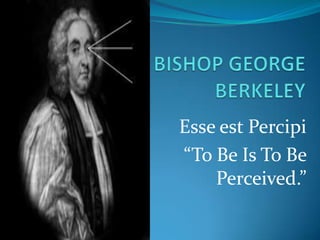
Esse est Percipi
“To Be Is To Be
    Perceived.”
LIFE
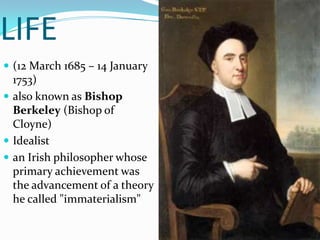
 (12 March 1685 – 14 January
  1753)
 also known as Bishop
  Berkeley (Bishop of
  Cloyne)
 Idealist
 an Irish philosopher whose
  primary achievement was
  the advancement of a theory
  he called "immaterialism"
 This theory contends that individuals
 can only know directly sensations and
 ideas of objects, not abstractions such
 as "matter". The theory also contends
 that ideas are dependent upon being
 perceived by minds for their very
 existence, a belief that became
 immortalized in the dictum, "esse est
 percipi" ("to be is to be perceived")
 His earliest publication was on
  mathematics, but the first that brought him
  notice was his Essay Towards a New Theory
  of Vision, first published in 1709.
 The next publication to appear was the
  Treatise Concerning the Principles of Human
  Knowledge in 1710, which was followed in
  1713 by Three Dialogues between Hylas and
  Philonous.
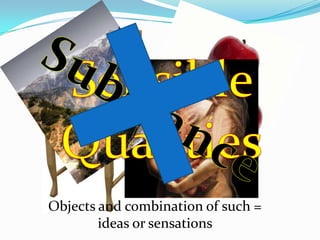
Objects and combination of such =
        ideas or sensations
Material substance do not exist
The analysis of sensible things
 yields nothing but sensible
 qualities
Minds are mental substances and
No sensible quality or collection of
 sensible qualities can exist without
 inhering in some substance.
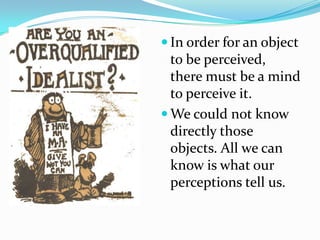
 In order for an object
  to be perceived,
  there must be a mind
  to perceive it.
 We could not know
  directly those
  objects. All we can
  know is what our
  perceptions tell us.
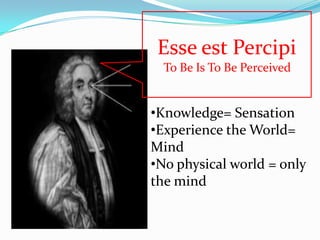
Esse est Percipi
  To Be Is To Be Perceived


•Knowledge= Sensation
•Experience the World=
Mind
•No physical world = only
the mind
What is the color of a
       cloud?
Warm Hand   Cold Hand


              Luke
             Warm
             Water
             inside
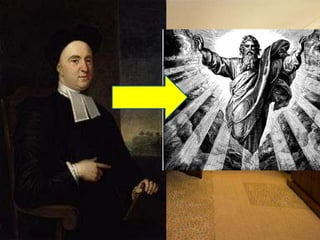
 Berkeley held that all properties of material objects exist
  only in our minds (to be is to be perceived). Since physical
  objects exist even when no one perceives them, then their
  objective existence (when no human mind perceives them)
  implies the God's existence, or, more precisely, existence of
  the God's mind, Berkeley argued.}
 Material substance do not exist
 The analysis of sensible things yields nothing but
  sensible qualities
 Minds are mental substances and
 No sensible quality or collection of sensible qualities
  can exist without inhering in some substance.
COUNTER ARGUMENTS
Verdical (True) Perception
Counter Intuitive
Question of God

Bishop george berkeley

  • 2.
    Esse est Percipi “ToBe Is To Be Perceived.”
  • 3.
    LIFE  (12 March1685 – 14 January 1753)  also known as Bishop Berkeley (Bishop of Cloyne)  Idealist  an Irish philosopher whose primary achievement was the advancement of a theory he called "immaterialism"
  • 4.
     This theorycontends that individuals can only know directly sensations and ideas of objects, not abstractions such as "matter". The theory also contends that ideas are dependent upon being perceived by minds for their very existence, a belief that became immortalized in the dictum, "esse est percipi" ("to be is to be perceived")
  • 5.
     His earliestpublication was on mathematics, but the first that brought him notice was his Essay Towards a New Theory of Vision, first published in 1709.  The next publication to appear was the Treatise Concerning the Principles of Human Knowledge in 1710, which was followed in 1713 by Three Dialogues between Hylas and Philonous.
  • 6.
    Objects and combinationof such = ideas or sensations
  • 8.
    Material substance donot exist The analysis of sensible things yields nothing but sensible qualities Minds are mental substances and No sensible quality or collection of sensible qualities can exist without inhering in some substance.
  • 9.
     In orderfor an object to be perceived, there must be a mind to perceive it.  We could not know directly those objects. All we can know is what our perceptions tell us.
  • 10.
    Esse est Percipi To Be Is To Be Perceived •Knowledge= Sensation •Experience the World= Mind •No physical world = only the mind
  • 11.
    What is thecolor of a cloud?
  • 12.
    Warm Hand Cold Hand Luke Warm Water inside
  • 14.
     Berkeley heldthat all properties of material objects exist only in our minds (to be is to be perceived). Since physical objects exist even when no one perceives them, then their objective existence (when no human mind perceives them) implies the God's existence, or, more precisely, existence of the God's mind, Berkeley argued.}  Material substance do not exist  The analysis of sensible things yields nothing but sensible qualities  Minds are mental substances and  No sensible quality or collection of sensible qualities can exist without inhering in some substance.
  • 15.
    COUNTER ARGUMENTS Verdical (True)Perception Counter Intuitive Question of God