“There is an Indian story -- at least I heard it
as an Indian story -- about an Englishman
who, having been told that the world rested on
a platform which rested on the back of an
elephant which rested in turn on the back of a
turtle, asked (perhaps he was an
ethnographer; it is the way they behave), what
did the turtle rest on? Another turtle. And that
turtle?
‘Ah, Sahib, after that it is turtles all the way
down.’”
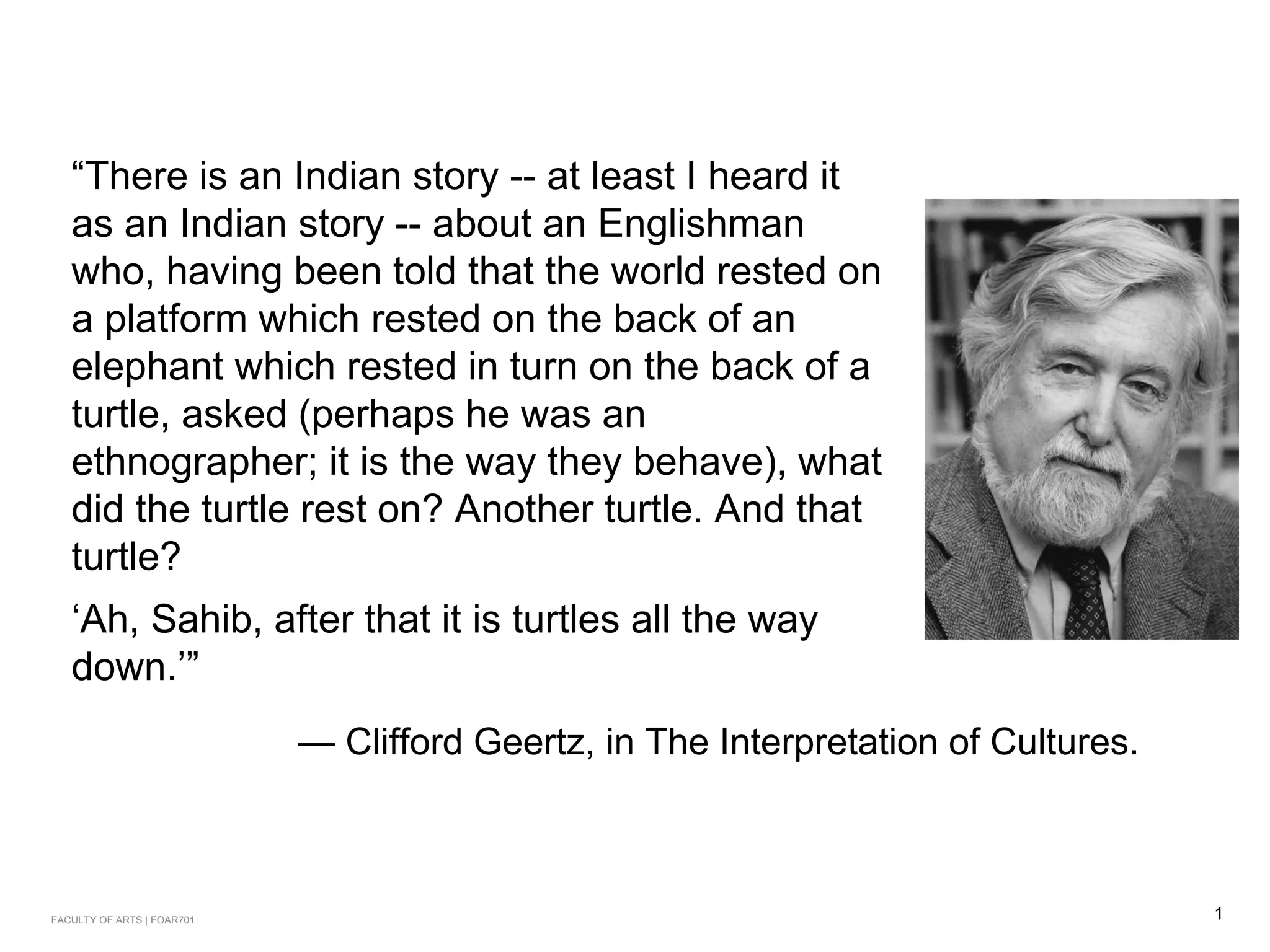
— Clifford Geertz, in The Interpretation of Cultures.
1FACULTY OF ARTS | FOAR701
FOAR701: Research paradigms (2016)
Hermeneutics: overview
2
Greg Downey
Department of Anthropology
Faculty of Arts
Macquarie University
greg.downey@mq.edu.au
Twitter: @gregdowney1
‘social or cultural
constructivism’*
* more on this in the week on interactionism…
FACULTY OF ARTS | FOAR701 3
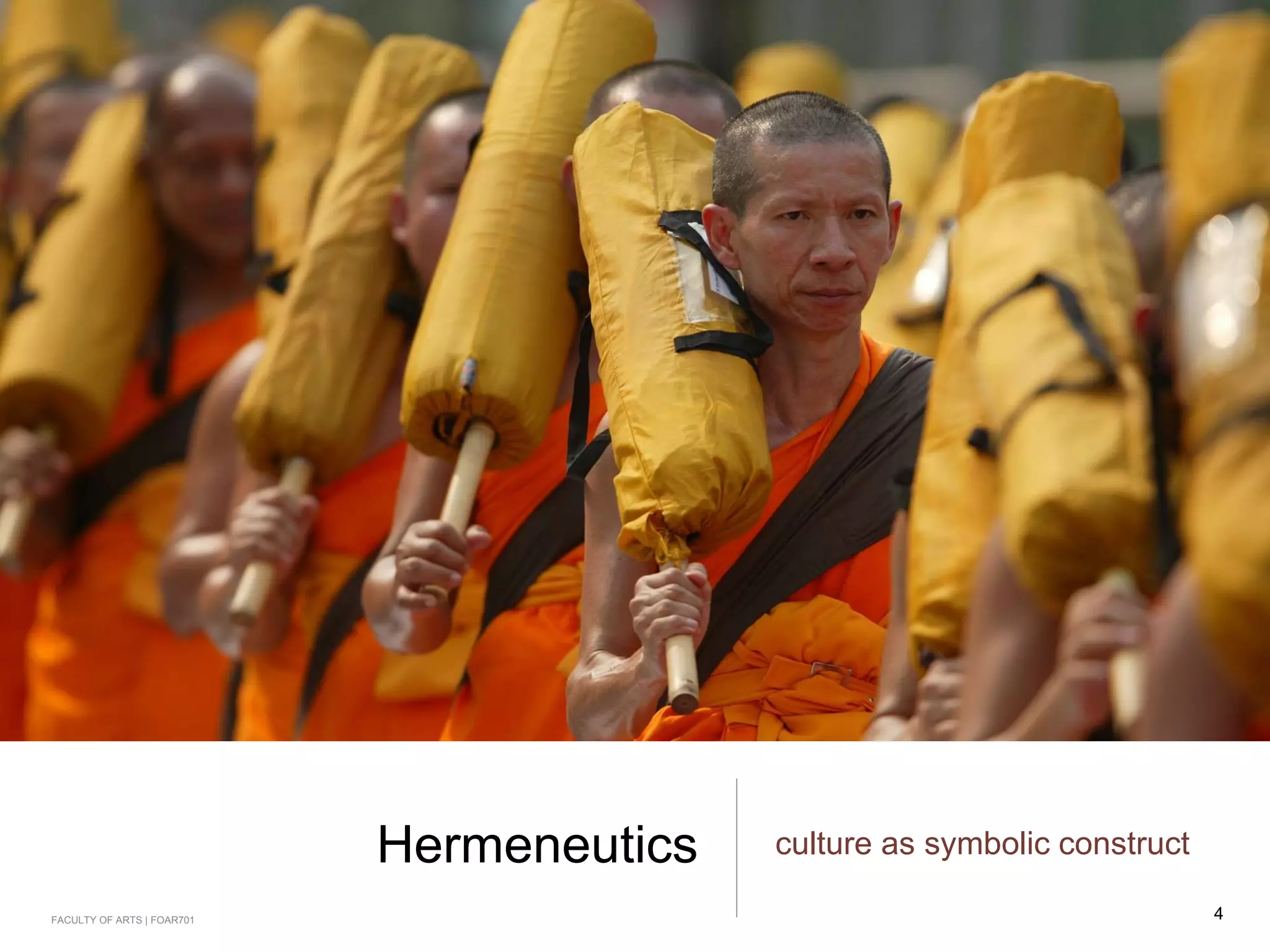
Hermeneutics culture as symbolic construct
FACULTY OF ARTS | FOAR701 4
hermeneutics
FACULTY OF ARTS | FOAR701 5
Culture as ‘text’ But NOT an integrated whole.
6FACULTY OF ARTS | FOAR701
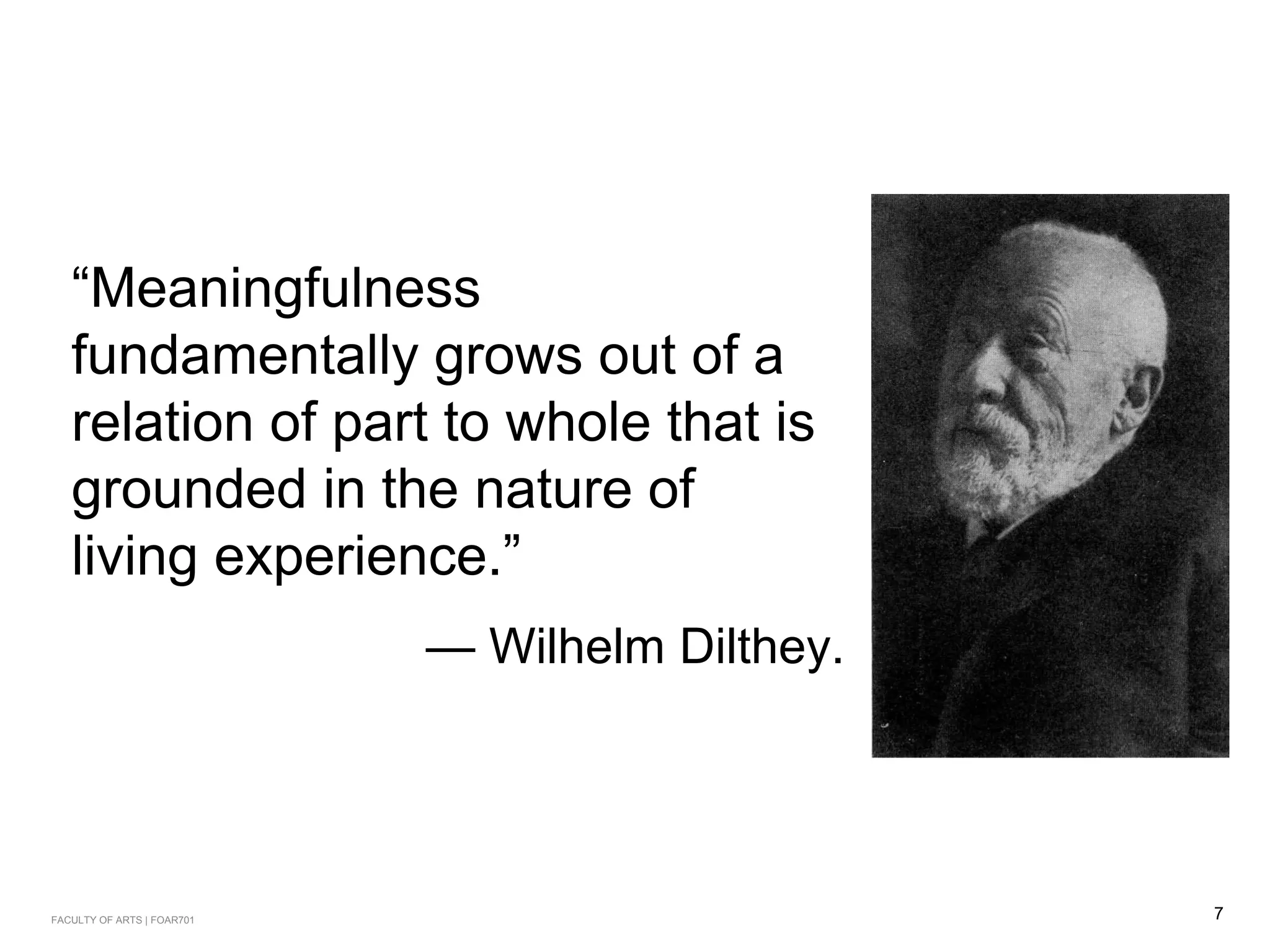
“Meaningfulness
fundamentally grows out of a
relation of part to whole that is
grounded in the nature of
living experience.”
— Wilhelm Dilthey.
7FACULTY OF ARTS | FOAR701
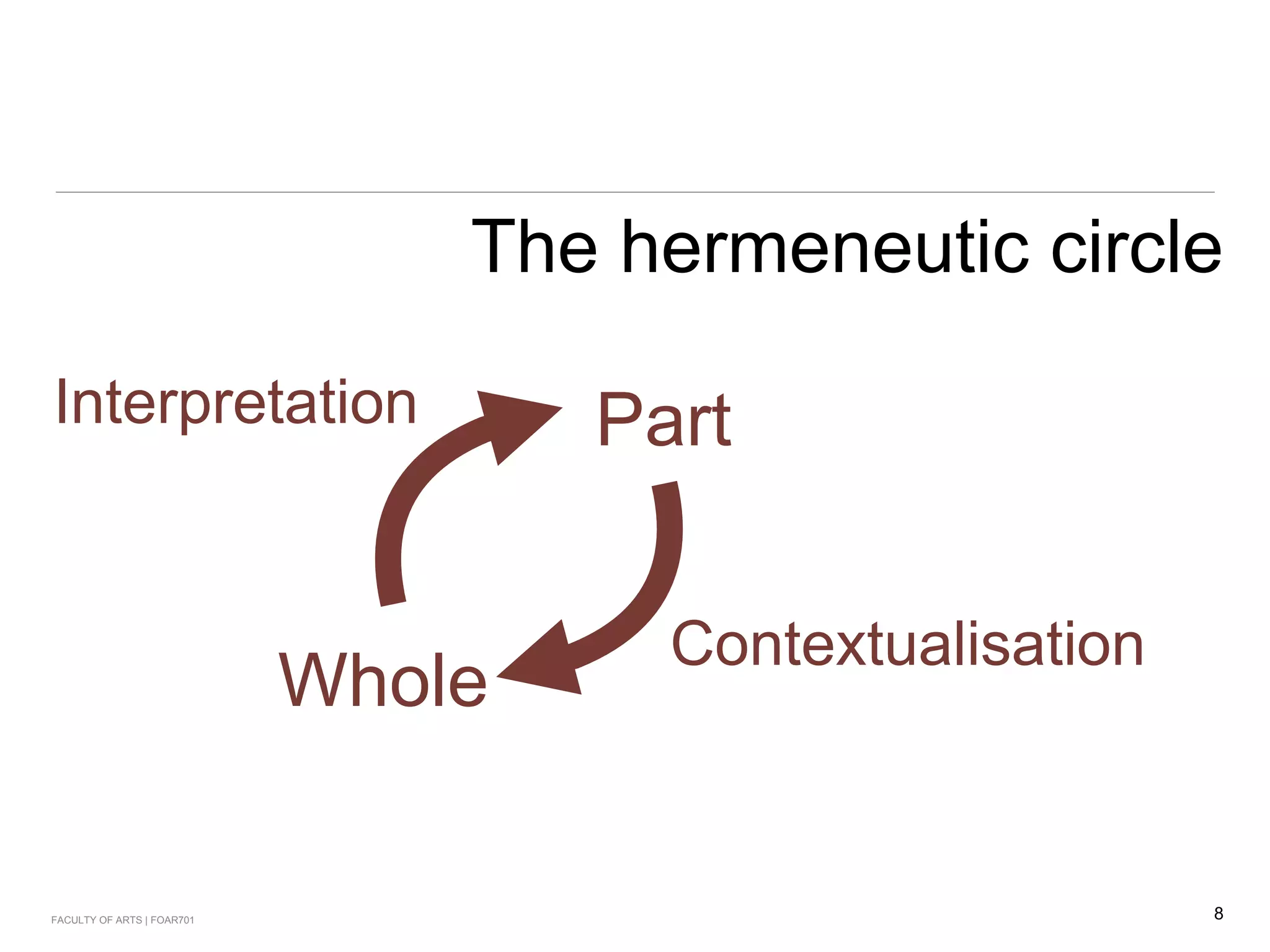
The hermeneutic circle
FACULTY OF ARTS | FOAR701
Part
Whole
Interpretation
Contextualisation
8
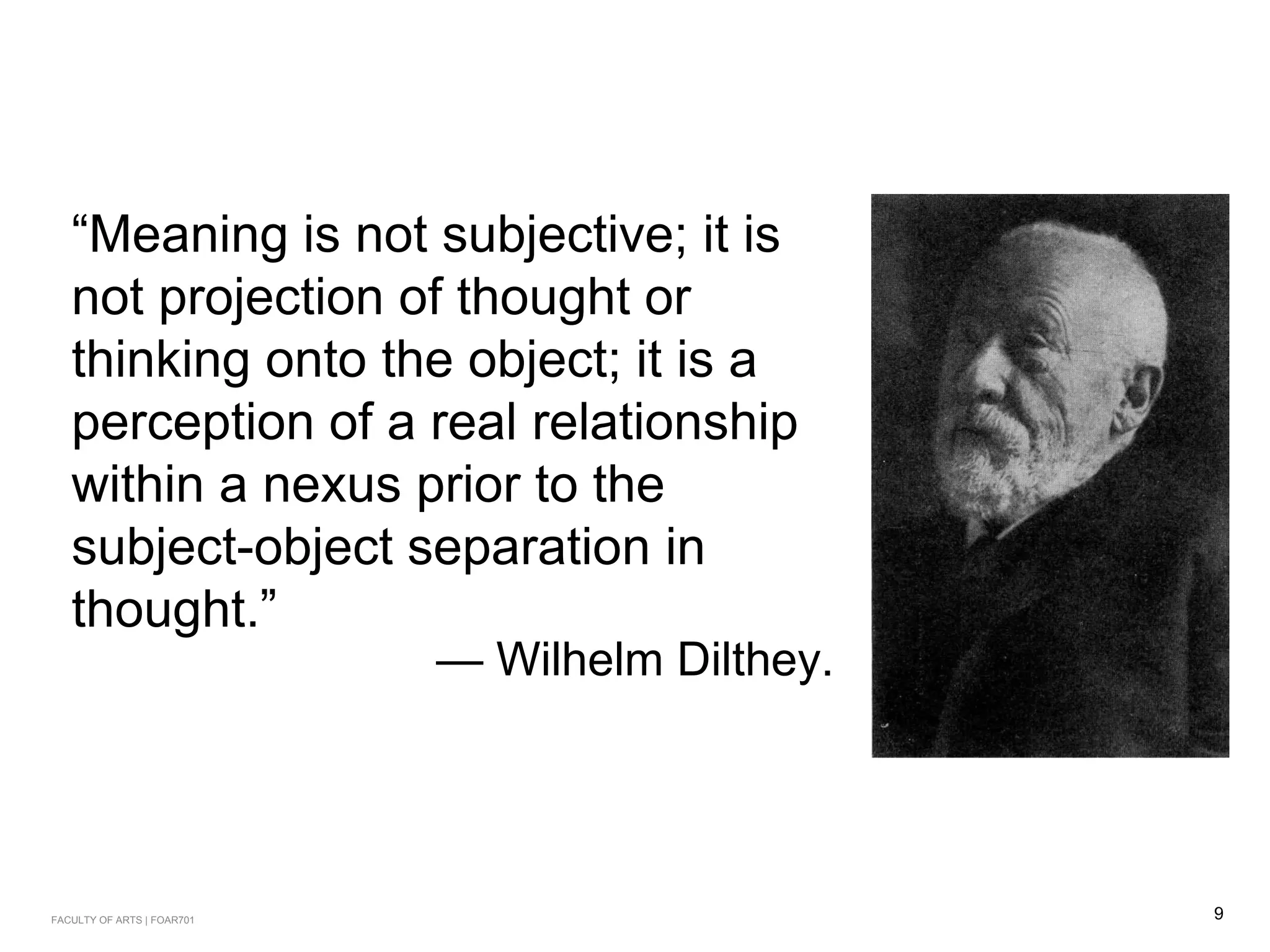
“Meaning is not subjective; it is
not projection of thought or
thinking onto the object; it is a
perception of a real relationship
within a nexus prior to the
subject-object separation in
thought.”
— Wilhelm Dilthey.
9FACULTY OF ARTS | FOAR701
Contextualisation*
* key difference to psychodynamics & structuralism…
10FACULTY OF ARTS | FOAR701
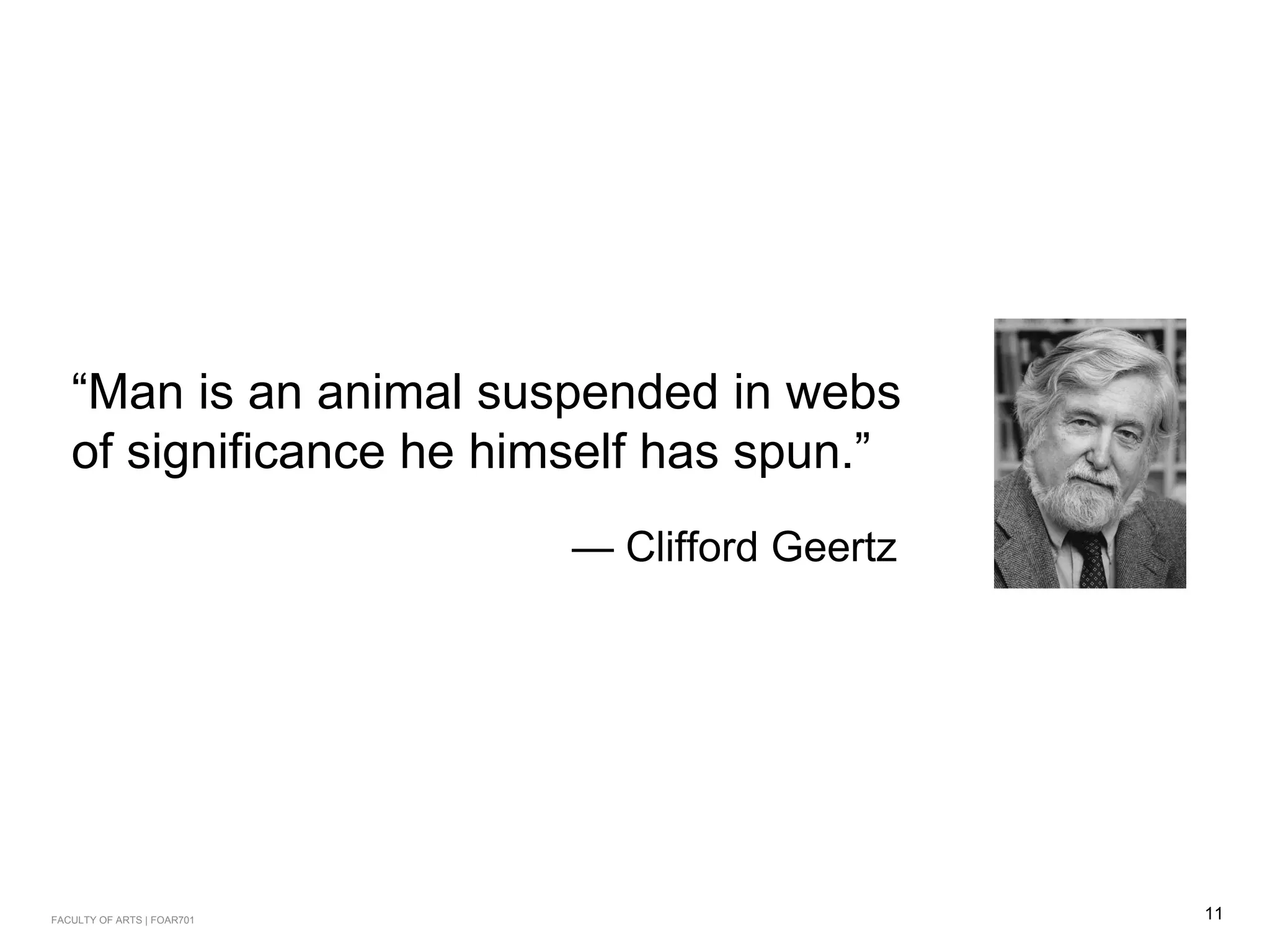
“Man is an animal suspended in webs
of significance he himself has spun.”
— Clifford Geertz
11FACULTY OF ARTS | FOAR701
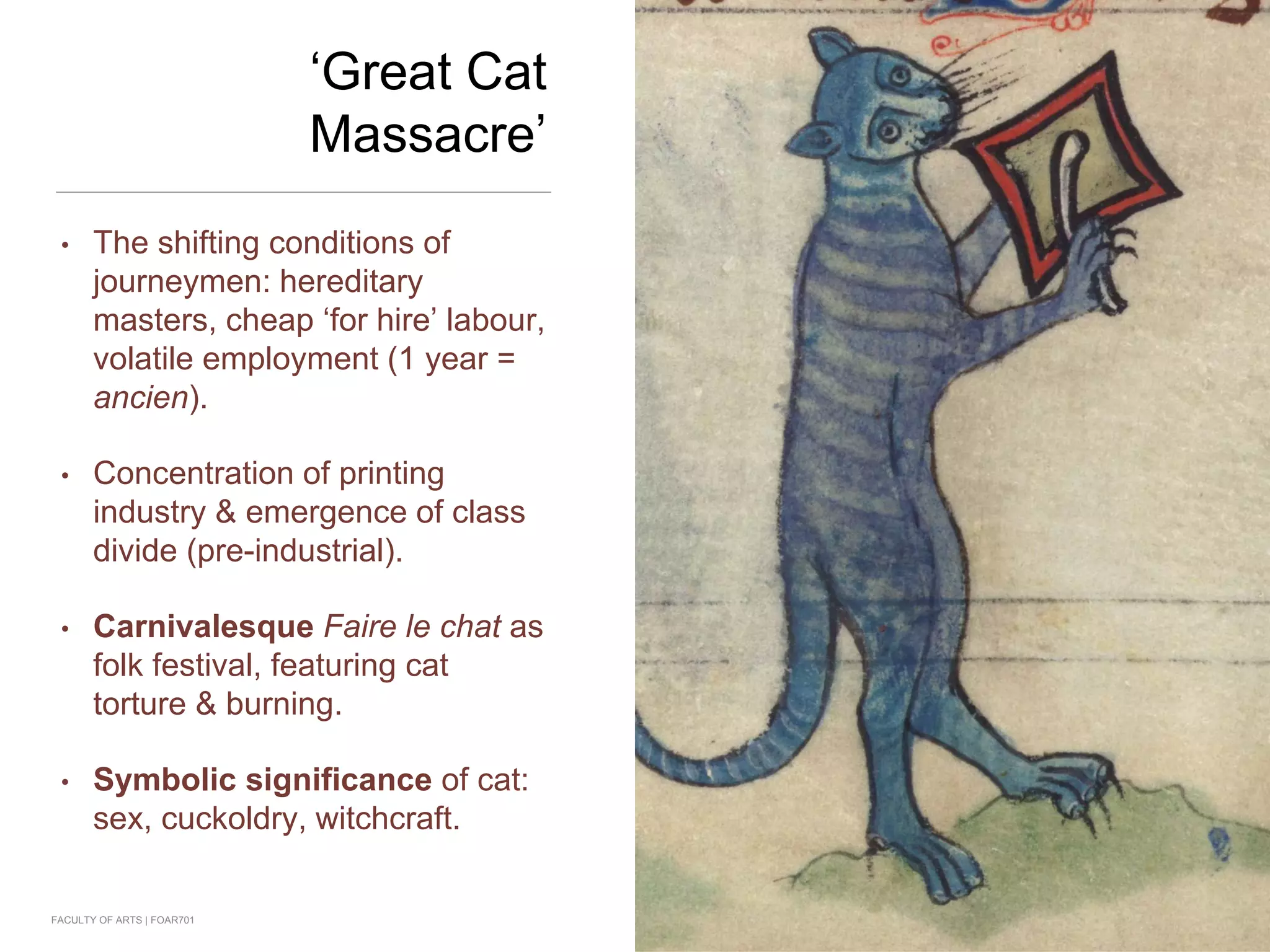
‘Great Cat Massacre’
The starting point is the gap
between contemporaries’
experience (hilarity) & modern
response (revulsion).
Robert Darnton: noticing the gap in
understanding is first step in
interpretation.
12FACULTY OF ARTS | FOAR701
‘Great Cat
Massacre’
• The shifting conditions of
journeymen: hereditary
masters, cheap ‘for hire’ labour,
volatile employment (1 year =
ancien).
• Concentration of printing
industry & emergence of class
divide (pre-industrial).
• Carnivalesque Faire le chat as
folk festival, featuring cat
torture & burning.
• Symbolic significance of cat:
sex, cuckoldry, witchcraft.
FACULTY OF ARTS | FOAR701
Darnton on the cat massacre
• The workers’ activities (hunt, trial,
executions) were symbolic
theatre.
• The meanings were not even
available to the bourgeois.
• Merged popular expressive
forms: charivari, witch burning,
defensive maiming, mock
sabbath, fête of Saint John the
Baptist…
• Popular act scrutinised like
literary work.
14FACULTY OF ARTS | FOAR701
Clifford Geertz, hermeneutical
analysis of the Balinese
cockfight.
Symbolic anthropology
FACULTY OF ARTS | FOAR701 15
Clifford Geertz and ‘symbolic anthropology’
• Symbols are not merely mental but
public and shared.
• Transmit meaning by links to other
symbols (model is language).
• Key to approach the ‘native’s point
of view’ (‘emic’ perspective, v. etic).
Symbols are gateway to worldview.
• Explicitly rejects functionalism
(unlike some symbolic research).
16FACULTY OF ARTS | FOAR701
Deep Play: Notes on
Geertz
Cock as polysemous symbol:
masculinity, sexuality, animality,
status, demonic, group identity.
Cockfight is a cultural form through
which the Balinese reflect on
themselves.
FACULTY OF ARTS | FOAR701
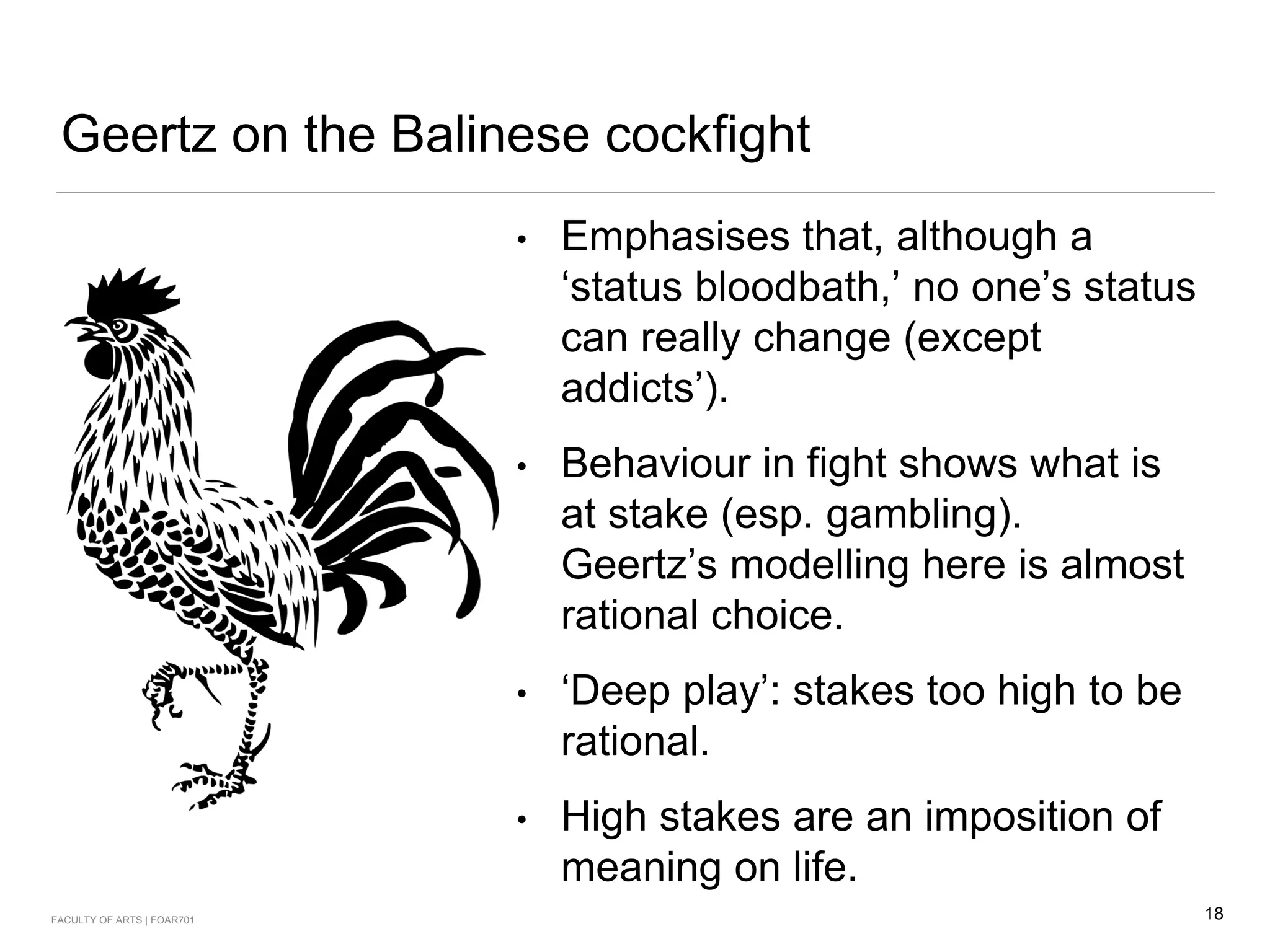
Geertz on the Balinese cockfight
• Emphasises that, although a
‘status bloodbath,’ no one’s status
can really change (except
addicts’).
• Behaviour in fight shows what is
at stake (esp. gambling).
Geertz’s modelling here is almost
rational choice.
• ‘Deep play’: stakes too high to be
rational.
• High stakes are an imposition of
meaning on life.
18FACULTY OF ARTS | FOAR701
FACULTY OF ARTS | FOAR701
Geertz on interpreting the Balinese cockfight
‘… the Balinese peasants
themselves are quite aware of all
this and can, at least to an
ethnographer, do state most of it in
approximately the same terms as I
have. Fighting cocks, almost every
Balinese I have ever discussed the
subject with has said, is like playing
with fire only not getting burned.’
— Clifford Geertz, in ‘Deep Play’ (2005: 77)
20FACULTY OF ARTS | FOAR701
Geertz on interpreting the Balinese cockfight
‘An image, fiction, a model, a
metaphor, the cockfight is a means
of expression; its function is neither
to assuage social passions nor to
heighten them (though, in its play-
with-fire way, it does a bit of both),
but, in a medium of feathers, blood,
crowds, and money, to display
them.’
— Clifford Geertz, in ‘Deep Play’ (2005: 79)
21FACULTY OF ARTS | FOAR701
Geertz on interpreting the Balinese cockfight
‘Its function, if you want to call it
that, is interpretive: it is a Balinese
reading of Balinese experience; a
story they tell themselves about
themselves.’
— Clifford Geertz, in ‘Deep Play’ (2005: 79)
22FACULTY OF ARTS | FOAR701
Symbols as polysemous
• Multiple significances.
• Incompleteness: necessity of
interpretation.
• Victor Turner: exegetical,
operational & positional
meanings stretching from
normative to sensory.
• Myth & ritual crucial to
understanding.
23FACULTY OF ARTS | FOAR701
Dominant or ‘axiomatic’ symbols (V. Turner)
• Combine three properties:
• Condensation of multiple
meanings and referrants,
• Unification of disparate
significata, and
• Polarisation of meaning.
(Freudian symbolic theory still
influential within hermeneutics.)
24FACULTY OF ARTS | FOAR701
Rapid overview
symptom is private symbols are
public
interpretation
requires
uncovering past
trauma
interpretation
requires following
links in play
FACULTY OF ARTS | FOAR701 25
Rapid overview
subject is
unconscious
subject can
volunteer
interpretation
significance is
ultimately
idiosyncratic &
specific
symbol is
polysemic &
shared
FACULTY OF ARTS | FOAR701 26
“The culture of people is an ensemble
of texts, themselves ensembles, which
the anthropologist strains to read over
the shoulders of those to whom they
properly belong. There are enormous
difficulties in such an enterprise,
methodological pitfalls to make a
Freudian quake, and some moral
perplexities as well….”
— Clifford Geertz, in ‘Deep Play’ (2005: 86).
27FACULTY OF ARTS | FOAR701
goal?
empathy based on situating
activity or expression in
context.
“… But to regard such forms as
‘saying something of something,’
and saying it to somebody, is at
least to open up the possibility of an
analysis which attends to their
substance rather than to reductive
formulas professing to account for
them.”
— Clifford Geertz, in ‘Deep Play’ (2005: 86).
29FACULTY OF ARTS | FOAR701
‘Thick Description’
From philosopher Gilbert Ryle,
developed by Geertz.
Description requires an
understanding of the context in
which a practice, act or symbol is
meaningful.
30FACULTY OF ARTS | FOAR701
Philosophical roots: the
‘hermeneutic turn’
Very brief review…
FACULTY OF ARTS | FOAR701 32
Martin Heidegger
• In Sein und Zeit (1927),
Heidegger rejects Cartesian
attempt to build solid foundation
for knowledge in
consciousness.
• The subject is Dasein, ‘being
there’: determined by world.
• Our relationship to the world is
through ‘understanding’ in
immediate, practical sense (no
objective knowledge).
• Hermeneutic circle: experience
of all meaning from projection.
FACULTY OF ARTS | FOAR701
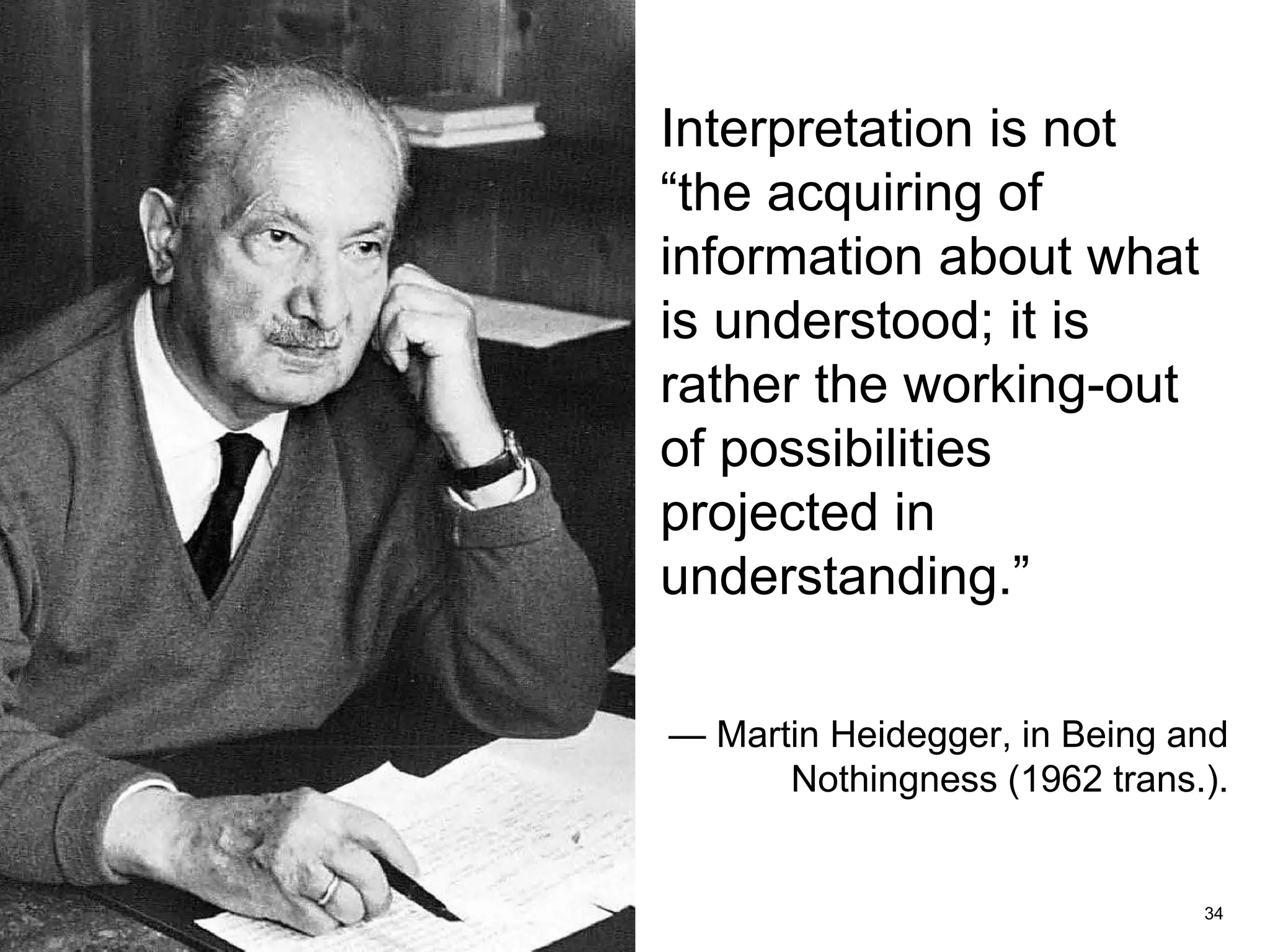
Interpretation is not
“the acquiring of
information about what
is understood; it is
rather the working-out
of possibilities
projected in
understanding.”
— Martin Heidegger, in Being and
Nothingness (1962 trans.).
34FACULTY OF ARTS | FOAR701
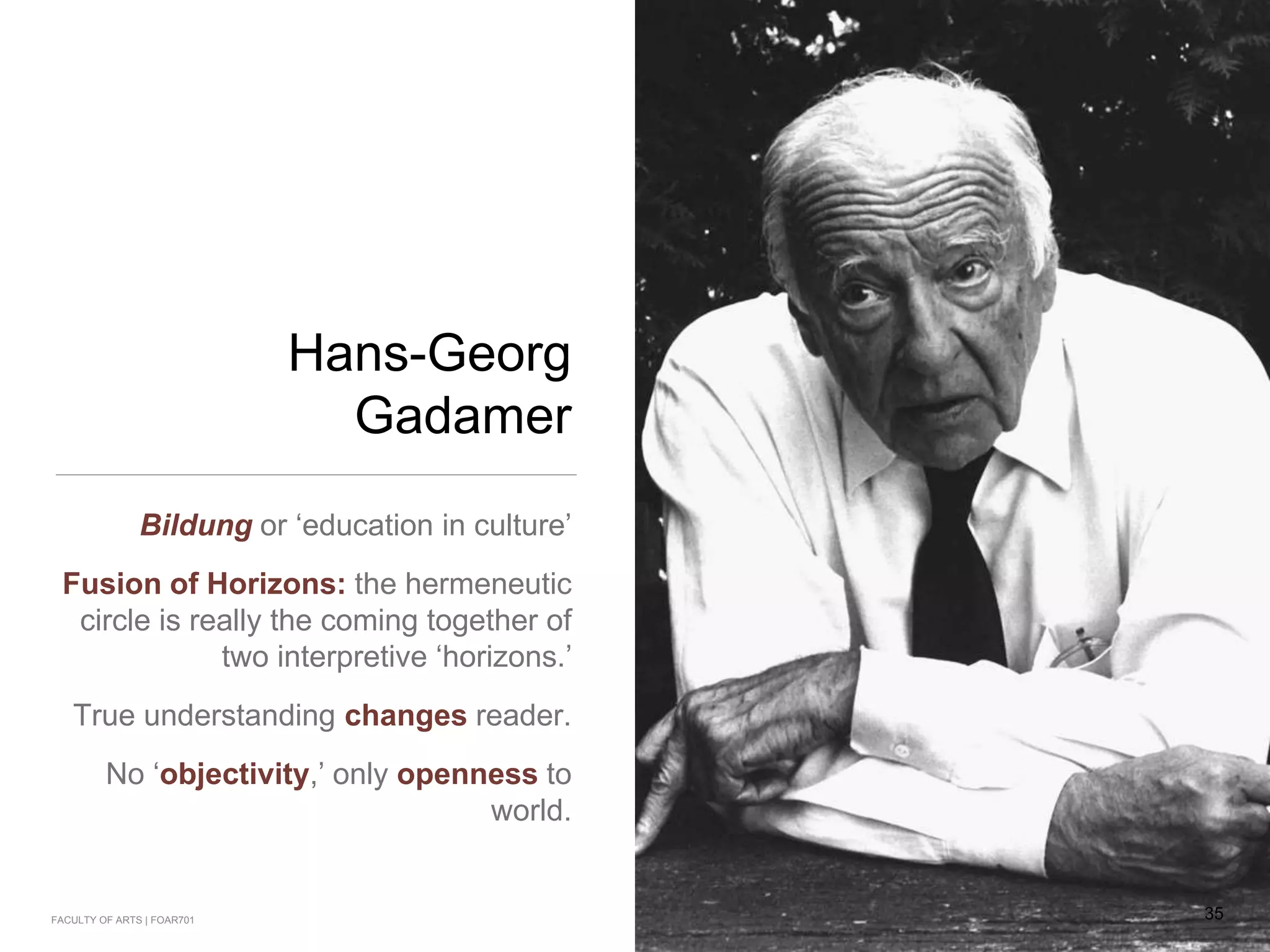
Hans-Georg
Gadamer
Bildung or ‘education in culture’
Fusion of Horizons: the hermeneutic
circle is really the coming together of
two interpretive ‘horizons.’
True understanding changes reader.
No ‘objectivity,’ only openness to
world.
35FACULTY OF ARTS | FOAR701
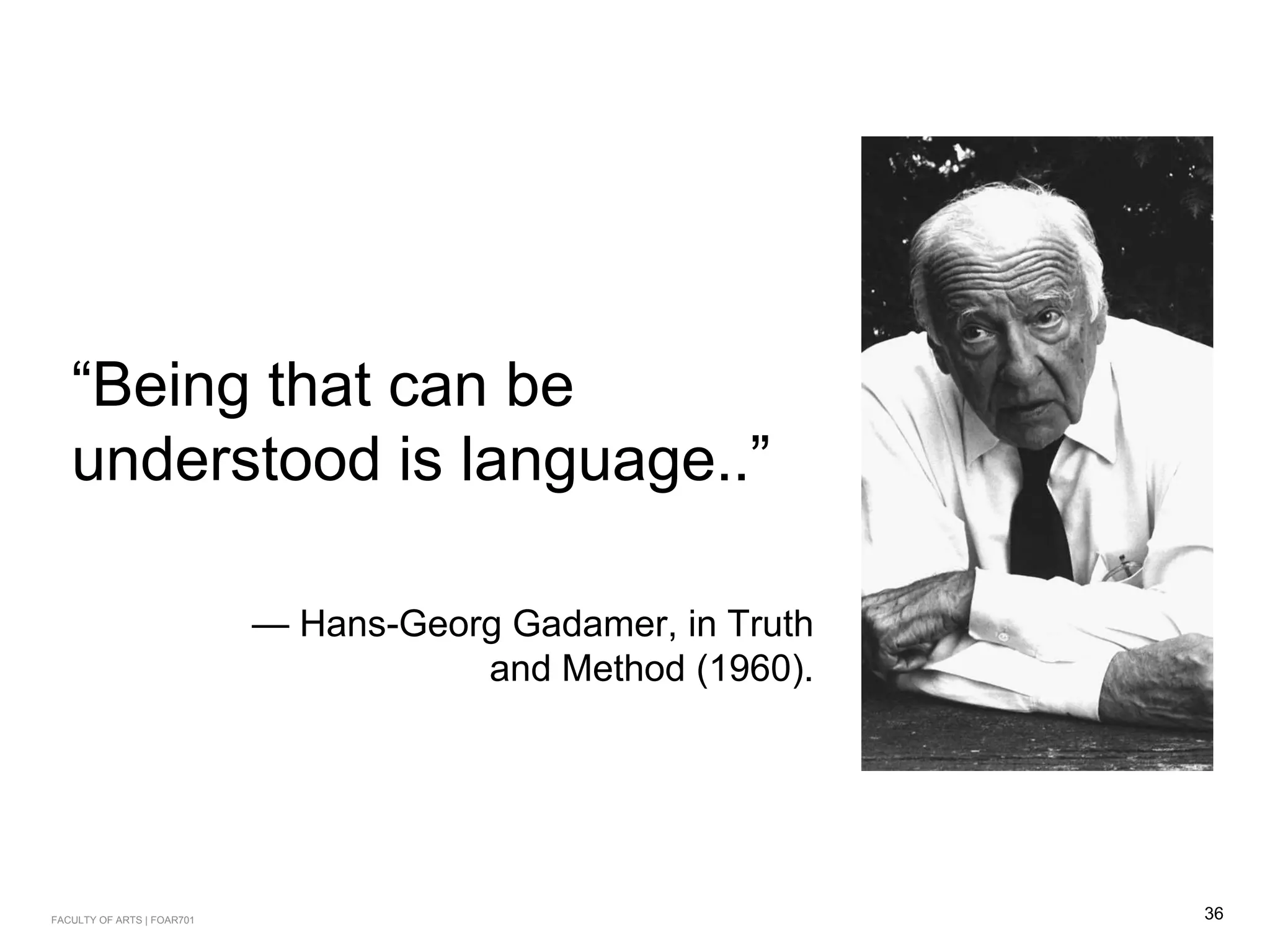
“Being that can be
understood is language..”
— Hans-Georg Gadamer, in Truth
and Method (1960).
36FACULTY OF ARTS | FOAR701
Key components of hermeneutic paradigm
• The act of interpretation is both methodological and ontological.
• Interpretive method eclectic and often relies on individual insight (as well
as drawing fairly promiscuously from other paradigms).
• Symbolic or interpretive analysis invariably draws in context (contrasts with
structuralism and cognitive approaches).
• Goal is understanding not explanation (empathy v. causation).
• The use of misunderstanding, incomprehensibility and even shock as a
tool for exposing one’s own symbolic ‘prejudices.’
FACULTY OF ARTS | FOAR701 37
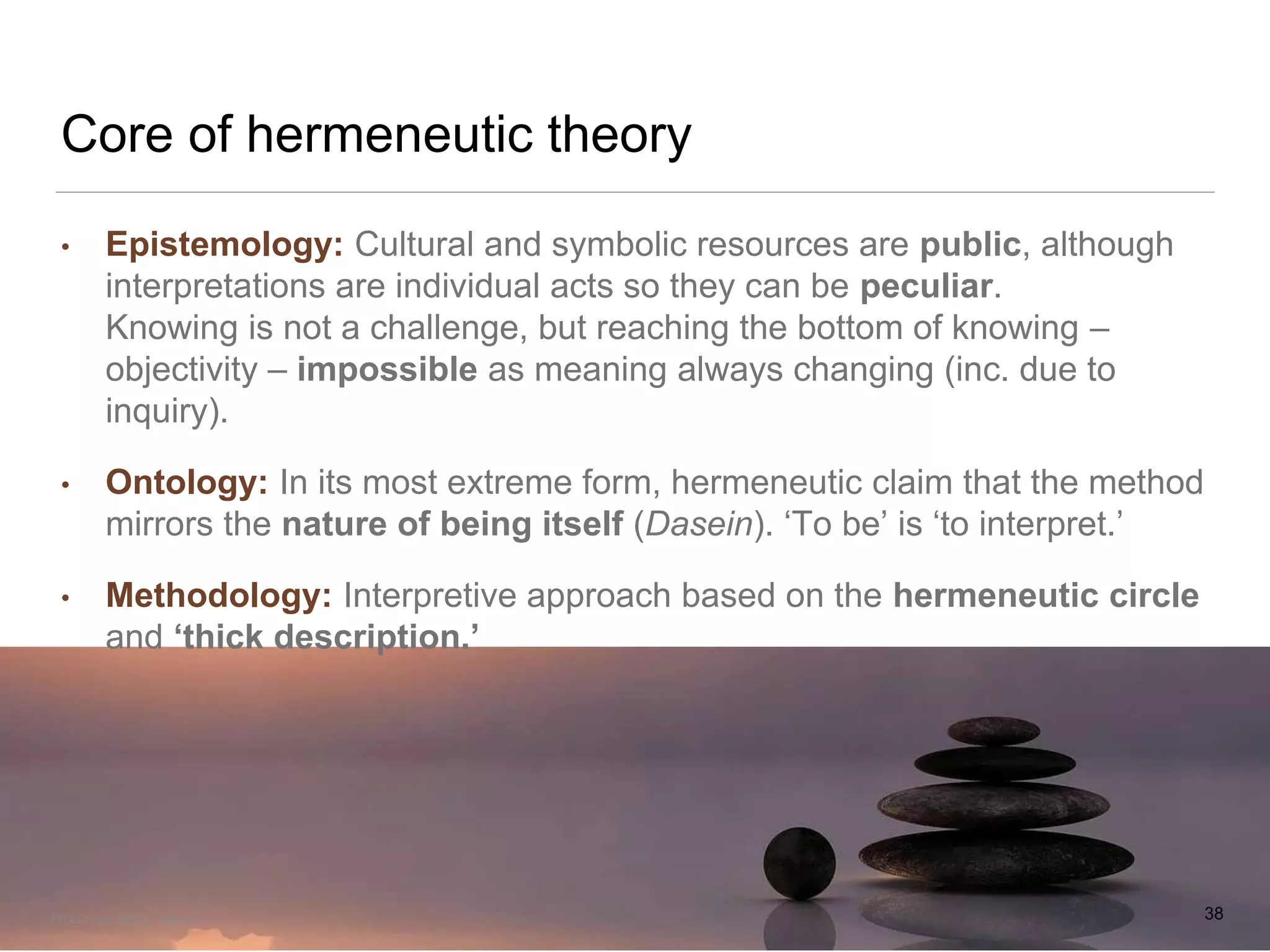
Core of hermeneutic theory
• Epistemology: Cultural and symbolic resources are public, although
interpretations are individual acts so they can be peculiar.
Knowing is not a challenge, but reaching the bottom of knowing –
objectivity – impossible as meaning always changing (inc. due to
inquiry).
• Ontology: In its most extreme form, hermeneutic claim that the method
mirrors the nature of being itself (Dasein). ‘To be’ is ‘to interpret.’
• Methodology: Interpretive approach based on the hermeneutic circle
and ‘thick description.’
38FACULTY OF ARTS | FOAR701
“Cultural analysis is intrinsically
incomplete. And, worse than that, the
more deeply it goes the less complete it
is.”
— Clifford Geertz
39FACULTY OF ARTS | FOAR701
Strengths of hermeneutic paradigm
• Radically relativist (in some forms, e.g. Gadamer) so it builds a
moral mission for understanding as bridging human divides.
• Grapples with cultural variation better than any other
perspective we’ve had to this point. (Doesn’t pathologise
difference or suffer from ethnocentrism.)
• Also highlights competing voices and interpretations.
• Takes seriously subjects’ own capacity to know their worlds
(not a ‘hermeneutics of suspicion’).
• Puts an emphasis on the quality of writing and exposition
(clearly seen in Geertz’s article).
Rather than aping natural sciences & striving for false
‘objectivity.’
FACULTY OF ARTS | FOAR701 40
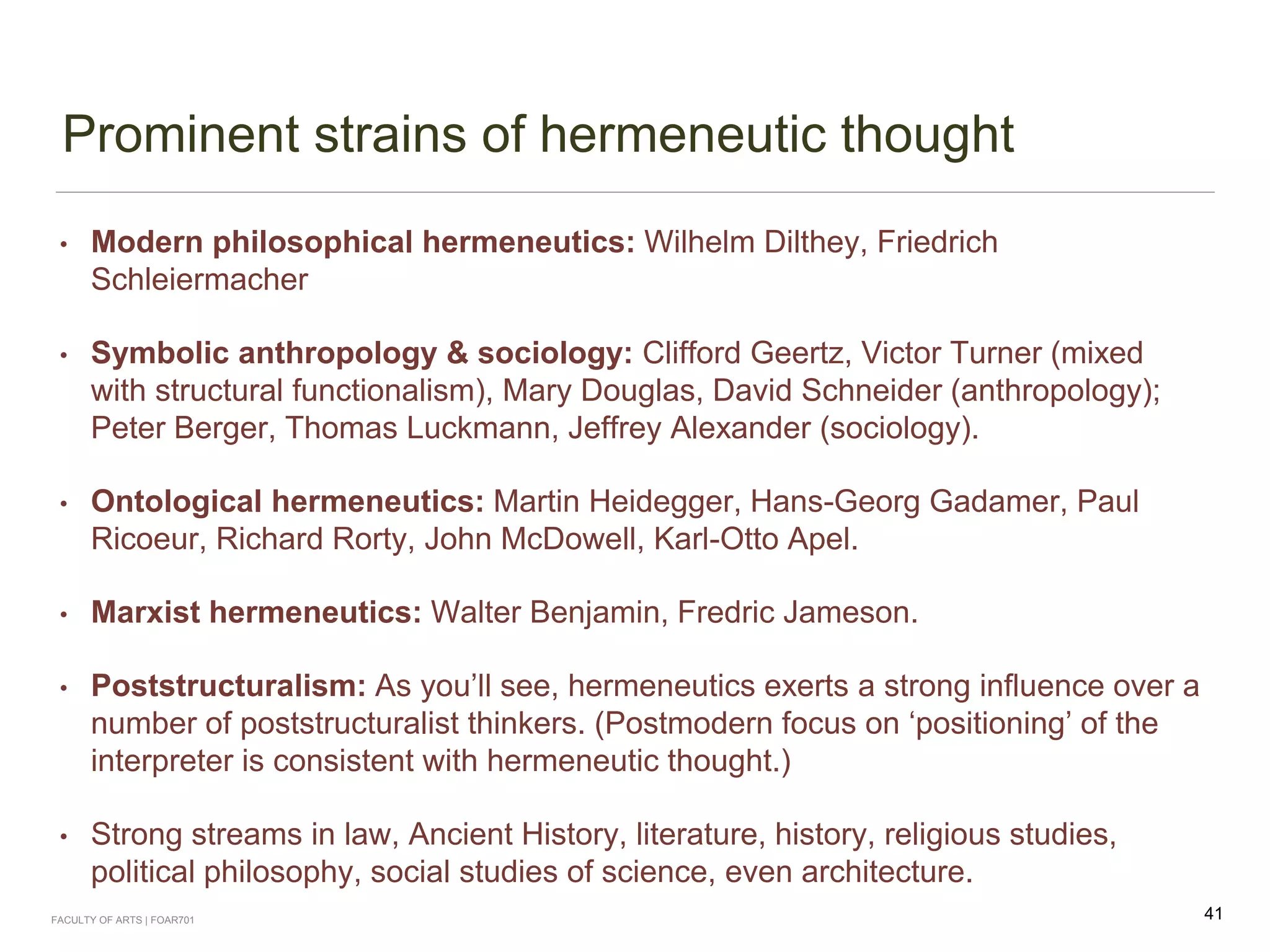
Prominent strains of hermeneutic thought
• Modern philosophical hermeneutics: Wilhelm Dilthey, Friedrich
Schleiermacher
• Symbolic anthropology & sociology: Clifford Geertz, Victor Turner (mixed
with structural functionalism), Mary Douglas, David Schneider (anthropology);
Peter Berger, Thomas Luckmann, Jeffrey Alexander (sociology).
• Ontological hermeneutics: Martin Heidegger, Hans-Georg Gadamer, Paul
Ricoeur, Richard Rorty, John McDowell, Karl-Otto Apel.
• Marxist hermeneutics: Walter Benjamin, Fredric Jameson.
• Poststructuralism: As you’ll see, hermeneutics exerts a strong influence over a
number of poststructuralist thinkers. (Postmodern focus on ‘positioning’ of the
interpreter is consistent with hermeneutic thought.)
• Strong streams in law, Ancient History, literature, history, religious studies,
political philosophy, social studies of science, even architecture.
FACULTY OF ARTS | FOAR701 41
Criticism of hermeneutic approach
• Ultimately, makes analysis a descriptive exercise; does not
lend itself to general theoretical or predictive formulations.
• Unfalsifiable interpretive exercise (similar to psychoanalysis).
Are all potential interpretations really in play?
• Seems to rely heavily on individual insightfulness of the
analyst rather than offering systematic tool.
Even Geertz says: ‘guessing at meanings’ and then
assessing guesses.
• How is ‘context’ ever delimited in any meaningful way?
• Been criticised as anti-materialist and ignoring inequality by
other perspectives (Marxist, post-structuralist, scientific).
FACULTY OF ARTS | FOAR701 42
Criticism of hermeneutic approach
• Creates unbridgeable gap between humanity and
science, places social sciences on an ‘arts’
foundation.
• What happens when your subjects insist something is
‘meaningless’ or offer an interpretation you suspect is,
well, wrong? (resolving the emic/etic conflict)
• Odd when treating culture as ‘text’ undermines actual
ability to evaluate and critique texts (because they
can only be understood or evaluated in context).
• Problem of the relationship between language and the
non-linguistic (action, for example).
FACULTY OF ARTS | FOAR701 43
Thanks for your
attention!
Bibliography online at iLearn
Photos public domain at Pixabay
or as indicated.
FACULTY OF ARTS | FOAR701 44
Additional readings (philosophy)
Bruns, Gerald. 1992. Hermeneutics. Ancient and Modern. New Haven: Yale University Press.
Dilthey, Wilhelm. 1989. Introduction to the Human Sciences. Eds. Rudolf A. Makkreel and Frithjof Rodi.
Princeton, New Jersey: Princeton University Press.
Gadamer, Hans-Georg. 1976. Philosophical Hermeneutics. Trans. David E. Linge. Berkeley: University of
California Press.
Gadamer, Hans-Georg. 1994. Truth and Method. Trans. Joel Weinsheimer and Donald G. Marshall. New
York: Continuum.
Habermas, Jürgen. “The Hermeneutic Claim to Universality.” Trans. Joseph Bleicher. Ormiston and Schrift,
245-272.
Heidegger, Martin. 1962. Being and Time. Trans. John Macquarrie and Edward Robinson. San Francisco:
Harper.
Ricoeur, Paul. 1981. Hermeneutics and the Human Sciences: Essays on Language, Action and Interpretation.
Trans. John B. Thompson. Cambridge: Cambridge University Press.
Rorty, Richard. 1991. Essays on Heidegger and Others. Cambridge: Cambridge University Press.
Schleiermacher, Friedrich. 1998. Hermeneutics and Criticism. Ed. and trans. Andrew Bowie. Cambridge:
Cambridge University Press.
Vico, Giambattista. 1984. The New Science of Giambattista Vico. Trans. Thomas Goddard Bergin and Max
Harold Fisch. Ithaca: Cornell University Press.
FACULTY OF ARTS | FOAR701 45
Additional readings (anthro, soc, STS)
Alexander, Jeffrey C. 2003. “The Strong Program in Cultural Sociology: Elements of a Structural Hermeneutics (with Philip Smith),”
in The Meanings of Social Life: A Cultural Sociology. New York: Oxford University Press.
Basso, Keith. 1976. ”’Wise Words’ of the Western Apache: Metaphor and Semantic Theory,” in Meaning in Anthropology, ed. Keith
Basso and Henry Selby (Albuquerque,N.M.), pp. 93-122.
Berger, P.L. and Luckmann, T., 1991. The social construction of reality: A treatise in the sociology of knowledge. (No. 10). Penguin
UK.
Boland, R. J. (1991). Information system use as a hermeneutic process. In H. E. Nissen, H. K. Klein, & R. Hirschheim, (Eds.).
Information systems research: contemporary approaches and emergent traditions (pp. 439-458). Amsterdam: Elsevier Science
Publishers B.V., North Holland
Danforth, Loring M. 1982. The Death Rituals of Rural Greece. Princeton,N.J.: Princeton University Press.
Daniel, E. Valentine. 1984. Fluid Signs: Being a Person the Tamil Way. Berkeley and Los Angeles: U of California Press.
Dolgin, Janet L., David S. Kemnitzer, and David M. Schneider, eds. 1977. Symbolic Anthropology: A Reader in the Study of
Symbols and Meanings. New York.
Douglas, Mary. 1966. Purity and Danger: An analysis of the concepts of pollution and taboo. London: Rutledge and Kegan Paul.
____. 1970. Natural Symbols: Explorations in Cosmology. New York: Pantheon Books.
Geertz, Clifford. 1973. The Interpretation of Cultures. New York: Basic Books.
____. (1983). Local knowledge: Further essays in interpretive anthropology. New York, NY: Basic Books.
Turner, Victor. 1967. The Forest of Symbols: Aspects of Ndembu Ritual. Ithaca, NY: Cornell University Press.
Rheingold, H. 1993. The virtual community: Homesteading on the electronic frontier. Reading, MA: Addison-Wesley.
Sherratt, Yvonne. 2006. Continental philosophy of social science: hermeneutics, genealogy, critical theory. Cambridge and New
York: Cambridge University Press.
FACULTY OF ARTS | FOAR701 46
Hermeneutics overview

Hermeneutics overview

  • 1.
    “There is anIndian story -- at least I heard it as an Indian story -- about an Englishman who, having been told that the world rested on a platform which rested on the back of an elephant which rested in turn on the back of a turtle, asked (perhaps he was an ethnographer; it is the way they behave), what did the turtle rest on? Another turtle. And that turtle? ‘Ah, Sahib, after that it is turtles all the way down.’” — Clifford Geertz, in The Interpretation of Cultures. 1FACULTY OF ARTS | FOAR701
  • 2.
    FOAR701: Research paradigms(2016) Hermeneutics: overview 2 Greg Downey Department of Anthropology Faculty of Arts Macquarie University greg.downey@mq.edu.au Twitter: @gregdowney1
  • 3.
    ‘social or cultural constructivism’* *more on this in the week on interactionism… FACULTY OF ARTS | FOAR701 3
  • 4.
    Hermeneutics culture assymbolic construct FACULTY OF ARTS | FOAR701 4
  • 5.
  • 6.
    Culture as ‘text’But NOT an integrated whole. 6FACULTY OF ARTS | FOAR701
  • 7.
    “Meaningfulness fundamentally grows outof a relation of part to whole that is grounded in the nature of living experience.” — Wilhelm Dilthey. 7FACULTY OF ARTS | FOAR701
  • 8.
    The hermeneutic circle FACULTYOF ARTS | FOAR701 Part Whole Interpretation Contextualisation 8
  • 9.
    “Meaning is notsubjective; it is not projection of thought or thinking onto the object; it is a perception of a real relationship within a nexus prior to the subject-object separation in thought.” — Wilhelm Dilthey. 9FACULTY OF ARTS | FOAR701
  • 10.
    Contextualisation* * key differenceto psychodynamics & structuralism… 10FACULTY OF ARTS | FOAR701
  • 11.
    “Man is ananimal suspended in webs of significance he himself has spun.” — Clifford Geertz 11FACULTY OF ARTS | FOAR701
  • 12.
    ‘Great Cat Massacre’ Thestarting point is the gap between contemporaries’ experience (hilarity) & modern response (revulsion). Robert Darnton: noticing the gap in understanding is first step in interpretation. 12FACULTY OF ARTS | FOAR701
  • 13.
    ‘Great Cat Massacre’ • Theshifting conditions of journeymen: hereditary masters, cheap ‘for hire’ labour, volatile employment (1 year = ancien). • Concentration of printing industry & emergence of class divide (pre-industrial). • Carnivalesque Faire le chat as folk festival, featuring cat torture & burning. • Symbolic significance of cat: sex, cuckoldry, witchcraft. FACULTY OF ARTS | FOAR701
  • 14.
    Darnton on thecat massacre • The workers’ activities (hunt, trial, executions) were symbolic theatre. • The meanings were not even available to the bourgeois. • Merged popular expressive forms: charivari, witch burning, defensive maiming, mock sabbath, fête of Saint John the Baptist… • Popular act scrutinised like literary work. 14FACULTY OF ARTS | FOAR701
  • 15.
    Clifford Geertz, hermeneutical analysisof the Balinese cockfight. Symbolic anthropology FACULTY OF ARTS | FOAR701 15
  • 16.
    Clifford Geertz and‘symbolic anthropology’ • Symbols are not merely mental but public and shared. • Transmit meaning by links to other symbols (model is language). • Key to approach the ‘native’s point of view’ (‘emic’ perspective, v. etic). Symbols are gateway to worldview. • Explicitly rejects functionalism (unlike some symbolic research). 16FACULTY OF ARTS | FOAR701
  • 17.
    Deep Play: Noteson Geertz Cock as polysemous symbol: masculinity, sexuality, animality, status, demonic, group identity. Cockfight is a cultural form through which the Balinese reflect on themselves. FACULTY OF ARTS | FOAR701
  • 18.
    Geertz on theBalinese cockfight • Emphasises that, although a ‘status bloodbath,’ no one’s status can really change (except addicts’). • Behaviour in fight shows what is at stake (esp. gambling). Geertz’s modelling here is almost rational choice. • ‘Deep play’: stakes too high to be rational. • High stakes are an imposition of meaning on life. 18FACULTY OF ARTS | FOAR701
  • 19.
    FACULTY OF ARTS| FOAR701
  • 20.
    Geertz on interpretingthe Balinese cockfight ‘… the Balinese peasants themselves are quite aware of all this and can, at least to an ethnographer, do state most of it in approximately the same terms as I have. Fighting cocks, almost every Balinese I have ever discussed the subject with has said, is like playing with fire only not getting burned.’ — Clifford Geertz, in ‘Deep Play’ (2005: 77) 20FACULTY OF ARTS | FOAR701
  • 21.
    Geertz on interpretingthe Balinese cockfight ‘An image, fiction, a model, a metaphor, the cockfight is a means of expression; its function is neither to assuage social passions nor to heighten them (though, in its play- with-fire way, it does a bit of both), but, in a medium of feathers, blood, crowds, and money, to display them.’ — Clifford Geertz, in ‘Deep Play’ (2005: 79) 21FACULTY OF ARTS | FOAR701
  • 22.
    Geertz on interpretingthe Balinese cockfight ‘Its function, if you want to call it that, is interpretive: it is a Balinese reading of Balinese experience; a story they tell themselves about themselves.’ — Clifford Geertz, in ‘Deep Play’ (2005: 79) 22FACULTY OF ARTS | FOAR701
  • 23.
    Symbols as polysemous •Multiple significances. • Incompleteness: necessity of interpretation. • Victor Turner: exegetical, operational & positional meanings stretching from normative to sensory. • Myth & ritual crucial to understanding. 23FACULTY OF ARTS | FOAR701
  • 24.
    Dominant or ‘axiomatic’symbols (V. Turner) • Combine three properties: • Condensation of multiple meanings and referrants, • Unification of disparate significata, and • Polarisation of meaning. (Freudian symbolic theory still influential within hermeneutics.) 24FACULTY OF ARTS | FOAR701
  • 25.
    Rapid overview symptom isprivate symbols are public interpretation requires uncovering past trauma interpretation requires following links in play FACULTY OF ARTS | FOAR701 25
  • 26.
    Rapid overview subject is unconscious subjectcan volunteer interpretation significance is ultimately idiosyncratic & specific symbol is polysemic & shared FACULTY OF ARTS | FOAR701 26
  • 27.
    “The culture ofpeople is an ensemble of texts, themselves ensembles, which the anthropologist strains to read over the shoulders of those to whom they properly belong. There are enormous difficulties in such an enterprise, methodological pitfalls to make a Freudian quake, and some moral perplexities as well….” — Clifford Geertz, in ‘Deep Play’ (2005: 86). 27FACULTY OF ARTS | FOAR701
  • 28.
    goal? empathy based onsituating activity or expression in context.
  • 29.
    “… But toregard such forms as ‘saying something of something,’ and saying it to somebody, is at least to open up the possibility of an analysis which attends to their substance rather than to reductive formulas professing to account for them.” — Clifford Geertz, in ‘Deep Play’ (2005: 86). 29FACULTY OF ARTS | FOAR701
  • 30.
    ‘Thick Description’ From philosopherGilbert Ryle, developed by Geertz. Description requires an understanding of the context in which a practice, act or symbol is meaningful. 30FACULTY OF ARTS | FOAR701
  • 32.
    Philosophical roots: the ‘hermeneuticturn’ Very brief review… FACULTY OF ARTS | FOAR701 32
  • 33.
    Martin Heidegger • InSein und Zeit (1927), Heidegger rejects Cartesian attempt to build solid foundation for knowledge in consciousness. • The subject is Dasein, ‘being there’: determined by world. • Our relationship to the world is through ‘understanding’ in immediate, practical sense (no objective knowledge). • Hermeneutic circle: experience of all meaning from projection. FACULTY OF ARTS | FOAR701
  • 34.
    Interpretation is not “theacquiring of information about what is understood; it is rather the working-out of possibilities projected in understanding.” — Martin Heidegger, in Being and Nothingness (1962 trans.). 34FACULTY OF ARTS | FOAR701
  • 35.
    Hans-Georg Gadamer Bildung or ‘educationin culture’ Fusion of Horizons: the hermeneutic circle is really the coming together of two interpretive ‘horizons.’ True understanding changes reader. No ‘objectivity,’ only openness to world. 35FACULTY OF ARTS | FOAR701
  • 36.
    “Being that canbe understood is language..” — Hans-Georg Gadamer, in Truth and Method (1960). 36FACULTY OF ARTS | FOAR701
  • 37.
    Key components ofhermeneutic paradigm • The act of interpretation is both methodological and ontological. • Interpretive method eclectic and often relies on individual insight (as well as drawing fairly promiscuously from other paradigms). • Symbolic or interpretive analysis invariably draws in context (contrasts with structuralism and cognitive approaches). • Goal is understanding not explanation (empathy v. causation). • The use of misunderstanding, incomprehensibility and even shock as a tool for exposing one’s own symbolic ‘prejudices.’ FACULTY OF ARTS | FOAR701 37
  • 38.
    Core of hermeneutictheory • Epistemology: Cultural and symbolic resources are public, although interpretations are individual acts so they can be peculiar. Knowing is not a challenge, but reaching the bottom of knowing – objectivity – impossible as meaning always changing (inc. due to inquiry). • Ontology: In its most extreme form, hermeneutic claim that the method mirrors the nature of being itself (Dasein). ‘To be’ is ‘to interpret.’ • Methodology: Interpretive approach based on the hermeneutic circle and ‘thick description.’ 38FACULTY OF ARTS | FOAR701
  • 39.
    “Cultural analysis isintrinsically incomplete. And, worse than that, the more deeply it goes the less complete it is.” — Clifford Geertz 39FACULTY OF ARTS | FOAR701
  • 40.
    Strengths of hermeneuticparadigm • Radically relativist (in some forms, e.g. Gadamer) so it builds a moral mission for understanding as bridging human divides. • Grapples with cultural variation better than any other perspective we’ve had to this point. (Doesn’t pathologise difference or suffer from ethnocentrism.) • Also highlights competing voices and interpretations. • Takes seriously subjects’ own capacity to know their worlds (not a ‘hermeneutics of suspicion’). • Puts an emphasis on the quality of writing and exposition (clearly seen in Geertz’s article). Rather than aping natural sciences & striving for false ‘objectivity.’ FACULTY OF ARTS | FOAR701 40
  • 41.
    Prominent strains ofhermeneutic thought • Modern philosophical hermeneutics: Wilhelm Dilthey, Friedrich Schleiermacher • Symbolic anthropology & sociology: Clifford Geertz, Victor Turner (mixed with structural functionalism), Mary Douglas, David Schneider (anthropology); Peter Berger, Thomas Luckmann, Jeffrey Alexander (sociology). • Ontological hermeneutics: Martin Heidegger, Hans-Georg Gadamer, Paul Ricoeur, Richard Rorty, John McDowell, Karl-Otto Apel. • Marxist hermeneutics: Walter Benjamin, Fredric Jameson. • Poststructuralism: As you’ll see, hermeneutics exerts a strong influence over a number of poststructuralist thinkers. (Postmodern focus on ‘positioning’ of the interpreter is consistent with hermeneutic thought.) • Strong streams in law, Ancient History, literature, history, religious studies, political philosophy, social studies of science, even architecture. FACULTY OF ARTS | FOAR701 41
  • 42.
    Criticism of hermeneuticapproach • Ultimately, makes analysis a descriptive exercise; does not lend itself to general theoretical or predictive formulations. • Unfalsifiable interpretive exercise (similar to psychoanalysis). Are all potential interpretations really in play? • Seems to rely heavily on individual insightfulness of the analyst rather than offering systematic tool. Even Geertz says: ‘guessing at meanings’ and then assessing guesses. • How is ‘context’ ever delimited in any meaningful way? • Been criticised as anti-materialist and ignoring inequality by other perspectives (Marxist, post-structuralist, scientific). FACULTY OF ARTS | FOAR701 42
  • 43.
    Criticism of hermeneuticapproach • Creates unbridgeable gap between humanity and science, places social sciences on an ‘arts’ foundation. • What happens when your subjects insist something is ‘meaningless’ or offer an interpretation you suspect is, well, wrong? (resolving the emic/etic conflict) • Odd when treating culture as ‘text’ undermines actual ability to evaluate and critique texts (because they can only be understood or evaluated in context). • Problem of the relationship between language and the non-linguistic (action, for example). FACULTY OF ARTS | FOAR701 43
  • 44.
    Thanks for your attention! Bibliographyonline at iLearn Photos public domain at Pixabay or as indicated. FACULTY OF ARTS | FOAR701 44
  • 45.
    Additional readings (philosophy) Bruns,Gerald. 1992. Hermeneutics. Ancient and Modern. New Haven: Yale University Press. Dilthey, Wilhelm. 1989. Introduction to the Human Sciences. Eds. Rudolf A. Makkreel and Frithjof Rodi. Princeton, New Jersey: Princeton University Press. Gadamer, Hans-Georg. 1976. Philosophical Hermeneutics. Trans. David E. Linge. Berkeley: University of California Press. Gadamer, Hans-Georg. 1994. Truth and Method. Trans. Joel Weinsheimer and Donald G. Marshall. New York: Continuum. Habermas, Jürgen. “The Hermeneutic Claim to Universality.” Trans. Joseph Bleicher. Ormiston and Schrift, 245-272. Heidegger, Martin. 1962. Being and Time. Trans. John Macquarrie and Edward Robinson. San Francisco: Harper. Ricoeur, Paul. 1981. Hermeneutics and the Human Sciences: Essays on Language, Action and Interpretation. Trans. John B. Thompson. Cambridge: Cambridge University Press. Rorty, Richard. 1991. Essays on Heidegger and Others. Cambridge: Cambridge University Press. Schleiermacher, Friedrich. 1998. Hermeneutics and Criticism. Ed. and trans. Andrew Bowie. Cambridge: Cambridge University Press. Vico, Giambattista. 1984. The New Science of Giambattista Vico. Trans. Thomas Goddard Bergin and Max Harold Fisch. Ithaca: Cornell University Press. FACULTY OF ARTS | FOAR701 45
  • 46.
    Additional readings (anthro,soc, STS) Alexander, Jeffrey C. 2003. “The Strong Program in Cultural Sociology: Elements of a Structural Hermeneutics (with Philip Smith),” in The Meanings of Social Life: A Cultural Sociology. New York: Oxford University Press. Basso, Keith. 1976. ”’Wise Words’ of the Western Apache: Metaphor and Semantic Theory,” in Meaning in Anthropology, ed. Keith Basso and Henry Selby (Albuquerque,N.M.), pp. 93-122. Berger, P.L. and Luckmann, T., 1991. The social construction of reality: A treatise in the sociology of knowledge. (No. 10). Penguin UK. Boland, R. J. (1991). Information system use as a hermeneutic process. In H. E. Nissen, H. K. Klein, & R. Hirschheim, (Eds.). Information systems research: contemporary approaches and emergent traditions (pp. 439-458). Amsterdam: Elsevier Science Publishers B.V., North Holland Danforth, Loring M. 1982. The Death Rituals of Rural Greece. Princeton,N.J.: Princeton University Press. Daniel, E. Valentine. 1984. Fluid Signs: Being a Person the Tamil Way. Berkeley and Los Angeles: U of California Press. Dolgin, Janet L., David S. Kemnitzer, and David M. Schneider, eds. 1977. Symbolic Anthropology: A Reader in the Study of Symbols and Meanings. New York. Douglas, Mary. 1966. Purity and Danger: An analysis of the concepts of pollution and taboo. London: Rutledge and Kegan Paul. ____. 1970. Natural Symbols: Explorations in Cosmology. New York: Pantheon Books. Geertz, Clifford. 1973. The Interpretation of Cultures. New York: Basic Books. ____. (1983). Local knowledge: Further essays in interpretive anthropology. New York, NY: Basic Books. Turner, Victor. 1967. The Forest of Symbols: Aspects of Ndembu Ritual. Ithaca, NY: Cornell University Press. Rheingold, H. 1993. The virtual community: Homesteading on the electronic frontier. Reading, MA: Addison-Wesley. Sherratt, Yvonne. 2006. Continental philosophy of social science: hermeneutics, genealogy, critical theory. Cambridge and New York: Cambridge University Press. FACULTY OF ARTS | FOAR701 46