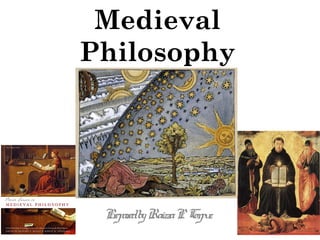
Medieval
Philosophy
PreparedbyRaizzaP. Corpuz
BIG QUESTION in MEDIEVAL
EPOCH….
WHAT IS FAITH?
WHAT IS RELIGION?
RPC2013
Faith is personal: INTERNAL, Within the power
of the “I”. It is both the cognitive and the
emotive. It is within the context of it and NOT
bound with QUANDARY.
BASIS
Religion: EXTERNAL: bound with the choice we
made. It can be change. It is structural and
functional.
PRACTICERPC2013
RPC2013
2 views
FAITHFAITH RELIGIONRELIGION
MEME WEWE
RPC2013
Medieval Philosophy
• Medieval philosophy is the
philosophy in the era now
known as medieval or the
Middle Ages, the period
roughly extending from the fall
of the Western Roma Empire
in the fifth century AD to the
Renaissance in the sixteenth
century
• Essentially “monotheistic”
• From a state of polytheism to a
belief in a one and only God.
• God here is the center of
man’s life Medieval philosophy is not to be
separated from theology
RPC2013
Medieval Philosophy and the
Problem of Evil
RPC2013
The Dark Ages
• The "Dark Ages" is a historical
period emphasizing the cultural
and economic deterioration that
occurred in Europe following the
decline of the Roma Empire.
• The label employs traditional
“light-versus darkness” imagery to
contrast the "darkness" of the
period with earlier and later
periods of "light“ (Middle Age).
• The period is characterized by a
relative scarcity of historical and
other written records at least for
some areas of Europe, rendering it
obscure to historians.
Petrarch conceived the idea of a European "Dark Age".
From Cycle of Famous Men and Women, c. 1450
RPC2013
Challenged Church AuthorityChallenged Church Authority
• In the 16th century,In the 16th century,
various humanistsvarious humanists
had begun to askhad begun to ask
dangerous questions.dangerous questions.
• The EnlightenmentThe Enlightenment
allowed people toallowed people to
believe in progress,believe in progress,
to “think outside theto “think outside the
box,” and it led tobox,” and it led to
the rise ofthe rise of
individualismindividualism
The Ninety-Five Theses, (1517) written by Martin
Luther, described his hopes and wants for reform in the
Catholic Church. This effectively challenged the pope'e
authority and the infallibility of the general council, and
eventually led to Luther being excommunicated from
the church and declared a public enemy by the
state.The 95 Theses were translated into German and
Luther's ideas were circulated throughout the empire.RPC2013
Medieval Philosophy
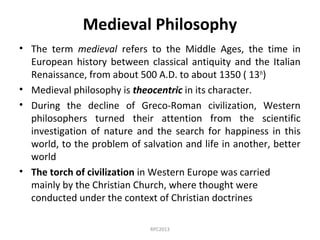
• The term medieval refers to the Middle Ages, the time in
European history between classical antiquity and the Italian
Renaissance, from about 500 A.D. to about 1350 ( 13th
)
• Medieval philosophy is theocentric in its character.
• During the decline of Greco-Roman civilization, Western
philosophers turned their attention from the scientific
investigation of nature and the search for happiness in this
world, to the problem of salvation and life in another, better
world
• The torch of civilization in Western Europe was carried
mainly by the Christian Church, where thought were
conducted under the context of Christian doctrines
RPC2013
• By the 3rd
century AD, Christianity
had spread throughout the Roman
Empire.
• The religious teachings of the
Gospels were combined by the
Fathers of the Church with many of
the philosophical concepts of the
Greeks and Roman schools.RPC2013
FOCUS: ON RELIGION and FAITH
RPC2013
St. Augustine
“You are great, O Lord, and man desires to praise you. You so excite him that
to praise you is his joy. For you have made us for yourself and our hearts
are restless until they rest in You.”
St. Augustine (354–430 C.E) : Uses aspects of
Neoplatonism to understand, explain Christianity.
RPC2013
Conversion
• He regret that once he believed in
Manichaeism means taught an
elaborate dualistic
cosmology describing the struggle
between a good, spiritual world of
light, and an evil , material world of
darkness.
• Began to study under Saint Ambrose.
• Became fascinated by intellectual
nature of faith.
• Was not baptized, at first, because he
didn’t want to give up life of sin.
His Philosophical Beliefs
• The man with his strength does not exceed
this vicious cycle of not being able to not want
what cannot get
• Only the grace of Christ save us
• History is called original sin
Jesus says that the Holy Spirit "will convince the world
concerning sin" (Jn 16:8). As I tried to penetrate these words,
I was led back to the opening pages of the Book of Genesis, to
the event known as "original sin."
RPC2013
• described the nature of this sin as
follows: amor sui usque ad contemptum Dei
—self-love to the point of contempt for God.
• It was amor sui which drove our first parents
toward that initial rebellion and then gave rise
to the spread of sin throughout human
history.
RPC2013
• The Book of Genesis speaks of this: "you will
be like God, knowing good and evil" (Gn 3:5),
in other words, you yourselves will
decide what is good and what is
evil.
• Man is not, in general, self-sufficient: marked
by original sin, is called to communion with
God, in Christ.
• This non-self-sufficiency is also seen in the
field of knowledge. It's Christ truth (as
interior Teacher , through the illumination).
RPC2013
INFLUENTIAL BOOK
Confessions (Latin: Confessiones)
•is the name of an autobiographical wok, consisting of 13
books
•The work outlines Augustine's sinful youth and his
conversion to Christianity
•Sinful Youth: fleshly desires for women
RPC2013
The City of God 
• Answers profound questions of theology
such as the suffering of the righteous, the existence 
of evil, the conflict between free will and divine 
omniscience, and the doctrine of original sin.
RPC2013
His legacy
• He believed humans       
cannot  experience  true 
happiness  until  they 
find God.
• His  work  centred 
around  the  notion  that 
everything in the world 
is basically good.
• He  wrote  many  works 
over his lifetime.
• He  attempted  to  dispel 
heresy  and 
blasphemous 
ideologies.
RPC2013
St. Thomas Aquinas
Overview
• An  Italian-born  monk  who  taught  at  the 
University of Paris
• Born:  January 28th
, 1225 in Roccasecca, Sicily
• Died:  March 7th
, 1274 in Fossanova, Sicily
• Taught  that  faith  came  first  and  greatly 
expanded the scope of reason
• Major figure in scholasticism
The Nature of God
• Aquinas developed a list of the (5) 
five divine qualities:
1. God is simple,  without 
composition of parts, such 
as body and soul, or matter 
and form. 
2.  God is perfect, lacking 
nothing.  That  is,  God  is 
distinguished  from  other 
beings on account of God's 
complete actuality. 
Thomas 
defined  God  as  the  ‘Ipse
Actus Essendi subsistens,’ 
subsisting act of being.
3. God is infinite. That is, God is not finite in the ways that 
created beings are physically, intellectually, and emotionally 
limited. This infinity is to be distinguished from infinity of size 
and infinity of number. 
4.  God is immutable, incapable  of  change  on  the  levels  of 
God's essence and character.
5. God is one, without diversification within God's self. The 
unity of God is such that God's essence is the same as God's 
existence. In Thomas's words, "in itself the proposition 'God 
exists' is necessarily true, for in it subject and predicate are 
the same.” 
RPC2013
Reason 
• Aquinas  retained  the  basic  belief 
while studying reason
• He believed that:
1. Humans  could  –  through  reason 
alone – know much of the natural 
order, moral law, and the nature 
of God 
2.  All  essential  knowledge  could  be 
organized coherently
• Wrote  a  series  of  Summas 
(highest  works)  that  employed 
careful  logic  to  counter  any 
possible  objections  to  truth  as 
revealed by reason and faith
Summas
• Summa Theologica:  Most well-known 
and best work of Aquinas
• Intended as a sort of introduction to 
theology and the main theological 
points of Church doctrine 
• Three parts:
– Part One:  God’s existence, the creation 
of the world, angels, and the nature of 
man
– Part Two:  Morality (general and specific)
– Part Three:  Christ, the Sacraments, and 
the end of the world
Ethics
• Four Cardinal Virtues:
1.Prudence
2.Temperance
3. Justice
4.Fortitude
• Three Theological Virtues: .
1.Faith
2.Hope
3.Charity
Four types of Law:
1. Eternal: direct word of God, governs all Creation
2. Natural: human adherence to eternal law,
discovered by reason
3. Human: positive law (natural law applied to
human government and society)
4. Divine: the law as defined in the scriptures
RPC2013
The Existence of God can be
proved in five ways.
1. Argument from Motion
2. Argument from Efficient Causes
3. Argument from Possibility and Necessity
(Reduction argument)
4. Argument from Gradation of Being
5. Argument from Design
-----VIDEO CLIP-----
RPC2013
***EXPLANATION FROM 1st
CAUSE
The Argument From MotionSt. Thomas Aquinas:
•studying the works of the Greek philosopher Aristotle
concluded from common observation:
that an object that is in motion (e.g. the planets, a rolling
stone) is put in motion by some other object or force.
From this, Aquinas believes that
ultimately there must have been an
UNMOVED MOVER (GOD) who first put
things in motion.
RPC2013
ST. ANSELM
• Anselm's motto is “faith seeking
understanding” (fides quaerens intellectum)
• St. Anselm of Canterbury (1033–1109 CE) was
a Christian philosopher.
• He was Archbishop of Canterbury from the age
of 60 until his death
The Ontological Argument
• Anselm is perhaps most famous for
developing the ontological argument for the
existence of God.
1.God is that than which nothing greater can be
conceived.
2.It is greater to exist than to not exist.
3.Therefore, God exists.
RPC2013
RPC2013
To one who has faith, no
explanation is necessary. To one
without faith, no explanation is
possible.
---Thomas Aquinas
MERCY and COMPASSION
RPC2013
References
The Evolution of Medieval Thought (1962) by David Knowles Random House
New York
St. Augustine (1960). The Confessions of St. Augustine. New York. by John K.
Ryan.)
St. Augustine (1960). The Confessions of St. Augustine. New York. by John K.
Ryan.)
A History of Philosophy 2: Medieval Philosophy by Frederick Charles
Copleston
The Christian Philosophy of St. Thomas Aquinas by Étienne Gilson
Some Slides excerpt by Dr. Tenorio’s Lecture
Google Images
THANK YOU and GOD BLESS!!
RPC2013

Medieval Philosophy

  • 1.
  • 2.
    BIG QUESTION inMEDIEVAL EPOCH…. WHAT IS FAITH? WHAT IS RELIGION? RPC2013
  • 3.
    Faith is personal:INTERNAL, Within the power of the “I”. It is both the cognitive and the emotive. It is within the context of it and NOT bound with QUANDARY. BASIS Religion: EXTERNAL: bound with the choice we made. It can be change. It is structural and functional. PRACTICERPC2013
  • 4.
  • 5.
  • 6.
    Medieval Philosophy • Medievalphilosophy is the philosophy in the era now known as medieval or the Middle Ages, the period roughly extending from the fall of the Western Roma Empire in the fifth century AD to the Renaissance in the sixteenth century • Essentially “monotheistic” • From a state of polytheism to a belief in a one and only God. • God here is the center of man’s life Medieval philosophy is not to be separated from theology RPC2013
  • 7.
    Medieval Philosophy andthe Problem of Evil RPC2013
  • 8.
    The Dark Ages •The "Dark Ages" is a historical period emphasizing the cultural and economic deterioration that occurred in Europe following the decline of the Roma Empire. • The label employs traditional “light-versus darkness” imagery to contrast the "darkness" of the period with earlier and later periods of "light“ (Middle Age). • The period is characterized by a relative scarcity of historical and other written records at least for some areas of Europe, rendering it obscure to historians. Petrarch conceived the idea of a European "Dark Age". From Cycle of Famous Men and Women, c. 1450 RPC2013
  • 9.
    Challenged Church AuthorityChallengedChurch Authority • In the 16th century,In the 16th century, various humanistsvarious humanists had begun to askhad begun to ask dangerous questions.dangerous questions. • The EnlightenmentThe Enlightenment allowed people toallowed people to believe in progress,believe in progress, to “think outside theto “think outside the box,” and it led tobox,” and it led to the rise ofthe rise of individualismindividualism The Ninety-Five Theses, (1517) written by Martin Luther, described his hopes and wants for reform in the Catholic Church. This effectively challenged the pope'e authority and the infallibility of the general council, and eventually led to Luther being excommunicated from the church and declared a public enemy by the state.The 95 Theses were translated into German and Luther's ideas were circulated throughout the empire.RPC2013
  • 10.
    Medieval Philosophy • Theterm medieval refers to the Middle Ages, the time in European history between classical antiquity and the Italian Renaissance, from about 500 A.D. to about 1350 ( 13th ) • Medieval philosophy is theocentric in its character. • During the decline of Greco-Roman civilization, Western philosophers turned their attention from the scientific investigation of nature and the search for happiness in this world, to the problem of salvation and life in another, better world • The torch of civilization in Western Europe was carried mainly by the Christian Church, where thought were conducted under the context of Christian doctrines RPC2013
  • 11.
    • By the3rd century AD, Christianity had spread throughout the Roman Empire. • The religious teachings of the Gospels were combined by the Fathers of the Church with many of the philosophical concepts of the Greeks and Roman schools.RPC2013
  • 12.
    FOCUS: ON RELIGIONand FAITH RPC2013
  • 13.
    St. Augustine “You aregreat, O Lord, and man desires to praise you. You so excite him that to praise you is his joy. For you have made us for yourself and our hearts are restless until they rest in You.” St. Augustine (354–430 C.E) : Uses aspects of Neoplatonism to understand, explain Christianity. RPC2013
  • 14.
    Conversion • He regretthat once he believed in Manichaeism means taught an elaborate dualistic cosmology describing the struggle between a good, spiritual world of light, and an evil , material world of darkness. • Began to study under Saint Ambrose. • Became fascinated by intellectual nature of faith. • Was not baptized, at first, because he didn’t want to give up life of sin.
  • 15.
    His Philosophical Beliefs •The man with his strength does not exceed this vicious cycle of not being able to not want what cannot get • Only the grace of Christ save us • History is called original sin Jesus says that the Holy Spirit "will convince the world concerning sin" (Jn 16:8). As I tried to penetrate these words, I was led back to the opening pages of the Book of Genesis, to the event known as "original sin." RPC2013
  • 16.
    • described thenature of this sin as follows: amor sui usque ad contemptum Dei —self-love to the point of contempt for God. • It was amor sui which drove our first parents toward that initial rebellion and then gave rise to the spread of sin throughout human history. RPC2013
  • 17.
    • The Bookof Genesis speaks of this: "you will be like God, knowing good and evil" (Gn 3:5), in other words, you yourselves will decide what is good and what is evil. • Man is not, in general, self-sufficient: marked by original sin, is called to communion with God, in Christ. • This non-self-sufficiency is also seen in the field of knowledge. It's Christ truth (as interior Teacher , through the illumination). RPC2013
  • 18.
    INFLUENTIAL BOOK Confessions (Latin:Confessiones) •is the name of an autobiographical wok, consisting of 13 books •The work outlines Augustine's sinful youth and his conversion to Christianity •Sinful Youth: fleshly desires for women RPC2013
  • 19.
    The City ofGod  • Answers profound questions of theology such as the suffering of the righteous, the existence  of evil, the conflict between free will and divine  omniscience, and the doctrine of original sin. RPC2013
  • 20.
    His legacy • He believed humans        cannot  experience true  happiness  until  they  find God. • His  work  centred  around  the  notion  that  everything in the world  is basically good. • He  wrote  many  works  over his lifetime. • He  attempted  to  dispel  heresy  and  blasphemous  ideologies.
  • 21.
  • 22.
  • 23.
    Overview • An  Italian-born monk  who  taught  at  the  University of Paris • Born:  January 28th , 1225 in Roccasecca, Sicily • Died:  March 7th , 1274 in Fossanova, Sicily • Taught  that  faith  came  first  and  greatly  expanded the scope of reason • Major figure in scholasticism
  • 24.
    The Nature of God • Aquinas developed a list of the (5)  five divinequalities: 1. God is simple,  without  composition of parts, such  as body and soul, or matter  and form.  2.  God is perfect, lacking  nothing.  That  is,  God  is  distinguished  from  other  beings on account of God's  complete actuality.  Thomas  defined  God  as  the  ‘Ipse Actus Essendi subsistens,’  subsisting act of being.
  • 25.
    3. God is infinite. That is, God is not finite in the ways that  created beings are physically, intellectually, and emotionally  limited. This infinity is to be distinguished from infinity of size  and infinity of number.  4. God is immutable, incapable  of  change  on  the  levels  of  God's essence and character. 5. God is one, without diversification within God's self. The  unity of God is such that God's essence is the same as God's  existence. In Thomas's words, "in itself the proposition 'God  exists' is necessarily true, for in it subject and predicate are  the same.”  RPC2013
  • 26.
    Reason  • Aquinas  retained the  basic  belief  while studying reason • He believed that: 1. Humans  could  –  through  reason  alone – know much of the natural  order, moral law, and the nature  of God  2.  All  essential  knowledge  could  be  organized coherently • Wrote  a  series  of  Summas  (highest  works)  that  employed  careful  logic  to  counter  any  possible  objections  to  truth  as  revealed by reason and faith
  • 27.
    Summas • Summa Theologica:  Most well-known  and best work of Aquinas • Intended as a sort of introduction to  theology and the main theological  points of Church doctrine  •Three parts: – Part One:  God’s existence, the creation  of the world, angels, and the nature of  man – Part Two:  Morality (general and specific) – Part Three:  Christ, the Sacraments, and  the end of the world
  • 28.
    Ethics • Four CardinalVirtues: 1.Prudence 2.Temperance 3. Justice 4.Fortitude • Three Theological Virtues: . 1.Faith 2.Hope 3.Charity
  • 29.
    Four types ofLaw: 1. Eternal: direct word of God, governs all Creation 2. Natural: human adherence to eternal law, discovered by reason 3. Human: positive law (natural law applied to human government and society) 4. Divine: the law as defined in the scriptures RPC2013
  • 30.
    The Existence ofGod can be proved in five ways. 1. Argument from Motion 2. Argument from Efficient Causes 3. Argument from Possibility and Necessity (Reduction argument) 4. Argument from Gradation of Being 5. Argument from Design -----VIDEO CLIP----- RPC2013
  • 31.
    ***EXPLANATION FROM 1st CAUSE TheArgument From MotionSt. Thomas Aquinas: •studying the works of the Greek philosopher Aristotle concluded from common observation: that an object that is in motion (e.g. the planets, a rolling stone) is put in motion by some other object or force. From this, Aquinas believes that ultimately there must have been an UNMOVED MOVER (GOD) who first put things in motion. RPC2013
  • 32.
    ST. ANSELM • Anselm'smotto is “faith seeking understanding” (fides quaerens intellectum) • St. Anselm of Canterbury (1033–1109 CE) was a Christian philosopher. • He was Archbishop of Canterbury from the age of 60 until his death
  • 33.
    The Ontological Argument •Anselm is perhaps most famous for developing the ontological argument for the existence of God. 1.God is that than which nothing greater can be conceived. 2.It is greater to exist than to not exist. 3.Therefore, God exists. RPC2013
  • 34.
    RPC2013 To one whohas faith, no explanation is necessary. To one without faith, no explanation is possible. ---Thomas Aquinas
  • 35.
  • 36.
    References The Evolution ofMedieval Thought (1962) by David Knowles Random House New York St. Augustine (1960). The Confessions of St. Augustine. New York. by John K. Ryan.) St. Augustine (1960). The Confessions of St. Augustine. New York. by John K. Ryan.) A History of Philosophy 2: Medieval Philosophy by Frederick Charles Copleston The Christian Philosophy of St. Thomas Aquinas by Étienne Gilson Some Slides excerpt by Dr. Tenorio’s Lecture Google Images THANK YOU and GOD BLESS!! RPC2013

Editor's Notes

  • #14 Common Era (also Current Era or Christian Era), abbreviated as CE, is an alternative naming of the calendar era Anno Domini ("in the year of the/our Lord", abbreviated AD). BCE is the abbreviation for Before the Common/Current/Christian Era (an alternative to Before Christ, abbreviated BC).
  • #15 St ambrose was a bishop of Milan who became one of the most influential ecclesiastical figures of the 4th century. MANICHAEISM a dualistic religious system with Christian, Gnostic, and pagan elements, f
  • #29 Prudence-discreet Fortitude-strength of mind