RATIONALISM
AND EMPIRICISM
PRESENTING BY,
JIBIN ROJI
INTRODUCTION
Rationalism and Empiricism are two sides of the same coin of
philosophy which have diverging differences, especially when
it comes to their belief systems. This seminar will briefly
discuss about Rationalism And Empiricism. It goes to the
historical way and explains some of the major thinkers of
rationalist and empiricist. It also discuss the debate between
Empiricism and Rationalism.
SOME MAJOR ENTERPRISES OF
EPISTEMOLOGY
Some of the central enterprises of epistemology, which deal
with issues similar as what’s the source of knowledge, what’s
knowledge, how do we know which is verity and how is it
different from justification. In other words, Epistemology is
mainly concerned with the nature, source, compass and limits
of Knowledge. After the Renaissance, two main epistemological
thoughts of knowledge dominated philosophical inquiry into the
proposition of knowledge, empiricism and rationalism.
Empiricism views knowledge as the product of sensitive
perception. This thought holds that the origin of all
knowledge is sense experience. The term also refers to
the system of observation and trial used in the natural
sciences. Rationalism is varied with empiricism.
Rationalism is a thought which holds that the mind may
avoid some trueness directly, without taking the
consideration of the senses.
RATIONALISM
• Greek philosophers, mainly Pythagoras, Plato and Aristotle, laid the
foundations of logical thinking. The main aim of rationalism or logical
thinking is that truth can be best discovered through reason and rational
thought. Rationalists assume that the world is deterministic, and that
cause and effect hold for all events. They also assume that these can be
understood through sufficient understanding and thought. A priori (from
cause to effect) is a source of much knowledge. On the other hand sense
experience is seen as confusing and rejecting.
Logic and mathematics are older rational disciplines. Some of the main
rationalists include Descartes, Spinoza and Leibniz. The ideas of
Descartes, who was the most important of them all.
Rationalism is the view that reason or knowledge from god to its
children. It plays a dominant role in our attempt to gain knowledge.
Different forms of rationalism are distinguished by different forms of
reason and its role as a source of knowledge, by different descriptions
of the alternatives to which reason is opposed, by different accounts
of the nature of knowledge, and by different choices of the subject
matter, For example, ethics, physics, mathematics, metaphysics, etc.
These all are seen, reason is the major source of knowledge. The
common application of the term ‘rationalist’ can say very little about
what two philosophers have in common.
HISTORY OF RATIONALISM
• The first thinker of Rationalism was Pythagoras. Pythagoras
argued that all is number, leading to the idea of a world
governed by mathematically formulable laws. He was a great
influencer of 6th
century BCE. It is viewed that he had caught
the rationalist’s vision, later seen by Galileo, of a world which
is governed throughout by mathematically formulable laws.
Then the next Rationalist emerged on the 4th
century BCE
was Plato. Plato emphasised logical intuition.
Plato’s famous forms are accessible only to reason, not to sense,
and he viewed them as distilling common properties of a class. He
also held that the form is an ideal, a non-sensible goal to which
the sensible thing approximates, and that philosophers must
penetrate to these invisible essences to understand how they are
linked together.
After Plato, Aristotle comes to the rational school of thought.
Aristotle’s syllogistic logic is the main item of rational explanation,
which tells that humans explain facts by bringing them under
general principles that are self-evident and necessary. The argued
this with the three great Greeks were in agreement on this thesis.
After Aristotle there is no much comparable rationalist
thought emerged for the 1800 years. After that the
work of St. Thomas Aquinas was an impressive
attempt to blend Greek rationalism and Christian
revelation into a single harmonious system in the 13th
century.
RENE DESCARTES
• Descartes is regarded as the first “modern” thinker who has
provided a philosophical framework for the natural sciences.
• Descartes attempts to arrive at a fundamental set of principles
that one can know as true without any doubt. To achieve this, he
creates a method called methodological skepticism.
• He doubts any idea that can be doubted. He gives the example
of dreaming.
Descartes asks, what can one know for certain?
• If I am being deceived, then surely “I” must exist. Most
famously, this is known as Cogito, ergo Sum, (“I think,
therefore I am”).
• In this manner, Descartes concludes that he can be certain
that he exists. But in what form? You perceive your body
thought the use of the senses; however, in Descartes logic,
these have previously proven unreliable. So Descartes
proposes that at this point, he would only say that he is a
thinking thing. Thinking is his essence as it is the only thing
about him that cannot be doubted.
• Wax Argument
• “Thus what I thought I had seen with my eyes, I actually grasped
solely with the faculty of judgment, which is in my mind.”
• In this manner Descartes constructed a system of knowledge,
removing perception and admitting only deduction as a method.
He then claims to prove the existence of a God, who has
provided him with a working mind and sensory system, and
establishes the possibility of acquiring knowledge about the
world based on deduction and perception.
INTUITION AND DEDUCTION
René Descartes argued that knowledge must be certain and can only
be acquired through intellect or reason. He distinguishes between
intuition and deduction, which are two actions of the intellect through
which we arrive at certain knowledge. Intuition is the indubitable,
immediate apprehension of a self-evident truth by reason, while
deduction is the intuitive certainty of the first principles and
intermediate steps. Descartes applies the mathematical method to
philosophy, which consists in intuition and deduction.
He believes that God put some innate ideas on the mind
at the time of birth, and that we can acquire certainty
when the facts are inferred from true and known principles
through a continuous and uninterrupted movement of
thought in which each individual proposition is clearly
intuited.
Descartes accepts the existence of three substances: mind,
matter and God, but recognises Mind and Matter as
relative substances dependent upon God.
Innate,
Adventitious
and Factitious
Descartes accepting three kinds of ‘ideas’ based three different sources,
viz. ‘innate’, ‘adventitious’ and ‘factitious’. While he considers ‘innate
ideas’ as implanted in our understanding and ‘factitious ideas’ as
creations of our imagination, he views the ‘adventitious ideas’ are as
productions of sensations. The ideas imposed on the mind from
without or sensations are adventitious; they are not clear and distinct.
The ideas created by the mind by the conjunction of ideas are
factitious; they are the ideas created by the imagination; they are also
are not clear and distinct. Both are doubtful. But the innate ideas,
which are neither adventitious nor factitious, are clear and distinct and
implanted in the mind by God at the time of birth; they are self-
evident.
ATTRIBUTES AND MODES : MIND
BODY /DUALISM
Descartes suggests that matter and mind are independent of each
other, with Matter being divisible, figurable, and movable, and
Mind being feeling, volition, desire, and judgement. This is known
as Cartesian dualism.
Descartes proposed the Psycho-physical Interactionism, which
states that body and mind act upon each other in the ‘Pineal
gland’ of the brain, and the body acts upon the mind in senses
and the mind causes movements to take place in the body
through the will.
He argued that all occurrences are due to the
transference of motion from one part to another, and that
the functions of the human body follow from the
mechanical arrangements of its various organs. He also
argued that the relation of the soul to the body is of the
nature of the pilot to his machine.
Cartesian dualism explained the appearance of
interaction while denying its reality.
AFTER DESCARTES
SPINOZA
• Benedict De Spinoza (1532-1677) starts with the innate idea of God,
which is self-existent and conceived by itself, and deduces the finite
minds and the infinite physical objects from it. He calls the single
substances as God, and Nature is known as Natura Naturata, i.e., sum-
total of all that exist. God and Nature are governed by eternal laws,
and there is only one Being who is wholly positive, and He must be
absolutely infinite. This is known as pantheism, according to which the
reality of a single impersonal God permeates and in-dwells all things.
Spinoza rejected Cartesian dualism and rejected the
substantiality of mind and body, believing that Mind is the
expression of the infinite consciousness of God and Matter is
the appearance of God’s unlimited extension.
LEIBNIZ
Descartes allowed three substances, God, mind and matter;
Spinoza admitted God alone. For Descartes, extension is the
essence of matter; for Spinoza, both extension and thought are
attributes of God.
Leibniz held that extension cannot be an attribute of a
substance, and believed in an infinite number of monads,
which he called “souls”. This led him to deny the reality of
matter and substitute an infinite family of souls.
RATIONALIST METHODS IN SOCIAL
SCIENCE
• Game Theory: Game theory is a mathematical framework
used to model strategic interactions between individuals or
groups. It assumes that individuals are rational and try to
maximize their utility in every interaction. Game theory is
commonly used in economics, political science, and
sociology to model behavior in situations of conflict,
cooperation, and competition.
Rational Choice Theory: Rational choice theory is a framework
used to explain social phenomena by analyzing the choices made
by individuals. It assumes that individuals are rational and try to
maximize their utility or welfare by weighing the costs and benefits
of different options. Rational choice theory is commonly used in
economics, political science, and sociology to explain behavior in
areas such as voting, crime, and social movements.
Econometrics: Econometrics is the application of statistical
methods to economic data to test economic theories and models.
It assumes that economic behavior is rational and that individuals
respond to incentives. Econometrics is commonly used in
economics to test the impact of policies and to forecast economic
trends.
Behavioural Economics: Behavioral economics is a field that
combines insights from psychology and economics to explain why
people make decisions that deviate from rationality. It assumes
that individuals are not always rational and that their behavior is
influenced by cognitive biases and emotions. Behavioral
economics is commonly used in fields such as public policy and
marketing to design interventions that nudge individuals towards
making better decisions.
CRITICAL RATIONALISM –KARL
POPPER
•The modern founder of critical rationalism was Karl Popper.
• Popper pointed out we can never justify anything, we merely
criticize and weed out bad ideas and work with what’s left.
Popper’s initial emphasis was on empirical science, where he
solved the problem of induction, something that had been
haunting philosophers and scientists for centuries.
•What Popper pointed out is that you can never justify any
scientific theory, but you can falsify it.
EMPIRICISM
• The central principle of empiricism is that truth comes only
from direct experience. Empiricism is based on sense
perception, which Descartes rejected as inferior to
rationalism. British empiricism rejected the theory of innate
ideas and argued that knowledge is based on both sense
experience and internal mental experiences such as
emotions and self-reflection.
JOHN LOCKE
• John Locke (1632-1704) criticizes Descartes’ doctrine of innate
ideas and expounds the doctrine of empiricism. He argued that
there are no innate ideas, such as causality, infinity, eternity, God
and the like, which are universally present in all minds. Instead,
Locke argued that the so-called innate principles are general
truths, which are induction from particular facts of experience
and are not the primary facts of knowledge, but generalisations
from particular facts, which are acquired from perception.
He also argued that the innate ideas of God, morality and the
like differ in different societies, in different countries, and in
different ages, and that even if there were the same idea in all
minds, it would not prove their innateness.
Locke argued that the mind is a tabula rasa in the beginning,
and that all knowledge is derived from experience, which is
posterior to or after experience. Experience is twofold:
sensation and reflection
George Berkeley
George Berkeley (1685-1753) pushed ahead with the argument
of empiricism and demolished Locke’s acceptance of the belief
that physical substances exist. Berkeleian empiricism states that
physical substances do not exist, but that mental substances
exist, in the form of finite minds and infinite minds. Berkeley
believes that our perceptions are reliable and orderly, and that
we can trust in the uniformity of experience and the
dependability of scientific laws.
David Hume
• Combined the empiricism of Locke and Berkeley, who argued
that knowledge comes only from sense perception.
• Hume argued that our best knowledge, our scientific laws,
are nothing but sense perceptions which our feelings lead us
to believe, and that we have only sense perceptions and
feelings.
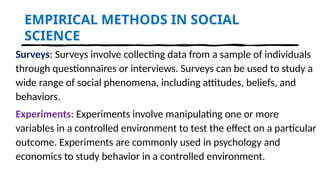
EMPIRICAL METHODS IN SOCIAL
SCIENCE
Surveys: Surveys involve collecting data from a sample of individuals
through questionnaires or interviews. Surveys can be used to study a
wide range of social phenomena, including attitudes, beliefs, and
behaviors.
Experiments: Experiments involve manipulating one or more
variables in a controlled environment to test the effect on a particular
outcome. Experiments are commonly used in psychology and
economics to study behavior in a controlled environment.
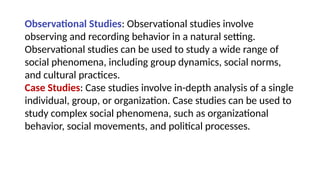
Observational Studies: Observational studies involve
observing and recording behavior in a natural setting.
Observational studies can be used to study a wide range of
social phenomena, including group dynamics, social norms,
and cultural practices.
Case Studies: Case studies involve in-depth analysis of a single
individual, group, or organization. Case studies can be used to
study complex social phenomena, such as organizational
behavior, social movements, and political processes.
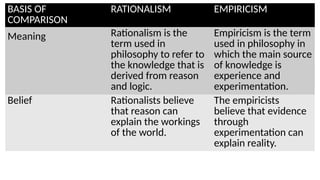
BASIS OF
COMPARISON
RATIONALISM EMPIRICISM
Meaning Rationalism is the
term used in
philosophy to refer to
the knowledge that is
derived from reason
and logic.
Empiricism is the term
used in philosophy in
which the main source
of knowledge is
experience and
experimentation.
Belief Rationalists believe
that reason can
explain the workings
of the world.
The empiricists
believe that evidence
through
experimentation can
explain reality.
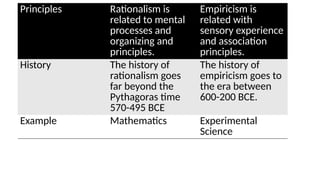
Principles Rationalism is
related to mental
processes and
organizing and
principles.
Empiricism is
related with
sensory experience
and association
principles.
History The history of
rationalism goes
far beyond the
Pythagoras time
570-495 BCE
The history of
empiricism goes to
the era between
600-200 BCE.
Example Mathematics Experimental
Science
DEBATE BETWEEN RATIONALISM AND
EMPIRICISM
• ARGUMENTS FROM EMPIRICISTS
• Main problem innate knowledge.
• Tend to agree with the idea of tabula rasa.
• For the simple fact that, if we had innate knowledge from a
previous life or from god or from a greater reality then why do
we not carry this when we are born.
• A baby seems more like a blank slate rather than having innate
knowledge.
• ARGUMENTS FROM RATIONALISTS
• It is fair to say that no rationalist would argue that all
knowledge from another life or another world is with us as
innate knowledge. Only some core concepts or principles that
we can recognize and even this may need to be brought to the
forefront of our consciousness by an empirical experience.
• Secondly, taboola rasa as a concept is a lot more problematic
than innate knowledge. Think about how different people are
think about.
• People have their own natural desires and interests. And these
are with us from birth. These are innate. We come stocked with
these from birth. We are not blank slates.
ARGUMENTS FROM EMPIRICISTS
• All scientific discoveries.
• We rely on our understanding of the empirical world and our
scientific laws are discovered via sense perception. It shows
that the empirical method of discovering knowledge is the only
concrete approach.
ARGUMENTS FROM RATIONALISTS
• We just need to look at Maths as concrete a priori truths
developed from the rationalist approach. Mathematical
concepts rely on our experience. They are purely a rational
game.
• You do not need empirical experience to understand the
concept of 1 and 2 and to understand that 1+1=2 really.
ARGUMENTS FROM EMPIRICISTS
• We do use our intellect for mathematical, but this also
grounded in sense experience.
• Concept of one – we see single objects. We also see
multiple objects. Objects we can see One tree and we
know if we see another tree then this would make two.
• The concepts of numbers need sensory experience.
CONCLUSION
Rationalism and Empiricism are both terms used in
philosophy. Both the terms are used under the term
Epistemology, which is a branch of philosophy concerned with
knowledge. Although the terms sound the same, they are too
different from each other. Actually, the terms have always
been used as opposed to each other. It’s an old controversy.
Though both are theories.
REFERENCES
Majumdar, P. K.2015. Research Methods in Social Science. New Delhi:
Viva Books
Robinson Dave, Mayblin Bill. 2004. Introducing Empiricism. Singapore:
Tien wah press Ltd
Kuper Adam, Kuper Jessica. 2009. The Social Science Encyclopedia.
New York: Routledge Taylor and Francis group
Bernard, Russell.H.2008.Research Methods in Anthropology.
Jaipur :Rawat publications
Hjorland Birger.2005.Empiricism,Rationalism And positivism in
Library and Information Science vol 1 pp 130- 150.
http://dx.doi.org/10.1108/00220410510578050
Ladd George Trumbull. 1913. Rationalism and Empiricism. Vol
22,No. 85(Jan 1913) pp 1-3. Oxford University Press on behalf of
the Mind Association. https://www.jstor.org/stable/2248654
Byjus. https://byjus.com/free-ias-prep/rationalism-vs-empiricism/
H. Russel Bernard. 1998. Handbook of Methods in Cultural
Anthropology. New Delhi: Sage Publications India Pvt. Ltd
Lewisbeck S. Michael, Bryman Alan, Liao Tim Futing.
2004. The SAGE Encyclopedia of social science
Research Methods. New Delhi: SAGE Publications.
India Pvt. Ltd

_RATIONALISM_AND_EMPIRICISM SEMINAR.pptx

  • 1.
  • 2.
    INTRODUCTION Rationalism and Empiricismare two sides of the same coin of philosophy which have diverging differences, especially when it comes to their belief systems. This seminar will briefly discuss about Rationalism And Empiricism. It goes to the historical way and explains some of the major thinkers of rationalist and empiricist. It also discuss the debate between Empiricism and Rationalism.
  • 3.
    SOME MAJOR ENTERPRISESOF EPISTEMOLOGY Some of the central enterprises of epistemology, which deal with issues similar as what’s the source of knowledge, what’s knowledge, how do we know which is verity and how is it different from justification. In other words, Epistemology is mainly concerned with the nature, source, compass and limits of Knowledge. After the Renaissance, two main epistemological thoughts of knowledge dominated philosophical inquiry into the proposition of knowledge, empiricism and rationalism.
  • 4.
    Empiricism views knowledgeas the product of sensitive perception. This thought holds that the origin of all knowledge is sense experience. The term also refers to the system of observation and trial used in the natural sciences. Rationalism is varied with empiricism. Rationalism is a thought which holds that the mind may avoid some trueness directly, without taking the consideration of the senses.
  • 5.
    RATIONALISM • Greek philosophers,mainly Pythagoras, Plato and Aristotle, laid the foundations of logical thinking. The main aim of rationalism or logical thinking is that truth can be best discovered through reason and rational thought. Rationalists assume that the world is deterministic, and that cause and effect hold for all events. They also assume that these can be understood through sufficient understanding and thought. A priori (from cause to effect) is a source of much knowledge. On the other hand sense experience is seen as confusing and rejecting.
  • 6.
    Logic and mathematicsare older rational disciplines. Some of the main rationalists include Descartes, Spinoza and Leibniz. The ideas of Descartes, who was the most important of them all. Rationalism is the view that reason or knowledge from god to its children. It plays a dominant role in our attempt to gain knowledge. Different forms of rationalism are distinguished by different forms of reason and its role as a source of knowledge, by different descriptions of the alternatives to which reason is opposed, by different accounts of the nature of knowledge, and by different choices of the subject matter, For example, ethics, physics, mathematics, metaphysics, etc. These all are seen, reason is the major source of knowledge. The common application of the term ‘rationalist’ can say very little about what two philosophers have in common.
  • 7.
    HISTORY OF RATIONALISM •The first thinker of Rationalism was Pythagoras. Pythagoras argued that all is number, leading to the idea of a world governed by mathematically formulable laws. He was a great influencer of 6th century BCE. It is viewed that he had caught the rationalist’s vision, later seen by Galileo, of a world which is governed throughout by mathematically formulable laws. Then the next Rationalist emerged on the 4th century BCE was Plato. Plato emphasised logical intuition.
  • 8.
    Plato’s famous formsare accessible only to reason, not to sense, and he viewed them as distilling common properties of a class. He also held that the form is an ideal, a non-sensible goal to which the sensible thing approximates, and that philosophers must penetrate to these invisible essences to understand how they are linked together. After Plato, Aristotle comes to the rational school of thought. Aristotle’s syllogistic logic is the main item of rational explanation, which tells that humans explain facts by bringing them under general principles that are self-evident and necessary. The argued this with the three great Greeks were in agreement on this thesis.
  • 9.
    After Aristotle thereis no much comparable rationalist thought emerged for the 1800 years. After that the work of St. Thomas Aquinas was an impressive attempt to blend Greek rationalism and Christian revelation into a single harmonious system in the 13th century.
  • 10.
    RENE DESCARTES • Descartesis regarded as the first “modern” thinker who has provided a philosophical framework for the natural sciences. • Descartes attempts to arrive at a fundamental set of principles that one can know as true without any doubt. To achieve this, he creates a method called methodological skepticism. • He doubts any idea that can be doubted. He gives the example of dreaming.
  • 11.
    Descartes asks, whatcan one know for certain? • If I am being deceived, then surely “I” must exist. Most famously, this is known as Cogito, ergo Sum, (“I think, therefore I am”). • In this manner, Descartes concludes that he can be certain that he exists. But in what form? You perceive your body thought the use of the senses; however, in Descartes logic, these have previously proven unreliable. So Descartes proposes that at this point, he would only say that he is a thinking thing. Thinking is his essence as it is the only thing about him that cannot be doubted.
  • 12.
    • Wax Argument •“Thus what I thought I had seen with my eyes, I actually grasped solely with the faculty of judgment, which is in my mind.” • In this manner Descartes constructed a system of knowledge, removing perception and admitting only deduction as a method. He then claims to prove the existence of a God, who has provided him with a working mind and sensory system, and establishes the possibility of acquiring knowledge about the world based on deduction and perception.
  • 13.
    INTUITION AND DEDUCTION RenéDescartes argued that knowledge must be certain and can only be acquired through intellect or reason. He distinguishes between intuition and deduction, which are two actions of the intellect through which we arrive at certain knowledge. Intuition is the indubitable, immediate apprehension of a self-evident truth by reason, while deduction is the intuitive certainty of the first principles and intermediate steps. Descartes applies the mathematical method to philosophy, which consists in intuition and deduction.
  • 14.
    He believes thatGod put some innate ideas on the mind at the time of birth, and that we can acquire certainty when the facts are inferred from true and known principles through a continuous and uninterrupted movement of thought in which each individual proposition is clearly intuited. Descartes accepts the existence of three substances: mind, matter and God, but recognises Mind and Matter as relative substances dependent upon God.
  • 15.
  • 16.
    Descartes accepting threekinds of ‘ideas’ based three different sources, viz. ‘innate’, ‘adventitious’ and ‘factitious’. While he considers ‘innate ideas’ as implanted in our understanding and ‘factitious ideas’ as creations of our imagination, he views the ‘adventitious ideas’ are as productions of sensations. The ideas imposed on the mind from without or sensations are adventitious; they are not clear and distinct. The ideas created by the mind by the conjunction of ideas are factitious; they are the ideas created by the imagination; they are also are not clear and distinct. Both are doubtful. But the innate ideas, which are neither adventitious nor factitious, are clear and distinct and implanted in the mind by God at the time of birth; they are self- evident.
  • 17.
    ATTRIBUTES AND MODES: MIND BODY /DUALISM Descartes suggests that matter and mind are independent of each other, with Matter being divisible, figurable, and movable, and Mind being feeling, volition, desire, and judgement. This is known as Cartesian dualism. Descartes proposed the Psycho-physical Interactionism, which states that body and mind act upon each other in the ‘Pineal gland’ of the brain, and the body acts upon the mind in senses and the mind causes movements to take place in the body through the will.
  • 18.
    He argued thatall occurrences are due to the transference of motion from one part to another, and that the functions of the human body follow from the mechanical arrangements of its various organs. He also argued that the relation of the soul to the body is of the nature of the pilot to his machine. Cartesian dualism explained the appearance of interaction while denying its reality.
  • 19.
    AFTER DESCARTES SPINOZA • BenedictDe Spinoza (1532-1677) starts with the innate idea of God, which is self-existent and conceived by itself, and deduces the finite minds and the infinite physical objects from it. He calls the single substances as God, and Nature is known as Natura Naturata, i.e., sum- total of all that exist. God and Nature are governed by eternal laws, and there is only one Being who is wholly positive, and He must be absolutely infinite. This is known as pantheism, according to which the reality of a single impersonal God permeates and in-dwells all things.
  • 20.
    Spinoza rejected Cartesiandualism and rejected the substantiality of mind and body, believing that Mind is the expression of the infinite consciousness of God and Matter is the appearance of God’s unlimited extension. LEIBNIZ Descartes allowed three substances, God, mind and matter; Spinoza admitted God alone. For Descartes, extension is the essence of matter; for Spinoza, both extension and thought are attributes of God. Leibniz held that extension cannot be an attribute of a substance, and believed in an infinite number of monads, which he called “souls”. This led him to deny the reality of matter and substitute an infinite family of souls.
  • 21.
    RATIONALIST METHODS INSOCIAL SCIENCE • Game Theory: Game theory is a mathematical framework used to model strategic interactions between individuals or groups. It assumes that individuals are rational and try to maximize their utility in every interaction. Game theory is commonly used in economics, political science, and sociology to model behavior in situations of conflict, cooperation, and competition.
  • 22.
    Rational Choice Theory:Rational choice theory is a framework used to explain social phenomena by analyzing the choices made by individuals. It assumes that individuals are rational and try to maximize their utility or welfare by weighing the costs and benefits of different options. Rational choice theory is commonly used in economics, political science, and sociology to explain behavior in areas such as voting, crime, and social movements. Econometrics: Econometrics is the application of statistical methods to economic data to test economic theories and models. It assumes that economic behavior is rational and that individuals respond to incentives. Econometrics is commonly used in economics to test the impact of policies and to forecast economic trends.
  • 23.
    Behavioural Economics: Behavioraleconomics is a field that combines insights from psychology and economics to explain why people make decisions that deviate from rationality. It assumes that individuals are not always rational and that their behavior is influenced by cognitive biases and emotions. Behavioral economics is commonly used in fields such as public policy and marketing to design interventions that nudge individuals towards making better decisions.
  • 24.
    CRITICAL RATIONALISM –KARL POPPER •Themodern founder of critical rationalism was Karl Popper. • Popper pointed out we can never justify anything, we merely criticize and weed out bad ideas and work with what’s left. Popper’s initial emphasis was on empirical science, where he solved the problem of induction, something that had been haunting philosophers and scientists for centuries. •What Popper pointed out is that you can never justify any scientific theory, but you can falsify it.
  • 25.
    EMPIRICISM • The centralprinciple of empiricism is that truth comes only from direct experience. Empiricism is based on sense perception, which Descartes rejected as inferior to rationalism. British empiricism rejected the theory of innate ideas and argued that knowledge is based on both sense experience and internal mental experiences such as emotions and self-reflection.
  • 26.
    JOHN LOCKE • JohnLocke (1632-1704) criticizes Descartes’ doctrine of innate ideas and expounds the doctrine of empiricism. He argued that there are no innate ideas, such as causality, infinity, eternity, God and the like, which are universally present in all minds. Instead, Locke argued that the so-called innate principles are general truths, which are induction from particular facts of experience and are not the primary facts of knowledge, but generalisations from particular facts, which are acquired from perception.
  • 27.
    He also arguedthat the innate ideas of God, morality and the like differ in different societies, in different countries, and in different ages, and that even if there were the same idea in all minds, it would not prove their innateness. Locke argued that the mind is a tabula rasa in the beginning, and that all knowledge is derived from experience, which is posterior to or after experience. Experience is twofold: sensation and reflection
  • 28.
    George Berkeley George Berkeley(1685-1753) pushed ahead with the argument of empiricism and demolished Locke’s acceptance of the belief that physical substances exist. Berkeleian empiricism states that physical substances do not exist, but that mental substances exist, in the form of finite minds and infinite minds. Berkeley believes that our perceptions are reliable and orderly, and that we can trust in the uniformity of experience and the dependability of scientific laws.
  • 29.
    David Hume • Combinedthe empiricism of Locke and Berkeley, who argued that knowledge comes only from sense perception. • Hume argued that our best knowledge, our scientific laws, are nothing but sense perceptions which our feelings lead us to believe, and that we have only sense perceptions and feelings.
  • 30.
    EMPIRICAL METHODS INSOCIAL SCIENCE Surveys: Surveys involve collecting data from a sample of individuals through questionnaires or interviews. Surveys can be used to study a wide range of social phenomena, including attitudes, beliefs, and behaviors. Experiments: Experiments involve manipulating one or more variables in a controlled environment to test the effect on a particular outcome. Experiments are commonly used in psychology and economics to study behavior in a controlled environment.
  • 31.
    Observational Studies: Observationalstudies involve observing and recording behavior in a natural setting. Observational studies can be used to study a wide range of social phenomena, including group dynamics, social norms, and cultural practices. Case Studies: Case studies involve in-depth analysis of a single individual, group, or organization. Case studies can be used to study complex social phenomena, such as organizational behavior, social movements, and political processes.
  • 32.
    BASIS OF COMPARISON RATIONALISM EMPIRICISM MeaningRationalism is the term used in philosophy to refer to the knowledge that is derived from reason and logic. Empiricism is the term used in philosophy in which the main source of knowledge is experience and experimentation. Belief Rationalists believe that reason can explain the workings of the world. The empiricists believe that evidence through experimentation can explain reality.
  • 33.
    Principles Rationalism is relatedto mental processes and organizing and principles. Empiricism is related with sensory experience and association principles. History The history of rationalism goes far beyond the Pythagoras time 570-495 BCE The history of empiricism goes to the era between 600-200 BCE. Example Mathematics Experimental Science
  • 34.
    DEBATE BETWEEN RATIONALISMAND EMPIRICISM • ARGUMENTS FROM EMPIRICISTS • Main problem innate knowledge. • Tend to agree with the idea of tabula rasa. • For the simple fact that, if we had innate knowledge from a previous life or from god or from a greater reality then why do we not carry this when we are born. • A baby seems more like a blank slate rather than having innate knowledge.
  • 35.
    • ARGUMENTS FROMRATIONALISTS • It is fair to say that no rationalist would argue that all knowledge from another life or another world is with us as innate knowledge. Only some core concepts or principles that we can recognize and even this may need to be brought to the forefront of our consciousness by an empirical experience. • Secondly, taboola rasa as a concept is a lot more problematic than innate knowledge. Think about how different people are think about. • People have their own natural desires and interests. And these are with us from birth. These are innate. We come stocked with these from birth. We are not blank slates.
  • 36.
    ARGUMENTS FROM EMPIRICISTS •All scientific discoveries. • We rely on our understanding of the empirical world and our scientific laws are discovered via sense perception. It shows that the empirical method of discovering knowledge is the only concrete approach. ARGUMENTS FROM RATIONALISTS • We just need to look at Maths as concrete a priori truths developed from the rationalist approach. Mathematical concepts rely on our experience. They are purely a rational game. • You do not need empirical experience to understand the concept of 1 and 2 and to understand that 1+1=2 really.
  • 37.
    ARGUMENTS FROM EMPIRICISTS •We do use our intellect for mathematical, but this also grounded in sense experience. • Concept of one – we see single objects. We also see multiple objects. Objects we can see One tree and we know if we see another tree then this would make two. • The concepts of numbers need sensory experience.
  • 38.
    CONCLUSION Rationalism and Empiricismare both terms used in philosophy. Both the terms are used under the term Epistemology, which is a branch of philosophy concerned with knowledge. Although the terms sound the same, they are too different from each other. Actually, the terms have always been used as opposed to each other. It’s an old controversy. Though both are theories.
  • 39.
    REFERENCES Majumdar, P. K.2015.Research Methods in Social Science. New Delhi: Viva Books Robinson Dave, Mayblin Bill. 2004. Introducing Empiricism. Singapore: Tien wah press Ltd Kuper Adam, Kuper Jessica. 2009. The Social Science Encyclopedia. New York: Routledge Taylor and Francis group Bernard, Russell.H.2008.Research Methods in Anthropology. Jaipur :Rawat publications
  • 40.
    Hjorland Birger.2005.Empiricism,Rationalism Andpositivism in Library and Information Science vol 1 pp 130- 150. http://dx.doi.org/10.1108/00220410510578050 Ladd George Trumbull. 1913. Rationalism and Empiricism. Vol 22,No. 85(Jan 1913) pp 1-3. Oxford University Press on behalf of the Mind Association. https://www.jstor.org/stable/2248654 Byjus. https://byjus.com/free-ias-prep/rationalism-vs-empiricism/ H. Russel Bernard. 1998. Handbook of Methods in Cultural Anthropology. New Delhi: Sage Publications India Pvt. Ltd
  • 41.
    Lewisbeck S. Michael,Bryman Alan, Liao Tim Futing. 2004. The SAGE Encyclopedia of social science Research Methods. New Delhi: SAGE Publications. India Pvt. Ltd