JAN 18, 2023
YISHAK TEKLEGIORGIS
Urban and Regional Planning PhD Program
Book chapter review
Advanced Research Methods in the Built Environment
Andrew knight & Les Ruddock
Ethiopian Institute of Architecture, Building Construction & City Development
Urban and Regional Planning (PhD program)
Urban and Regional studies I_ GURP/1311
Prepared by: Yishak Teklegiorgis
JAN 18, 2023
YISHAK TEKLEGIORGIS
Urban and Regional Planning PhD Program
Book chapter review
Advanced Research Methods in the Built
Environment
Andrew knight & Les Ruddock
CHAPTER SIX:
Epistemology
Andrew Knight and Neil Turnbull
JAN 18, 2023
YISHAK TEKLEGIORGIS
Urban and Regional Planning PhD Program
Content
Chapter six: Epistemology
• Introduction
• Concepts
• Classical Epistemology
• Modern Epistemology
• Post modern and the critique
JAN 18, 2023
YISHAK TEKLEGIORGIS
Urban and Regional Planning PhD Program
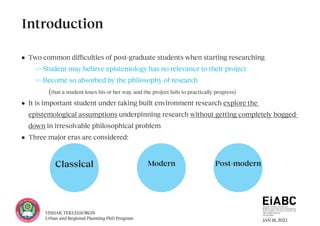
• Two common difficulties of post-graduate students when starting researching
>> Student may believe epistemology has no relevance to their project
>> Become so absorbed by the philosophy of research
		(that a student loses his or her way, and the project fails to practically progress)
• It is important student under taking built environment research explore the
epistemological assumptions underpinning research without getting completely bogged-
down in irresolvable philosophical problem
• Three major eras are considered:
Introduction
Classical Modern Post-modern
JAN 18, 2023
YISHAK TEKLEGIORGIS
Urban and Regional Planning PhD Program
• The term ‘epistemology’ comes from Greek word ‘episteme’ meaning ‘Knowledge’ and
‘logos’ means ‘account’
• Epistemology particularly concerned with theories of knowledge that attempt to answer
questions surrounding the nature of knowledge, its limit and how we acquire it.
• In philosophy, knowledge is typically defined as a ‘justified true belief’
• In knowledge claim, the source and quality of our justification are very important
For instance, you may believe that interest rates will fall next month. If, in one month’s time, interest rates do fall, is it
fair to say you had knowledge that they would fall? The answer is: it depends on your justification. A true belief by itself
does not constitute knowledge;a true belief requires an additional ingredient: justification.
Concepts
JAN 18, 2023
YISHAK TEKLEGIORGIS
Urban and Regional Planning PhD Program
>> Since Ancient Greeks there has been disagreement amongst philosophers about how we
should derive our knowledge (leads to different schools of thoughts)
1. Normative tradition: Most dominant school
>> Foundationalism: knowledge rests on a basic, or foundational belief and these
unshakable basic beliefs act as a substructure for various other inferred non-basic beliefs:
		 Can be further subdivided to rationalists and empiricists
		>> Empiricists: believes knowledge is derived through five senses
		>> Rationalist: humans derive their basic beliefs not through the senses but from
rational thoughts.
>> Coherentism: there are no foundational belief, only beliefs that support each other;
the justification for the belief revolves around the match between it and other beliefs
2. Naturalistic tradition: an approach to the theory of knowledge based on the use of scientific methods and
empirical data rather than relying solely on deductive methods and a priori analysis of concepts
Concepts
JAN 18, 2023
YISHAK TEKLEGIORGIS
Urban and Regional Planning PhD Program
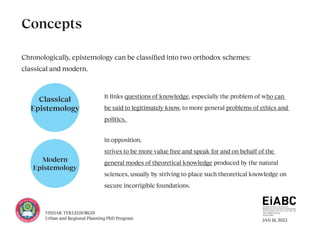
Classical
Epistemology
Modern
Epistemology
Chronologically, epistemology can be classified into two orthodox schemes:
classical and modern.
Concepts
in opposition,
strives to be more value free and speak for and on behalf of the
general modes of theoretical knowledge produced by the natural
sciences, usually by striving to place such theoretical knowledge on
secure incorrigible foundations.
It links questions of knowledge, especially the problem of who can
be said to legitimately know, to more general problems of ethics and
politics.
JAN 18, 2023
YISHAK TEKLEGIORGIS
Urban and Regional Planning PhD Program
>> Can be divided into two: Platonic and Pyrrhonic
Platonic epistemology:
has its orgion in the ideas of Plato (427 – 347BC)
>> According to Plato/Socrates most people do not use their intellectual power to good
effect and as such cannot provide a true and justified account
>> They live in a state of akrasia or self-delusion, which results in people acting against their
own better judgment
>> It is the task of the philosopher to expose these illusion so individuals know
themselves more authentically
>> The opposite and opponent of knowledge is general public opinion or doxa
Classic epistemology
JAN 18, 2023
YISHAK TEKLEGIORGIS
Urban and Regional Planning PhD Program
For Plato:
>> True knowledge is not tied to or determined by the vagaries of public tastes, but is
timeless, abstract and universal: that is, rational
>> True knowledge is never particular, never simply about this or that, but essential,
general and fundamental.
>> To know something is to know its underlying unified form or general ideas, is
something that lies behind and beyond the deceptive realm of appearance.
>> Classical epistemology is a radically anti-democratic discipline in that it restricts
knowledge to an elite cadre of thinkers
>> Democracy is the rule of the mob, of opinion, and therefore democracy is a mode of
politics productive of error and illusion rather than knowledge per se.
Cont.
JAN 18, 2023
YISHAK TEKLEGIORGIS
Urban and Regional Planning PhD Program
Pyrrhonic epistemology
>> The tradition has its roots in the ideas of Sceptic, especially Phyroo (360 –
270BC) and Sextus Empiricus (150 -225AD) but still evident today in the ideas of
postmodernists.
>> There is no way to resolve disputes between different ways of making
judgments about the world.
>> They argued the philosophical certainty associated with Platonism is
fundamentally mistaken, and the only appropriate epistemological response is to
suspend judgment.
Nobody does, in fact, know anything because nobody can, in fact, know anything.
Cont.
JAN 18, 2023
YISHAK TEKLEGIORGIS
Urban and Regional Planning PhD Program
Aristotle ((384–322 BC)
>> was platonist in that he gave priority to universal theoretical knowledge over
and above practical knowledge
>> he recognised that knowledge is never purely and simply theoretical, but has an
important practical aspect.
>> For Aristotle there are three kinds of practical knowledge. First, there is
knowledge required to make things ‘techne’. Second, there is knowledge required
to create or imagine things ‘poesis’ and finally, there is knowledge required in order
live a good life ‘phronesis’.
Cont.
JAN 18, 2023
YISHAK TEKLEGIORGIS
Urban and Regional Planning PhD Program
Rationalism
>> The ideas of the sceptic seen as a treat to the then developing scientific world
view by philosophers like: Renee Descartes, Leibniz and Spinoza
>> Descartes’ strategy was to turn the sceptics’ doubts about the possibility of
knowing anything for certain against themselves, by bringing into play his so-
called ‘method of doubt’.
>> Descartes’ method involved calling into question, ‘rejecting as false’, all those
beliefs that are capable of being doubted, until we arrive at a belief that cannot be
doubted on pain of contradiction or self-refutation.
>> The final ‘indubitable belief’ can function as a foundation upon which other
beliefs derived from it by a process of logical deduction
Modern Epistemology
JAN 18, 2023
YISHAK TEKLEGIORGIS
Urban and Regional Planning PhD Program
>> He invented an imaginary interlocutor (malignant demon) whose task is to
make hypothetically false each and every belief that desecrates held to be true
>> Descartes famously argued that there is one belief that even an all-powerful
malignant demon could not make false, and that is the cogito or the belief that ‘I
think’.
>> Descartes states of his demon, ‘let him deceive me as much as he can, he will
never bring about that I am nothing so long that I think that I am something‘
Cont.
JAN 18, 2023
YISHAK TEKLEGIORGIS
Urban and Regional Planning PhD Program
Empiricism
>> Empiricism is the philosophy associated with the ideas of John Locke, Gorge
Berkeley and David Hume of 17th & 18th century and ideas of postivists in the 20th
century
>> Any belief can count as knowledge if, and only if, it is grounded in sets of actual
or possible experiences.
>> In order to justify it one must be able to directly perceive that (seeing, hearing,
tasting, smelling and touching)
>> Empiricism is also a foundationalist epistemology in that it attempts to found
knowledge on the certainties, or incorrigibility, associated with sense perception.
Cont.
JAN 18, 2023
YISHAK TEKLEGIORGIS
Urban and Regional Planning PhD Program
>> Unlike classical epistemology, authentic knowledge begins with knowledge of
concrete particulars, that is with an experience of this or that.
>> For empiricism to be a valid theory of knowledge it must show how we are to
move from concrete experience to abstract theoretical thought (from concrete to
universal knowledge)
>> Francis Bacon (1561 – 1626), this method of inferring the universal from the
particular is the method of induction
>> Hume(1975) the first to note that induction, as a cognitive process, could never
warrant the assertion of general theoretical knowledge
Cont.
JAN 18, 2023
YISHAK TEKLEGIORGIS
Urban and Regional Planning PhD Program
>> For hume, there was no rationality, no true preserving aspect, to inductive
inferences, no such thing as ‘inductive proof’
>> Karl Popper (1959) claimed that although experience did produce epistemically
significant particulars, these discrete experiential particulars could not, logically be
induced into theoretical universals
>> For Popper it is theoretical universals that have priority in both time and fact,
experience only provide ways of testing for the truth value of theses
Cont.
JAN 18, 2023
YISHAK TEKLEGIORGIS
Urban and Regional Planning PhD Program
>> The postmodern critique of epistemology emerges out of a series of reflections
derived from the work of Friedrich Nietzsche (1844–1900).
>> Nietzsche criticises those who want to link knowledge to timeless truth and
transcendent objective realities,
>> Once we recognise that truth has a history, or, as he states, a
genealogy, then we can see knowledge as created rather than ‘discovered’.
>> Knowledge is no longer a static and timeless structure but is dynamic; ever-
changing and ever-shifting
>> Geographical specificity of given ways of knowing.
Postmodernism and the critique of
epistemology
JAN 18, 2023
YISHAK TEKLEGIORGIS
Urban and Regional Planning PhD Program
>> There may be other ways of knowing that do not fit into western rationalist or
empiricist models and approaches
>> Richard Rorty (1931-2007) argued that there is on neutral and impartial
standpoint from which to view the world because all perspectives on the world are
mediated by language and culture.
>> For many, this kind of postmodern rejection of the very possibility of
epistemology is extremely depressing in that it seems to threaten to undermine the
very foundations of intellectual life
Cont.
JAN 18, 2023
YISHAK TEKLEGIORGIS
Urban and Regional Planning PhD Program
The End!

Epistemology " Theory of Knowledge'

  • 1.
    JAN 18, 2023 YISHAKTEKLEGIORGIS Urban and Regional Planning PhD Program Book chapter review Advanced Research Methods in the Built Environment Andrew knight & Les Ruddock Ethiopian Institute of Architecture, Building Construction & City Development Urban and Regional Planning (PhD program) Urban and Regional studies I_ GURP/1311 Prepared by: Yishak Teklegiorgis
  • 2.
    JAN 18, 2023 YISHAKTEKLEGIORGIS Urban and Regional Planning PhD Program Book chapter review Advanced Research Methods in the Built Environment Andrew knight & Les Ruddock CHAPTER SIX: Epistemology Andrew Knight and Neil Turnbull
  • 3.
    JAN 18, 2023 YISHAKTEKLEGIORGIS Urban and Regional Planning PhD Program Content Chapter six: Epistemology • Introduction • Concepts • Classical Epistemology • Modern Epistemology • Post modern and the critique
  • 4.
    JAN 18, 2023 YISHAKTEKLEGIORGIS Urban and Regional Planning PhD Program • Two common difficulties of post-graduate students when starting researching >> Student may believe epistemology has no relevance to their project >> Become so absorbed by the philosophy of research (that a student loses his or her way, and the project fails to practically progress) • It is important student under taking built environment research explore the epistemological assumptions underpinning research without getting completely bogged- down in irresolvable philosophical problem • Three major eras are considered: Introduction Classical Modern Post-modern
  • 5.
    JAN 18, 2023 YISHAKTEKLEGIORGIS Urban and Regional Planning PhD Program • The term ‘epistemology’ comes from Greek word ‘episteme’ meaning ‘Knowledge’ and ‘logos’ means ‘account’ • Epistemology particularly concerned with theories of knowledge that attempt to answer questions surrounding the nature of knowledge, its limit and how we acquire it. • In philosophy, knowledge is typically defined as a ‘justified true belief’ • In knowledge claim, the source and quality of our justification are very important For instance, you may believe that interest rates will fall next month. If, in one month’s time, interest rates do fall, is it fair to say you had knowledge that they would fall? The answer is: it depends on your justification. A true belief by itself does not constitute knowledge;a true belief requires an additional ingredient: justification. Concepts
  • 6.
    JAN 18, 2023 YISHAKTEKLEGIORGIS Urban and Regional Planning PhD Program >> Since Ancient Greeks there has been disagreement amongst philosophers about how we should derive our knowledge (leads to different schools of thoughts) 1. Normative tradition: Most dominant school >> Foundationalism: knowledge rests on a basic, or foundational belief and these unshakable basic beliefs act as a substructure for various other inferred non-basic beliefs: Can be further subdivided to rationalists and empiricists >> Empiricists: believes knowledge is derived through five senses >> Rationalist: humans derive their basic beliefs not through the senses but from rational thoughts. >> Coherentism: there are no foundational belief, only beliefs that support each other; the justification for the belief revolves around the match between it and other beliefs 2. Naturalistic tradition: an approach to the theory of knowledge based on the use of scientific methods and empirical data rather than relying solely on deductive methods and a priori analysis of concepts Concepts
  • 7.
    JAN 18, 2023 YISHAKTEKLEGIORGIS Urban and Regional Planning PhD Program Classical Epistemology Modern Epistemology Chronologically, epistemology can be classified into two orthodox schemes: classical and modern. Concepts in opposition, strives to be more value free and speak for and on behalf of the general modes of theoretical knowledge produced by the natural sciences, usually by striving to place such theoretical knowledge on secure incorrigible foundations. It links questions of knowledge, especially the problem of who can be said to legitimately know, to more general problems of ethics and politics.
  • 8.
    JAN 18, 2023 YISHAKTEKLEGIORGIS Urban and Regional Planning PhD Program >> Can be divided into two: Platonic and Pyrrhonic Platonic epistemology: has its orgion in the ideas of Plato (427 – 347BC) >> According to Plato/Socrates most people do not use their intellectual power to good effect and as such cannot provide a true and justified account >> They live in a state of akrasia or self-delusion, which results in people acting against their own better judgment >> It is the task of the philosopher to expose these illusion so individuals know themselves more authentically >> The opposite and opponent of knowledge is general public opinion or doxa Classic epistemology
  • 9.
    JAN 18, 2023 YISHAKTEKLEGIORGIS Urban and Regional Planning PhD Program For Plato: >> True knowledge is not tied to or determined by the vagaries of public tastes, but is timeless, abstract and universal: that is, rational >> True knowledge is never particular, never simply about this or that, but essential, general and fundamental. >> To know something is to know its underlying unified form or general ideas, is something that lies behind and beyond the deceptive realm of appearance. >> Classical epistemology is a radically anti-democratic discipline in that it restricts knowledge to an elite cadre of thinkers >> Democracy is the rule of the mob, of opinion, and therefore democracy is a mode of politics productive of error and illusion rather than knowledge per se. Cont.
  • 10.
    JAN 18, 2023 YISHAKTEKLEGIORGIS Urban and Regional Planning PhD Program Pyrrhonic epistemology >> The tradition has its roots in the ideas of Sceptic, especially Phyroo (360 – 270BC) and Sextus Empiricus (150 -225AD) but still evident today in the ideas of postmodernists. >> There is no way to resolve disputes between different ways of making judgments about the world. >> They argued the philosophical certainty associated with Platonism is fundamentally mistaken, and the only appropriate epistemological response is to suspend judgment. Nobody does, in fact, know anything because nobody can, in fact, know anything. Cont.
  • 11.
    JAN 18, 2023 YISHAKTEKLEGIORGIS Urban and Regional Planning PhD Program Aristotle ((384–322 BC) >> was platonist in that he gave priority to universal theoretical knowledge over and above practical knowledge >> he recognised that knowledge is never purely and simply theoretical, but has an important practical aspect. >> For Aristotle there are three kinds of practical knowledge. First, there is knowledge required to make things ‘techne’. Second, there is knowledge required to create or imagine things ‘poesis’ and finally, there is knowledge required in order live a good life ‘phronesis’. Cont.
  • 12.
    JAN 18, 2023 YISHAKTEKLEGIORGIS Urban and Regional Planning PhD Program Rationalism >> The ideas of the sceptic seen as a treat to the then developing scientific world view by philosophers like: Renee Descartes, Leibniz and Spinoza >> Descartes’ strategy was to turn the sceptics’ doubts about the possibility of knowing anything for certain against themselves, by bringing into play his so- called ‘method of doubt’. >> Descartes’ method involved calling into question, ‘rejecting as false’, all those beliefs that are capable of being doubted, until we arrive at a belief that cannot be doubted on pain of contradiction or self-refutation. >> The final ‘indubitable belief’ can function as a foundation upon which other beliefs derived from it by a process of logical deduction Modern Epistemology
  • 13.
    JAN 18, 2023 YISHAKTEKLEGIORGIS Urban and Regional Planning PhD Program >> He invented an imaginary interlocutor (malignant demon) whose task is to make hypothetically false each and every belief that desecrates held to be true >> Descartes famously argued that there is one belief that even an all-powerful malignant demon could not make false, and that is the cogito or the belief that ‘I think’. >> Descartes states of his demon, ‘let him deceive me as much as he can, he will never bring about that I am nothing so long that I think that I am something‘ Cont.
  • 14.
    JAN 18, 2023 YISHAKTEKLEGIORGIS Urban and Regional Planning PhD Program Empiricism >> Empiricism is the philosophy associated with the ideas of John Locke, Gorge Berkeley and David Hume of 17th & 18th century and ideas of postivists in the 20th century >> Any belief can count as knowledge if, and only if, it is grounded in sets of actual or possible experiences. >> In order to justify it one must be able to directly perceive that (seeing, hearing, tasting, smelling and touching) >> Empiricism is also a foundationalist epistemology in that it attempts to found knowledge on the certainties, or incorrigibility, associated with sense perception. Cont.
  • 15.
    JAN 18, 2023 YISHAKTEKLEGIORGIS Urban and Regional Planning PhD Program >> Unlike classical epistemology, authentic knowledge begins with knowledge of concrete particulars, that is with an experience of this or that. >> For empiricism to be a valid theory of knowledge it must show how we are to move from concrete experience to abstract theoretical thought (from concrete to universal knowledge) >> Francis Bacon (1561 – 1626), this method of inferring the universal from the particular is the method of induction >> Hume(1975) the first to note that induction, as a cognitive process, could never warrant the assertion of general theoretical knowledge Cont.
  • 16.
    JAN 18, 2023 YISHAKTEKLEGIORGIS Urban and Regional Planning PhD Program >> For hume, there was no rationality, no true preserving aspect, to inductive inferences, no such thing as ‘inductive proof’ >> Karl Popper (1959) claimed that although experience did produce epistemically significant particulars, these discrete experiential particulars could not, logically be induced into theoretical universals >> For Popper it is theoretical universals that have priority in both time and fact, experience only provide ways of testing for the truth value of theses Cont.
  • 17.
    JAN 18, 2023 YISHAKTEKLEGIORGIS Urban and Regional Planning PhD Program >> The postmodern critique of epistemology emerges out of a series of reflections derived from the work of Friedrich Nietzsche (1844–1900). >> Nietzsche criticises those who want to link knowledge to timeless truth and transcendent objective realities, >> Once we recognise that truth has a history, or, as he states, a genealogy, then we can see knowledge as created rather than ‘discovered’. >> Knowledge is no longer a static and timeless structure but is dynamic; ever- changing and ever-shifting >> Geographical specificity of given ways of knowing. Postmodernism and the critique of epistemology
  • 18.
    JAN 18, 2023 YISHAKTEKLEGIORGIS Urban and Regional Planning PhD Program >> There may be other ways of knowing that do not fit into western rationalist or empiricist models and approaches >> Richard Rorty (1931-2007) argued that there is on neutral and impartial standpoint from which to view the world because all perspectives on the world are mediated by language and culture. >> For many, this kind of postmodern rejection of the very possibility of epistemology is extremely depressing in that it seems to threaten to undermine the very foundations of intellectual life Cont.
  • 19.
    JAN 18, 2023 YISHAKTEKLEGIORGIS Urban and Regional Planning PhD Program The End!