Plato vs. René Descartes
 A philosophical theory based on the idea of
opposing concepts, especially the theory that
human beings are made up of two independent
constituents, the body and the mind or soul.
 The behavior of the body is determined by
mechanistic laws and can be measured in a
scientific manner. But the mind, which
transcends the material world, cannot be
similarly studied.
 Ancient believes of immortality
 Mythology/Devine intervention
 Scholasticism
 The complexity of man
 Man is both a doer and an observer
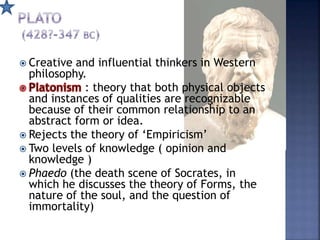
 Creative and influential thinkers in Western
philosophy.
: theory that both physical objects
and instances of qualities are recognizable
because of their common relationship to an
abstract form or idea.
 Rejects the theory of ‘Empiricism’
 Two levels of knowledge ( opinion and
knowledge )
 Phaedo (the death scene of Socrates, in
which he discusses the theory of Forms, the
nature of the soul, and the question of
immortality)
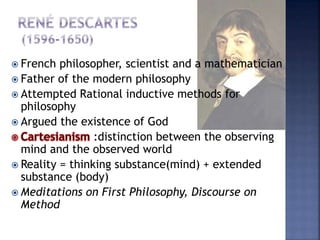
 French philosopher, scientist and a mathematician
 Father of the modern philosophy
 Attempted Rational inductive methods for
philosophy
 Argued the existence of God
:distinction between the observing
mind and the observed world
 Reality = thinking substance(mind) + extended
substance (body)
 Meditations on First Philosophy, Discourse on
Method
 Both Plato and Descartes saw mind as
identical with soul.
 We consist of something incorporeal
(soul/mind).
 Both identify the self.
 Whether mind or soul can/can’t exist
altogether independently of body.
 Both are concerned with the immortality of
the soul.
In Platonic dualism–
 The ultimate dualism is between “being” and
“nonbeing”—that is, between ideas and
matter.
 Plato’s theory of Forms.
 Plato argued that the soul pre-existed and
survived the body.
 Reincarnation and obtaining knowledge.
In Phaedo :
I. The Cyclical Argument
Coming to be and ceasing to be
II. The Recollection Argument
Knowing is Remembering
III. The Affinity Argument
The Indestructibility of the Soul
IV. The Argument from Opposites
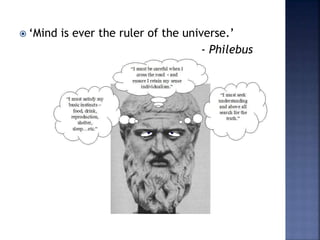
 ‘Mind is ever the ruler of the universe.’
- Philebus
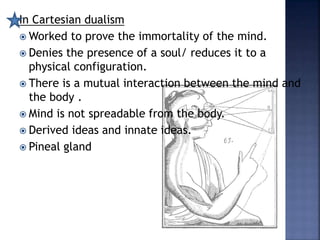
In Cartesian dualism
 Worked to prove the immortality of the mind.
 Denies the presence of a soul/ reduces it to a
physical configuration.
 There is a mutual interaction between the mind and
the body .
 Mind is not spreadable from the body.
 Derived ideas and innate ideas.
 Pineal gland
 "I think, therefore I am.” - Discourse on Method.
 “But what then am I? A thing that thinks. What is that? A
thing that doubts, understands, affirms, denies, is
willing, is unwilling, and also imagines and has sensory
perceptions.” -Meditations on First Philosophy.
 “While I could pretend that I had no body and that
there was no world and no place for me to be in, I could
not for all that pretend that I did not exist...Accordingly
this 'I'...is entirely distinct from the body.” -Discourse on
Method
 “There is a great difference between the mind and the
body, inasmuch as the body is by its very nature always
divisible, while the mind is utterly indivisible.” -
Meditations on First Philosophy
 Plato's acceptance and Descartes'
rejection of the assumption that the soul
(= intellect) is identical with what
animates the body.
 Soul vs. mind
 Reincarnation vs. Empiricism
 Religion vs. science
 A/13/AI/718
 A/13/AI/746

Dualism - the relationship between mind and body

  • 1.
    Plato vs. RenéDescartes
  • 2.
     A philosophicaltheory based on the idea of opposing concepts, especially the theory that human beings are made up of two independent constituents, the body and the mind or soul.  The behavior of the body is determined by mechanistic laws and can be measured in a scientific manner. But the mind, which transcends the material world, cannot be similarly studied.
  • 3.
     Ancient believesof immortality  Mythology/Devine intervention  Scholasticism  The complexity of man  Man is both a doer and an observer
  • 4.
     Creative andinfluential thinkers in Western philosophy. : theory that both physical objects and instances of qualities are recognizable because of their common relationship to an abstract form or idea.  Rejects the theory of ‘Empiricism’  Two levels of knowledge ( opinion and knowledge )  Phaedo (the death scene of Socrates, in which he discusses the theory of Forms, the nature of the soul, and the question of immortality)
  • 5.
     French philosopher,scientist and a mathematician  Father of the modern philosophy  Attempted Rational inductive methods for philosophy  Argued the existence of God :distinction between the observing mind and the observed world  Reality = thinking substance(mind) + extended substance (body)  Meditations on First Philosophy, Discourse on Method
  • 6.
     Both Platoand Descartes saw mind as identical with soul.  We consist of something incorporeal (soul/mind).  Both identify the self.  Whether mind or soul can/can’t exist altogether independently of body.  Both are concerned with the immortality of the soul.
  • 7.
    In Platonic dualism– The ultimate dualism is between “being” and “nonbeing”—that is, between ideas and matter.  Plato’s theory of Forms.  Plato argued that the soul pre-existed and survived the body.  Reincarnation and obtaining knowledge.
  • 8.
    In Phaedo : I.The Cyclical Argument Coming to be and ceasing to be II. The Recollection Argument Knowing is Remembering III. The Affinity Argument The Indestructibility of the Soul IV. The Argument from Opposites
  • 9.
     ‘Mind isever the ruler of the universe.’ - Philebus
  • 10.
    In Cartesian dualism Worked to prove the immortality of the mind.  Denies the presence of a soul/ reduces it to a physical configuration.  There is a mutual interaction between the mind and the body .  Mind is not spreadable from the body.  Derived ideas and innate ideas.  Pineal gland
  • 11.
     "I think,therefore I am.” - Discourse on Method.  “But what then am I? A thing that thinks. What is that? A thing that doubts, understands, affirms, denies, is willing, is unwilling, and also imagines and has sensory perceptions.” -Meditations on First Philosophy.  “While I could pretend that I had no body and that there was no world and no place for me to be in, I could not for all that pretend that I did not exist...Accordingly this 'I'...is entirely distinct from the body.” -Discourse on Method  “There is a great difference between the mind and the body, inasmuch as the body is by its very nature always divisible, while the mind is utterly indivisible.” - Meditations on First Philosophy
  • 12.
     Plato's acceptanceand Descartes' rejection of the assumption that the soul (= intellect) is identical with what animates the body.  Soul vs. mind  Reincarnation vs. Empiricism  Religion vs. science
  • 14.