VIVEK YADAV,,,,,,,TC NITRA
TECHNICAL CAMPUS
• A PRESENAION ON MOISTURE
ABSORPTION OF DIFFERENT FIBRE
Rate Of Absorption Of Moisture
• Textile materials take a long time to come
into equilibrium with their surrounding e.g
Drying after Washing.
• Rate depends on temperature, air
humidity, wind velocity, surroundings,
thickness of material, density of material,
nature of fibre etc.
• Slowness of Conditioning – May be a
technical nuisance, because textiles
have to be conditioned before
processing or sale.
• Advantageous – Valuable stabilizing
influence : absorbent fibrous materials
in a room will prevent rapid changes in
humidity or temperature.
• Study – Factors that play a part in
change of conditions in textiles.
DIFFUSION OF MOISTURE
• Slow Conditioning – Slowness with which
water molecules diffuse through the fibre
or through the air to the fibre.
• If concentration of H2O molecules ( or of
any other substance with which one is
concerned ) varies from place to place in a
given medium ( e.g – air or fibre
substance ), the molecules will diffuse
from regions of high concentration to
regions of low concentration until their
distribution becomes uniform.
Fick’s Equation – (First Law)
• Rate of transport of diffusing substance passing
through a cross-section ‘A’ is proportional to the
concentration gradient of moisture.
• Units – cm square/sec.
• D = Diffusion coefficient
• D ~ cm 2/sec
• Determined experimentally and in tables.
A = Unit cross sectional area
J= Mass of moisture passing
throu’ unit cross section
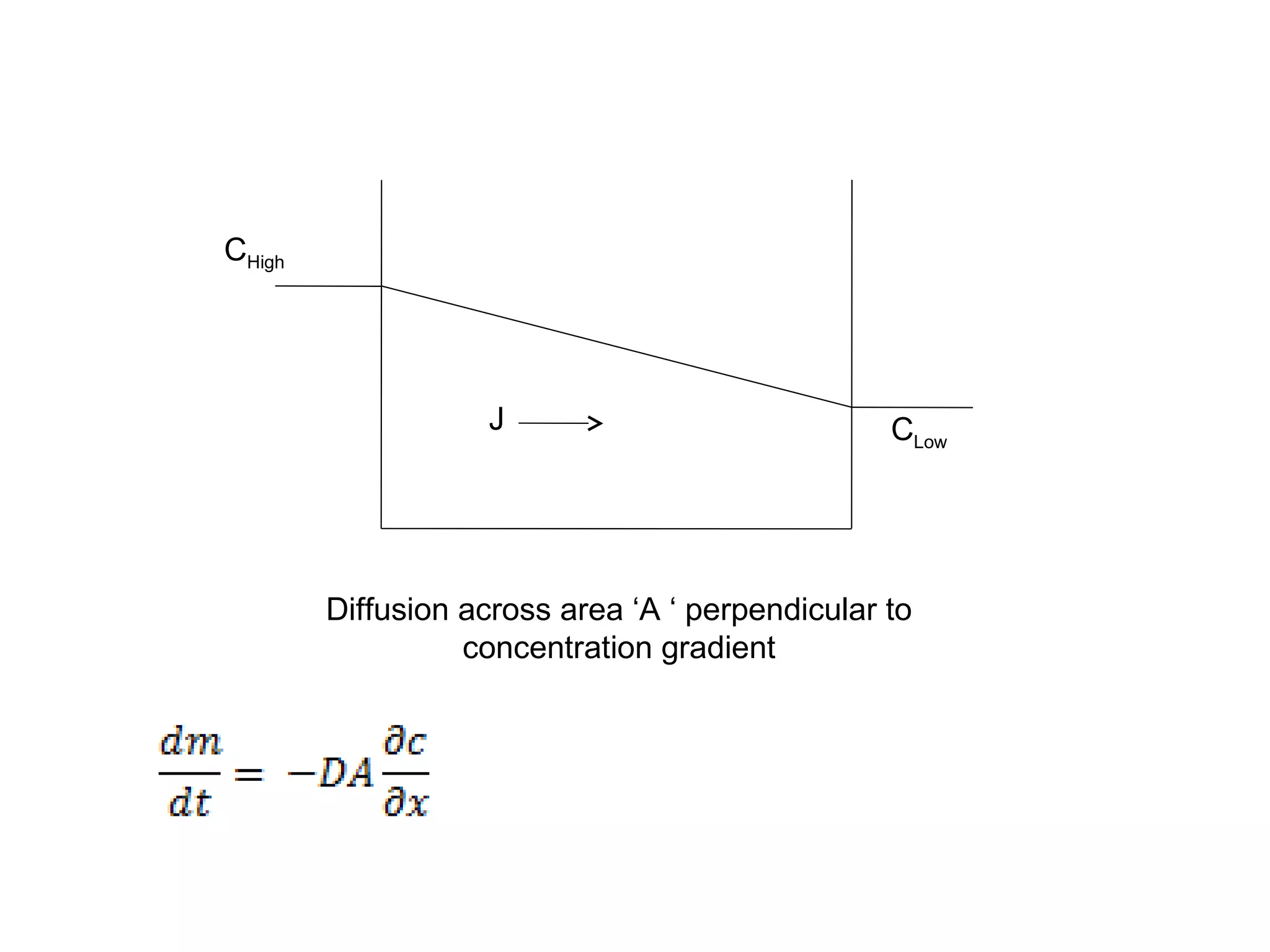
CHigh
CLow
J
Diffusion across area ‘A ‘ perpendicular to
concentration gradient
Fick’s first law has limited use.
• Practical problem, which can be solved ---
Membrane problem
• Flux ‘J’ Mass of moisture passing through
a unit cross-section :
• Problem – A membrane separates two
flowing streams of gases that have
different concentration of an impurity.
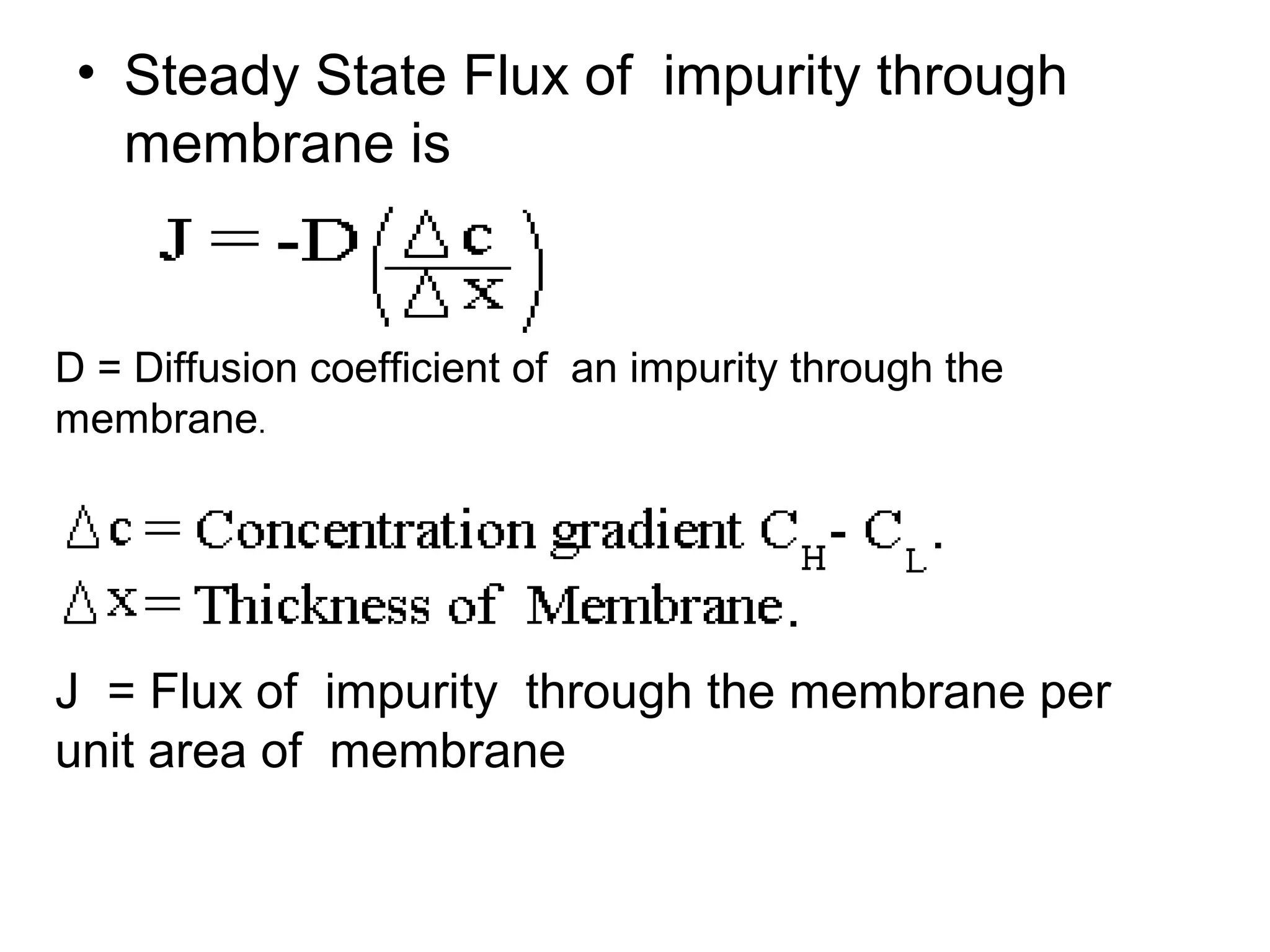
• Steady State Flux of impurity through
membrane is
D = Diffusion coefficient of an impurity through the
membrane.
J = Flux of impurity through the membrane per
unit area of membrane
• Fick’s first law is useful here because
concentration gradient is constant & at
steady state ‘D’ is constant
Most Problems in Diffusion, i.e, Textile
fibres –
Region where ‘c’ changes with time
Fibre experiences an increase in moisture
content with absorption.
In such cases, we cannot use Fick’s first
law
J1 J2
Δx
J1
J2
X1 X2
Diffusion of Impurity through a bar
DIFFUSION OF AN IMPURITY THROUGH A
SOLID BAR
• Flux through this bar of unit cross-
sectional area at x coordinate 1.
Since J1 is not equal to J2, the concentration
of species ‘c’ in the volume changes with
time
Fick’s Second Law – Flux that
corresponds to experimental conditions
• Law of Mass Conservation,
Substituting the expression for J from Fick’s
First Law,
This is Fick’s Second Law.
Simpler form where D is a constant & not a function of x
or c.
• Problem – To determine about how long it
will take for a fibre to absorb or desorb
moisture.
• Complications arise in fibres where
diffusion coefficient may vary with time.
• ( Absorption – Molecules removed from
diffusion process )
cannot be solved unless some relation
between D & c can substituted.
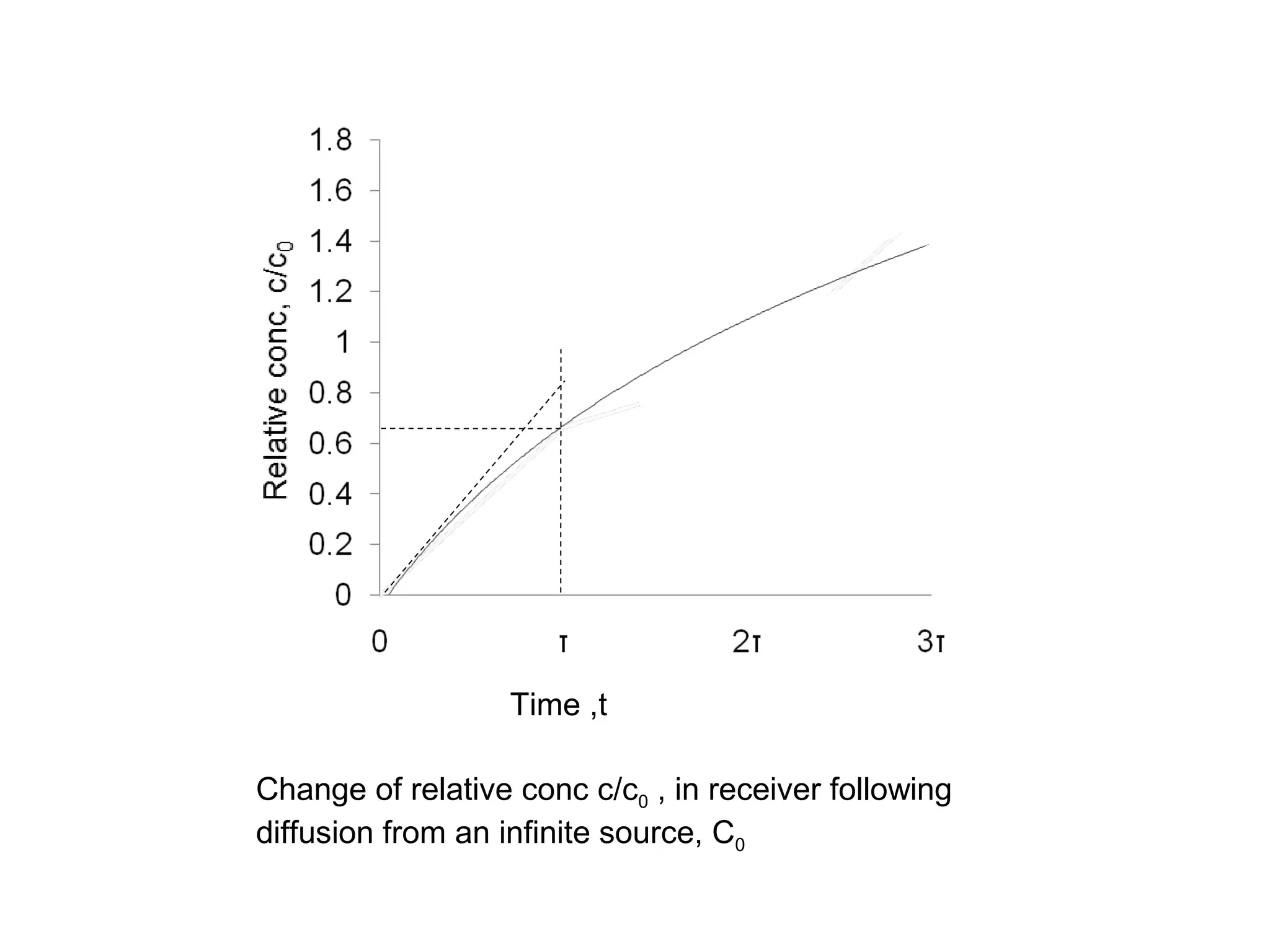
Diffusion Into A Receiver From An
Infinite Source Of Concentration Co
On integrating & assuming as initial
conditions c = 0 at t = 0,
C0
C
c=0
at
t=0
Time ,t
Change of relative conc c/c0 , in receiver following
diffusion from an infinite source, C0
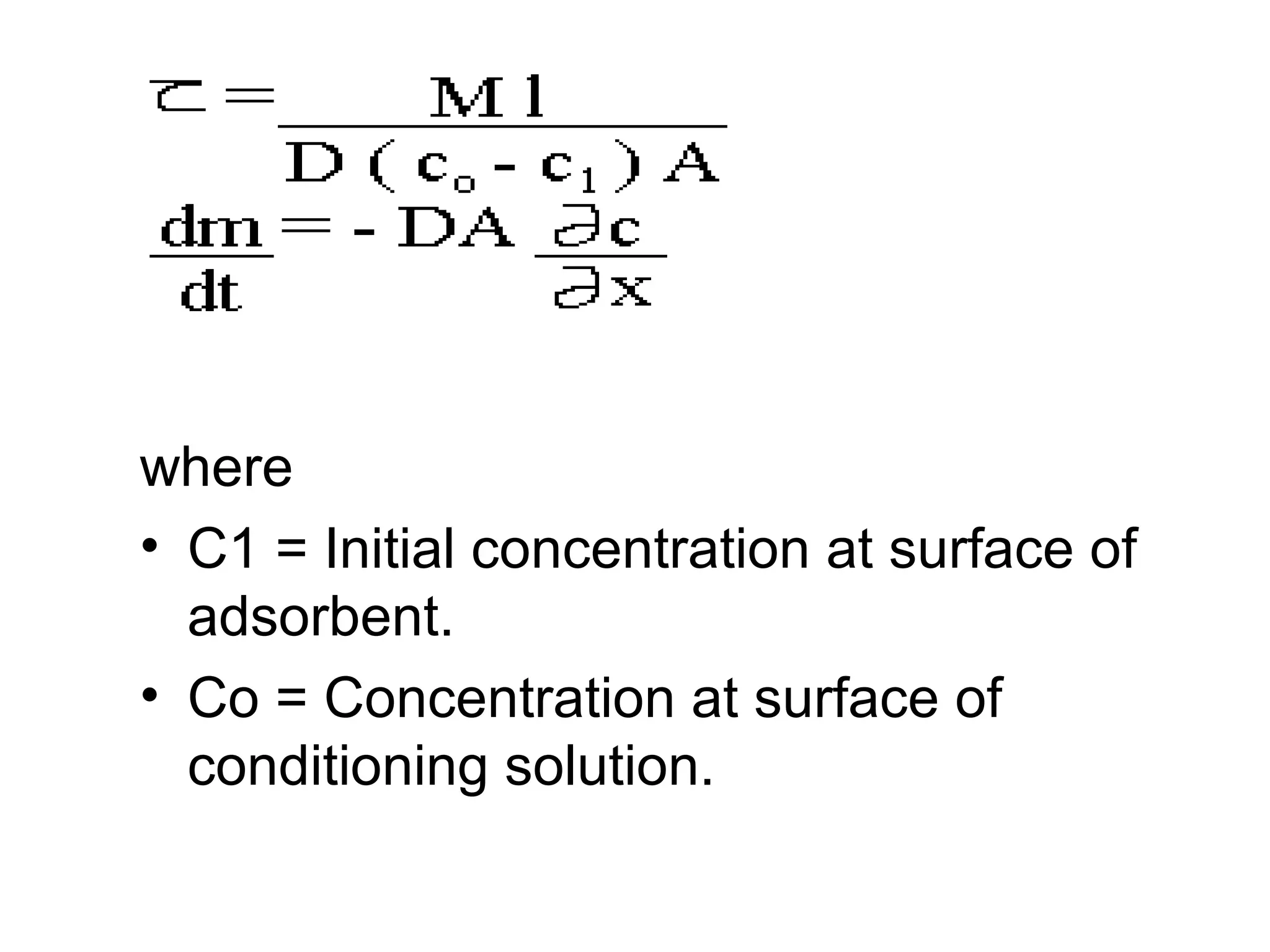
M = Mass needed to bring the adsorbent to
equilibrium.
where
• C1 = Initial concentration at surface of
adsorbent.
• Co = Concentration at surface of
conditioning solution.
• For a homogeneous cylinder of length ‘l’
& radius ‘r’ in which there is a change of
conditions at surface such as to cause a
change in the equilibrium concentration in
the cylinder from C2 to Co, the mass
observed is given by product of the
volume of the cylinder and change in
concentration.

Rate of absorption of moisture

  • 1.
    VIVEK YADAV,,,,,,,TC NITRA TECHNICALCAMPUS • A PRESENAION ON MOISTURE ABSORPTION OF DIFFERENT FIBRE
  • 2.
    Rate Of AbsorptionOf Moisture • Textile materials take a long time to come into equilibrium with their surrounding e.g Drying after Washing. • Rate depends on temperature, air humidity, wind velocity, surroundings, thickness of material, density of material, nature of fibre etc.
  • 3.
    • Slowness ofConditioning – May be a technical nuisance, because textiles have to be conditioned before processing or sale. • Advantageous – Valuable stabilizing influence : absorbent fibrous materials in a room will prevent rapid changes in humidity or temperature. • Study – Factors that play a part in change of conditions in textiles.
  • 4.
    DIFFUSION OF MOISTURE •Slow Conditioning – Slowness with which water molecules diffuse through the fibre or through the air to the fibre. • If concentration of H2O molecules ( or of any other substance with which one is concerned ) varies from place to place in a given medium ( e.g – air or fibre substance ), the molecules will diffuse from regions of high concentration to regions of low concentration until their distribution becomes uniform.
  • 5.
    Fick’s Equation –(First Law) • Rate of transport of diffusing substance passing through a cross-section ‘A’ is proportional to the concentration gradient of moisture. • Units – cm square/sec. • D = Diffusion coefficient • D ~ cm 2/sec • Determined experimentally and in tables. A = Unit cross sectional area J= Mass of moisture passing throu’ unit cross section
  • 6.
    CHigh CLow J Diffusion across area‘A ‘ perpendicular to concentration gradient
  • 7.
    Fick’s first lawhas limited use. • Practical problem, which can be solved --- Membrane problem • Flux ‘J’ Mass of moisture passing through a unit cross-section : • Problem – A membrane separates two flowing streams of gases that have different concentration of an impurity.
  • 8.
    • Steady StateFlux of impurity through membrane is D = Diffusion coefficient of an impurity through the membrane. J = Flux of impurity through the membrane per unit area of membrane
  • 9.
    • Fick’s firstlaw is useful here because concentration gradient is constant & at steady state ‘D’ is constant Most Problems in Diffusion, i.e, Textile fibres – Region where ‘c’ changes with time Fibre experiences an increase in moisture content with absorption. In such cases, we cannot use Fick’s first law
  • 10.
    J1 J2 Δx J1 J2 X1 X2 Diffusionof Impurity through a bar
  • 11.
    DIFFUSION OF ANIMPURITY THROUGH A SOLID BAR • Flux through this bar of unit cross- sectional area at x coordinate 1. Since J1 is not equal to J2, the concentration of species ‘c’ in the volume changes with time Fick’s Second Law – Flux that corresponds to experimental conditions
  • 12.
    • Law ofMass Conservation, Substituting the expression for J from Fick’s First Law, This is Fick’s Second Law. Simpler form where D is a constant & not a function of x or c.
  • 13.
    • Problem –To determine about how long it will take for a fibre to absorb or desorb moisture. • Complications arise in fibres where diffusion coefficient may vary with time. • ( Absorption – Molecules removed from diffusion process ) cannot be solved unless some relation between D & c can substituted.
  • 14.
    Diffusion Into AReceiver From An Infinite Source Of Concentration Co On integrating & assuming as initial conditions c = 0 at t = 0, C0 C c=0 at t=0
  • 15.
    Time ,t Change ofrelative conc c/c0 , in receiver following diffusion from an infinite source, C0
  • 17.
    M = Massneeded to bring the adsorbent to equilibrium.
  • 18.
    where • C1 =Initial concentration at surface of adsorbent. • Co = Concentration at surface of conditioning solution.
  • 19.
    • For ahomogeneous cylinder of length ‘l’ & radius ‘r’ in which there is a change of conditions at surface such as to cause a change in the equilibrium concentration in the cylinder from C2 to Co, the mass observed is given by product of the volume of the cylinder and change in concentration.