Chapter 6


            DIFFUSION IN SOLIDS


       • How does diffusion occur?

       • Why is it an important part of processing?

       • How can the rate of diffusion be predicted for
          some simple cases?

       • How does diffusion depend on structure
          and temperature?
Driving force for movement
In general, force is a position derivative of energy (F = - dE/dr).
In other words, if there is any energy difference in space,
there is a force which will act on matters - Force will move things.

(ex1) Potential energy by gravity:
      Apple falls from high altitude (high potential energy) to
      low altitude (low potential energy).

(ex2) Drift current by battery (electrical potential energy).

(ex3) Atoms move from high concentration (high chemical potential)
      to low concentration (low chemical potential) → Diffusion!
      * Concentration gradient is the driving force.
        (well, it is chemical potential energy to be precise.
     Concentration gradient is not sufficient condition for diffusion.)
Interdiffusion
• Interdiffusion: In an alloy, atoms tend to migrate
   from regions of large concentration.
       Initially                      After some time


          Cu       Ni
100%                          100%


  0                                0
       Concentration Profiles       Concentration Profiles
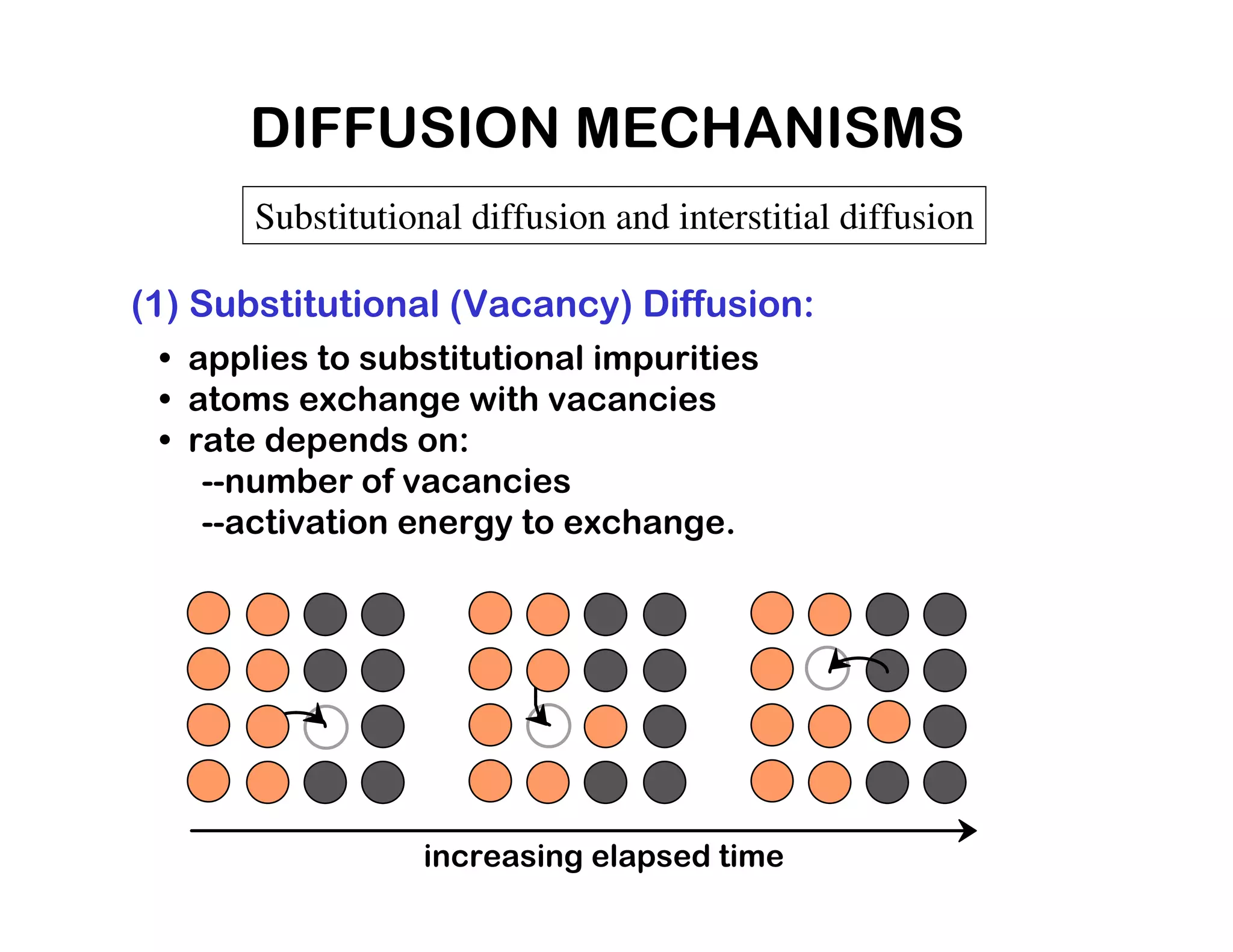
DIFFUSION MECHANISMS
       Substitutional diffusion and interstitial diffusion

(1) Substitutional (Vacancy) Diffusion:
 • applies to substitutional impurities
 • atoms exchange with vacancies
 • rate depends on:
    --number of vacancies
    --activation energy to exchange.


                  increasing elapsed time
Vacancy Diffusion

• Simulation of
  interdiffusion
  across an interface:

• Rate of substitutional
  diffusion depends on:
  --vacancy concentration
  --frequency of jumping.
           Temperature dependent.
(2) Interstitial Diffusion
                                  tetrahedral   octahedral
• Applies to interstitial
  (small) impurities        FCC
  (O, N, C, etc).

• More rapid than vacancy
  diffusion
                            BCC
      Why?
Self-Diffusion
• Self-diffusion: In an elemental solid, atoms also migrate
                  through diffusion. Driving force can be
                  described by more general thermodynamic
                  potential. This type of diffusion in the
                  crystalline material generally occurs
                  through substitutional diffusion.


        Label some atoms             After some time
                                        C
                 C
                 A                                  D
                                            A
                D
                                                B
                 B
PROCESSING USING DIFFUSION (1)
 • Case Hardening:
  --Diffuse carbon atoms
    into the host iron atoms
    at the surface.
  --Example of interstitial
    diffusion is a case
    hardened gear.


• Result: The "Case" is
 -- hard to deform: C atoms
   "lock" planes from shearing.
 -- hard to crack: C atoms put
    the surface in compression.
PROCESSING USING DIFFUSION (2)
• Doping Silicon with P for n-type semiconductors:
• Process:
                                  0.5mm
  1. Deposit P rich
     layers on surface.

                          magnified image of a computer chip
          silicon
  2. Heat it.
  3. Result: Doped
                             light regions: Si atoms
    semiconductor
    regions.


                             light regions: Al atoms
          silicon
MODELING DIFFUSION: FLUX
• Flux: Amount of matter that passes
        through unit area per unit time.
       1 dM  kg       atoms
    J=      ⇒  2  or  2 
       A dt   m s     m s 

• Flux can be measured for:
  --vacancies                                 x-direction
  --host (A) atoms
  --impurity (B) atoms

• Flux is directional Quantity.            Unit area A
             y J                           through
                 y
                                           which
                     Jx                    atoms
             Jz                            move.
                      x
      z
MODELING DIFFUSION: FLUX
• Flux can be also given by
           Flux = (conductivity) x (driving force)
     (ex) Electrical current (I) = (1/R) x V (Ohm’s law)

  - For diffusion, the conductivity is called
            ‘diffusivity’ or ‘diffusion coefficient’,
                 and it is typically presented by the symbol, D.

  - Driving force is concentration gradient, ∆C/∆x.

  - One important issue when you face with the diffusion problem
    is whether or not things change as a function of time.
      Steady state diffusion (nothing changes.)
      Non steady-state diffusion (flux & conc. profile change.)
STEADY STATE DIFFUSION
                        (Fick’s First Law)
• Steady State:
                                                  Steady State:
  Jx(left)                       Jx(right)       J x(left) = Jx(right)
                                 x
  Concentration, C, in the box doesn’t change w/time.

                                   dC
• Apply Fick's First Law: J x = −D
                                   dx
                                dC        dC 
• If Jx)left = Jx)right , then          = 
                                dx  left  dx  right
 • Result: the slope, dC/dx, must be constant
   (i.e., slope doesn't vary with position and time)!
EX: STEADY STATE DIFFUSION
                                          3
                                      g/m
• Steel plate at                  . 2k          3
                                =1           g/m
  700C with                  C1          .8k
                                      =0
                                 C2
  geometry       Carbon                     Steady State =
                  rich                    straight line!
  shown:
                  gas                        Carbon
                                             deficient
                                               gas
                                            D=3x10-11m2/s
                           0 x1 x2


                                   10
• Q: How much                5m

                                     m
                               m

                                     m
     carbon transfers
     from the rich to               C2 − C1 =          −9 kg
                             J = −D           2.4 × 10
     the deficient side?            x2 − x1              m2s
DIFFUSION AND TEMPERATURE
• Diffusivity increases with T.
                                       pre-exponential [m2/s] (see Table 5.2, Callister 6e)
                                                  activation energy
                                          Q  [J/mol],[eV/mol]
diffusivity          D = Do          exp − d  (see Table 5.2, Callister 6e )
                                             RT 
                                                     gas constant [8.31J/mol-K]
• Experimental Data:
             1500
                      1000

                               600


                                            300
                                                  T(C)
     10-8                                                D has exp. dependence on T
              C
                    in


 D (m2/s)                          Ci                    Recall: Vacancy does also!
                      γ-


                                     nα
                         Fe


                                       -Fe               Dinterstitial >> Dsubstitutional
     10-14                                                 C in α-Fe        Cu in Cu
                       Zn


                                                                            Al in Al
                    Fe


                                                           C in γ-Fe
                          in Cun α-

                          Al


                                                                            Fe in α-Fe
                             Cu in Fe
                             Fe -Fe


                             in
                       in


                                                                            Fe in γ-Fe
                                Al
                                γ
                                i


                                                                            Zn in Cu
                                   Cu


     10-20
         0.5                 1.0      1.5         2.0 1000K/T
NON STEADY STATE DIFFUSION
                  (Fick’s Second Law)
                                     dx
• Concentration profile,
                         J(left)                  J(right)
  C(x), changes
   w/ time.                                     Concentration,
                                                C, in the box
• To conserve matter:           • Fick's First Law:
   J(right) − J(left) = dC                  dC
                       −            J = −D       or
         dx              dt                 dx
                 dJ = dC          dJ =      d2 C (if D does
                       −                −D       not vary
                 dx      dt       dx        dx2 with x)
                                                 (Temperature
                       equate                     is fixed here.)
• Governing Eqn.:
                     dC   d2C
                        =D 2             Fick’s Second Law
                     dt   dx
NON STEADY STATE DIFFUSION
• Copper diffuses into a bar of aluminum.
  Surface conc.,
  Cs of Cu atoms                                      Al bar
                             pre-existing conc., C o of copper atoms
               C(x,t)
        Cs                                        Boundary condition:
                                                  t=0, C=C0 at 0≤x ≤∞
                           t
                        t2 3
                                                  t>0, C=Cs at x=0
           to t1
                                                       C=C0 at x=∞
        Co
            x=0                position, x
• General solution
  for C(x,t):                  C(x, t) − Co =          x 
                                              1 − erf       
                                                       2 Dt 
Fick’s 2nd law is               Cs − Co
the differential equation.         "error function"
NON STEADY STATE DIFFUSION

(ex1) – EXAMPLE PROBLEM 6.2 (page 162)

    Carburizing steel with methane gas (source for C)
    Q. How long will it take to achieve a carbon content of 0.80 wt%
       at a position 0.5mm below the surface of the steel piece under
       given Cs and Co condition?

    A. The question gave you C(x,t) and x. Need to find t.


C(x, t) − Co =          x 
               1 − erf       
                        2 Dt 
 Cs − Co
  "error function"
                                 z
PROCESSING QUESTION
• Copper diffuses into a bar of aluminum.
• 10 hours at 600C gives desired C(x).
• How many hours would it take to get the same C(x)
   if we processed at 500C?
   Key point 1: C(x,t500C) = C(x,t600C).
   Key point 2: Both cases have the same Co and Cs.
• Result: Dt should be held constant.
  C(x,t) − Co            x 
              = 1 − erf      
                         2Dt 
                                   (Dt)500ºC =(Dt)600ºC
   Cs − Co

     5.3x10⁻¹³m2/s             10hrs
                      (Dt)600              Note: values
• Answer:     t 500 =         = 110 hr     of D are
            -14m2/s
                       D500                provided here.
     4.8x10
SUMMARY

Diffusion FASTER for...       Diffusion SLOWER for...

• open crystal structures     • close-packed structures

• lower melting T materials   • higher melting T materials
  (self diffusion)              (self diffusion)

• materials w/secondary       • materials w/covalent
  bonding (self diffusion)      bonding (self diffusion)

• smaller diffusing atoms     • larger diffusing atoms

• cations (small)             • anions (big)

• lower density materials     • higher density materials

Chapter 06

  • 1.
    Chapter 6 DIFFUSION IN SOLIDS • How does diffusion occur? • Why is it an important part of processing? • How can the rate of diffusion be predicted for some simple cases? • How does diffusion depend on structure and temperature?
  • 2.
    Driving force formovement In general, force is a position derivative of energy (F = - dE/dr). In other words, if there is any energy difference in space, there is a force which will act on matters - Force will move things. (ex1) Potential energy by gravity: Apple falls from high altitude (high potential energy) to low altitude (low potential energy). (ex2) Drift current by battery (electrical potential energy). (ex3) Atoms move from high concentration (high chemical potential) to low concentration (low chemical potential) → Diffusion! * Concentration gradient is the driving force. (well, it is chemical potential energy to be precise. Concentration gradient is not sufficient condition for diffusion.)
  • 3.
    Interdiffusion • Interdiffusion: Inan alloy, atoms tend to migrate from regions of large concentration. Initially After some time Cu Ni 100% 100% 0 0 Concentration Profiles Concentration Profiles
  • 4.
    DIFFUSION MECHANISMS Substitutional diffusion and interstitial diffusion (1) Substitutional (Vacancy) Diffusion: • applies to substitutional impurities • atoms exchange with vacancies • rate depends on: --number of vacancies --activation energy to exchange. increasing elapsed time
  • 5.
    Vacancy Diffusion • Simulationof interdiffusion across an interface: • Rate of substitutional diffusion depends on: --vacancy concentration --frequency of jumping. Temperature dependent.
  • 6.
    (2) Interstitial Diffusion tetrahedral octahedral • Applies to interstitial (small) impurities FCC (O, N, C, etc). • More rapid than vacancy diffusion BCC Why?
  • 7.
    Self-Diffusion • Self-diffusion: Inan elemental solid, atoms also migrate through diffusion. Driving force can be described by more general thermodynamic potential. This type of diffusion in the crystalline material generally occurs through substitutional diffusion. Label some atoms After some time C C A D A D B B
  • 8.
    PROCESSING USING DIFFUSION(1) • Case Hardening: --Diffuse carbon atoms into the host iron atoms at the surface. --Example of interstitial diffusion is a case hardened gear. • Result: The "Case" is -- hard to deform: C atoms "lock" planes from shearing. -- hard to crack: C atoms put the surface in compression.
  • 9.
    PROCESSING USING DIFFUSION(2) • Doping Silicon with P for n-type semiconductors: • Process: 0.5mm 1. Deposit P rich layers on surface. magnified image of a computer chip silicon 2. Heat it. 3. Result: Doped light regions: Si atoms semiconductor regions. light regions: Al atoms silicon
  • 10.
    MODELING DIFFUSION: FLUX •Flux: Amount of matter that passes through unit area per unit time. 1 dM  kg   atoms J= ⇒  2  or  2  A dt m s   m s  • Flux can be measured for: --vacancies x-direction --host (A) atoms --impurity (B) atoms • Flux is directional Quantity. Unit area A y J through y which Jx atoms Jz move. x z
  • 11.
    MODELING DIFFUSION: FLUX •Flux can be also given by Flux = (conductivity) x (driving force) (ex) Electrical current (I) = (1/R) x V (Ohm’s law) - For diffusion, the conductivity is called ‘diffusivity’ or ‘diffusion coefficient’, and it is typically presented by the symbol, D. - Driving force is concentration gradient, ∆C/∆x. - One important issue when you face with the diffusion problem is whether or not things change as a function of time. Steady state diffusion (nothing changes.) Non steady-state diffusion (flux & conc. profile change.)
  • 12.
    STEADY STATE DIFFUSION (Fick’s First Law) • Steady State: Steady State: Jx(left) Jx(right) J x(left) = Jx(right) x Concentration, C, in the box doesn’t change w/time. dC • Apply Fick's First Law: J x = −D dx  dC   dC  • If Jx)left = Jx)right , then   =   dx  left  dx  right • Result: the slope, dC/dx, must be constant (i.e., slope doesn't vary with position and time)!
  • 13.
    EX: STEADY STATEDIFFUSION 3 g/m • Steel plate at . 2k 3 =1 g/m 700C with C1 .8k =0 C2 geometry Carbon Steady State = rich straight line! shown: gas Carbon deficient gas D=3x10-11m2/s 0 x1 x2 10 • Q: How much 5m m m m carbon transfers from the rich to C2 − C1 = −9 kg J = −D 2.4 × 10 the deficient side? x2 − x1 m2s
  • 14.
    DIFFUSION AND TEMPERATURE •Diffusivity increases with T. pre-exponential [m2/s] (see Table 5.2, Callister 6e) activation energy  Q  [J/mol],[eV/mol] diffusivity D = Do exp − d  (see Table 5.2, Callister 6e )  RT  gas constant [8.31J/mol-K] • Experimental Data: 1500 1000 600 300 T(C) 10-8 D has exp. dependence on T C in D (m2/s) Ci Recall: Vacancy does also! γ- nα Fe -Fe Dinterstitial >> Dsubstitutional 10-14 C in α-Fe Cu in Cu Zn Al in Al Fe C in γ-Fe in Cun α- Al Fe in α-Fe Cu in Fe Fe -Fe in in Fe in γ-Fe Al γ i Zn in Cu Cu 10-20 0.5 1.0 1.5 2.0 1000K/T
  • 16.
    NON STEADY STATEDIFFUSION (Fick’s Second Law) dx • Concentration profile, J(left) J(right) C(x), changes w/ time. Concentration, C, in the box • To conserve matter: • Fick's First Law: J(right) − J(left) = dC dC − J = −D or dx dt dx dJ = dC dJ = d2 C (if D does − −D not vary dx dt dx dx2 with x) (Temperature equate is fixed here.) • Governing Eqn.: dC d2C =D 2 Fick’s Second Law dt dx
  • 17.
    NON STEADY STATEDIFFUSION • Copper diffuses into a bar of aluminum. Surface conc., Cs of Cu atoms Al bar pre-existing conc., C o of copper atoms C(x,t) Cs Boundary condition: t=0, C=C0 at 0≤x ≤∞ t t2 3 t>0, C=Cs at x=0 to t1 C=C0 at x=∞ Co x=0 position, x • General solution for C(x,t): C(x, t) − Co =  x  1 − erf    2 Dt  Fick’s 2nd law is Cs − Co the differential equation. "error function"
  • 18.
    NON STEADY STATEDIFFUSION (ex1) – EXAMPLE PROBLEM 6.2 (page 162) Carburizing steel with methane gas (source for C) Q. How long will it take to achieve a carbon content of 0.80 wt% at a position 0.5mm below the surface of the steel piece under given Cs and Co condition? A. The question gave you C(x,t) and x. Need to find t. C(x, t) − Co =  x  1 − erf    2 Dt  Cs − Co "error function" z
  • 19.
    PROCESSING QUESTION • Copperdiffuses into a bar of aluminum. • 10 hours at 600C gives desired C(x). • How many hours would it take to get the same C(x) if we processed at 500C? Key point 1: C(x,t500C) = C(x,t600C). Key point 2: Both cases have the same Co and Cs. • Result: Dt should be held constant. C(x,t) − Co  x  = 1 − erf    2Dt  (Dt)500ºC =(Dt)600ºC Cs − Co 5.3x10⁻¹³m2/s 10hrs (Dt)600 Note: values • Answer: t 500 = = 110 hr of D are -14m2/s D500 provided here. 4.8x10
  • 20.
    SUMMARY Diffusion FASTER for... Diffusion SLOWER for... • open crystal structures • close-packed structures • lower melting T materials • higher melting T materials (self diffusion) (self diffusion) • materials w/secondary • materials w/covalent bonding (self diffusion) bonding (self diffusion) • smaller diffusing atoms • larger diffusing atoms • cations (small) • anions (big) • lower density materials • higher density materials