
ADITYA CHAUHAN
17BT010705
Textile Engineering
Presentation
Textile Testing - I
Moisture In Textile
TOPIC
 ASOLUTE AND RELATIVE HUMIDITY
 MOISTURE REGAIN AND CONTENT
 Regain-Humidity Relations of Textiles
 Regain VS Relative Humidity Curve
 Factors Affecting the Regain of Textile
Materials
Humidity
 "Humidity" refers to the presence of water vapor
in the atmosphere.
 Types of humidity
 Absolute humidity
 Relative humidity
Absolute humidity
Absolute humidity is the total amount of water
vapour present in a given volume of air. It does
not take temperature into consideration. Absolute
humidity in the atmosphere ranges from near
zero to roughly 30 grams per cubic meter when
the air is saturated at 30 °C
OR
 Absolute humidity is the weight of water present
in a unit volume of moist air i.e. grams per cubic
meter or, grains per cubic meter.
Relative humidity
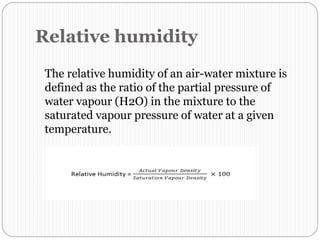
The relative humidity of an air-water mixture is
defined as the ratio of the partial pressure of
water vapour (H2O) in the mixture to the
saturated vapour pressure of water at a given
temperature.
REGAIN & MOISTURE CONTENT
 The amount of the moisture present in a material may be
expressed in terms of regain or moisture content.
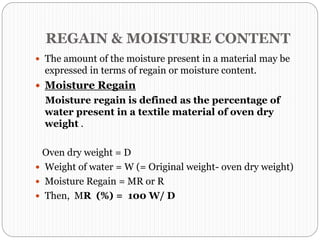
 Moisture Regain
Moisture regain is defined as the percentage of
water present in a textile material of oven dry
weight .
Oven dry weight = D
 Weight of water = W (= Original weight- oven dry weight)
 Moisture Regain = MR or R
 Then, MR (%) = 100 W/ D
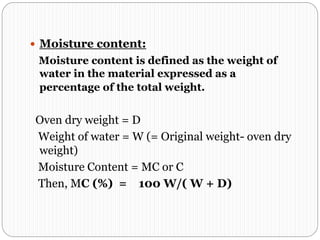
 Moisture content:
Moisture content is defined as the weight of
water in the material expressed as a
percentage of the total weight.
Oven dry weight = D
Weight of water = W (= Original weight- oven dry
weight)
Moisture Content = MC or C
Then, MC (%) = 100 W/( W + D)
 Regain is more commonly used than moisture
content.
 The regain of any given fiber type gives a very
good indication of how sensitive that fibers
towards moisture.
 Its actual value will clearly depends on the
humidity of the surroundings.
Regain-Humidity Relations of Textiles
 If a piece of fabric or other textiles materials is placed
in a room in which the humidity is constant, then it
will eventually come to equilibrium by absorbing or
desorbing moisture as necessary until it reaches a
state of constant regain.
 If the air humidity is in the normal range (around
65%rh) then wet fabric would become drier, whereas
a dry fabric would gradually become wetter.
Regain-Humidity Relations of Textiles
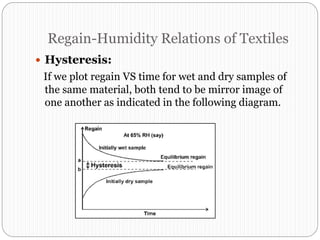
 Hysteresis:
If we plot regain VS time for wet and dry samples of
the same material, both tend to be mirror image of
one another as indicated in the following diagram.
Regain-Humidity Relations of Textiles
 Hysteresis:
 However the two curves do not come together at
equilibrium, the equilibrium regain value of the two curve
is different.
 specifically, the initially wet sample will end up somewhat
wetter than the initially dry sample, no matter how
long the two samples remain in the conditioned
atmosphere.
 This is an example of Hysteresis, and is very important
where samples have to be conditioned for testing or other
purposes.
 It implies that the approach to equilibrium should always
be from the same direction (i.e. either from wet to dry, or
else from dry to wet).
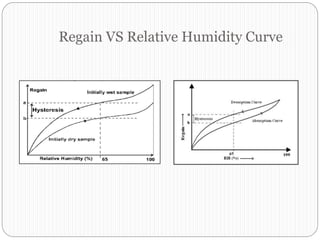
Regain VS Relative Humidity Curve
 Mostly the plots of Regain VS Relative Humidity (RH) are
S-shaped (often described as ‘sigmoidal’). Because of
Hysteresis, any given material will produce two different
curves; the absorption curve and the desorption curve
(desorption curve is always higher).
 Curve A is the absorption curve, that is, the regain-r.h.
percentage relation as a material takes up moisture.
 Curve D is the desorption curve.
 For instance, point a is the equilibrium condition at 65 %
relative humidity when approached from the wet side, and
point a is the equilibrium regain when approached from
the dry side. this is the hysteresis effect.
Regain VS Relative Humidity Curve
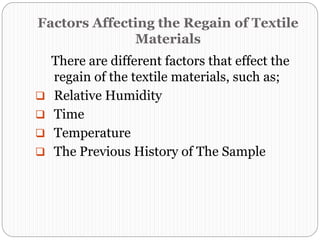
Factors Affecting the Regain of Textile
Materials
There are different factors that effect the
regain of the textile materials, such as;
 Relative Humidity
 Time
 Temperature
 The Previous History of The Sample
Relative Humidity:
Relative humidity is the most important factor that affects the
regain of textile materials. If the relative humidity in the air
is more then there will be more moisture regain or more rate
of conditioning of textile materials and vice versa.
Time:
A material placed in a given atmosphere takes a certain time
to reach equilibrium. The rate of conditioning depends on
several factors, such as;
 The size and form of sample
 The type of material
 External conditions
Temperature:
The effect of temperature on regain is not
important. A change of 10 0C will give a change in
regain of cotton of about 0.3 percent. This effect
can be ignored.
The previous history of the sample:
The previous history of the sample can affect the
equilibrium regain of the sample. The hysteresis is
a good example. Processing can also change the
regain. When oils, waxes and other impurities are
removed then regain may change.
Effect of moisture on physical
properties
 The physical properties of fibres can be affected
by their moisture content.
 In general the fibres that absorb the greatest
amount of moisture are the ones whose properties
change the most. Three main types of properties
are affected:
 Dimensional
 Physical
 Electrical
Effect of moisture on
dimensional properties
 The absorption of moisture by fibres causes them
to swell, because of the insertion of water
molecules between the previously tightly packed
fibre molecules.
 Because the fibre molecules are long and narrow
most of the available intermolecular spaces are
along the length of the molecules rather than at
the ends, so that the swelling takes place mainly
in the fibre width.
 Nylon is a notable exception to this.
Effect of moisture on mechanical
properties
 Some fibres, such as wool and viscose, lose strength when they absorb
water.
 some, such as cotton, flax, hemp and jute, increase in strength.
Furthermore the extensibility, that is the extension at a given load, can
 increase for some fibres when they are wet. Some properties such as
fabric tearing strength are ones
 that are obviously likely to be affected by fibre strength, but for other
ones
 such as crease resistance or abrasion resistance the connection between
 them and changes in fibre tensile properties is less apparent. It is
because
 of these changes in properties that textile tests should be carried out in a
 controlled atmosphere.
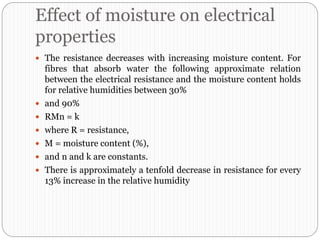
Effect of moisture on electrical
properties
 The resistance decreases with increasing moisture content. For
fibres that absorb water the following approximate relation
between the electrical resistance and the moisture content holds
for relative humidities between 30%
 and 90%
 RMn = k
 where R = resistance,
 M = moisture content (%),
 and n and k are constants.
 There is approximately a tenfold decrease in resistance for every
13% increase in the relative humidity
(1) The Wet-and-Dry Bulb Hygrometer
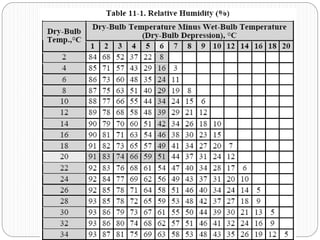
 In this type of hygrometer there are two
thermometers one of which is surrounded by a
wet sleeve of muslin. The temperature difference
between wet and dry thermometer bulbs is
determined by the evaporation rate, which in turn
can be related to RH through look-up tables.
(1) The Wet-and-Dry Bulb Hygrometer
 EXAMPLE:
 Dry bulb reading =20 OC,
 Wet bulb reading = 14 OC
 Difference = 6 OC
 RH percent from the table = 51%
(1) The Wet-and-Dry Bulb Hygrometer
 Its advantages include the simplicity and the fact
that it needs no calibration.
 Its disadvantages are that it requires a constant
supply of distilled water and the fact that it is an
indirect method, since tables are needed.
 Its various types are;
a) Wet-and-dry bulb hygrometer, wall mounted
b) Wet-and-dry bulb hygrometer, sling type
c) Assmann type hygrometer
d) Recording type hygrometer
(2) Hair Hygrometer
 Human hair has the property of lengthening or
shortening as the humidity of the air increases or
decreases. By connecting a band of hairs to a suitable
lever system, the relative humidity can be indicated
directly and, if needed, recorded on a chart. It is a fact
that, it does not give great accuracy.
 The main advantages of this type of hygrometer are
the direct reading and elimination of distilled water.
 Drawbacks (or disadvantages) are also present such
as it requires frequent calibration and it have slow
response to change in atmospheric conditions.
(3) Electrolytic Hygrometer
 Electrolytic hygrometer operates by measuring the
electrical current flowing in a skein of very fine fibers
impregnated with salt solution (e.g. Lithium Chloride)
which have the property of very rapidly attaining
equilibrium with the surrounding atmosphere.
 The heart of this type of instrument is an element
consisting of a plastic frame carrying platinum-clad
electrodes. Skein of very fine fibers impregnated with
a chemical is wound across these electrodes.
(3) Electrolytic Hygrometer
 Three advantages of electrolytic hygrometer are:
 They can have very fast response
 They take direct reading
 They require only low air currents
 They have no particular disadvantage.
 Some other types of hygrometer are;
1) Electrical Hygrometer
2) DuPont Hygrometer
THANK YOU 

Moisture in textile

  • 1.
  • 2.
    TOPIC  ASOLUTE ANDRELATIVE HUMIDITY  MOISTURE REGAIN AND CONTENT  Regain-Humidity Relations of Textiles  Regain VS Relative Humidity Curve  Factors Affecting the Regain of Textile Materials
  • 3.
    Humidity  "Humidity" refersto the presence of water vapor in the atmosphere.  Types of humidity  Absolute humidity  Relative humidity
  • 4.
    Absolute humidity Absolute humidityis the total amount of water vapour present in a given volume of air. It does not take temperature into consideration. Absolute humidity in the atmosphere ranges from near zero to roughly 30 grams per cubic meter when the air is saturated at 30 °C OR  Absolute humidity is the weight of water present in a unit volume of moist air i.e. grams per cubic meter or, grains per cubic meter.
  • 5.
    Relative humidity The relativehumidity of an air-water mixture is defined as the ratio of the partial pressure of water vapour (H2O) in the mixture to the saturated vapour pressure of water at a given temperature.
  • 6.
    REGAIN & MOISTURECONTENT  The amount of the moisture present in a material may be expressed in terms of regain or moisture content.  Moisture Regain Moisture regain is defined as the percentage of water present in a textile material of oven dry weight . Oven dry weight = D  Weight of water = W (= Original weight- oven dry weight)  Moisture Regain = MR or R  Then, MR (%) = 100 W/ D
  • 7.
     Moisture content: Moisturecontent is defined as the weight of water in the material expressed as a percentage of the total weight. Oven dry weight = D Weight of water = W (= Original weight- oven dry weight) Moisture Content = MC or C Then, MC (%) = 100 W/( W + D)
  • 8.
     Regain ismore commonly used than moisture content.  The regain of any given fiber type gives a very good indication of how sensitive that fibers towards moisture.  Its actual value will clearly depends on the humidity of the surroundings.
  • 9.
    Regain-Humidity Relations ofTextiles  If a piece of fabric or other textiles materials is placed in a room in which the humidity is constant, then it will eventually come to equilibrium by absorbing or desorbing moisture as necessary until it reaches a state of constant regain.  If the air humidity is in the normal range (around 65%rh) then wet fabric would become drier, whereas a dry fabric would gradually become wetter.
  • 10.
    Regain-Humidity Relations ofTextiles  Hysteresis: If we plot regain VS time for wet and dry samples of the same material, both tend to be mirror image of one another as indicated in the following diagram.
  • 11.
    Regain-Humidity Relations ofTextiles  Hysteresis:  However the two curves do not come together at equilibrium, the equilibrium regain value of the two curve is different.  specifically, the initially wet sample will end up somewhat wetter than the initially dry sample, no matter how long the two samples remain in the conditioned atmosphere.  This is an example of Hysteresis, and is very important where samples have to be conditioned for testing or other purposes.  It implies that the approach to equilibrium should always be from the same direction (i.e. either from wet to dry, or else from dry to wet).
  • 12.
    Regain VS RelativeHumidity Curve  Mostly the plots of Regain VS Relative Humidity (RH) are S-shaped (often described as ‘sigmoidal’). Because of Hysteresis, any given material will produce two different curves; the absorption curve and the desorption curve (desorption curve is always higher).  Curve A is the absorption curve, that is, the regain-r.h. percentage relation as a material takes up moisture.  Curve D is the desorption curve.  For instance, point a is the equilibrium condition at 65 % relative humidity when approached from the wet side, and point a is the equilibrium regain when approached from the dry side. this is the hysteresis effect.
  • 13.
    Regain VS RelativeHumidity Curve
  • 14.
    Factors Affecting theRegain of Textile Materials There are different factors that effect the regain of the textile materials, such as;  Relative Humidity  Time  Temperature  The Previous History of The Sample
  • 15.
    Relative Humidity: Relative humidityis the most important factor that affects the regain of textile materials. If the relative humidity in the air is more then there will be more moisture regain or more rate of conditioning of textile materials and vice versa. Time: A material placed in a given atmosphere takes a certain time to reach equilibrium. The rate of conditioning depends on several factors, such as;  The size and form of sample  The type of material  External conditions
  • 16.
    Temperature: The effect oftemperature on regain is not important. A change of 10 0C will give a change in regain of cotton of about 0.3 percent. This effect can be ignored. The previous history of the sample: The previous history of the sample can affect the equilibrium regain of the sample. The hysteresis is a good example. Processing can also change the regain. When oils, waxes and other impurities are removed then regain may change.
  • 17.
    Effect of moistureon physical properties  The physical properties of fibres can be affected by their moisture content.  In general the fibres that absorb the greatest amount of moisture are the ones whose properties change the most. Three main types of properties are affected:  Dimensional  Physical  Electrical
  • 18.
    Effect of moistureon dimensional properties  The absorption of moisture by fibres causes them to swell, because of the insertion of water molecules between the previously tightly packed fibre molecules.  Because the fibre molecules are long and narrow most of the available intermolecular spaces are along the length of the molecules rather than at the ends, so that the swelling takes place mainly in the fibre width.  Nylon is a notable exception to this.
  • 19.
    Effect of moistureon mechanical properties  Some fibres, such as wool and viscose, lose strength when they absorb water.  some, such as cotton, flax, hemp and jute, increase in strength. Furthermore the extensibility, that is the extension at a given load, can  increase for some fibres when they are wet. Some properties such as fabric tearing strength are ones  that are obviously likely to be affected by fibre strength, but for other ones  such as crease resistance or abrasion resistance the connection between  them and changes in fibre tensile properties is less apparent. It is because  of these changes in properties that textile tests should be carried out in a  controlled atmosphere.
  • 20.
    Effect of moistureon electrical properties  The resistance decreases with increasing moisture content. For fibres that absorb water the following approximate relation between the electrical resistance and the moisture content holds for relative humidities between 30%  and 90%  RMn = k  where R = resistance,  M = moisture content (%),  and n and k are constants.  There is approximately a tenfold decrease in resistance for every 13% increase in the relative humidity
  • 21.
    (1) The Wet-and-DryBulb Hygrometer  In this type of hygrometer there are two thermometers one of which is surrounded by a wet sleeve of muslin. The temperature difference between wet and dry thermometer bulbs is determined by the evaporation rate, which in turn can be related to RH through look-up tables.
  • 22.
    (1) The Wet-and-DryBulb Hygrometer  EXAMPLE:  Dry bulb reading =20 OC,  Wet bulb reading = 14 OC  Difference = 6 OC  RH percent from the table = 51%
  • 24.
    (1) The Wet-and-DryBulb Hygrometer  Its advantages include the simplicity and the fact that it needs no calibration.  Its disadvantages are that it requires a constant supply of distilled water and the fact that it is an indirect method, since tables are needed.  Its various types are; a) Wet-and-dry bulb hygrometer, wall mounted b) Wet-and-dry bulb hygrometer, sling type c) Assmann type hygrometer d) Recording type hygrometer
  • 25.
    (2) Hair Hygrometer Human hair has the property of lengthening or shortening as the humidity of the air increases or decreases. By connecting a band of hairs to a suitable lever system, the relative humidity can be indicated directly and, if needed, recorded on a chart. It is a fact that, it does not give great accuracy.  The main advantages of this type of hygrometer are the direct reading and elimination of distilled water.  Drawbacks (or disadvantages) are also present such as it requires frequent calibration and it have slow response to change in atmospheric conditions.
  • 26.
    (3) Electrolytic Hygrometer Electrolytic hygrometer operates by measuring the electrical current flowing in a skein of very fine fibers impregnated with salt solution (e.g. Lithium Chloride) which have the property of very rapidly attaining equilibrium with the surrounding atmosphere.  The heart of this type of instrument is an element consisting of a plastic frame carrying platinum-clad electrodes. Skein of very fine fibers impregnated with a chemical is wound across these electrodes.
  • 27.
    (3) Electrolytic Hygrometer Three advantages of electrolytic hygrometer are:  They can have very fast response  They take direct reading  They require only low air currents  They have no particular disadvantage.  Some other types of hygrometer are; 1) Electrical Hygrometer 2) DuPont Hygrometer
  • 28.