
CREPE AND SATIN WEAVE 
By Ashutosh Gupta
INTRODUCTION 
Crepe weaves constitute an useful variety of simple weaves and 
are also known as “crape” or “oatmeal” fabrics due to their 
pebbly or crinkled (rough) surface. The size of the pebbles and 
their arrangement on the fabric surface determine the type of 
crepe fabric. 
The crepe effect can be achieved either by the use of crepe yarns 
(highly twisted) or a crepe weave, and sometimes by special 
process of finishing, i.e., embossing.
Methods for the construction 
of crepe weaves- 
 Construction of crepe weaves upon 
sateen base 
 Combination of a floating weave with 
plain threads 
 By reversing a small motif 
 Insertion of one weave over another.
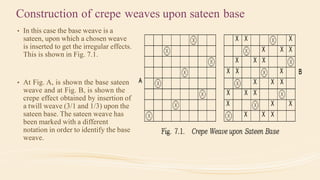
Construction of crepe weaves upon sateen base 
• In this case the base weave is a 
sateen, upon which a chosen weave 
is inserted to get the irregular effects. 
This is shown in Fig. 7.1. 
• At Fig. A, is shown the base sateen 
weave and at Fig. B, is shown the 
crepe effect obtained by insertion of 
a twill weave (3/1 and 1/3) upon the 
sateen base. The sateen weave has 
been marked with a different 
notation in order to identify the base 
weave.
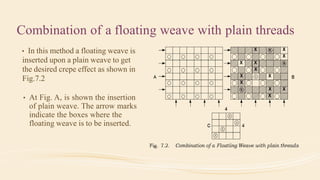
Combination of a floating weave with plain threads 
• In this method a floating weave is 
inserted upon a plain weave to get 
the desired crepe effect as shown in 
Fig.7.2 
• At Fig. A, is shown the insertion 
of plain weave. The arrow marks 
indicate the boxes where the 
floating weave is to be inserted.
By reversing of a small motif 
• In this method a simple motif can 
be chosen and reversed at 
intervals within the design repeat 
to get an irregular effect as shown 
in Fig. 7.3. 
• At A, is shown a simple motif and 
at B, is shown the crepe designs 
obtained by reversal of the motif 
at regular intervals.
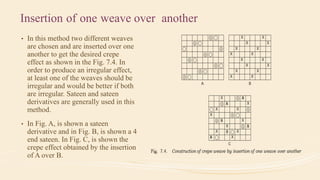
Insertion of one weave over another 
• In this method two different weaves 
are chosen and are inserted over one 
another to get the desired crepe 
effect as shown in the Fig. 7.4. In 
order to produce an irregular effect, 
at least one of the weaves should be 
irregular and would be better if both 
are irregular. Sateen and sateen 
derivatives are generally used in this 
method. 
• In Fig. A, is shown a sateen 
derivative and in Fig. B, is shown a 4 
end sateen. In Fig. C, is shown the 
crepe effect obtained by the insertion 
of A over B.
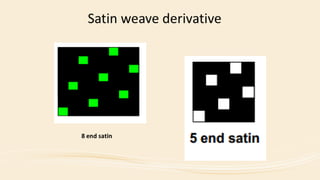
Satin fabrics
Thumb rules for making satin weave 
Move can not be one or less than one of the satin no. 
Move no. should not be factor of satin no. 
There should not be any common factor between move no. & 
satin no.
Thank you

Crepe weave

  • 1.
    CREPE AND SATINWEAVE By Ashutosh Gupta
  • 2.
    INTRODUCTION Crepe weavesconstitute an useful variety of simple weaves and are also known as “crape” or “oatmeal” fabrics due to their pebbly or crinkled (rough) surface. The size of the pebbles and their arrangement on the fabric surface determine the type of crepe fabric. The crepe effect can be achieved either by the use of crepe yarns (highly twisted) or a crepe weave, and sometimes by special process of finishing, i.e., embossing.
  • 3.
    Methods for theconstruction of crepe weaves-  Construction of crepe weaves upon sateen base  Combination of a floating weave with plain threads  By reversing a small motif  Insertion of one weave over another.
  • 4.
    Construction of crepeweaves upon sateen base • In this case the base weave is a sateen, upon which a chosen weave is inserted to get the irregular effects. This is shown in Fig. 7.1. • At Fig. A, is shown the base sateen weave and at Fig. B, is shown the crepe effect obtained by insertion of a twill weave (3/1 and 1/3) upon the sateen base. The sateen weave has been marked with a different notation in order to identify the base weave.
  • 5.
    Combination of afloating weave with plain threads • In this method a floating weave is inserted upon a plain weave to get the desired crepe effect as shown in Fig.7.2 • At Fig. A, is shown the insertion of plain weave. The arrow marks indicate the boxes where the floating weave is to be inserted.
  • 6.
    By reversing ofa small motif • In this method a simple motif can be chosen and reversed at intervals within the design repeat to get an irregular effect as shown in Fig. 7.3. • At A, is shown a simple motif and at B, is shown the crepe designs obtained by reversal of the motif at regular intervals.
  • 7.
    Insertion of oneweave over another • In this method two different weaves are chosen and are inserted over one another to get the desired crepe effect as shown in the Fig. 7.4. In order to produce an irregular effect, at least one of the weaves should be irregular and would be better if both are irregular. Sateen and sateen derivatives are generally used in this method. • In Fig. A, is shown a sateen derivative and in Fig. B, is shown a 4 end sateen. In Fig. C, is shown the crepe effect obtained by the insertion of A over B.
  • 10.
  • 12.
    Thumb rules formaking satin weave Move can not be one or less than one of the satin no. Move no. should not be factor of satin no. There should not be any common factor between move no. & satin no.
  • 17.