Rapid Prototyping by Layered Manufacturing
Product Realization Cycle  Mock-Up’s, Engg prototypes
Why speed up prototyping?
Quick product entry into market captive market.
Lower operating costs of development group
Longer PRP time  higher reluctance of managers to
change existing technologies
 causes stagnation of products
Rapid Prototyping
Rapid prototyping =
quick fabrication of geometric shape
possibly use different materials than designed materials
possibly use different process than production process
Uses of prototype models:
1. Aesthetic Visualization
2. Form-fit-and-function testing
3. Casting models
Layered Manufacturing Processes
Stereolithography
Selective Laser Sintering
Fused Deposition Modeling
Laminated Object Manufacturing (LOM)
Three Dimensional Printing (MIT  ZCorp)
Laser Engineered Net Shaping
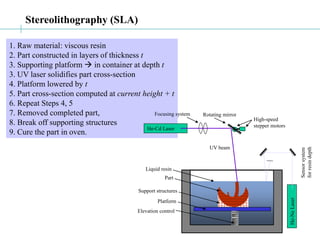
Stereolithography (SLA)
1. Raw material: viscous resin
2. Part constructed in layers of thickness t
3. Supporting platform  in container at depth t
3. UV laser solidifies part cross-section
4. Platform lowered by t
5. Part cross-section computed at current height + t
6. Repeat Steps 4, 5
7. Removed completed part,
8. Break off supporting structures
9. Cure the part in oven.
He-Cd Laser
UV beam
Rotating mirror
High-speed
stepper motors
Focusing system
Liquid resin
Part
Platform
Elevation control
Support structures
He-Ne
Laser
Sensor
system
for
resin
depth
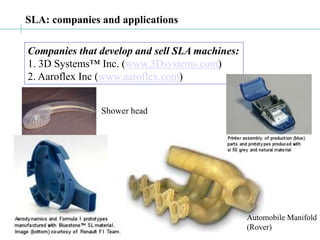
SLA: companies and applications
Companies that develop and sell SLA machines:
1. 3D Systems™ Inc. (www.3Dsystems.com)
2. Aaroflex Inc (www.aaroflex.com)
Shower head
Automobile Manifold
(Rover)
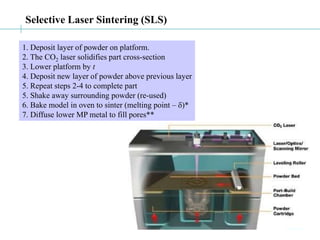
Selective Laser Sintering (SLS)
1. Deposit layer of powder on platform.
2. The CO2 laser solidifies part cross-section
3. Lower platform by t
4. Deposit new layer of powder above previous layer
5. Repeat steps 2-4 to complete part
5. Shake away surrounding powder (re-used)
6. Bake model in oven to sinter (melting point – d)*
7. Diffuse lower MP metal to fill pores**
SLS: companies and applications
First commercialized by Prof Carl Deckard (UT Austin)
Marketed by DTM Corp.
DTM acquired by 3Dsystems Inc.
1. 3D Systems™ Inc. (www.3Dsystems.com)
2. EOS GmbH, Munich, Germany.
[both examples, source: DTM inc.]
Plastic parts using SLS Metal mold using SLS, injection molded parts
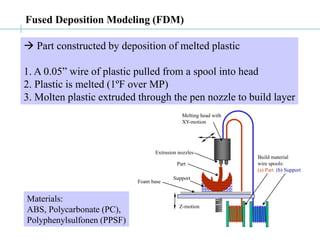
Fused Deposition Modeling (FDM)
Z-motion
Melting head with
XY-motion
Build material
wire spools:
(a) Part (b) Support
Extrusion nozzles
Part
Support
Foam base
 Part constructed by deposition of melted plastic
1. A 0.05” wire of plastic pulled from a spool into head
2. Plastic is melted (1ºF over MP)
3. Molten plastic extruded through the pen nozzle to build layer
Materials:
ABS, Polycarbonate (PC),
Polyphenylsulfonen (PPSF)
FDM: companies and applications
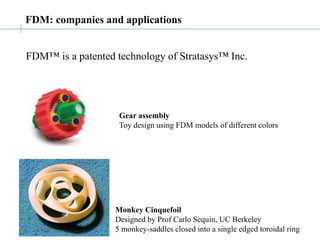
FDM™ is a patented technology of Stratasys™ Inc.
Monkey Cinquefoil
Designed by Prof Carlo Sequin, UC Berkeley
5 monkey-saddles closed into a single edged toroidal ring
Gear assembly
Toy design using FDM models of different colors
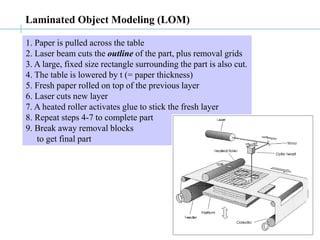
Laminated Object Modeling (LOM)
1. Paper is pulled across the table
2. Laser beam cuts the outline of the part, plus removal grids
3. A large, fixed size rectangle surrounding the part is also cut.
4. The table is lowered by t (= paper thickness)
5. Fresh paper rolled on top of the previous layer
6. Laser cuts new layer
7. A heated roller activates glue to stick the fresh layer
8. Repeat steps 4-7 to complete part
9. Break away removal blocks
to get final part
LOM: companies, applications
Original technology developed by Helisys Inc.;
Helisys acquired by Corum.
1. Cubic Technologies Inc [www.cubictechnologies.com]
2. KIRA Corp, Japan [www.kiracorp.co.jp]
[source: Corum Inc] [source: KIRA corporation]
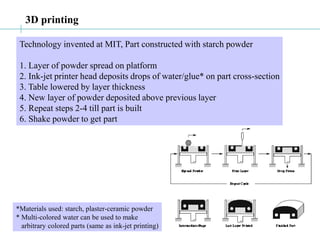
3D printing
Technology invented at MIT, Part constructed with starch powder
1. Layer of powder spread on platform
2. Ink-jet printer head deposits drops of water/glue* on part cross-section
3. Table lowered by layer thickness
4. New layer of powder deposited above previous layer
5. Repeat steps 2-4 till part is built
6. Shake powder to get part
*Materials used: starch, plaster-ceramic powder
* Multi-colored water can be used to make
arbitrary colored parts (same as ink-jet printing)
3D Printing: companies, applications
1. Z-corporation [www.zcorp.com]
2. Soligen [www.soligen.com]
Engine manifold for GM racing car
Cast after Direct Shell Production Casting
[source: www.soligen.com]
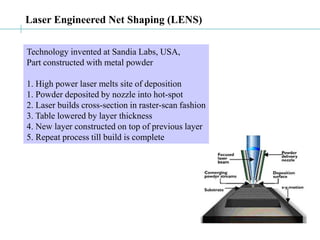
Laser Engineered Net Shaping (LENS)
Technology invented at Sandia Labs, USA,
Part constructed with metal powder
1. High power laser melts site of deposition
1. Powder deposited by nozzle into hot-spot
2. Laser builds cross-section in raster-scan fashion
3. Table lowered by layer thickness
4. New layer constructed on top of previous layer
5. Repeat process till build is complete
LENS: companies, applications
1. Optomec Inc, USA [www.optomec.com]
[source: www.optomec.com]
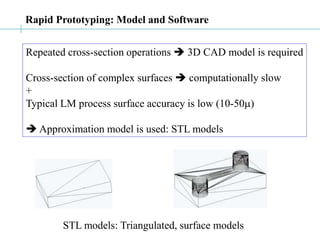
Rapid Prototyping: Model and Software
Repeated cross-section operations  3D CAD model is required
Cross-section of complex surfaces  computationally slow
+
Typical LM process surface accuracy is low (10-50m)
 Approximation model is used: STL models
STL models: Triangulated, surface models
STL format
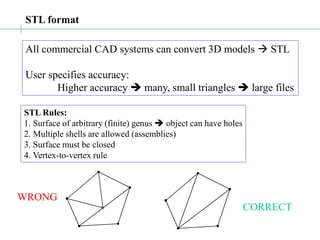
All commercial CAD systems can convert 3D models  STL
User specifies accuracy:
Higher accuracy  many, small triangles  large files
STL Rules:
1. Surface of arbitrary (finite) genus  object can have holes
2. Multiple shells are allowed (assemblies)
3. Surface must be closed
4. Vertex-to-vertex rule
WRONG
CORRECT
Rapid Prototyping by Layered Manufacturing
a
c
b
valid:
a  b  c
b  c  a, etc.
invalid:
b  a  c, etc.
outward
normal
a
c
b
valid:
a  b  c
b  c  a, etc.
invalid:
b  a  c, etc.
a
c
b
valid:
a  b  c
b  c  a, etc.
invalid:
b  a  c, etc.
outward
normal
The ASCII STL File Format
Solid [name]
[facet normal [nx] [ny] [nz]
outer loop
vertex [v1x] [v1y] [v1z]
vertex [v2x] [v2y] [v2z]
vertex [v3x] [v3y] [v3z]
endloop
endfacet]+
endsolid [name]
Remarks
About STL:
STL is de facto standard for all RP technologies
ASCII STL files are LARGE, Binary format is more compact
About LM:
Expensive, but gaining popularity
First popular technique: SLA
Currently (2006) most popular: FDM

RP.ppt

  • 1.
    Rapid Prototyping byLayered Manufacturing Product Realization Cycle  Mock-Up’s, Engg prototypes Why speed up prototyping? Quick product entry into market captive market. Lower operating costs of development group Longer PRP time  higher reluctance of managers to change existing technologies  causes stagnation of products
  • 2.
    Rapid Prototyping Rapid prototyping= quick fabrication of geometric shape possibly use different materials than designed materials possibly use different process than production process Uses of prototype models: 1. Aesthetic Visualization 2. Form-fit-and-function testing 3. Casting models
  • 3.
    Layered Manufacturing Processes Stereolithography SelectiveLaser Sintering Fused Deposition Modeling Laminated Object Manufacturing (LOM) Three Dimensional Printing (MIT  ZCorp) Laser Engineered Net Shaping
  • 4.
    Stereolithography (SLA) 1. Rawmaterial: viscous resin 2. Part constructed in layers of thickness t 3. Supporting platform  in container at depth t 3. UV laser solidifies part cross-section 4. Platform lowered by t 5. Part cross-section computed at current height + t 6. Repeat Steps 4, 5 7. Removed completed part, 8. Break off supporting structures 9. Cure the part in oven. He-Cd Laser UV beam Rotating mirror High-speed stepper motors Focusing system Liquid resin Part Platform Elevation control Support structures He-Ne Laser Sensor system for resin depth
  • 5.
    SLA: companies andapplications Companies that develop and sell SLA machines: 1. 3D Systems™ Inc. (www.3Dsystems.com) 2. Aaroflex Inc (www.aaroflex.com) Shower head Automobile Manifold (Rover)
  • 6.
    Selective Laser Sintering(SLS) 1. Deposit layer of powder on platform. 2. The CO2 laser solidifies part cross-section 3. Lower platform by t 4. Deposit new layer of powder above previous layer 5. Repeat steps 2-4 to complete part 5. Shake away surrounding powder (re-used) 6. Bake model in oven to sinter (melting point – d)* 7. Diffuse lower MP metal to fill pores**
  • 7.
    SLS: companies andapplications First commercialized by Prof Carl Deckard (UT Austin) Marketed by DTM Corp. DTM acquired by 3Dsystems Inc. 1. 3D Systems™ Inc. (www.3Dsystems.com) 2. EOS GmbH, Munich, Germany. [both examples, source: DTM inc.] Plastic parts using SLS Metal mold using SLS, injection molded parts
  • 8.
    Fused Deposition Modeling(FDM) Z-motion Melting head with XY-motion Build material wire spools: (a) Part (b) Support Extrusion nozzles Part Support Foam base  Part constructed by deposition of melted plastic 1. A 0.05” wire of plastic pulled from a spool into head 2. Plastic is melted (1ºF over MP) 3. Molten plastic extruded through the pen nozzle to build layer Materials: ABS, Polycarbonate (PC), Polyphenylsulfonen (PPSF)
  • 9.
    FDM: companies andapplications FDM™ is a patented technology of Stratasys™ Inc. Monkey Cinquefoil Designed by Prof Carlo Sequin, UC Berkeley 5 monkey-saddles closed into a single edged toroidal ring Gear assembly Toy design using FDM models of different colors
  • 10.
    Laminated Object Modeling(LOM) 1. Paper is pulled across the table 2. Laser beam cuts the outline of the part, plus removal grids 3. A large, fixed size rectangle surrounding the part is also cut. 4. The table is lowered by t (= paper thickness) 5. Fresh paper rolled on top of the previous layer 6. Laser cuts new layer 7. A heated roller activates glue to stick the fresh layer 8. Repeat steps 4-7 to complete part 9. Break away removal blocks to get final part
  • 11.
    LOM: companies, applications Originaltechnology developed by Helisys Inc.; Helisys acquired by Corum. 1. Cubic Technologies Inc [www.cubictechnologies.com] 2. KIRA Corp, Japan [www.kiracorp.co.jp] [source: Corum Inc] [source: KIRA corporation]
  • 12.
    3D printing Technology inventedat MIT, Part constructed with starch powder 1. Layer of powder spread on platform 2. Ink-jet printer head deposits drops of water/glue* on part cross-section 3. Table lowered by layer thickness 4. New layer of powder deposited above previous layer 5. Repeat steps 2-4 till part is built 6. Shake powder to get part *Materials used: starch, plaster-ceramic powder * Multi-colored water can be used to make arbitrary colored parts (same as ink-jet printing)
  • 13.
    3D Printing: companies,applications 1. Z-corporation [www.zcorp.com] 2. Soligen [www.soligen.com] Engine manifold for GM racing car Cast after Direct Shell Production Casting [source: www.soligen.com]
  • 14.
    Laser Engineered NetShaping (LENS) Technology invented at Sandia Labs, USA, Part constructed with metal powder 1. High power laser melts site of deposition 1. Powder deposited by nozzle into hot-spot 2. Laser builds cross-section in raster-scan fashion 3. Table lowered by layer thickness 4. New layer constructed on top of previous layer 5. Repeat process till build is complete
  • 15.
    LENS: companies, applications 1.Optomec Inc, USA [www.optomec.com] [source: www.optomec.com]
  • 16.
    Rapid Prototyping: Modeland Software Repeated cross-section operations  3D CAD model is required Cross-section of complex surfaces  computationally slow + Typical LM process surface accuracy is low (10-50m)  Approximation model is used: STL models STL models: Triangulated, surface models
  • 17.
    STL format All commercialCAD systems can convert 3D models  STL User specifies accuracy: Higher accuracy  many, small triangles  large files STL Rules: 1. Surface of arbitrary (finite) genus  object can have holes 2. Multiple shells are allowed (assemblies) 3. Surface must be closed 4. Vertex-to-vertex rule WRONG CORRECT
  • 18.
    Rapid Prototyping byLayered Manufacturing a c b valid: a  b  c b  c  a, etc. invalid: b  a  c, etc. outward normal a c b valid: a  b  c b  c  a, etc. invalid: b  a  c, etc. a c b valid: a  b  c b  c  a, etc. invalid: b  a  c, etc. outward normal The ASCII STL File Format Solid [name] [facet normal [nx] [ny] [nz] outer loop vertex [v1x] [v1y] [v1z] vertex [v2x] [v2y] [v2z] vertex [v3x] [v3y] [v3z] endloop endfacet]+ endsolid [name]
  • 19.
    Remarks About STL: STL isde facto standard for all RP technologies ASCII STL files are LARGE, Binary format is more compact About LM: Expensive, but gaining popularity First popular technique: SLA Currently (2006) most popular: FDM