IT2001PA
Engineering Essentials (1/2)


Chapter 11 – Alternating Current Circuits

Lecturer Name
lecturer_email@ite.edu.sg
                                Aug 17, 2012
Contact Number
Chapter 11 – Alternating Current Circuits


Lesson Objectives
Upon completion of this topic, you should be able to:
   Explain and calculate the fundamentals of alternating
    current waveform.


                                                            2
    IT2001PA Engineering Essentials (1/2)
Chapter 11 – Alternating Current Circuits


Specific Objectives
  Students should be able to :
      Describe the basic construction of a simple alternator.
      Describe the characteristics of an alternating quantity as
       fluctuating over a given period of time.
      Define the following terms with reference to an alternating
       quantity :
           Frequency
           Average value
           Instantaneous value
           Maximum value

      IT2001PA Engineering Essentials (1/2)
Chapter 11 – Alternating Current Circuits


Specific Objectives
  Students should be able to :
      State that the frequency of the generated emf is
       proportional to the speed and number of poles of the
       alternator.
      Explain the term Root Mean Square (RMS) value with
       reference to an alternating current.
      State the following equations for a sinusoidal waveform :
        RMS value        = 0.707 x Maximum value
        Average value = 0.637 x Maximum value


      IT2001PA Engineering Essentials (1/2)
Chapter 11 – Alternating Current Circuits


Alternating Waveform
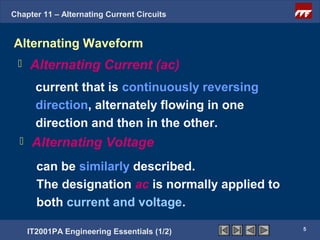
     Alternating Current (ac)
        current that is continuously reversing
        direction, alternately flowing in one
        direction and then in the other.
      Alternating Voltage
        can be similarly described.
        The designation ac is normally applied to
        both current and voltage.
                                                    5
      IT2001PA Engineering Essentials (1/2)
Chapter 11 – Alternating Current Circuits


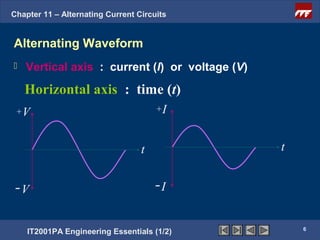
Alternating Waveform
   Vertical axis : current (I) or voltage (V)

    Horizontal axis : time (t)
 +V                                   +I


                                  t              t


 -V                                   -I

                                                     6
    IT2001PA Engineering Essentials (1/2)
Chapter 11 – Alternating Current Circuits


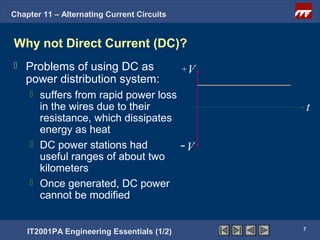
Why not Direct Current (DC)?
   Problems of using DC as                 +V
    power distribution system:
     suffers from rapid power loss
      in the wires due to their                      t
      resistance, which dissipates
      energy as heat
     DC power stations had         -V
      useful ranges of about two
      kilometers
     Once generated, DC power
      cannot be modified


                                                 7
    IT2001PA Engineering Essentials (1/2)
Chapter 11 – Alternating Current Circuits


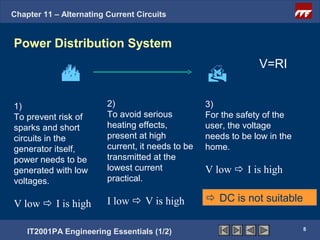
Power Distribution System
                                                                V=RI
                                                  
1)                       2)                        3)
To prevent risk of       To avoid serious          For the safety of the
sparks and short         heating effects,          user, the voltage
circuits in the          present at high           needs to be low in the
generator itself,        current, it needs to be   home.
power needs to be        transmitted at the
generated with low       lowest current            V low  I is high
voltages.                practical.

                         I low  V is high          DC is not suitable
V low  I is high

                                                                            8
    IT2001PA Engineering Essentials (1/2)
Chapter 11 – Alternating Current Circuits


Advantages of A.C.


    --- readily available from generators
    and power supply sockets in homes
    and workshops.
    --- can be stepped up or down by the
    use of a transformer.
    --- for transmission purpose.


                                            9
    IT2001PA Engineering Essentials (1/2)
Chapter 11 – Alternating Current Circuits


Alternator

    An alternator is a machine that converts
    mechanical energy to electrical energy.
    A simple alternator basically consists of
    two parts:

    a) coils or windings
    b) magnetic poles

                                                10
    IT2001PA Engineering Essentials (1/2)
Chapter 11 – Alternating Current Circuits


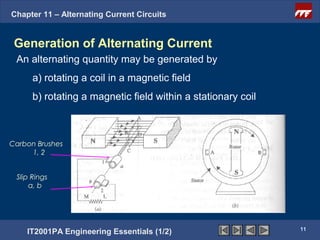
 Generation of Alternating Current
 An alternating quantity may be generated by
      a) rotating a coil in a magnetic field
      b) rotating a magnetic field within a stationary coil


Carbon Brushes
     1, 2


 Slip Rings
     a, b


                                                              11
    IT2001PA Engineering Essentials (1/2)
Chapter 11 – Alternating Current Circuits


Generation of Alternating Current
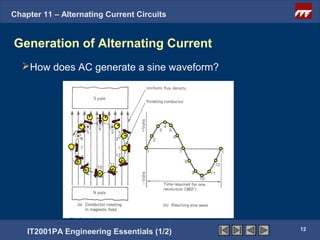
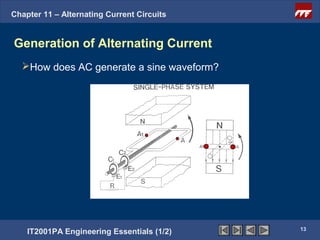
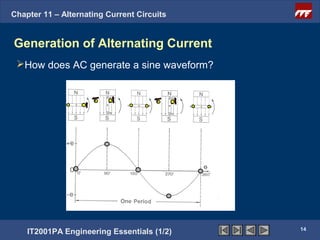
  How does AC generate a sine waveform?

                .
                .
                     .
                                         .
                             .

                 x                   x
                         x


                                 x
                             x


                                             12
    IT2001PA Engineering Essentials (1/2)
Chapter 11 – Alternating Current Circuits


Generation of Alternating Current
  How does AC generate a sine waveform?


                                            13
    IT2001PA Engineering Essentials (1/2)
Chapter 11 – Alternating Current Circuits


Generation of Alternating Current
 How does AC generate a sine waveform?


                     x                x

                         .


                                            .


                                                14
    IT2001PA Engineering Essentials (1/2)
Chapter 11 – Alternating Current Circuits


Generation of Alternating Current
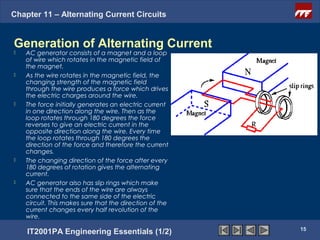
   AC generator consists of a magnet and a loop
    of wire which rotates in the magnetic field of
    the magnet.
   As the wire rotates in the magnetic field, the
    changing strength of the magnetic field
    through the wire produces a force which drives
    the electric charges around the wire.
   The force initially generates an electric current
    in one direction along the wire. Then as the
    loop rotates through 180 degrees the force
    reverses to give an electric current in the
    opposite direction along the wire. Every time
    the loop rotates through 180 degrees the
    direction of the force and therefore the current
    changes.
   The changing direction of the force after every
    180 degrees of rotation gives the alternating
    current.
   AC generator also has slip rings which make
    sure that the ends of the wire are always
    connected to the same side of the electric
    circuit. This makes sure that the direction of the
    current changes every half revolution of the
    wire.
                                                         15
    IT2001PA Engineering Essentials (1/2)
Chapter 11 – Alternating Current Circuits


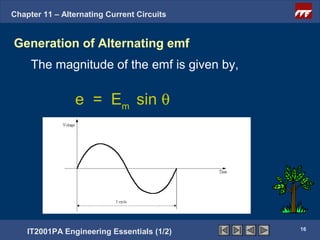
Generation of Alternating emf
     The magnitude of the emf is given by,

                e = Em sin θ


                                             16
    IT2001PA Engineering Essentials (1/2)
Chapter 11 – Alternating Current Circuits


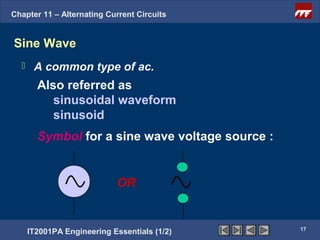
Sine Wave
      A common type of ac.
        Also referred as
           sinusoidal waveform
           sinusoid
        Symbol for a sine wave voltage source :


                            OR


                                                  17
      IT2001PA Engineering Essentials (1/2)
Chapter 11 – Alternating Current Circuits


What is an Alternating Quantity?


     An alternating quantity is one which acts in
  alternate directions and whose magnitude
  undergoes a definite cycle of changes in
  definite interval of time.


                                                18
    IT2001PA Engineering Essentials (1/2)
Chapter 11 – Alternating Current Circuits


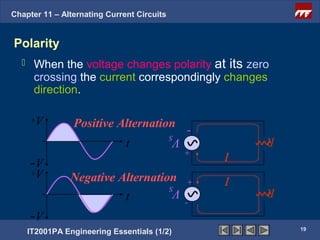
Polarity
      When the voltage changes polarity at its zero
       crossing,the current correspondingly changes
       direction.

      +V         Positive Alternation            -
                                            VS           R
                               t                 +
      -V                                             I
      +V
                 Negative Alternation            +
                                                     I
                                            VS           R
                               t                 -

      -V
                                                             19
      IT2001PA Engineering Essentials (1/2)
Chapter 11 – Alternating Current Circuits


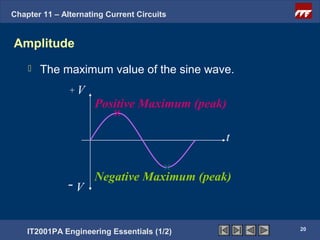
Amplitude
       The maximum value of the sine wave.
               +V
                      Positive Maximum (peak)

                                            t


                      Negative Maximum (peak)
              -V

                                                20
    IT2001PA Engineering Essentials (1/2)
Chapter 11 – Alternating Current Circuits


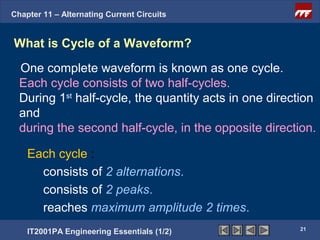
What is Cycle of a Waveform?
  One complete waveform is known as one cycle.
  Each cycle consists of two half-cycles.
  During 1st half-cycle, the quantity acts in one direction
  and
  during the second half-cycle, in the opposite direction.

    Each cycle :
      consists of 2 alternations.
      consists of 2 peaks.
      reaches maximum amplitude 2 times.
                                                       21
    IT2001PA Engineering Essentials (1/2)
Chapter 11 – Alternating Current Circuits


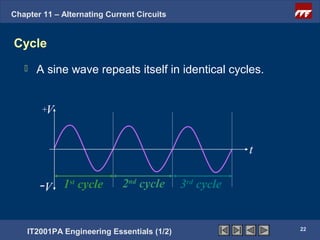
Cycle
      A sine wave repeats itself in identical cycles.


        +V


                                                        t

       -V    1st cycle       2nd cycle      3rd cycle


                                                            22
    IT2001PA Engineering Essentials (1/2)
Chapter 11 – Alternating Current Circuits


Period

      The time required for a given sine wave to
       complete one full cycle.

       symbol - T
       unit - second (s)
       Time taken is the same for each cycle;
         thus fixed value for a given sine wave.


                                                    23
    IT2001PA Engineering Essentials (1/2)
Chapter 11 – Alternating Current Circuits


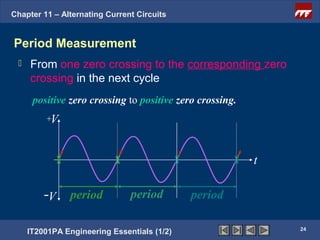
Period Measurement
    From one zero crossing to the corresponding zero
     crossing in the next cycle
      positive zero crossing to positive zero crossing.
         +V


                                                          t

         -V     period         period        period

                                                              24
     IT2001PA Engineering Essentials (1/2)
Chapter 11 – Alternating Current Circuits


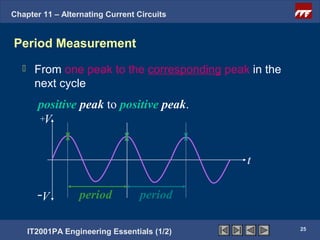
Period Measurement
      From one peak to the corresponding peak in the
       next cycle
        positive peak to positive peak.
        +V


                                              t

        -V         period         period

                                                        25
      IT2001PA Engineering Essentials (1/2)
Chapter 11 – Alternating Current Circuits


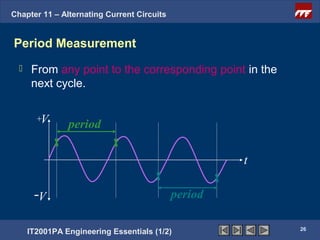
Period Measurement
      From any point to the corresponding point in the
       next cycle.


        +V
                period

                                                     t

       -V                                   period

                                                          26
      IT2001PA Engineering Essentials (1/2)
Chapter 11 – Alternating Current Circuits


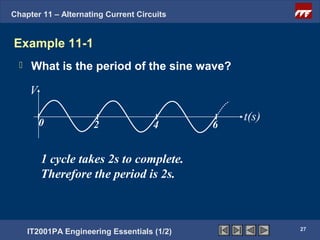
Example 11-1
      What is the period of the sine wave?

      V

          0
                                                  t(s)
                       2              4       6


          1 cycle takes 2s to complete.
          Therefore the period is 2s.


                                                         27
      IT2001PA Engineering Essentials (1/2)
Chapter 11 – Alternating Current Circuits


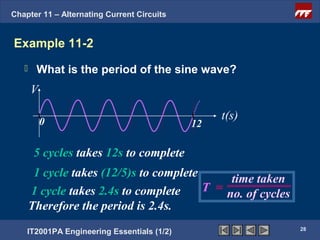
Example 11-2
       What is the period of the sine wave?
       V

           0
                                                 t(s)
                                            12

        5 cycles takes 12s to complete
        1 cycle takes (12/5)s to complete      time taken
       1 cycle takes 2.4s to complete     T =
                                              no. of cycles
       Therefore the period is 2.4s.
                                                              28
    IT2001PA Engineering Essentials (1/2)
Chapter 11 – Alternating Current Circuits


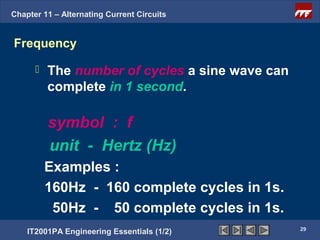
Frequency

         The number of cycles a sine wave can
          complete in 1 second.

          symbol : f
          unit - Hertz (Hz)
          Examples :
          160Hz - 160 complete cycles in 1s.
           50Hz - 50 complete cycles in 1s.
                                                 29
    IT2001PA Engineering Essentials (1/2)
Chapter 11 – Alternating Current Circuits


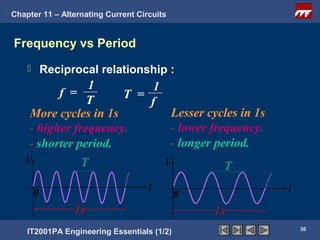
Frequency vs Period
           Reciprocal relationship :
                1         1
          f =         T =
                T         f
    More cycles in 1s        Lesser cycles in 1s
    - higher frequency.      - lower frequency.
    - shorter period.        - longer period.
   V           T            V           T

        0
                                    t                t
                                            0
                  1s                            1s
                                                         30
    IT2001PA Engineering Essentials (1/2)
Chapter 11 – Alternating Current Circuits


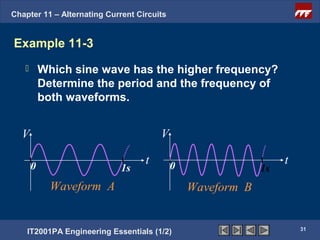
Example 11-3
          Which sine wave has the higher frequency?
           Determine the period and the frequency of
           both waveforms.


  V                                    V

       0
                                   t        0
                                                                  t
                             1s                              1s
             Waveform A                         Waveform B


                                                                      31
    IT2001PA Engineering Essentials (1/2)
Chapter 11 – Alternating Current Circuits


Example 11-3
      continue …
   V                                    V

       0
                                    t       0
                                                                  t
                             1s                              1s
           Waveform A                           Waveform B

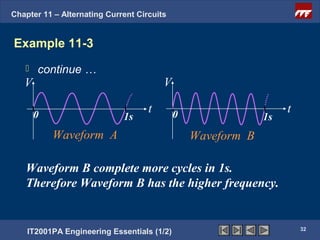
   Waveform B complete more cycles in 1s.
   Therefore Waveform B has the higher frequency.


                                                                      32
    IT2001PA Engineering Essentials (1/2)
Chapter 11 – Alternating Current Circuits


Example 11-3
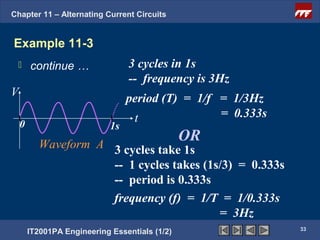
       continue …                3 cycles in 1s
                                  -- frequency is 3Hz
V
                                  period (T) = 1/f = 1/3Hz
                                   t               = 0.333s
    0                        1s
           Waveform A 3 cycles take 1s
                                                OR
                      -- 1 cycles takes (1s/3) = 0.333s
                      -- period is 0.333s
                      frequency (f) = 1/T = 1/0.333s
                                           = 3Hz
                                                              33
        IT2001PA Engineering Essentials (1/2)
Chapter 11 – Alternating Current Circuits


Example 11-3
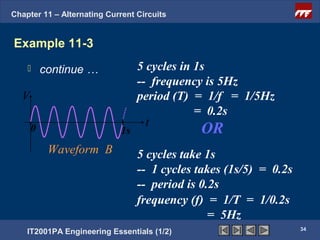
         continue …              5 cycles in 1s
                                  -- frequency is 5Hz
  V                               period (T) = 1/f = 1/5Hz
                                              = 0.2s
                                    t
      0                      1s               OR
           Waveform B             5 cycles take 1s
                                  -- 1 cycles takes (1s/5) = 0.2s
                                  -- period is 0.2s
                                  frequency (f) = 1/T = 1/0.2s
                                                 = 5Hz
                                                                    34
    IT2001PA Engineering Essentials (1/2)
Chapter 11 – Alternating Current Circuits


Example 11-4
      The period of a sine wave is 10ms. What is
       the frequency?

             period (T) = 10ms
          frequency (f) = 1/T
                        = 1/10ms
                            = 100Hz


                                                    35
    IT2001PA Engineering Essentials (1/2)
Chapter 11 – Alternating Current Circuits


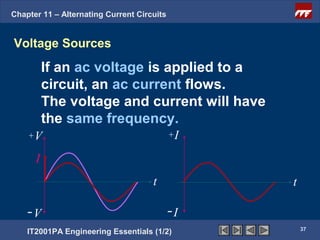
Example 11-5
      The frequency of a sine wave is 60Hz. What
       is the period?

           frequency (f) = 60Hz
                  period (T) = 1/f
                                 = 1/60Hz
                                 = 16.7ms


                                                    36
      IT2001PA Engineering Essentials (1/2)
Chapter 11 – Alternating Current Circuits


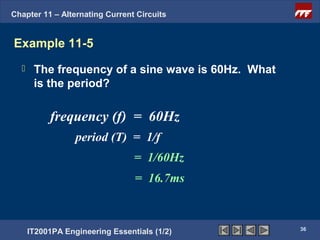
Voltage Sources
          If an ac voltage is applied to a
          circuit, an ac current flows.
          The voltage and current will have
          the same frequency.
    +V                                      +I

      I
                                     t           t

    -V                                      -I
                                                     37
    IT2001PA Engineering Essentials (1/2)
Chapter 11 – Alternating Current Circuits


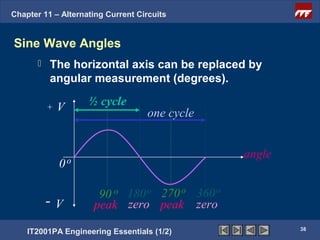
Sine Wave Angles
          The horizontal axis can be replaced by
           angular measurement (degrees).

           +   V    ½ cycle
                                    one cycle


                                                angle
               0o

                      90 o 180 o 270 o 360 o
           -V        peak zero peak zero
                                                        38
    IT2001PA Engineering Essentials (1/2)
Chapter 11 – Alternating Current Circuits


Sine Wave Values
       Ways to express and measure the value of a
        sine wave :

         1) instantaneous value.
         2) peak value.
         3) peak-to-peak value.
         4) root-mean-square value.
         5) average value.


                                                     39
    IT2001PA Engineering Essentials (1/2)
Chapter 11 – Alternating Current Circuits


Instantaneous Value

        The voltage or current value of a
         waveform at a given instant in time.


                Symbol :
                  voltage - v
                  current - i


                                                40
    IT2001PA Engineering Essentials (1/2)
Chapter 11 – Alternating Current Circuits


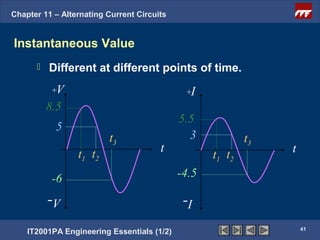
Instantaneous Value
         Different at different points of time.
           +V                                +I
          8.5
                                            5.5
           5
                         t3                   3            t3
                                       t                        t
                 t1 t2                             t1 t2
           -6                               -4.5

          -V                                 -I
                                                                    41
    IT2001PA Engineering Essentials (1/2)
Chapter 11 – Alternating Current Circuits


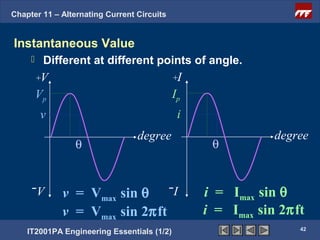
Instantaneous Value
         Different at different points of angle.
         +V                                 +I
         Vp                                 Ip
         v                                   i
                                 degree                     degree
                θ                                 θ


     -V       v = Vmax sin θ                -I   i = Imax sin θ
              v = Vmax sin 2πft                  i = Imax sin 2πft
                                                                 42
    IT2001PA Engineering Essentials (1/2)
Chapter 11 – Alternating Current Circuits


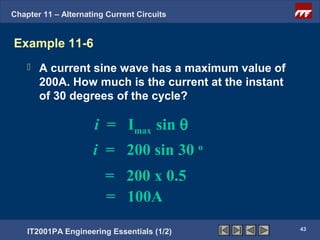
Example 11-6
       A current sine wave has a maximum value of
        200A. How much is the current at the instant
        of 30 degrees of the cycle?

                      i = Imax sin θ
                     i = 200 sin 30 o
                        = 200 x 0.5
                        = 100A
                                                       43
    IT2001PA Engineering Essentials (1/2)
Chapter 11 – Alternating Current Circuits


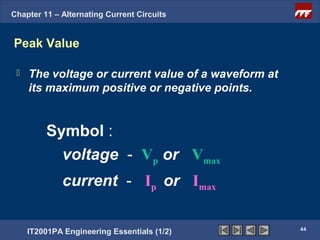
Peak Value

    The voltage or current value of a waveform at
     its maximum positive or negative points.


         Symbol :
           voltage - Vp or Vmax
              current - Ip or Imax

                                                     44
     IT2001PA Engineering Essentials (1/2)
Chapter 11 – Alternating Current Circuits


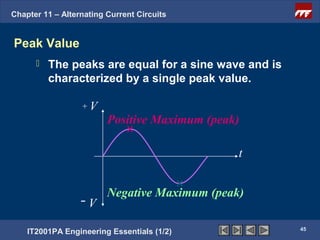
Peak Value
         The peaks are equal for a sine wave and is
          characterized by a single peak value.

                  +V
                         Positive Maximum (peak)

                                               t


                         Negative Maximum (peak)
                  -V
                                                       45
    IT2001PA Engineering Essentials (1/2)
Chapter 11 – Alternating Current Circuits


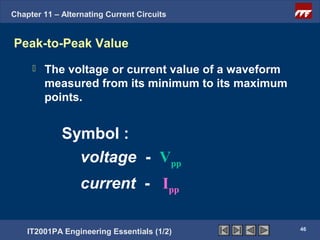
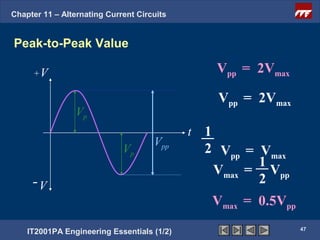
Peak-to-Peak Value
        The voltage or current value of a waveform
         measured from its minimum to its maximum
         points.


             Symbol :
               voltage - Vpp
                  current - Ipp

                                                      46
    IT2001PA Engineering Essentials (1/2)
Chapter 11 – Alternating Current Circuits


Peak-to-Peak Value

     +V                                          Vpp = 2Vmax

                                                 Vpp = 2Vmax
                 Vp
                                            t   1
                                     Vpp
                             Vp                 2 Vpp = Vmax
                                                        1
                                                  Vmax = Vpp
     -V                                                 2
                                                 Vmax = 0.5Vpp
                                                                 47
    IT2001PA Engineering Essentials (1/2)
Chapter 11 – Alternating Current Circuits


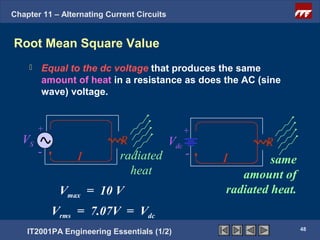
Root Mean Square Value
       Equal to the dc voltage that produces the same
        amount of heat in a resistance as does the AC (sine
        wave) voltage.


        +                                   +
  VS                        R        Vdc                 R
        -        I          radiated     -      I         same
                              heat                  amount of
             Vmax = 10 V                         radiated heat.
            Vrms = 7.07V = Vdc
                                                                  48
    IT2001PA Engineering Essentials (1/2)
Chapter 11 – Alternating Current Circuits


Root Mean Square Value

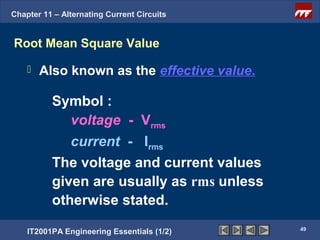
       Also known as the effective value.

          Symbol :
             voltage - Vrms
             current - Irms
          The voltage and current values
          given are usually as rms unless
          otherwise stated.
                                             49
    IT2001PA Engineering Essentials (1/2)
Chapter 11 – Alternating Current Circuits


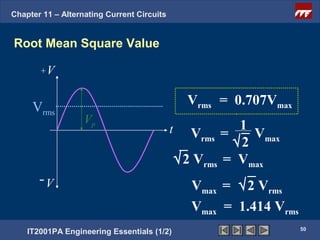
Root Mean Square Value

       +V


     Vrms                                         Vrms = 0.707Vmax
                   Vp
                                            t             1
                                                  Vrms =    Vmax
                                                         √2
                                                √2 Vrms = Vmax
       -V                                         Vmax = √2 Vrms
                                                  Vmax = 1.414 Vrms
                                                                      50
    IT2001PA Engineering Essentials (1/2)
Chapter 11 – Alternating Current Circuits


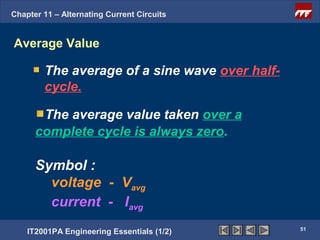
Average Value

        The average of a sine wave over half-
        cycle.

       The average value taken over a
      complete cycle is always zero.

      Symbol :
        voltage - Vavg
        current - Iavg
                                                51
    IT2001PA Engineering Essentials (1/2)
Chapter 11 – Alternating Current Circuits


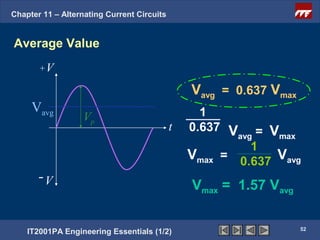
Average Value
       +V

                                                Vavg = 0.637 Vmax
     Vavg                                         1
                   Vp
                                            t   0.637 V = V
                                                       avg   max
                                                          1
                                                Vmax = 0.637 Vavg
       -V
                                                Vmax = 1.57 Vavg

                                                                    52
    IT2001PA Engineering Essentials (1/2)
Chapter 11 – Alternating Current Circuits


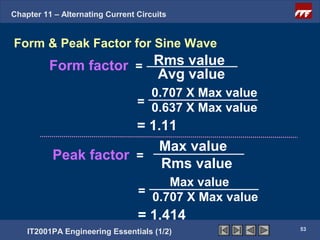
Form & Peak Factor for Sine Wave
          Form factor = Rms value
                        Avg value
                                   0.707 X Max value
                                 = 0.637 X Max value
                      = 1.11
                         Max value
          Peak factor =
                          Rms value
                                      Max value
                                 = 0.707 X Max value
                                 = 1.414
                                                       53
    IT2001PA Engineering Essentials (1/2)
Chapter 11 – Alternating Current Circuits


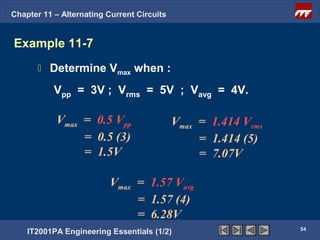
Example 11-7
          Determine Vmax when :
           Vpp = 3V ; Vrms = 5V ; Vavg = 4V.

            Vmax = 0.5 Vpp                  Vmax = 1.414 Vrms
                 = 0.5 (3)                       = 1.414 (5)
                 = 1.5V                          = 7.07V

                          Vmax = 1.57 Vavg
                               = 1.57 (4)
                               = 6.28V
                                                                54
    IT2001PA Engineering Essentials (1/2)
Chapter 11 – Alternating Current Circuits


Example 11-8
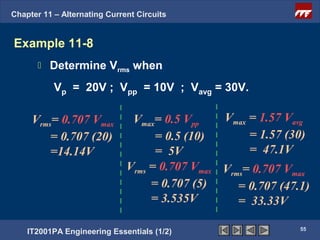
          Determine Vrms when
           Vp = 20V ; Vpp = 10V ; Vavg = 30V.

     Vrms= 0.707 Vmax          Vmax= 0.5 Vpp    Vmax = 1.57 Vavg
         = 0.707 (20)               = 0.5 (10)       = 1.57 (30)
         =14.14V                    = 5V             = 47.1V
                              Vrms = 0.707 Vmax Vrms= 0.707 Vmax
                                   = 0.707 (5)     = 0.707 (47.1)
                                   = 3.535V        = 33.33V

                                                               55
    IT2001PA Engineering Essentials (1/2)
Chapter 11 – Alternating Current Circuits


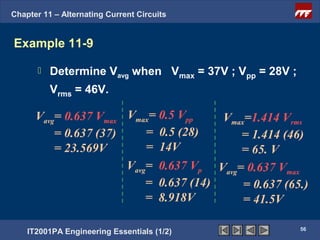
Example 11-9

          Determine Vavg when Vmax = 37V ; Vpp = 28V ;
           Vrms = 46V.

      Vavg= 0.637 Vmax Vmax= 0.5 Vpp    Vmax=1.414 Vrms
          = 0.637 (37)     = 0.5 (28)      = 1.414 (46)
          = 23.569V        = 14V           = 65. V
                       Vavg= 0.637 Vp Vavg= 0.637 Vmax
                           = 0.637 (14)     = 0.637 (65.)
                           = 8.918V         = 41.5V

                                                          56
    IT2001PA Engineering Essentials (1/2)
Chapter 11 – Alternating Current Circuits


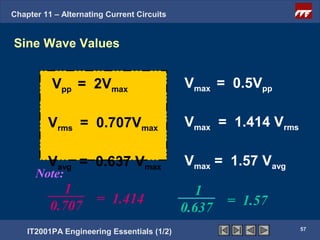
Sine Wave Values


          Vpp = 2Vmax                       Vmax = 0.5Vpp

         Vrms = 0.707Vmax                   Vmax = 1.414 Vrms

         Vavg = 0.637 Vmax                  Vmax = 1.57 Vavg
      Note:
             1                                 1
          0.707       = 1.414                       = 1.57
                                            0.637
                                                                57
    IT2001PA Engineering Essentials (1/2)
Chapter 11 – Alternating Current Circuits


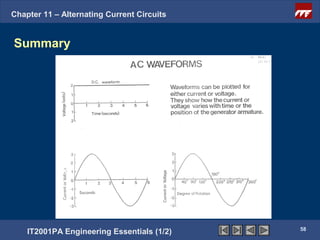
Summary


                                            58
    IT2001PA Engineering Essentials (1/2)
Chapter 11 – Alternating Current Circuits


Next Lesson


                                            59
    IT2001PA Engineering Essentials (1/2)

Ee1 chapter11 ac_circuits

  • 1.
    IT2001PA Engineering Essentials (1/2) Chapter11 – Alternating Current Circuits Lecturer Name lecturer_email@ite.edu.sg Aug 17, 2012 Contact Number
  • 2.
    Chapter 11 –Alternating Current Circuits Lesson Objectives Upon completion of this topic, you should be able to:  Explain and calculate the fundamentals of alternating current waveform. 2 IT2001PA Engineering Essentials (1/2)
  • 3.
    Chapter 11 –Alternating Current Circuits Specific Objectives Students should be able to :  Describe the basic construction of a simple alternator.  Describe the characteristics of an alternating quantity as fluctuating over a given period of time.  Define the following terms with reference to an alternating quantity :  Frequency  Average value  Instantaneous value  Maximum value IT2001PA Engineering Essentials (1/2)
  • 4.
    Chapter 11 –Alternating Current Circuits Specific Objectives Students should be able to :  State that the frequency of the generated emf is proportional to the speed and number of poles of the alternator.  Explain the term Root Mean Square (RMS) value with reference to an alternating current.  State the following equations for a sinusoidal waveform : RMS value = 0.707 x Maximum value Average value = 0.637 x Maximum value IT2001PA Engineering Essentials (1/2)
  • 5.
    Chapter 11 –Alternating Current Circuits Alternating Waveform  Alternating Current (ac) current that is continuously reversing direction, alternately flowing in one direction and then in the other.  Alternating Voltage can be similarly described. The designation ac is normally applied to both current and voltage. 5 IT2001PA Engineering Essentials (1/2)
  • 6.
    Chapter 11 –Alternating Current Circuits Alternating Waveform  Vertical axis : current (I) or voltage (V) Horizontal axis : time (t) +V +I t t -V -I 6 IT2001PA Engineering Essentials (1/2)
  • 7.
    Chapter 11 –Alternating Current Circuits Why not Direct Current (DC)?  Problems of using DC as +V power distribution system:  suffers from rapid power loss in the wires due to their t resistance, which dissipates energy as heat  DC power stations had -V useful ranges of about two kilometers  Once generated, DC power cannot be modified 7 IT2001PA Engineering Essentials (1/2)
  • 8.
    Chapter 11 –Alternating Current Circuits Power Distribution System V=RI   1) 2) 3) To prevent risk of To avoid serious For the safety of the sparks and short heating effects, user, the voltage circuits in the present at high needs to be low in the generator itself, current, it needs to be home. power needs to be transmitted at the generated with low lowest current V low  I is high voltages. practical. I low  V is high  DC is not suitable V low  I is high 8 IT2001PA Engineering Essentials (1/2)
  • 9.
    Chapter 11 –Alternating Current Circuits Advantages of A.C. --- readily available from generators and power supply sockets in homes and workshops. --- can be stepped up or down by the use of a transformer. --- for transmission purpose. 9 IT2001PA Engineering Essentials (1/2)
  • 10.
    Chapter 11 –Alternating Current Circuits Alternator An alternator is a machine that converts mechanical energy to electrical energy. A simple alternator basically consists of two parts: a) coils or windings b) magnetic poles 10 IT2001PA Engineering Essentials (1/2)
  • 11.
    Chapter 11 –Alternating Current Circuits Generation of Alternating Current An alternating quantity may be generated by a) rotating a coil in a magnetic field b) rotating a magnetic field within a stationary coil Carbon Brushes 1, 2 Slip Rings a, b 11 IT2001PA Engineering Essentials (1/2)
  • 12.
    Chapter 11 –Alternating Current Circuits Generation of Alternating Current How does AC generate a sine waveform? . . . . . x x x x x 12 IT2001PA Engineering Essentials (1/2)
  • 13.
    Chapter 11 –Alternating Current Circuits Generation of Alternating Current How does AC generate a sine waveform? 13 IT2001PA Engineering Essentials (1/2)
  • 14.
    Chapter 11 –Alternating Current Circuits Generation of Alternating Current How does AC generate a sine waveform? x x . . 14 IT2001PA Engineering Essentials (1/2)
  • 15.
    Chapter 11 –Alternating Current Circuits Generation of Alternating Current  AC generator consists of a magnet and a loop of wire which rotates in the magnetic field of the magnet.  As the wire rotates in the magnetic field, the changing strength of the magnetic field through the wire produces a force which drives the electric charges around the wire.  The force initially generates an electric current in one direction along the wire. Then as the loop rotates through 180 degrees the force reverses to give an electric current in the opposite direction along the wire. Every time the loop rotates through 180 degrees the direction of the force and therefore the current changes.  The changing direction of the force after every 180 degrees of rotation gives the alternating current.  AC generator also has slip rings which make sure that the ends of the wire are always connected to the same side of the electric circuit. This makes sure that the direction of the current changes every half revolution of the wire. 15 IT2001PA Engineering Essentials (1/2)
  • 16.
    Chapter 11 –Alternating Current Circuits Generation of Alternating emf The magnitude of the emf is given by, e = Em sin θ 16 IT2001PA Engineering Essentials (1/2)
  • 17.
    Chapter 11 –Alternating Current Circuits Sine Wave  A common type of ac. Also referred as sinusoidal waveform sinusoid Symbol for a sine wave voltage source : OR 17 IT2001PA Engineering Essentials (1/2)
  • 18.
    Chapter 11 –Alternating Current Circuits What is an Alternating Quantity? An alternating quantity is one which acts in alternate directions and whose magnitude undergoes a definite cycle of changes in definite interval of time. 18 IT2001PA Engineering Essentials (1/2)
  • 19.
    Chapter 11 –Alternating Current Circuits Polarity  When the voltage changes polarity at its zero crossing,the current correspondingly changes direction. +V Positive Alternation - VS R t + -V I +V Negative Alternation + I VS R t - -V 19 IT2001PA Engineering Essentials (1/2)
  • 20.
    Chapter 11 –Alternating Current Circuits Amplitude  The maximum value of the sine wave. +V Positive Maximum (peak) t Negative Maximum (peak) -V 20 IT2001PA Engineering Essentials (1/2)
  • 21.
    Chapter 11 –Alternating Current Circuits What is Cycle of a Waveform? One complete waveform is known as one cycle. Each cycle consists of two half-cycles. During 1st half-cycle, the quantity acts in one direction and during the second half-cycle, in the opposite direction. Each cycle : consists of 2 alternations. consists of 2 peaks. reaches maximum amplitude 2 times. 21 IT2001PA Engineering Essentials (1/2)
  • 22.
    Chapter 11 –Alternating Current Circuits Cycle  A sine wave repeats itself in identical cycles. +V t -V 1st cycle 2nd cycle 3rd cycle 22 IT2001PA Engineering Essentials (1/2)
  • 23.
    Chapter 11 –Alternating Current Circuits Period  The time required for a given sine wave to complete one full cycle. symbol - T unit - second (s) Time taken is the same for each cycle; thus fixed value for a given sine wave. 23 IT2001PA Engineering Essentials (1/2)
  • 24.
    Chapter 11 –Alternating Current Circuits Period Measurement  From one zero crossing to the corresponding zero crossing in the next cycle positive zero crossing to positive zero crossing. +V t -V period period period 24 IT2001PA Engineering Essentials (1/2)
  • 25.
    Chapter 11 –Alternating Current Circuits Period Measurement  From one peak to the corresponding peak in the next cycle positive peak to positive peak. +V t -V period period 25 IT2001PA Engineering Essentials (1/2)
  • 26.
    Chapter 11 –Alternating Current Circuits Period Measurement  From any point to the corresponding point in the next cycle. +V period t -V period 26 IT2001PA Engineering Essentials (1/2)
  • 27.
    Chapter 11 –Alternating Current Circuits Example 11-1  What is the period of the sine wave? V 0 t(s) 2 4 6 1 cycle takes 2s to complete. Therefore the period is 2s. 27 IT2001PA Engineering Essentials (1/2)
  • 28.
    Chapter 11 –Alternating Current Circuits Example 11-2  What is the period of the sine wave? V 0 t(s) 12 5 cycles takes 12s to complete 1 cycle takes (12/5)s to complete time taken 1 cycle takes 2.4s to complete T = no. of cycles Therefore the period is 2.4s. 28 IT2001PA Engineering Essentials (1/2)
  • 29.
    Chapter 11 –Alternating Current Circuits Frequency  The number of cycles a sine wave can complete in 1 second. symbol : f unit - Hertz (Hz) Examples : 160Hz - 160 complete cycles in 1s. 50Hz - 50 complete cycles in 1s. 29 IT2001PA Engineering Essentials (1/2)
  • 30.
    Chapter 11 –Alternating Current Circuits Frequency vs Period  Reciprocal relationship : 1 1 f = T = T f More cycles in 1s Lesser cycles in 1s - higher frequency. - lower frequency. - shorter period. - longer period. V T V T 0 t t 0 1s 1s 30 IT2001PA Engineering Essentials (1/2)
  • 31.
    Chapter 11 –Alternating Current Circuits Example 11-3  Which sine wave has the higher frequency? Determine the period and the frequency of both waveforms. V V 0 t 0 t 1s 1s Waveform A Waveform B 31 IT2001PA Engineering Essentials (1/2)
  • 32.
    Chapter 11 –Alternating Current Circuits Example 11-3  continue … V V 0 t 0 t 1s 1s Waveform A Waveform B Waveform B complete more cycles in 1s. Therefore Waveform B has the higher frequency. 32 IT2001PA Engineering Essentials (1/2)
  • 33.
    Chapter 11 –Alternating Current Circuits Example 11-3  continue … 3 cycles in 1s -- frequency is 3Hz V period (T) = 1/f = 1/3Hz t = 0.333s 0 1s Waveform A 3 cycles take 1s OR -- 1 cycles takes (1s/3) = 0.333s -- period is 0.333s frequency (f) = 1/T = 1/0.333s = 3Hz 33 IT2001PA Engineering Essentials (1/2)
  • 34.
    Chapter 11 –Alternating Current Circuits Example 11-3  continue … 5 cycles in 1s -- frequency is 5Hz V period (T) = 1/f = 1/5Hz = 0.2s t 0 1s OR Waveform B 5 cycles take 1s -- 1 cycles takes (1s/5) = 0.2s -- period is 0.2s frequency (f) = 1/T = 1/0.2s = 5Hz 34 IT2001PA Engineering Essentials (1/2)
  • 35.
    Chapter 11 –Alternating Current Circuits Example 11-4  The period of a sine wave is 10ms. What is the frequency? period (T) = 10ms frequency (f) = 1/T = 1/10ms = 100Hz 35 IT2001PA Engineering Essentials (1/2)
  • 36.
    Chapter 11 –Alternating Current Circuits Example 11-5  The frequency of a sine wave is 60Hz. What is the period? frequency (f) = 60Hz period (T) = 1/f = 1/60Hz = 16.7ms 36 IT2001PA Engineering Essentials (1/2)
  • 37.
    Chapter 11 –Alternating Current Circuits Voltage Sources If an ac voltage is applied to a circuit, an ac current flows. The voltage and current will have the same frequency. +V +I I t t -V -I 37 IT2001PA Engineering Essentials (1/2)
  • 38.
    Chapter 11 –Alternating Current Circuits Sine Wave Angles  The horizontal axis can be replaced by angular measurement (degrees). + V ½ cycle one cycle angle 0o 90 o 180 o 270 o 360 o -V peak zero peak zero 38 IT2001PA Engineering Essentials (1/2)
  • 39.
    Chapter 11 –Alternating Current Circuits Sine Wave Values  Ways to express and measure the value of a sine wave : 1) instantaneous value. 2) peak value. 3) peak-to-peak value. 4) root-mean-square value. 5) average value. 39 IT2001PA Engineering Essentials (1/2)
  • 40.
    Chapter 11 –Alternating Current Circuits Instantaneous Value  The voltage or current value of a waveform at a given instant in time. Symbol : voltage - v current - i 40 IT2001PA Engineering Essentials (1/2)
  • 41.
    Chapter 11 –Alternating Current Circuits Instantaneous Value  Different at different points of time. +V +I 8.5 5.5 5 t3 3 t3 t t t1 t2 t1 t2 -6 -4.5 -V -I 41 IT2001PA Engineering Essentials (1/2)
  • 42.
    Chapter 11 –Alternating Current Circuits Instantaneous Value  Different at different points of angle. +V +I Vp Ip v i degree degree θ θ -V v = Vmax sin θ -I i = Imax sin θ v = Vmax sin 2πft i = Imax sin 2πft 42 IT2001PA Engineering Essentials (1/2)
  • 43.
    Chapter 11 –Alternating Current Circuits Example 11-6  A current sine wave has a maximum value of 200A. How much is the current at the instant of 30 degrees of the cycle? i = Imax sin θ i = 200 sin 30 o = 200 x 0.5 = 100A 43 IT2001PA Engineering Essentials (1/2)
  • 44.
    Chapter 11 –Alternating Current Circuits Peak Value  The voltage or current value of a waveform at its maximum positive or negative points. Symbol : voltage - Vp or Vmax current - Ip or Imax 44 IT2001PA Engineering Essentials (1/2)
  • 45.
    Chapter 11 –Alternating Current Circuits Peak Value  The peaks are equal for a sine wave and is characterized by a single peak value. +V Positive Maximum (peak) t Negative Maximum (peak) -V 45 IT2001PA Engineering Essentials (1/2)
  • 46.
    Chapter 11 –Alternating Current Circuits Peak-to-Peak Value  The voltage or current value of a waveform measured from its minimum to its maximum points. Symbol : voltage - Vpp current - Ipp 46 IT2001PA Engineering Essentials (1/2)
  • 47.
    Chapter 11 –Alternating Current Circuits Peak-to-Peak Value +V Vpp = 2Vmax Vpp = 2Vmax Vp t 1 Vpp Vp 2 Vpp = Vmax 1 Vmax = Vpp -V 2 Vmax = 0.5Vpp 47 IT2001PA Engineering Essentials (1/2)
  • 48.
    Chapter 11 –Alternating Current Circuits Root Mean Square Value  Equal to the dc voltage that produces the same amount of heat in a resistance as does the AC (sine wave) voltage. + + VS R Vdc R - I radiated - I same heat amount of Vmax = 10 V radiated heat. Vrms = 7.07V = Vdc 48 IT2001PA Engineering Essentials (1/2)
  • 49.
    Chapter 11 –Alternating Current Circuits Root Mean Square Value  Also known as the effective value. Symbol : voltage - Vrms current - Irms The voltage and current values given are usually as rms unless otherwise stated. 49 IT2001PA Engineering Essentials (1/2)
  • 50.
    Chapter 11 –Alternating Current Circuits Root Mean Square Value +V Vrms Vrms = 0.707Vmax Vp t 1 Vrms = Vmax √2 √2 Vrms = Vmax -V Vmax = √2 Vrms Vmax = 1.414 Vrms 50 IT2001PA Engineering Essentials (1/2)
  • 51.
    Chapter 11 –Alternating Current Circuits Average Value The average of a sine wave over half- cycle. The average value taken over a complete cycle is always zero. Symbol : voltage - Vavg current - Iavg 51 IT2001PA Engineering Essentials (1/2)
  • 52.
    Chapter 11 –Alternating Current Circuits Average Value +V Vavg = 0.637 Vmax Vavg 1 Vp t 0.637 V = V avg max 1 Vmax = 0.637 Vavg -V Vmax = 1.57 Vavg 52 IT2001PA Engineering Essentials (1/2)
  • 53.
    Chapter 11 –Alternating Current Circuits Form & Peak Factor for Sine Wave Form factor = Rms value Avg value 0.707 X Max value = 0.637 X Max value = 1.11 Max value Peak factor = Rms value Max value = 0.707 X Max value = 1.414 53 IT2001PA Engineering Essentials (1/2)
  • 54.
    Chapter 11 –Alternating Current Circuits Example 11-7  Determine Vmax when : Vpp = 3V ; Vrms = 5V ; Vavg = 4V. Vmax = 0.5 Vpp Vmax = 1.414 Vrms = 0.5 (3) = 1.414 (5) = 1.5V = 7.07V Vmax = 1.57 Vavg = 1.57 (4) = 6.28V 54 IT2001PA Engineering Essentials (1/2)
  • 55.
    Chapter 11 –Alternating Current Circuits Example 11-8  Determine Vrms when Vp = 20V ; Vpp = 10V ; Vavg = 30V. Vrms= 0.707 Vmax Vmax= 0.5 Vpp Vmax = 1.57 Vavg = 0.707 (20) = 0.5 (10) = 1.57 (30) =14.14V = 5V = 47.1V Vrms = 0.707 Vmax Vrms= 0.707 Vmax = 0.707 (5) = 0.707 (47.1) = 3.535V = 33.33V 55 IT2001PA Engineering Essentials (1/2)
  • 56.
    Chapter 11 –Alternating Current Circuits Example 11-9  Determine Vavg when Vmax = 37V ; Vpp = 28V ; Vrms = 46V. Vavg= 0.637 Vmax Vmax= 0.5 Vpp Vmax=1.414 Vrms = 0.637 (37) = 0.5 (28) = 1.414 (46) = 23.569V = 14V = 65. V Vavg= 0.637 Vp Vavg= 0.637 Vmax = 0.637 (14) = 0.637 (65.) = 8.918V = 41.5V 56 IT2001PA Engineering Essentials (1/2)
  • 57.
    Chapter 11 –Alternating Current Circuits Sine Wave Values Vpp = 2Vmax Vmax = 0.5Vpp Vrms = 0.707Vmax Vmax = 1.414 Vrms Vavg = 0.637 Vmax Vmax = 1.57 Vavg Note: 1 1 0.707 = 1.414 = 1.57 0.637 57 IT2001PA Engineering Essentials (1/2)
  • 58.
    Chapter 11 –Alternating Current Circuits Summary 58 IT2001PA Engineering Essentials (1/2)
  • 59.
    Chapter 11 –Alternating Current Circuits Next Lesson 59 IT2001PA Engineering Essentials (1/2)

Editor's Notes

  • #16 http://www.sunblock99.org.uk/sb99/people/DMackay/ac.html
  • #54 NO need