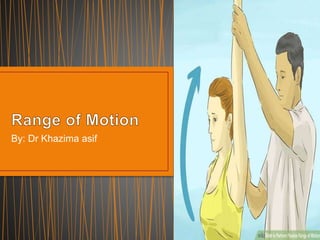
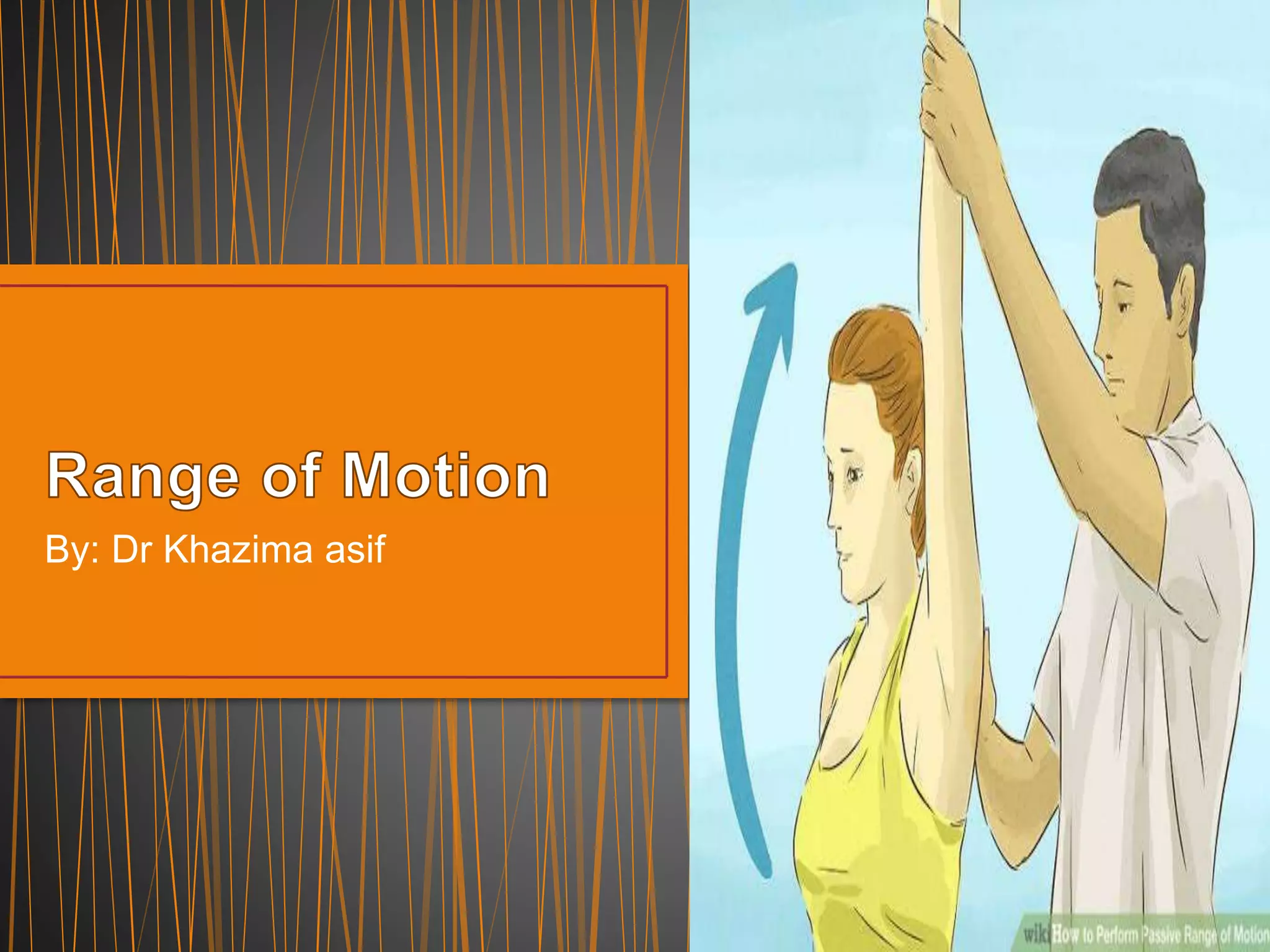
By: Dr Khazima asif
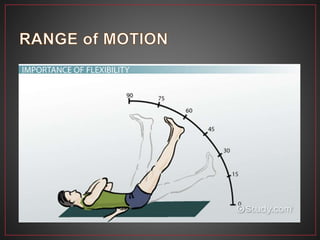
• Range of motion is a basic technique used for the
examination of movement and for initiating movement
into a program of therapeutic intervention. The full motion
possible is called the range of motion (ROM).
• FUNCTIONAL EXCURSION: Functional excursion is
the distance a muscle is capable of shortening after it has
been elongated to its maximum.
• Range of a muscle, is directly influenced by the joint
it crosses.
• The range for the brachialis muscle is limited by the
range available at the elbow joint. This is true of one-joint
muscles (muscles with their proximal and distal
attachments on the bones on either side of one joint). For
two-joint or multi joint muscles (those muscles that cross
over two or more joints), their range goes beyond the
limits of any one joint they cross.
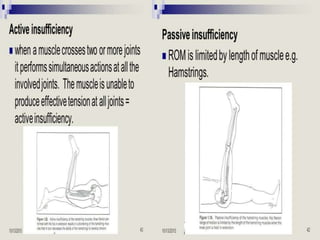
• Active insufficiency occurs when a multi-joint muscle
reaches a shortened length where it can no longer apply
a good effective force. Passive Insufficiency: When a
muscle cannot stretch anymore, occurs with the
antagonist
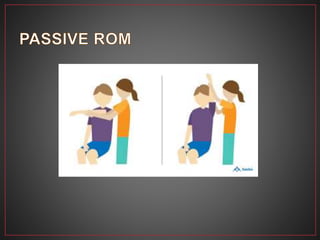
Passive ROM. Passive ROM (PROM) is
movement of a segment within the unrestricted
ROM that is produced entirely by an external
force; there is little to no voluntary muscle
contraction. The external force may be from
gravity, a machine, another individual, or another
part of the individual’s own body.
Active ROM. Active ROM (AROM) is
movement of a segment within the
unrestricted ROM that is produced by active
contraction of the muscles crossing that joint.
Active-
Assistive ROM.
Active-assistive
ROM (A-AROM)
is a type of
AROM in which
assistance is
provided
manually
or mechanically
by an outside
force because
the prime
mover muscles
need assistance
to complete the
motion
Passive ROM
• Indications for PROM: acute, inflamed tissue,
When a patient is not able to or not supposed
to actively move a segment(s) of the body, as
when comatose, paralyzed, or on complete bed
rest, movement is provided by an external
source.
• Goals for PROM:
â–  Maintain joint and connective tissue mobility.
â–  Minimize the effects of the formation of
contractures.
â–  Maintain mechanical elasticity of muscle.
â–  Assist circulation and vascular dynamics
â–  Enhance synovial movement for cartilage
nutrition and diffusion of materials in the joint.
â–  Decrease or inhibit pain.
â–  Assist with the healing process after injury or
surgery.
■ Help maintain the patient’s awareness of
movement
Limitations of Passive
Motion:
â–  Prevent muscle
atrophy.
â–  Increase strength or
endurance.
â–  Assist circulation to the
extent that active,
voluntary muscle
contraction does.
Indications for AROM:
When a patient is able to contract the muscles actively and
move a segment with or without assistance, AROM is used.
• When a patient has weak musculature and is unable to
move a joint through the desired range (usually against
gravity), When a segment of the body is immobilized for a
period of time.
• AROM can be used for aerobic conditioning programs
and is used to relieve stress from sustained postures.
• Maintain physiological elasticity and contractility of the
participating muscles.
• Provide sensory feedback from the contracting muscles.
• Provide a stimulus for bone and joint tissue integrity.
• Increase circulation and prevent thrombus formation.
• Develop coordination and motor skills for functional
• activities.
Limitations of Active ROM
• For strong muscles, active ROM does not maintain or
increase strength. It also does not develop skill or
coordination except in the movement patterns used.
• ROM should not be done when motion is disruptive to the
healing process.
• Carefully controlled motion within the limits of pain-free
motion during early phases of healing has been shown to
benefit healing and early recovery.
• Signs of too much or the wrong motion include increased
pain and inflammation.
• ROM should not be done when patient response or the
condition is life-threatening.
• PROM may be carefully initiated to major joints and
AROM to ankles and feet to minimize venous stasis and
thrombus formation.
• After myocardial infarction, coronary artery bypass
surgery, or percutaneous transluminal coronary
angioplasty, AROM of upper extremities and limited
walking are usually tolerated under careful monitoring of
symptoms
Range of motion chap 3

Range of motion chap 3

  • 1.
  • 2.
    • Range ofmotion is a basic technique used for the examination of movement and for initiating movement into a program of therapeutic intervention. The full motion possible is called the range of motion (ROM). • FUNCTIONAL EXCURSION: Functional excursion is the distance a muscle is capable of shortening after it has been elongated to its maximum. • Range of a muscle, is directly influenced by the joint it crosses.
  • 4.
    • The rangefor the brachialis muscle is limited by the range available at the elbow joint. This is true of one-joint muscles (muscles with their proximal and distal attachments on the bones on either side of one joint). For two-joint or multi joint muscles (those muscles that cross over two or more joints), their range goes beyond the limits of any one joint they cross. • Active insufficiency occurs when a multi-joint muscle reaches a shortened length where it can no longer apply a good effective force. Passive Insufficiency: When a muscle cannot stretch anymore, occurs with the antagonist
  • 6.
    Passive ROM. PassiveROM (PROM) is movement of a segment within the unrestricted ROM that is produced entirely by an external force; there is little to no voluntary muscle contraction. The external force may be from gravity, a machine, another individual, or another part of the individual’s own body. Active ROM. Active ROM (AROM) is movement of a segment within the unrestricted ROM that is produced by active contraction of the muscles crossing that joint. Active- Assistive ROM. Active-assistive ROM (A-AROM) is a type of AROM in which assistance is provided manually or mechanically by an outside force because the prime mover muscles need assistance to complete the motion
  • 8.
    Passive ROM • Indicationsfor PROM: acute, inflamed tissue, When a patient is not able to or not supposed to actively move a segment(s) of the body, as when comatose, paralyzed, or on complete bed rest, movement is provided by an external source. • Goals for PROM: ■ Maintain joint and connective tissue mobility. ■ Minimize the effects of the formation of contractures. ■ Maintain mechanical elasticity of muscle. ■ Assist circulation and vascular dynamics ■ Enhance synovial movement for cartilage nutrition and diffusion of materials in the joint. ■ Decrease or inhibit pain. ■ Assist with the healing process after injury or surgery. ■ Help maintain the patient’s awareness of movement Limitations of Passive Motion: ■ Prevent muscle atrophy. ■ Increase strength or endurance. ■ Assist circulation to the extent that active, voluntary muscle contraction does.
  • 9.
    Indications for AROM: Whena patient is able to contract the muscles actively and move a segment with or without assistance, AROM is used. • When a patient has weak musculature and is unable to move a joint through the desired range (usually against gravity), When a segment of the body is immobilized for a period of time. • AROM can be used for aerobic conditioning programs and is used to relieve stress from sustained postures.
  • 10.
    • Maintain physiologicalelasticity and contractility of the participating muscles. • Provide sensory feedback from the contracting muscles. • Provide a stimulus for bone and joint tissue integrity. • Increase circulation and prevent thrombus formation. • Develop coordination and motor skills for functional • activities. Limitations of Active ROM • For strong muscles, active ROM does not maintain or increase strength. It also does not develop skill or coordination except in the movement patterns used.
  • 11.
    • ROM shouldnot be done when motion is disruptive to the healing process. • Carefully controlled motion within the limits of pain-free motion during early phases of healing has been shown to benefit healing and early recovery. • Signs of too much or the wrong motion include increased pain and inflammation.
  • 12.
    • ROM shouldnot be done when patient response or the condition is life-threatening. • PROM may be carefully initiated to major joints and AROM to ankles and feet to minimize venous stasis and thrombus formation. • After myocardial infarction, coronary artery bypass surgery, or percutaneous transluminal coronary angioplasty, AROM of upper extremities and limited walking are usually tolerated under careful monitoring of symptoms