Range of motion exercises
BY:
Ass.Prof.Dr. Mohamed Serag
Dr. Doaa Tammam
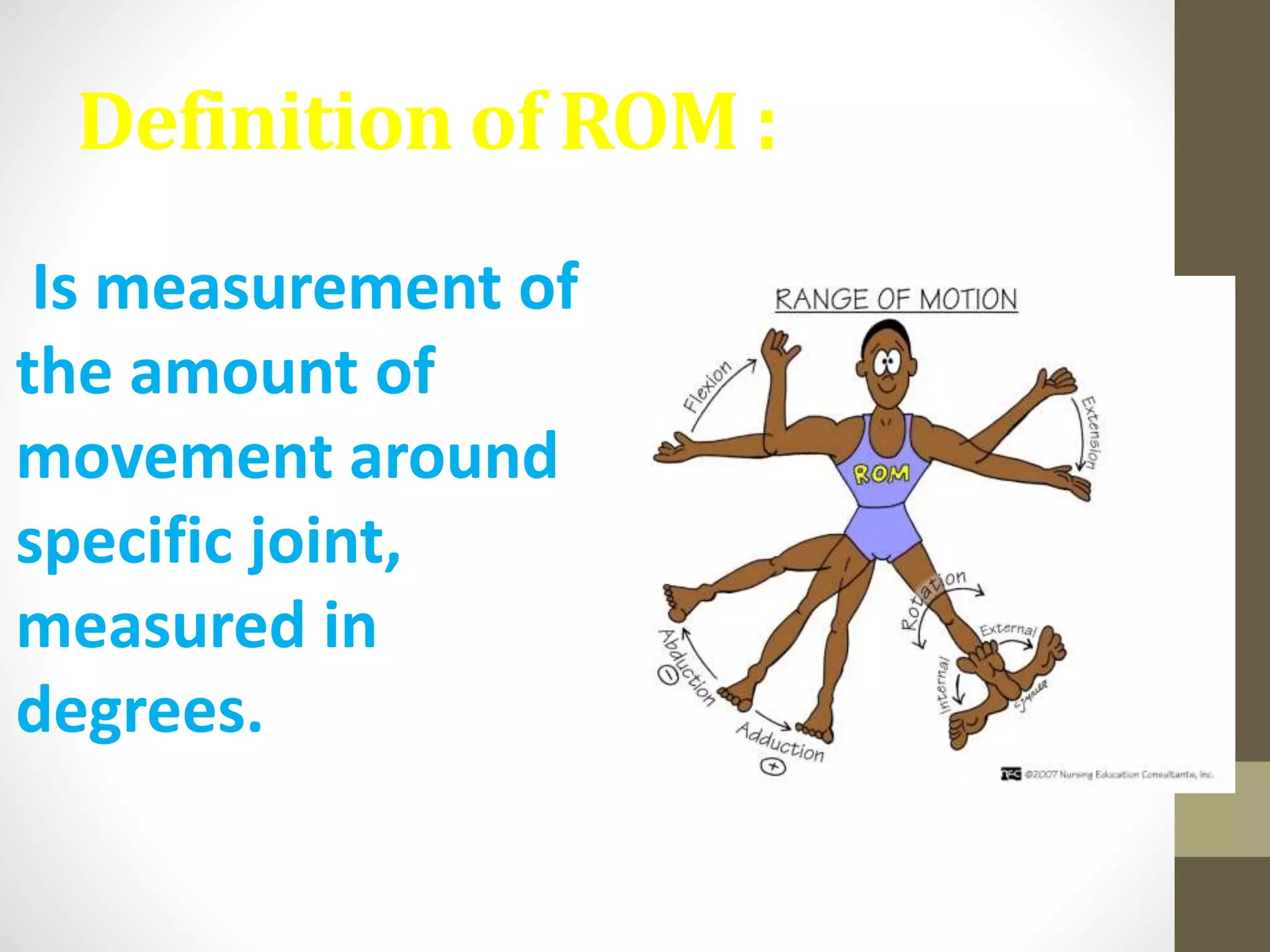
Definition of ROM :
Is measurement of
the amount of
movement around
specific joint,
measured in
degrees.
• -Therapist can help to improve joint
function by focusing on ROM exercises.
the goal of these ex.: is to gently increase
ROM and decrease pain, swelling and
stiffness.
Types of ROM EX.:
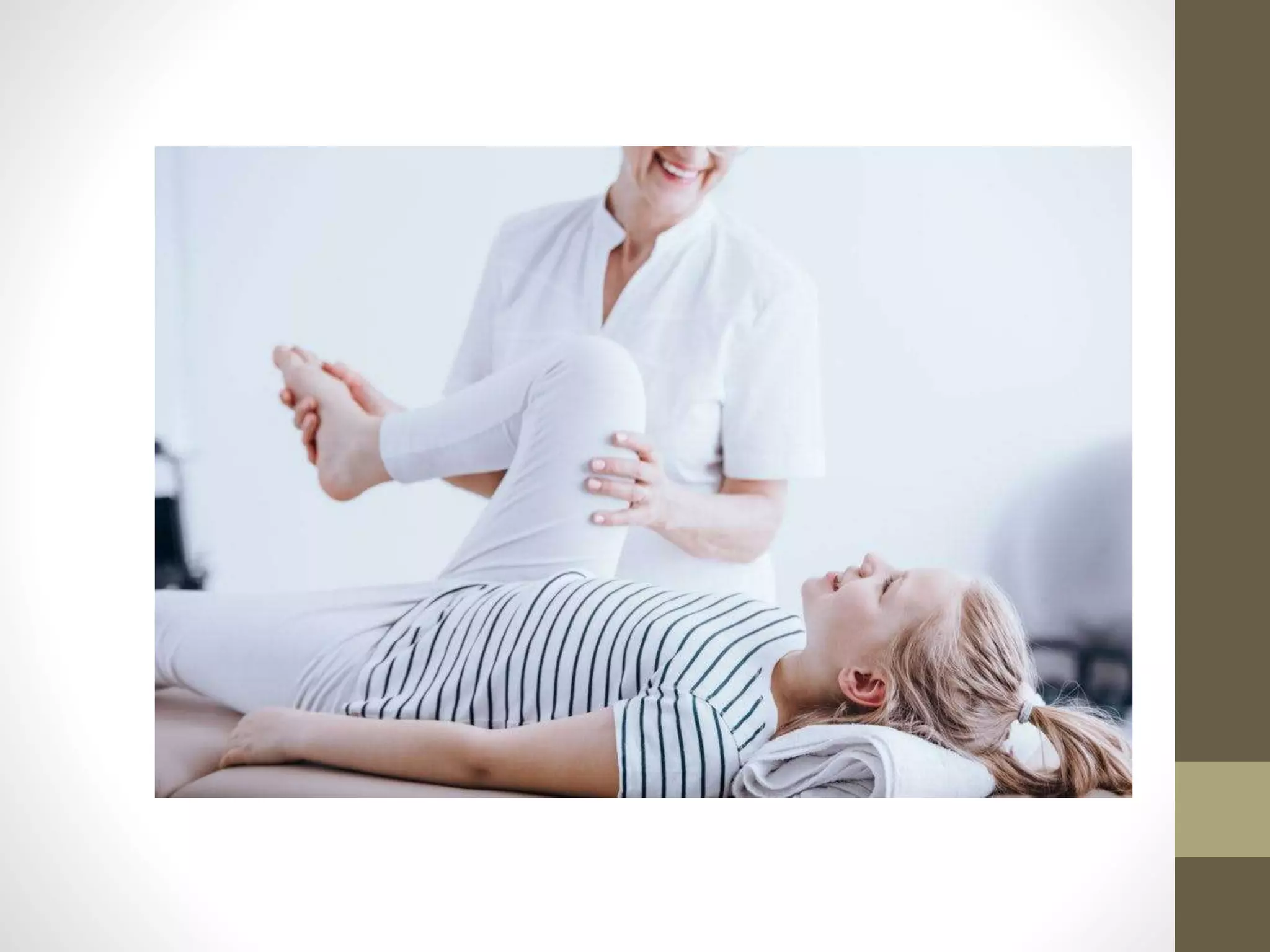
•1- Passive range of motion
exercise: (PROM)
•Movement performed within
unrestricted ROM by external
force (Therapist or equipment
moves the joint through the ROM)
without any muscle contraction
done by patient . (no voluntary
motion)
• 2-Active assisted range of motion exercise:
(AAROM)
• Movement performed within the
unrestricted ROM controlled by the
voluntary contraction of the muscle , in
which assistance is provided by outside
force (therapist or equipment )to complete
the ROM with gravity elimination.
• 3- Active range of motion exercise:
(AROM)
•Movement performed by
patient’s own muscular effort
within the un restricted ROM
without any assistance or
resistance of any external force
other than gravity.
Types of passive movement:
•1- Relaxed passive movement:
•( to maintain unrestricted ROM)
•2- Stretching passive movement: (to
increase restricted ROM)
•3-Mobilizing passive movement:
•(to increase ROM and break down
adhesion)
Relaxed passive movement:
• Goals of relaxed passive movement:
• 1- to maintain unrestricted ROM
• 2-Inhebit pain and reduce edema
• 3-improve circulation and vascular system
• 4-increase nutrition to joint capsule
• 5- assist in healing process of fracture or surgery
• 6-provide sensory stimulation and awareness
• 7-used to evaluate ROM, stability ,flexibility and
muscle tone
• 8- use it during teach active ex.
Indications of relaxed passive movement:
•1- Paralyzed Patient
•2- Comatosd Patients
•3- Immobilization
•4- Surgical Interference
•5- Muscle Re-education
Contraindicationsof relaxed passivemovement:
• 1- Fever
• 2- Acute Inflammation
• 3- Recent Injury E.G Fracture
• 4- Abnormal Blood Pressure
• 5- DVT
• 6- Open Wound
• 7- Sever Pain
Characteristicsof relaxed passivemovement:
•1- Slowly
•2- Rhythmic
•3- Regular
•4- Through Full ROM
Principleof application of relaxedpassivemovement
• 1- Complete Evaluation
• 2- Preparation For Patient:
• a- patients should be in comfortable
,relaxed and good alignment position
• b- Free the region from restriction of
clothes, splints ,cover the other parts
• 3- Therapist should be maintaining the
body mechanics (therapist position must be
near to the center of gravity of the part to
be treated realizing inner and outer hand
and standing with wide base of support
• 4- The vital signs should be measure before
and after ex.(blood pressure ,temperature
and pulse rate)
• 5- Sufficient space and place to perform
movement
• 6- preparation for application:
• - to control the mov. Grasp the extremity around
the joint, if the joints are painful modify the
grasp.
• -Support the area of poor structural integrity
(hypermobility ,or paralyzed limb)
• -Move the limb smoothly and rhythmically , also
don’t apply force or pressure at end of
movement.
• -Grasp should be firm not harmful.
• 7-repeated the movement 5-10 times according
to patient condition and response
Limitation for passive movement:
•Passive ROM EX doesn't :
-Prevent atrophy
-Increase strength and
endurance
THANK YOU

passive ROM ex.pptx

  • 1.
    Range of motionexercises BY: Ass.Prof.Dr. Mohamed Serag Dr. Doaa Tammam
  • 2.
    Definition of ROM: Is measurement of the amount of movement around specific joint, measured in degrees.
  • 3.
    • -Therapist canhelp to improve joint function by focusing on ROM exercises. the goal of these ex.: is to gently increase ROM and decrease pain, swelling and stiffness.
  • 4.
    Types of ROMEX.: •1- Passive range of motion exercise: (PROM) •Movement performed within unrestricted ROM by external force (Therapist or equipment moves the joint through the ROM) without any muscle contraction done by patient . (no voluntary motion)
  • 6.
    • 2-Active assistedrange of motion exercise: (AAROM) • Movement performed within the unrestricted ROM controlled by the voluntary contraction of the muscle , in which assistance is provided by outside force (therapist or equipment )to complete the ROM with gravity elimination.
  • 7.
    • 3- Activerange of motion exercise: (AROM) •Movement performed by patient’s own muscular effort within the un restricted ROM without any assistance or resistance of any external force other than gravity.
  • 9.
    Types of passivemovement: •1- Relaxed passive movement: •( to maintain unrestricted ROM) •2- Stretching passive movement: (to increase restricted ROM) •3-Mobilizing passive movement: •(to increase ROM and break down adhesion)
  • 10.
    Relaxed passive movement: •Goals of relaxed passive movement: • 1- to maintain unrestricted ROM • 2-Inhebit pain and reduce edema • 3-improve circulation and vascular system • 4-increase nutrition to joint capsule • 5- assist in healing process of fracture or surgery • 6-provide sensory stimulation and awareness • 7-used to evaluate ROM, stability ,flexibility and muscle tone • 8- use it during teach active ex.
  • 11.
    Indications of relaxedpassive movement: •1- Paralyzed Patient •2- Comatosd Patients •3- Immobilization •4- Surgical Interference •5- Muscle Re-education
  • 12.
    Contraindicationsof relaxed passivemovement: •1- Fever • 2- Acute Inflammation • 3- Recent Injury E.G Fracture • 4- Abnormal Blood Pressure • 5- DVT • 6- Open Wound • 7- Sever Pain
  • 13.
    Characteristicsof relaxed passivemovement: •1-Slowly •2- Rhythmic •3- Regular •4- Through Full ROM
  • 14.
    Principleof application ofrelaxedpassivemovement • 1- Complete Evaluation • 2- Preparation For Patient: • a- patients should be in comfortable ,relaxed and good alignment position • b- Free the region from restriction of clothes, splints ,cover the other parts
  • 15.
    • 3- Therapistshould be maintaining the body mechanics (therapist position must be near to the center of gravity of the part to be treated realizing inner and outer hand and standing with wide base of support • 4- The vital signs should be measure before and after ex.(blood pressure ,temperature and pulse rate) • 5- Sufficient space and place to perform movement
  • 16.
    • 6- preparationfor application: • - to control the mov. Grasp the extremity around the joint, if the joints are painful modify the grasp. • -Support the area of poor structural integrity (hypermobility ,or paralyzed limb) • -Move the limb smoothly and rhythmically , also don’t apply force or pressure at end of movement. • -Grasp should be firm not harmful. • 7-repeated the movement 5-10 times according to patient condition and response
  • 17.
    Limitation for passivemovement: •Passive ROM EX doesn't : -Prevent atrophy -Increase strength and endurance
  • 18.