Presentation on Crutch walking
By Dr Pushpendra
• Definition-: Assisting patient to walk using
crutches while providing support and as a
convenient method of getting from one place
to another.
Purpose of walking aids:-
• Increase area of support or base of support
• Maintain centre of gravity over supported
area
• Redistribute weight bearing area by
decreasing force on injured or inflamed part
or limb.
• Can be compensate for weak muscles
• Decrease pain
• Improve balance
Factors for use cructhes efficiently:-
• Muscle strength
• Correct selection of crutches
• Good sense of balance
• The pattern of gait employed
• Proper Instructions
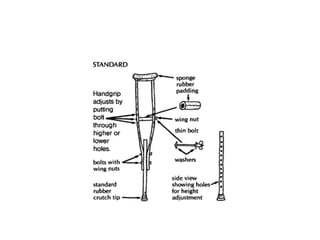
Types of crutches
1. Axillary / Regular/Standard crutches
Transfers 80% body weight.
2. Non axillary /forearm cruthes transfers 40-
50% body weight
How to stand and balance with
crutches...!
• Achieved by standing the patient against a wall and
placing a crutch under each arm
Correct stance with crutches:-
• Head up back straight with the pelvis over the feet as
much as possible,
• The shoulders depressed not hunched,
• The axillary pads of the crutches gripped between the
upper arm and the side walls of the chest 2 inches below
the anterior axillary fold
• The crutches tips 6 inches forward and 6 inches out from
the tip of the toes, the palm of the hands on top of the
handgrips,
• The body weight taken mainly on the hands and the
elbow in a position of 30 degree flexion.
Crutch walking-patterns of gait
• Four different patterns of gait
1. Swinging crutch gait :Pt is in the stable
position
a. Swing to crutch gait- both crutches ; lift and
swing the body to the crutches.
b. Swing through gait- both crutches ; lift and
swing the body beyond the crutches
2. Four-point crutch gait:-
Right crutch; left foot; left crutch; right foot;
The patient is standing on both feet with a
crutch under each arm
3. Two-point crutch gait-:
Right crutch and left foot simultaneously ;
Left crutch and right foot simultaneously
The patient is standing on both feet with a
crutch under each arm
4. Three-point crutch gait-:
both cructhes and the weaker lower limb
together; the stronger lower limb
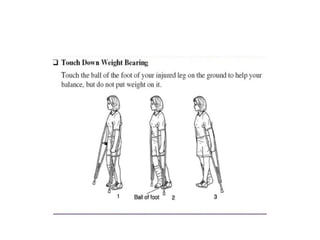
Walking , non weight bearing-
The pateint is standing on his right foot with a
crutch under each arm ; the left foot is off the
ground
• Any mobility is better then immobility....!
• Thank you................

Crutch walking.pptx

  • 1.
    Presentation on Crutchwalking By Dr Pushpendra
  • 2.
    • Definition-: Assistingpatient to walk using crutches while providing support and as a convenient method of getting from one place to another.
  • 3.
    Purpose of walkingaids:- • Increase area of support or base of support • Maintain centre of gravity over supported area • Redistribute weight bearing area by decreasing force on injured or inflamed part or limb. • Can be compensate for weak muscles • Decrease pain • Improve balance
  • 4.
    Factors for usecructhes efficiently:- • Muscle strength • Correct selection of crutches • Good sense of balance • The pattern of gait employed • Proper Instructions
  • 6.
  • 7.
    1. Axillary /Regular/Standard crutches Transfers 80% body weight. 2. Non axillary /forearm cruthes transfers 40- 50% body weight
  • 9.
    How to standand balance with crutches...! • Achieved by standing the patient against a wall and placing a crutch under each arm Correct stance with crutches:- • Head up back straight with the pelvis over the feet as much as possible, • The shoulders depressed not hunched, • The axillary pads of the crutches gripped between the upper arm and the side walls of the chest 2 inches below the anterior axillary fold • The crutches tips 6 inches forward and 6 inches out from the tip of the toes, the palm of the hands on top of the handgrips, • The body weight taken mainly on the hands and the elbow in a position of 30 degree flexion.
  • 12.
    Crutch walking-patterns ofgait • Four different patterns of gait 1. Swinging crutch gait :Pt is in the stable position a. Swing to crutch gait- both crutches ; lift and swing the body to the crutches. b. Swing through gait- both crutches ; lift and swing the body beyond the crutches
  • 13.
    2. Four-point crutchgait:- Right crutch; left foot; left crutch; right foot; The patient is standing on both feet with a crutch under each arm 3. Two-point crutch gait-: Right crutch and left foot simultaneously ; Left crutch and right foot simultaneously The patient is standing on both feet with a crutch under each arm
  • 14.
    4. Three-point crutchgait-: both cructhes and the weaker lower limb together; the stronger lower limb Walking , non weight bearing- The pateint is standing on his right foot with a crutch under each arm ; the left foot is off the ground
  • 20.
    • Any mobilityis better then immobility....! • Thank you................