Randomized
Clinical Trials
P: 3 U:2
Vedanti Gharat
Exam seat no. 3009
M.Sc. Biotechnology Part-2​
Introduction
2
Randomized clinical trials, or RCTs, are a type of study design commonly used
in medical research to evaluate the safety and efficacy of new treatments or
interventions.
Although no study is likely on its own to prove causality, randomization reduces
bias and provides a rigorous tool to examine cause-effect relationships between
an intervention and outcome.
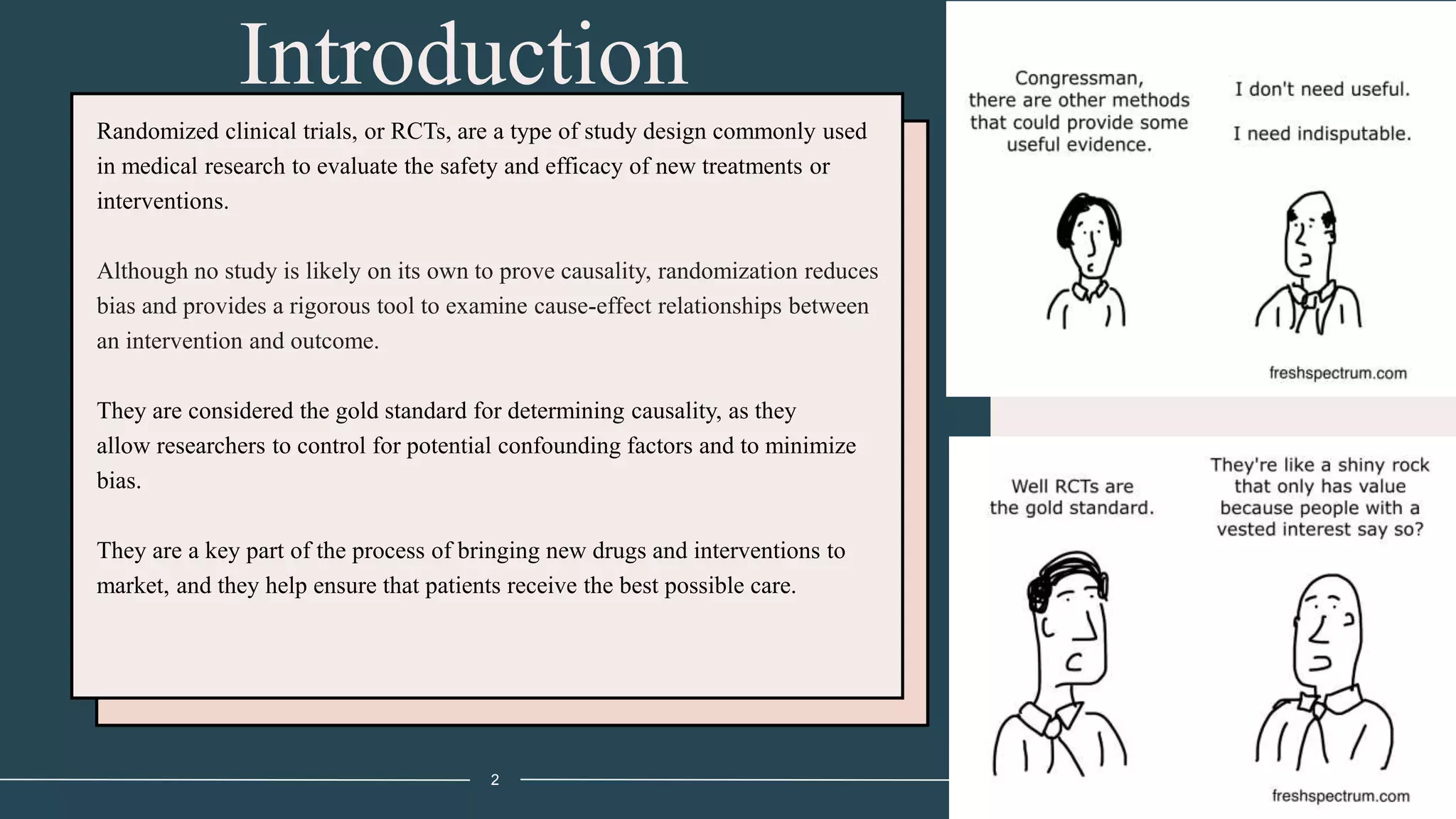
They are considered the gold standard for determining causality, as they
allow researchers to control for potential confounding factors and to minimize
bias.
They are a key part of the process of bringing new drugs and interventions to
market, and they help ensure that patients receive the best possible care.
How do randomized clinical trials work?
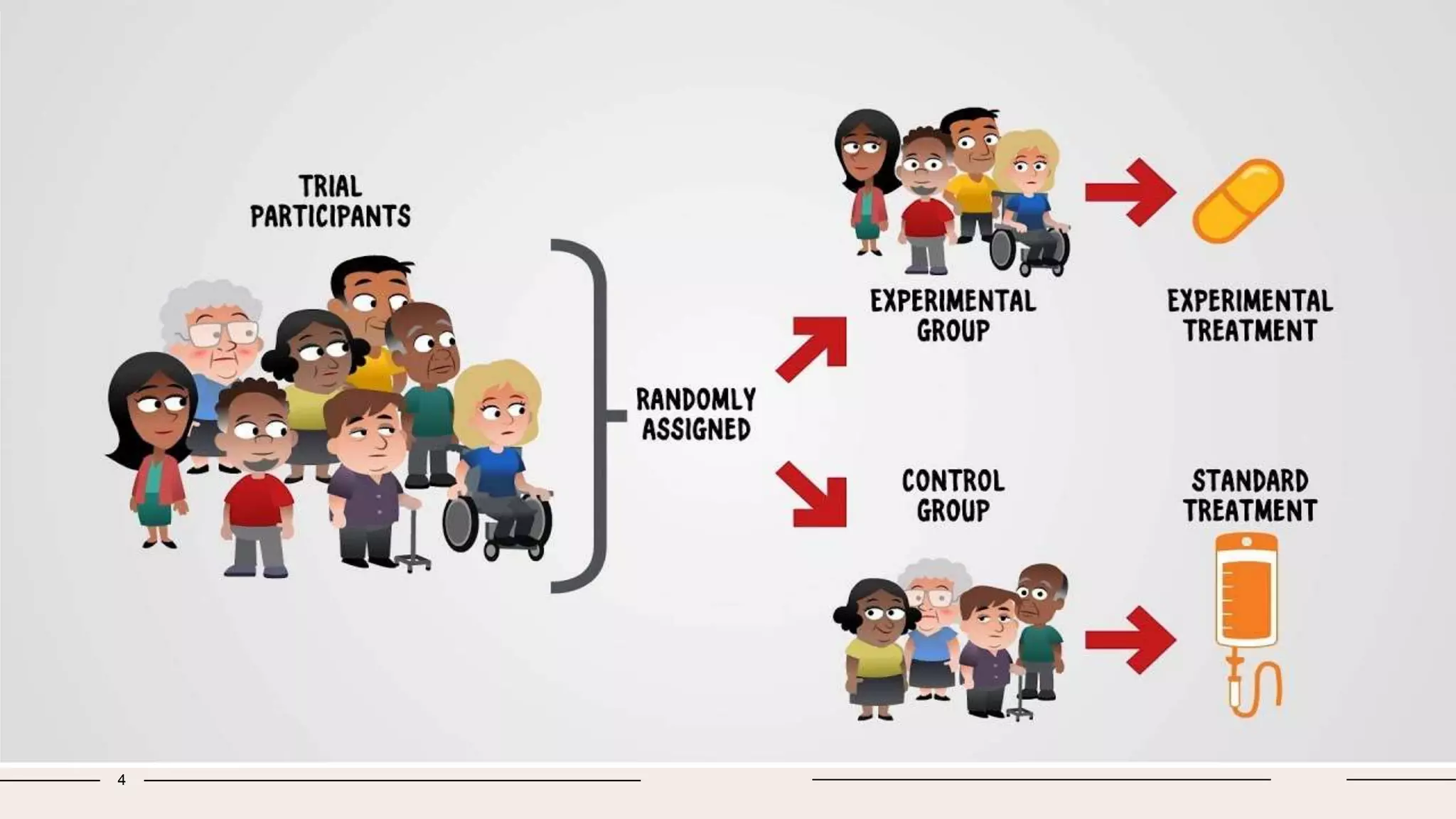
• First, a sample of participants is selected to take part in the study.
• These participants are then randomly assigned to one of two groups: the treatment group or the control group.
• The treatment group receives the new intervention or treatment being tested, while the control group receives either a
placebo or the standard of care treatment (if one exists).
• The participants in each group are then followed over time, and their outcomes are compared.
3
4
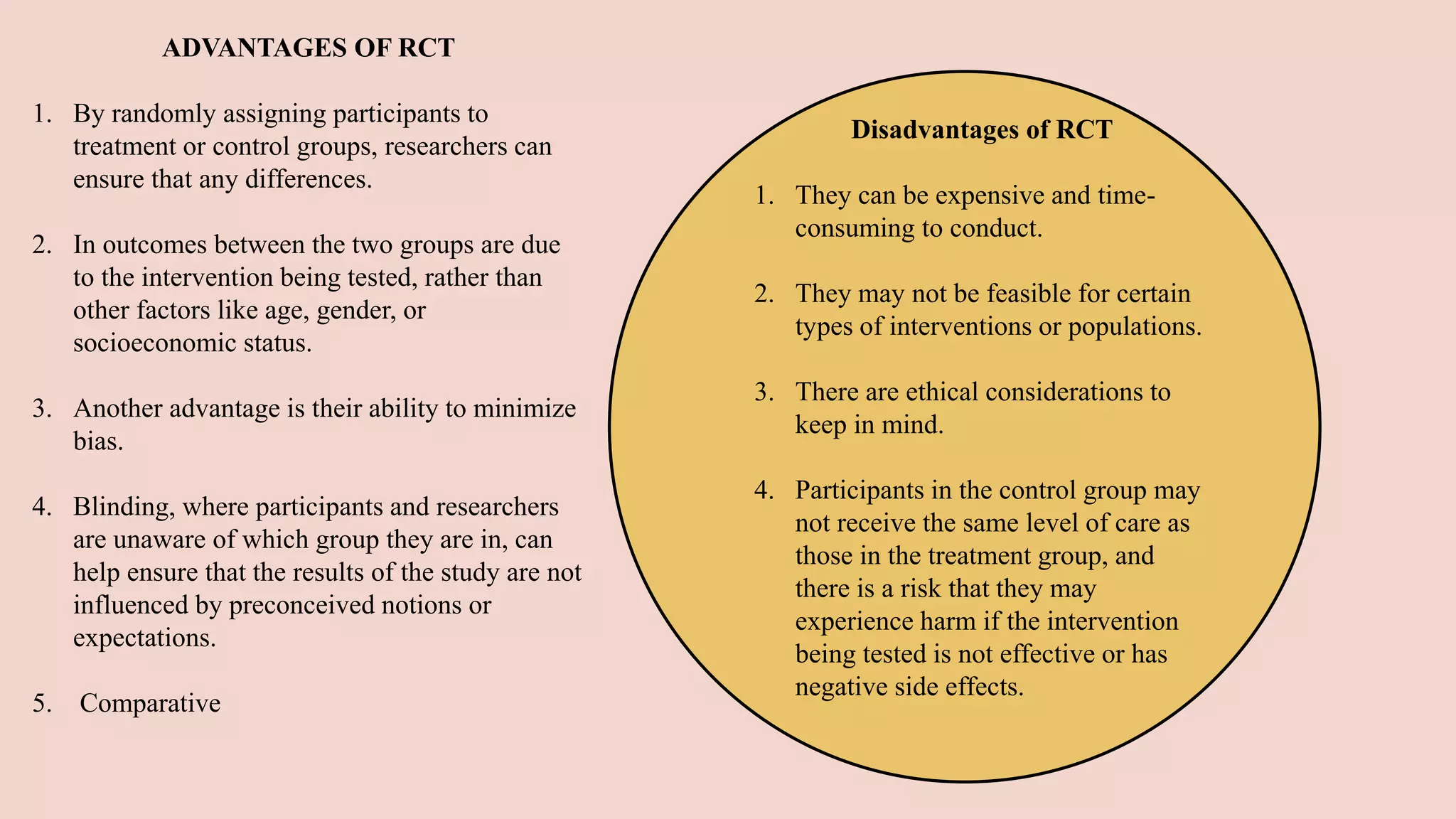
ADVANTAGES OF RCT
1. By randomly assigning participants to
treatment or control groups, researchers can
ensure that any differences.
2. In outcomes between the two groups are due
to the intervention being tested, rather than
other factors like age, gender, or
socioeconomic status.
3. Another advantage is their ability to minimize
bias.
4. Blinding, where participants and researchers
are unaware of which group they are in, can
help ensure that the results of the study are not
influenced by preconceived notions or
expectations.
5. Comparative
Disadvantages of RCT
1. They can be expensive and time-
consuming to conduct.
2. They may not be feasible for certain
types of interventions or populations.
3. There are ethical considerations to
keep in mind.
4. Participants in the control group may
not receive the same level of care as
those in the treatment group, and
there is a risk that they may
experience harm if the intervention
being tested is not effective or has
negative side effects.
Types of RCT
6
1.Parallel-
group Trials
1.Crossover
Trials
Factorial
Trials
1.Adaptive
Trials
Parallel-group Trial
7
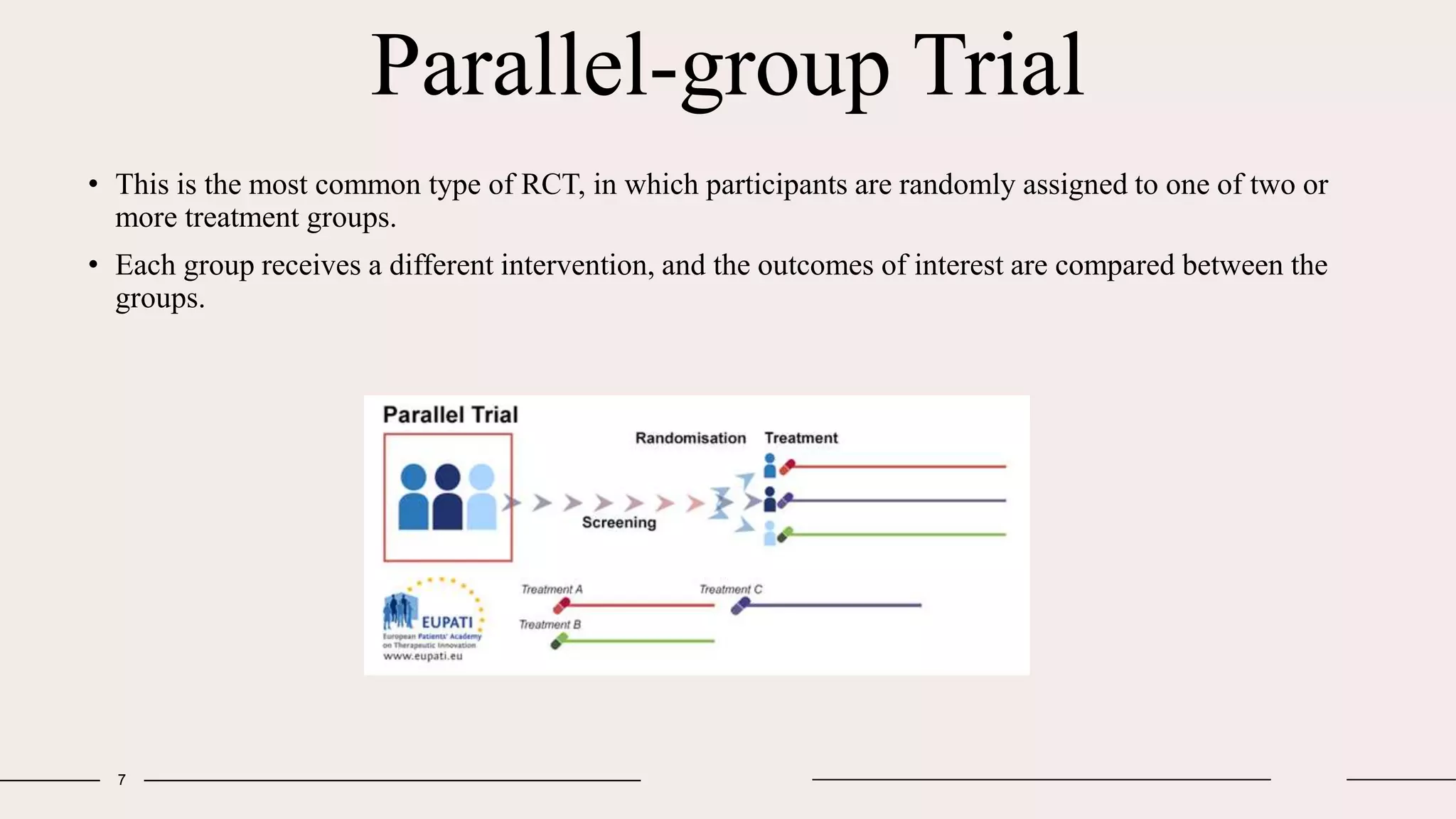
• This is the most common type of RCT, in which participants are randomly assigned to one of two or
more treatment groups.
• Each group receives a different intervention, and the outcomes of interest are compared between the
groups.
Crossover Trial
8
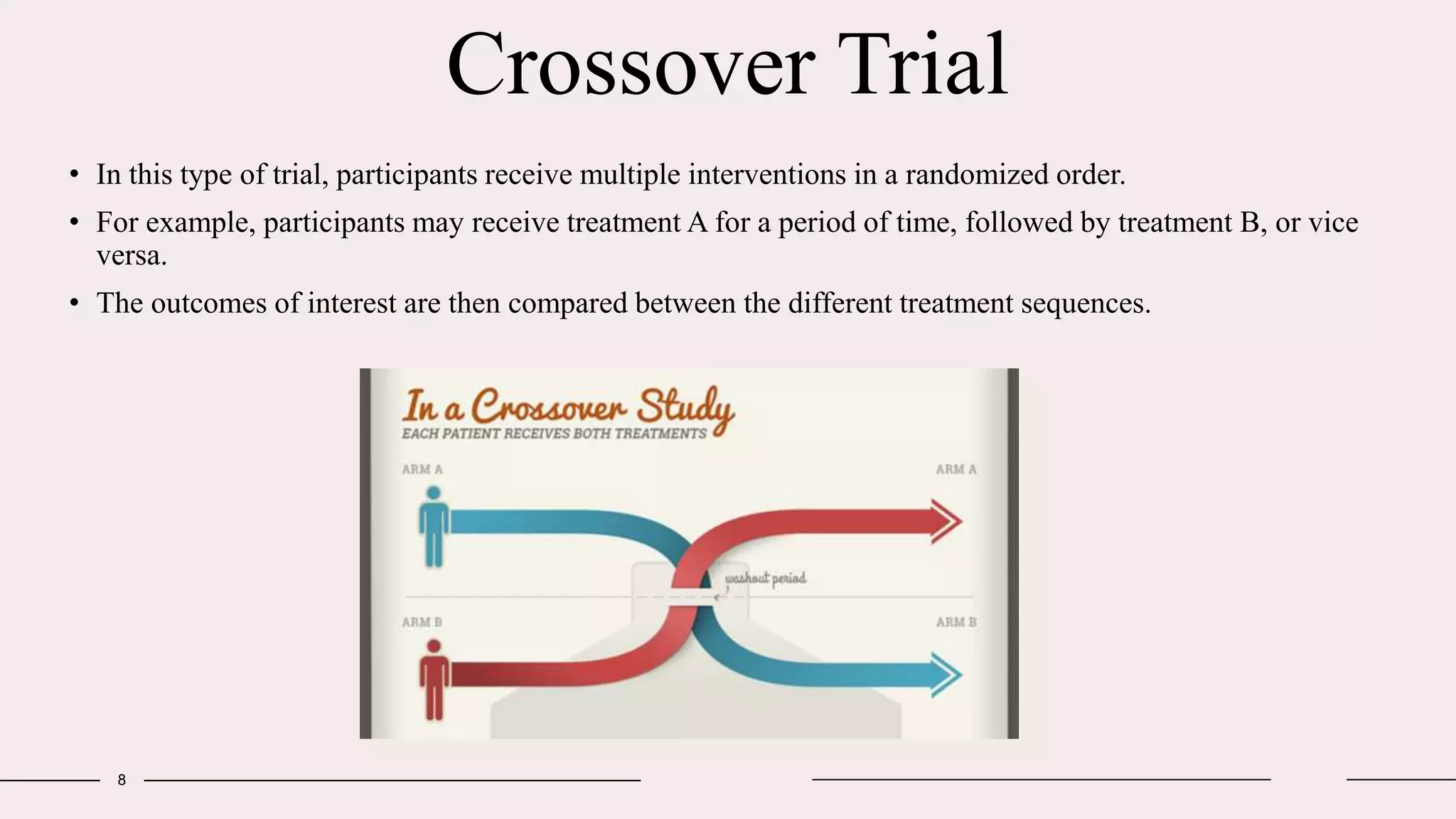
• In this type of trial, participants receive multiple interventions in a randomized order.
• For example, participants may receive treatment A for a period of time, followed by treatment B, or vice
versa.
• The outcomes of interest are then compared between the different treatment sequences.
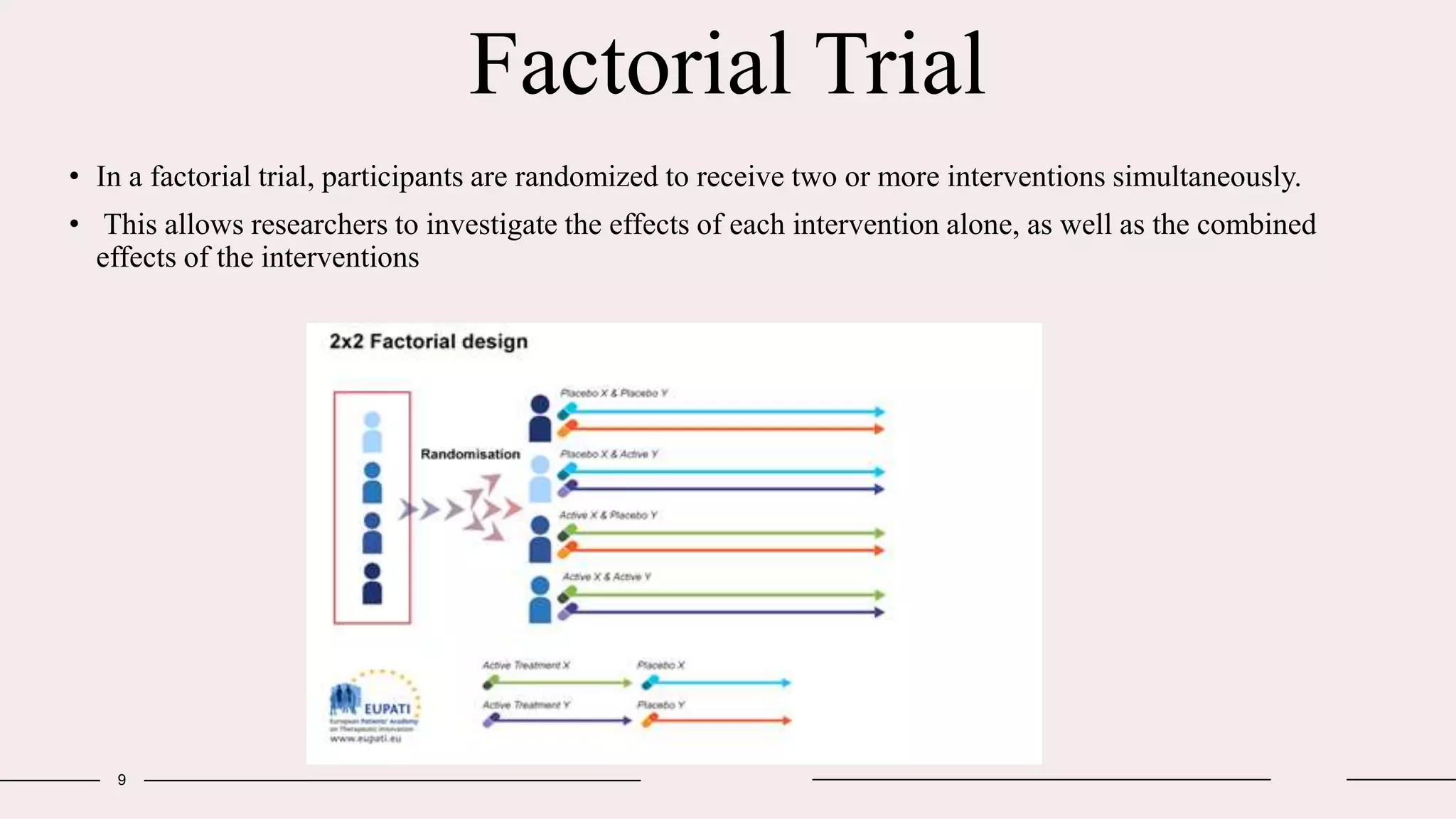
Factorial Trial
9
• In a factorial trial, participants are randomized to receive two or more interventions simultaneously.
• This allows researchers to investigate the effects of each intervention alone, as well as the combined
effects of the interventions
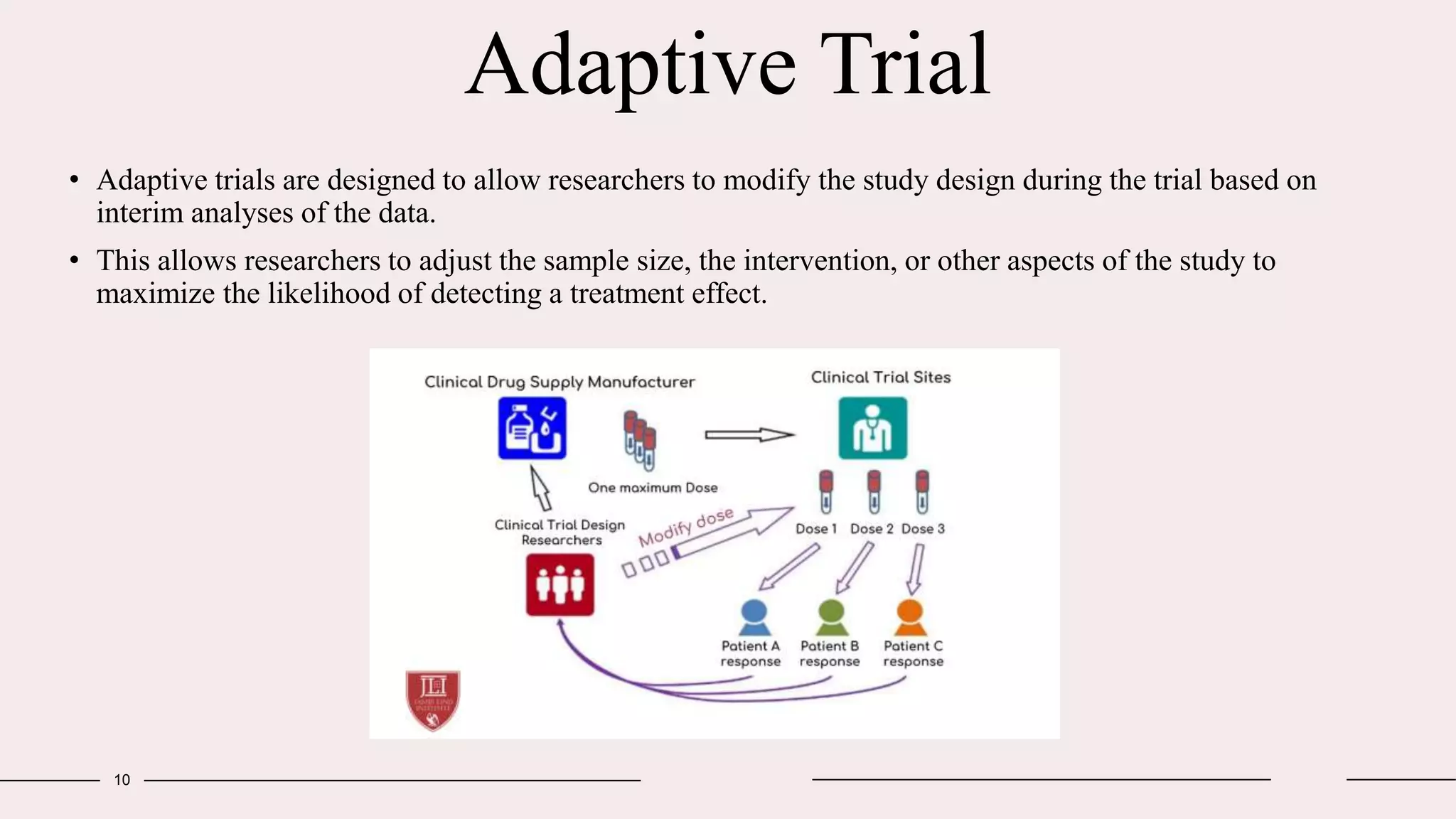
Adaptive Trial
10
• Adaptive trials are designed to allow researchers to modify the study design during the trial based on
interim analyses of the data.
• This allows researchers to adjust the sample size, the intervention, or other aspects of the study to
maximize the likelihood of detecting a treatment effect.
Adaptive Trial Types
Covariate-adaptive randomization:
This method uses participant characteristics
(e.g., age, gender, disease severity) to adjust the
probability of treatment allocation.
Response-adaptive randomization:
This method adjusts the allocation probabilities
based on the response to treatment observed in
participants already enrolled in the trial.
Play-the-winner:
In this method, the allocation probability for
each treatment group is based on the proportion
of participants who responded favorably to that
treatment so far in the trial. This method favors
the treatment that appears to be working
better in the early stages of the trial.
Drop-the-loser:
This method reduces the allocation probability
for a treatment group if it is performing poorly
compared to the other treatment group(s). This
method aims to identify the inferior treatment
early on in the trial and allocate more
participants to the better-performing treatment.
11
The works must be conceived
with fire in the soul but executed
with clinical coolness.
Joan Miro
12
Thank you!

Randomized Controlled Trials.pptx

  • 1.
    Randomized Clinical Trials P: 3U:2 Vedanti Gharat Exam seat no. 3009 M.Sc. Biotechnology Part-2​
  • 2.
    Introduction 2 Randomized clinical trials,or RCTs, are a type of study design commonly used in medical research to evaluate the safety and efficacy of new treatments or interventions. Although no study is likely on its own to prove causality, randomization reduces bias and provides a rigorous tool to examine cause-effect relationships between an intervention and outcome. They are considered the gold standard for determining causality, as they allow researchers to control for potential confounding factors and to minimize bias. They are a key part of the process of bringing new drugs and interventions to market, and they help ensure that patients receive the best possible care.
  • 3.
    How do randomizedclinical trials work? • First, a sample of participants is selected to take part in the study. • These participants are then randomly assigned to one of two groups: the treatment group or the control group. • The treatment group receives the new intervention or treatment being tested, while the control group receives either a placebo or the standard of care treatment (if one exists). • The participants in each group are then followed over time, and their outcomes are compared. 3
  • 4.
  • 5.
    ADVANTAGES OF RCT 1.By randomly assigning participants to treatment or control groups, researchers can ensure that any differences. 2. In outcomes between the two groups are due to the intervention being tested, rather than other factors like age, gender, or socioeconomic status. 3. Another advantage is their ability to minimize bias. 4. Blinding, where participants and researchers are unaware of which group they are in, can help ensure that the results of the study are not influenced by preconceived notions or expectations. 5. Comparative Disadvantages of RCT 1. They can be expensive and time- consuming to conduct. 2. They may not be feasible for certain types of interventions or populations. 3. There are ethical considerations to keep in mind. 4. Participants in the control group may not receive the same level of care as those in the treatment group, and there is a risk that they may experience harm if the intervention being tested is not effective or has negative side effects.
  • 6.
    Types of RCT 6 1.Parallel- groupTrials 1.Crossover Trials Factorial Trials 1.Adaptive Trials
  • 7.
    Parallel-group Trial 7 • Thisis the most common type of RCT, in which participants are randomly assigned to one of two or more treatment groups. • Each group receives a different intervention, and the outcomes of interest are compared between the groups.
  • 8.
    Crossover Trial 8 • Inthis type of trial, participants receive multiple interventions in a randomized order. • For example, participants may receive treatment A for a period of time, followed by treatment B, or vice versa. • The outcomes of interest are then compared between the different treatment sequences.
  • 9.
    Factorial Trial 9 • Ina factorial trial, participants are randomized to receive two or more interventions simultaneously. • This allows researchers to investigate the effects of each intervention alone, as well as the combined effects of the interventions
  • 10.
    Adaptive Trial 10 • Adaptivetrials are designed to allow researchers to modify the study design during the trial based on interim analyses of the data. • This allows researchers to adjust the sample size, the intervention, or other aspects of the study to maximize the likelihood of detecting a treatment effect.
  • 11.
    Adaptive Trial Types Covariate-adaptiverandomization: This method uses participant characteristics (e.g., age, gender, disease severity) to adjust the probability of treatment allocation. Response-adaptive randomization: This method adjusts the allocation probabilities based on the response to treatment observed in participants already enrolled in the trial. Play-the-winner: In this method, the allocation probability for each treatment group is based on the proportion of participants who responded favorably to that treatment so far in the trial. This method favors the treatment that appears to be working better in the early stages of the trial. Drop-the-loser: This method reduces the allocation probability for a treatment group if it is performing poorly compared to the other treatment group(s). This method aims to identify the inferior treatment early on in the trial and allocate more participants to the better-performing treatment. 11
  • 12.
    The works mustbe conceived with fire in the soul but executed with clinical coolness. Joan Miro 12
  • 13.