THE BASICS
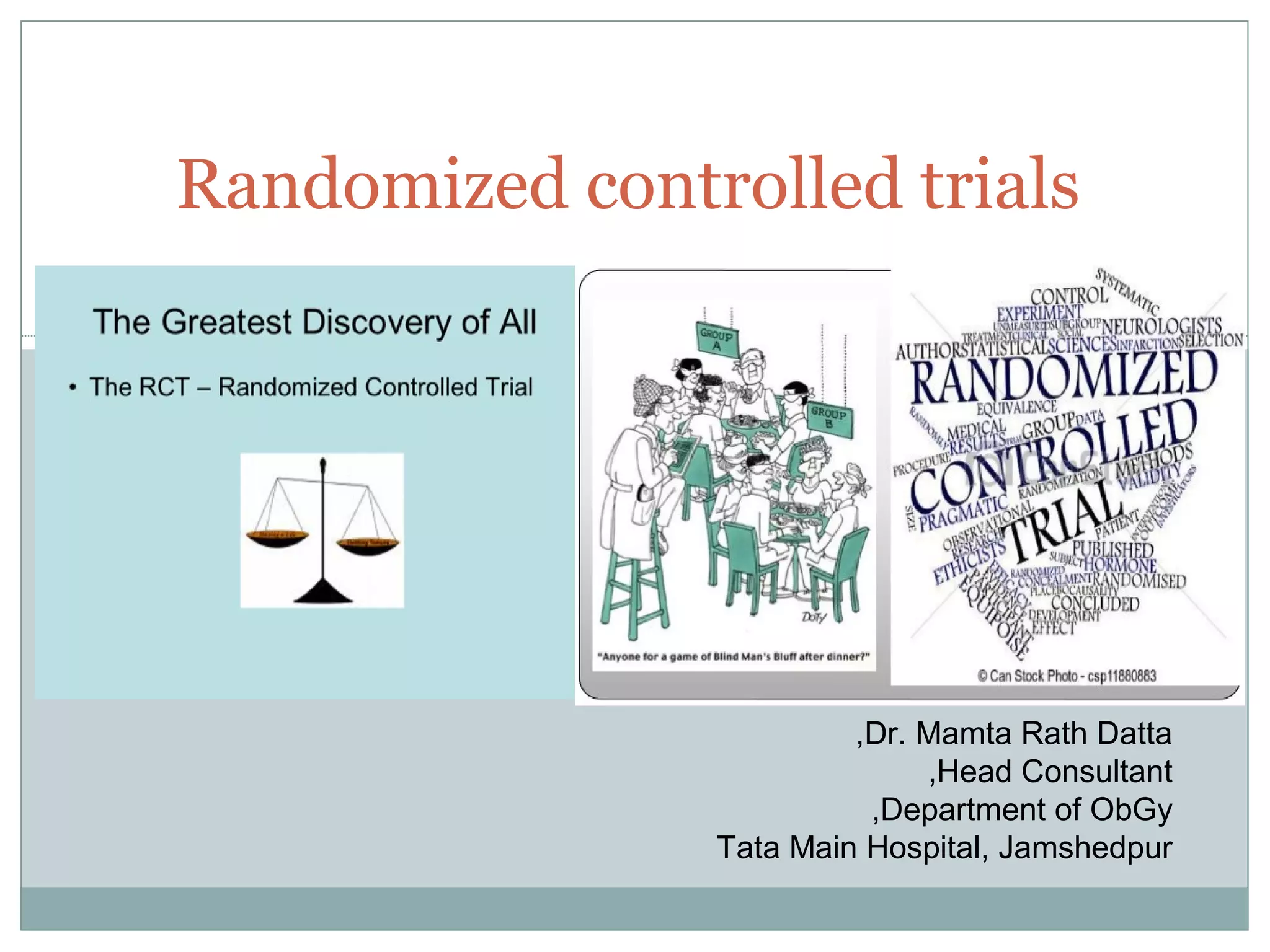
Randomized controlled trials
Dr. Mamta Rath Datta,
Head Consultant,
Department of ObGy,
Tata Main Hospital, Jamshedpur
Key points to be covered
1. Definition of RCT
2. Types of RCT
3. How to do randomisation
4. Bias in studies
5. Blinding in RCTs
6. Analysis and reporting of results
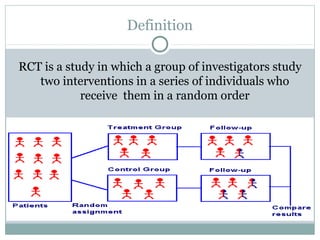
Definition
RCT is a study in which a group of investigators study
two interventions in a series of individuals who
receive them in a random order
Key terms
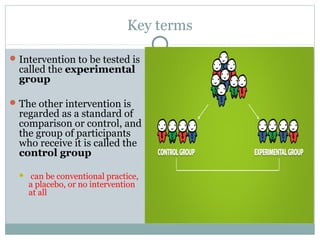
Intervention to be tested is
called the experimental
group
The other intervention is
regarded as a standard of
comparison or control, and
the group of participants
who receive it is called the
control group
 can be conventional practice,
a placebo, or no intervention
at all
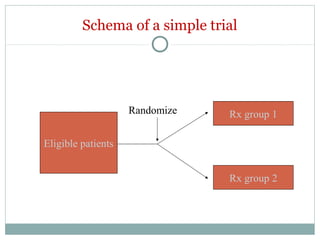
Schema of a simple trial
Eligible patients
Rx group 1
Rx group 2
Randomize
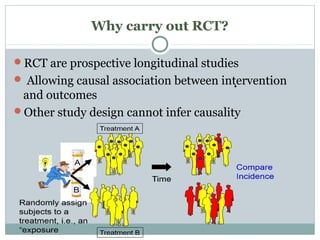
Why carry out RCT?
RCT are prospective longitudinal studies
 Allowing causal association between intervention
and outcomes
Other study design cannot infer causality
•
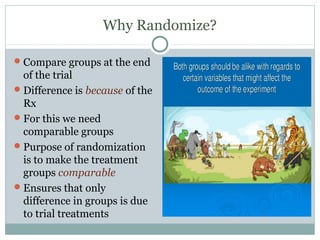
Why Randomize?
Compare groups at the end
of the trial
Difference is because of the
Rx
For this we need
comparable groups
Purpose of randomization
is to make the treatment
groups comparable
Ensures that only
difference in groups is due
to trial treatments
RCT
‘the most powerful tool in modern clinical research “
Prospective
Controlled
unbiased
Minimizing bias in RCT
1) Allocation bias
2) Performance bias
3) Assessment bias
4) Attrition bias
5) Allocation concealment
Allocation bias
Occurs when the measured treatment effect differs
from the true treatment effect because of how
participants were selected into the
intervention or control group
Performance bias
Occurs when participants’response to Rx is affected
by the knowledge of the group to which they are
assigned – intervention/control
Occurs when health professionals administer
treatment differently between treatment
arms
Assessment bias
Health professionals assessing the outcome may record
outcome measures biased by the knowledge of the
group assignments
Overestimation or underestimation of the effects
of an intervention is known as assessment bias
There might be a systematic difference in measuring
the outcomes between the two groups because of
the method of recording used
 – E.g. control group is assigned to one practitioner and the intervention
group to another, or groups are assessed at different times of the day
Assessment bias (cont.)
How to minimise assessment bias
 Use a standardized method of evaluation across both
groups o minimize the assessment bias?
 Avoid using subjective measures to assess the
effectiveness of a treatment which are more prone to
bias
Attrition bias
Also called as loss-to-follow-up bias
 Occurs when patients drop out of the study from
their respective study group
If halfway through a study the treatment has been
successful, participants may drop out and information
about the success of the treatment is then lost
Participants in the control group might be unhappy with
their lack of progress and may drop out of the study in
order to seek alternative help
Allocation concealment
 Bias will be minimized where the allocation schedule is
concealed
 Blinding (or masking)
 helps prevent systematic differences between comparison groups in
prognosis or responsiveness to treatments (allocation bias).
 Blinding of both participants and practitioners
 prevents performance and assessment bias by ensuring everybody
(participants, treatment admin, those measuring outcomes) do not
know which treatment was given.
 It is recommended RCT participants are blind to the
treatment they receive.
 – Control group receives placebo
Important factors in RCT
1) Sample size
2) Stratification
3) Trial design
4) Between group contamination
5) Ethical issues
1.Sample size
Sample size dependent upon
 the power of the test
 what size of intervention impact is considered meaningful
 type of hypothesis the RCT is testing
 The smaller magnitude of difference between groups
that is to be detected and the greater the variability
in outcomes, the larger the sample size that will be
required
2.Stratification
Stratification is a way of ensuring the treatment
groups are balanced on characteristics that are likely
to alter the relationship between treatment and
outcome.
3.Trial design
By study design
By outcome of interest (efficacy vs.
effectiveness)
By hypothesis (superiority vs. noninferiority
vs. equivalence)
Classification by study design
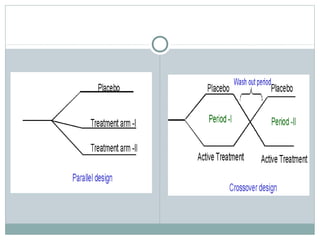
 Parallel-group
 each participant is randomly
assigned to a group
 all the participants in the
group receive (or do not
receive) an intervention.
 Crossover
 over time, each participant
receives (or does not receive)
an intervention in a random
sequence
 Cluster
 pre-existing groups of participants
(e.g., villages, schools) are randomly
selected to receive (or not receive) an
intervention.
 Factorial
 each participant is randomly assigned
to a group that receives a particular
combination of interventions or non-
interventions
 e.g., group 1 receives vitamin X and
vitamin Y, group 2 receives vitamin X
and placebo Y, group 3 receives
placebo X and vitamin Y, and group 4
receives placebo X and placebo Y
By outcome of interest (efficacy vs.
effectiveness)
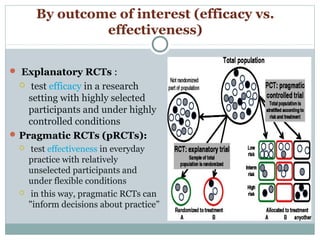
 Explanatory RCTs :
 test efficacy in a research
setting with highly selected
participants and under highly
controlled conditions
Pragmatic RCTs (pRCTs):
 test effectiveness in everyday
practice with relatively
unselected participants and
under flexible conditions
 in this way, pragmatic RCTs can
"inform decisions about practice”
By hypothesis (superiority vs.
noninferiority vs. equivalence)
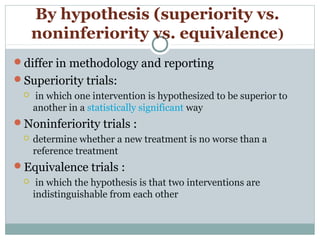
differ in methodology and reporting
Superiority trials:
 in which one intervention is hypothesized to be superior to
another in a statistically significant way
Noninferiority trials :
 determine whether a new treatment is no worse than a
reference treatment
Equivalence trials :
 in which the hypothesis is that two interventions are
indistinguishable from each other
4.Between group contamination
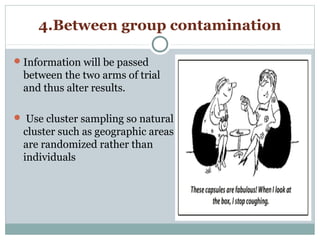
Information will be passed
between the two arms of trial
and thus alter results.
 Use cluster sampling so natural
cluster such as geographic areas
are randomized rather than
individuals
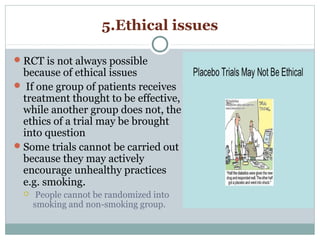
5.Ethical issues
RCT is not always possible
because of ethical issues
 If one group of patients receives
treatment thought to be effective,
while another group does not, the
ethics of a trial may be brought
into question
Some trials cannot be carried out
because they may actively
encourage unhealthy practices
e.g. smoking.
 People cannot be randomized into
smoking and non-smoking group.
What is wrong with non-randomized studies?
Two main types of study, those with and those
without concurrent control groups
Non-randomized studies II
Without concurrent controls
 Uncontrolled
 cannot really make much of such studies if there is any
variation in outcomes.
 Historical controls
 type of patient may change, due to eligibility criteria
 environment changes, due to trial
 data quality often quite different between groups
Non-randomized studies III
Non-randomized concurrent controls
Alternation
Odd/Even hospital no. or date of birth
First letter of surname
Difficult to argue that one group is different from
another but allocation is predictable, so bias can
arise from selection of patients
so randomization must be unpredictable
Randomization techniques
Randomization is the process of assigning clinical
trial participants to treatment groups
all participants have the same chance of being
assigned to each of the study groups
the purpose is to keep both groups as similar to each
as possible at the start of the trial.
Successful randomization requires that group
assignment cannot be predicted in advance.
Simple Randomization
1. Coin Tossing for each trial participant
2. Sequence of Random Numbers from statistical textbooks
3. Computer generated sequence
Examples
flipping a coin. For example, with two treatment
groups (i.e., heads - control, tails – treatment)
Shuffled deck of cards (e.g., even - control, odd -
treatment)
Throwing a dice (e.g., below and equal to 3 - control,
over 3 - treatment).
 The computer generated sequence:
4,8,3,2,7,2,6,6,3,4,2,1,6,2,0,…….
Is coin tossing OK?
OK for big trials
For small trials, such ‘simple randomization’
can lead to imbalance in group sizes
Block randomization
Designed to randomize subjects into groups that result in
equal sample sizes.
 The block size is determined by the researcher and should
be a multiple of the number of groups (i.e., with two
treatment groups, block size of either 4, 6).
Example: Two treatments of A, B and Block size of 2 x 2= 4
 Possible treatment allocations within each block are
 (1) AABB, (2) BBAA, (3) ABAB, (4) BABA, (5) ABBA, (6) BAAB
Stratified Randomization
Trial may not be valid if it is not well balanced across
prognostic factors.
• SR means block within block For example, Age
Group: < 40, 41-60, >60; Sex: M, F
• For 6 patients in a block, Total number of strata = 3
x 2 = 6 .
• It produce comparable groups with regard to certain
characteristics (e.g., gender, age, race, disease
severity), thus produces valid statistical tests
• The block size should be relative small to maintain
balance in small strata
• Increased number of stratification variables or
increased number of levels within strata leads to
fewer patients per stratum
• Subjects should have baseline measurements taken
before randomization
• Large clinical trials don’t use stratification
Unequal Randomization
 Most randomized trials allocate equal numbers of
patients to experimental and control groups.
 most statistically efficient randomization ratio as it maximizes
statistical power for a given total sample size.
 may not be the most economically efficient or
ethically/practically feasible
Substantial cost savings with smaller randomization
ratio such as a ratio of 2:1, with only a modest loss in
statistical power
Ratio of 3:1 will lose considerable statistical power
 Ratio >3:1 is not very useful - leads to much larger loss of
sample size power
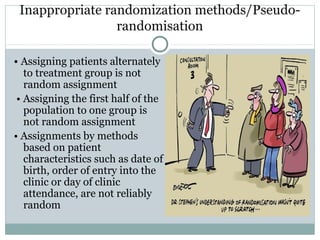
Inappropriate randomization methods/Pseudo-
randomisation
• Assigning patients alternately
to treatment group is not
random assignment
• Assigning the first half of the
population to one group is
not random assignment
• Assignments by methods
based on patient
characteristics such as date of
birth, order of entry into the
clinic or day of clinic
attendance, are not reliably
random
Types of RCTs/Hierarchy of Blinding
• Open label: no blinding
• Single blind: patient blinded to treatment
• Double blind: Patient and Physician (and data
collectors) blinded to treatment
• Complete blind: Everyone involved in the study
blinded to treatment
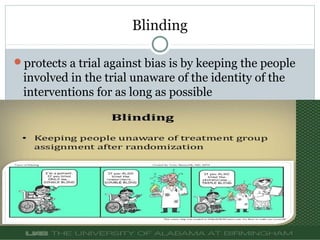
Blinding
protects a trial against bias is by keeping the people
involved in the trial unaware of the identity of the
interventions for as long as possible
Open Label Studies
 Useful for
 • Pilot studies
 • Dose ranging studies
 Open label studies are not recommended for comparative
trials
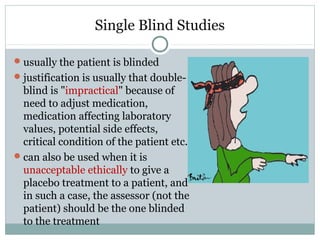
Single Blind Studies
usually the patient is blinded
justification is usually that double-
blind is "impractical" because of
need to adjust medication,
medication affecting laboratory
values, potential side effects,
critical condition of the patient etc.
can also be used when it is
unacceptable ethically to give a
placebo treatment to a patient, and
in such a case, the assessor (not the
patient) should be the one blinded
to the treatment
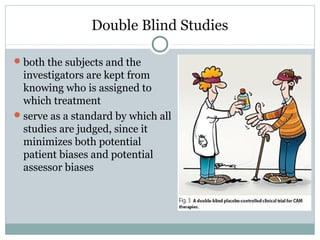
Double Blind Studies
both the subjects and the
investigators are kept from
knowing who is assigned to
which treatment
serve as a standard by which all
studies are judged, since it
minimizes both potential
patient biases and potential
assessor biases
Double Blinding:Techniques
Coded treatment groups
 Placebo for each possible treatment.
 Tablets identical in physical appearance.
 Tablets with similar taste and smell
 IV infusions would normally be the same carrier as
used for active medications.
 Other treatments "shammed" as far as possible: eg.
Minimal power ultrasound therapy when testing
effect of physical therapy in back pain.
Disadvantages: Double Blinding is not always
feasible??
When intervention is surgery- It is unlikely that
sham surgery would be considered ethical in a study
It would be hard to blind a patient to the therapy
given in an exercise study
it might not be possible to blind a patient while
comparing utility of different invasive procedures
Double Blind Studies: Difficulties
Side effects:
 Side effects (observable by
patient) are much harder to
blind
 in general, there are
significant ethical problems
using placebos to induce side
effects in patients
 a way to avoid it is that the
side effects of all the potential
therapies be combined into a
single list, so that knowledge
of side effects would not
indicate therapy (at least to
patient).
Efficacy:
 A truly effective treatment
can be recognized by its
efficacy in patients
 Some new treatments ARE
VERY EFFECTIVE and when
this happens, it is becomes
clear which treatment a
patient is receiving, at least
for the health care providers
involved in the trial
Complete Blinding
 Patient and the investigator, all members of the
clinical project team of the sponsor including CRA,
statistician, programmer, and data coordinator are
blinded.
May require two groups for data processing, one
group to encode the data/analysis and one group to
perform the analysis
 Normally only available in major drug company
studies, and not routinely used
Complete Blinding:Techniques
Analysis uses coded treatment groups
 Analysis uses coded side effects (e.g., side effects
coded using non-standard scheme, with only
numeric codes available at time of analysis)
 Analysis uses coded laboratory tests (e.g., name of
test coded numerically at time of analysis, using non-
standard code)
Coding of drugs
Assigning a random number.
 As many as different code.
Participants: unique code.
If only one code is used: disclosure for 1 will disclose
for all.
Many side effects in many people: decode
Efficient coding: should not confuse the prescriber and
stocking of drugs
Unblinding of study
The carton must contain slip of drug inside it
 Should not be disclosed to patients while storage
 Official unblinding may be necessary during
emergency
Blinding is difficult
Having placebo in the same shape , formula and
taste is very costly, and time consuming
The drug side effects e.g. local reaction at the site of
injection would partially unblind
Impossible if surgical and medical treatments are
compared
The need for urgent unblinding code in case of
serious side effects
Follow up
Adherence to the study protocol
Patients compliance with treatment and follow up
Sufficiently long and complete
Disadvantages of RCT
expensive: time and money
 volunteer bias
 ethically problematic at
times
high dropout when the
intervention has
undesirable side-effects or
there is little incentive to
stay in the control arm
ethical consideration may
mean that a research
question cannot be
investigated using RCT
design
 for a descriptive overview
it may be cheaper and
easier to use an
observational design.
 Prior knowledge is
required for sample size
calculation
 the level of improvement
that is clinically meaningful
 expected variation of
improvement in the sample
Analysis of data
 RCT are experiments set up to test hypotheses.
 Null hypotheses – the intervention will have no impact
on the outcome measure
 Outcome will be similar in both the test and control groups
 Alternative hypotheses – intervention will have
meaningful effect and statistically significant
 Statistical method (e.g.);
 Pre and post intervention differences = paired t-test
 Mean differences pre and post between two group = independent t-
test
 Mean differences pre and post between more than two groups =
ANOVA
Analysis of data
For dichotomous (binary) outcome data:
 logistic regression (e.g., to predict sustained virological
response after receipt of peginterferon alfa-2a for hepatitis C)
and other methods can be used.
For continuous outcome data:
 analysis of covariance (e.g., for changes in blood lipid levels after
receipt of atorvastatin after acute coronary syndrome[57]
) tests
the effects of predictor variables.
For time-to-event outcome data :
 censored, survival analysis (e.g., Kaplan–Meier
estimators and Cox proportional hazards models for time
to coronary heart disease after receipt of hormone replacement
therapy in menopause[58]
) is appropriate.
Interim Analysis
Done in large multicenter RCTs
To explore the results after recruiting of half of the
participants
If marked difference is recognized , then trial should
be stopped
Examples: WHI trial
 Breech Trial
 AIDS trial
Reporting of results
The CONSORT 2010 Statement is "an evidence-based,
minimum set of recommendations for reporting RCTs
 CONSORT 2010 checklist contains 25 items focusing on
"individually randomised, two group, parallel trials"
which are the most common type of RCT
For other RCT study designs, "CONSORT extensions"
have been published, some examples are:
 Consort 2010 Statement: Extension to Cluster Randomised Trials
 Consort 2010 Statement: Non-Pharmacologic Treatment
Interventions
Conflict of interest dangers
Some RCTs are fully or partly funded by the health care
industry
A systematic review published in 2003 found a correlation of
industry sponsorship and positive study outcome
A 2004 study of 1999-2001 RCTs determined that industry-
funded RCTs "are more likely to be associated with
statistically significant pro-industry findings."
These results have been mirrored in trials in surgery, where
although industry funding did not affect the rate of trial
discontinuation it was however associated with a lower odds
of publication for completed trials
One possible reason for the pro-industry results in industry-
funded published RCTs is publication bias.
Declaration of conflict of interest
essential
Take home message
The gold standard for clinical /interventional/drug
research
Basis for Meta-analysis for policy making and EBM
Familiarity with sample size, blinding and statistical
analytical tools is essential for interpretation of
outcome
Changes the way we practice medicine
Trial registration may be important/essential for
future studies
Randomized Controlled Trials

Randomized Controlled Trials

  • 1.
    THE BASICS Randomized controlledtrials Dr. Mamta Rath Datta, Head Consultant, Department of ObGy, Tata Main Hospital, Jamshedpur
  • 2.
    Key points tobe covered 1. Definition of RCT 2. Types of RCT 3. How to do randomisation 4. Bias in studies 5. Blinding in RCTs 6. Analysis and reporting of results
  • 3.
    Definition RCT is astudy in which a group of investigators study two interventions in a series of individuals who receive them in a random order
  • 4.
    Key terms Intervention tobe tested is called the experimental group The other intervention is regarded as a standard of comparison or control, and the group of participants who receive it is called the control group  can be conventional practice, a placebo, or no intervention at all
  • 6.
    Schema of asimple trial Eligible patients Rx group 1 Rx group 2 Randomize
  • 8.
    Why carry outRCT? RCT are prospective longitudinal studies  Allowing causal association between intervention and outcomes Other study design cannot infer causality •
  • 9.
    Why Randomize? Compare groupsat the end of the trial Difference is because of the Rx For this we need comparable groups Purpose of randomization is to make the treatment groups comparable Ensures that only difference in groups is due to trial treatments
  • 11.
    RCT ‘the most powerfultool in modern clinical research “ Prospective Controlled unbiased
  • 12.
    Minimizing bias inRCT 1) Allocation bias 2) Performance bias 3) Assessment bias 4) Attrition bias 5) Allocation concealment
  • 13.
    Allocation bias Occurs whenthe measured treatment effect differs from the true treatment effect because of how participants were selected into the intervention or control group
  • 14.
    Performance bias Occurs whenparticipants’response to Rx is affected by the knowledge of the group to which they are assigned – intervention/control Occurs when health professionals administer treatment differently between treatment arms
  • 15.
    Assessment bias Health professionalsassessing the outcome may record outcome measures biased by the knowledge of the group assignments Overestimation or underestimation of the effects of an intervention is known as assessment bias There might be a systematic difference in measuring the outcomes between the two groups because of the method of recording used  – E.g. control group is assigned to one practitioner and the intervention group to another, or groups are assessed at different times of the day
  • 16.
    Assessment bias (cont.) Howto minimise assessment bias  Use a standardized method of evaluation across both groups o minimize the assessment bias?  Avoid using subjective measures to assess the effectiveness of a treatment which are more prone to bias
  • 17.
    Attrition bias Also calledas loss-to-follow-up bias  Occurs when patients drop out of the study from their respective study group If halfway through a study the treatment has been successful, participants may drop out and information about the success of the treatment is then lost Participants in the control group might be unhappy with their lack of progress and may drop out of the study in order to seek alternative help
  • 18.
    Allocation concealment  Biaswill be minimized where the allocation schedule is concealed  Blinding (or masking)  helps prevent systematic differences between comparison groups in prognosis or responsiveness to treatments (allocation bias).  Blinding of both participants and practitioners  prevents performance and assessment bias by ensuring everybody (participants, treatment admin, those measuring outcomes) do not know which treatment was given.  It is recommended RCT participants are blind to the treatment they receive.  – Control group receives placebo
  • 19.
    Important factors inRCT 1) Sample size 2) Stratification 3) Trial design 4) Between group contamination 5) Ethical issues
  • 20.
    1.Sample size Sample sizedependent upon  the power of the test  what size of intervention impact is considered meaningful  type of hypothesis the RCT is testing  The smaller magnitude of difference between groups that is to be detected and the greater the variability in outcomes, the larger the sample size that will be required
  • 21.
    2.Stratification Stratification is away of ensuring the treatment groups are balanced on characteristics that are likely to alter the relationship between treatment and outcome.
  • 22.
    3.Trial design By studydesign By outcome of interest (efficacy vs. effectiveness) By hypothesis (superiority vs. noninferiority vs. equivalence)
  • 23.
    Classification by studydesign  Parallel-group  each participant is randomly assigned to a group  all the participants in the group receive (or do not receive) an intervention.  Crossover  over time, each participant receives (or does not receive) an intervention in a random sequence  Cluster  pre-existing groups of participants (e.g., villages, schools) are randomly selected to receive (or not receive) an intervention.  Factorial  each participant is randomly assigned to a group that receives a particular combination of interventions or non- interventions  e.g., group 1 receives vitamin X and vitamin Y, group 2 receives vitamin X and placebo Y, group 3 receives placebo X and vitamin Y, and group 4 receives placebo X and placebo Y
  • 25.
    By outcome ofinterest (efficacy vs. effectiveness)  Explanatory RCTs :  test efficacy in a research setting with highly selected participants and under highly controlled conditions Pragmatic RCTs (pRCTs):  test effectiveness in everyday practice with relatively unselected participants and under flexible conditions  in this way, pragmatic RCTs can "inform decisions about practice”
  • 26.
    By hypothesis (superiorityvs. noninferiority vs. equivalence) differ in methodology and reporting Superiority trials:  in which one intervention is hypothesized to be superior to another in a statistically significant way Noninferiority trials :  determine whether a new treatment is no worse than a reference treatment Equivalence trials :  in which the hypothesis is that two interventions are indistinguishable from each other
  • 27.
    4.Between group contamination Informationwill be passed between the two arms of trial and thus alter results.  Use cluster sampling so natural cluster such as geographic areas are randomized rather than individuals
  • 28.
    5.Ethical issues RCT isnot always possible because of ethical issues  If one group of patients receives treatment thought to be effective, while another group does not, the ethics of a trial may be brought into question Some trials cannot be carried out because they may actively encourage unhealthy practices e.g. smoking.  People cannot be randomized into smoking and non-smoking group.
  • 29.
    What is wrongwith non-randomized studies? Two main types of study, those with and those without concurrent control groups
  • 30.
    Non-randomized studies II Withoutconcurrent controls  Uncontrolled  cannot really make much of such studies if there is any variation in outcomes.  Historical controls  type of patient may change, due to eligibility criteria  environment changes, due to trial  data quality often quite different between groups
  • 31.
    Non-randomized studies III Non-randomizedconcurrent controls Alternation Odd/Even hospital no. or date of birth First letter of surname Difficult to argue that one group is different from another but allocation is predictable, so bias can arise from selection of patients so randomization must be unpredictable
  • 32.
    Randomization techniques Randomization isthe process of assigning clinical trial participants to treatment groups all participants have the same chance of being assigned to each of the study groups the purpose is to keep both groups as similar to each as possible at the start of the trial. Successful randomization requires that group assignment cannot be predicted in advance.
  • 33.
    Simple Randomization 1. CoinTossing for each trial participant 2. Sequence of Random Numbers from statistical textbooks 3. Computer generated sequence
  • 34.
    Examples flipping a coin.For example, with two treatment groups (i.e., heads - control, tails – treatment) Shuffled deck of cards (e.g., even - control, odd - treatment) Throwing a dice (e.g., below and equal to 3 - control, over 3 - treatment).  The computer generated sequence: 4,8,3,2,7,2,6,6,3,4,2,1,6,2,0,…….
  • 35.
    Is coin tossingOK? OK for big trials For small trials, such ‘simple randomization’ can lead to imbalance in group sizes
  • 36.
    Block randomization Designed torandomize subjects into groups that result in equal sample sizes.  The block size is determined by the researcher and should be a multiple of the number of groups (i.e., with two treatment groups, block size of either 4, 6). Example: Two treatments of A, B and Block size of 2 x 2= 4  Possible treatment allocations within each block are  (1) AABB, (2) BBAA, (3) ABAB, (4) BABA, (5) ABBA, (6) BAAB
  • 37.
    Stratified Randomization Trial maynot be valid if it is not well balanced across prognostic factors. • SR means block within block For example, Age Group: < 40, 41-60, >60; Sex: M, F • For 6 patients in a block, Total number of strata = 3 x 2 = 6 . • It produce comparable groups with regard to certain characteristics (e.g., gender, age, race, disease severity), thus produces valid statistical tests
  • 38.
    • The blocksize should be relative small to maintain balance in small strata • Increased number of stratification variables or increased number of levels within strata leads to fewer patients per stratum • Subjects should have baseline measurements taken before randomization • Large clinical trials don’t use stratification
  • 39.
    Unequal Randomization  Mostrandomized trials allocate equal numbers of patients to experimental and control groups.  most statistically efficient randomization ratio as it maximizes statistical power for a given total sample size.  may not be the most economically efficient or ethically/practically feasible Substantial cost savings with smaller randomization ratio such as a ratio of 2:1, with only a modest loss in statistical power Ratio of 3:1 will lose considerable statistical power  Ratio >3:1 is not very useful - leads to much larger loss of sample size power
  • 40.
    Inappropriate randomization methods/Pseudo- randomisation •Assigning patients alternately to treatment group is not random assignment • Assigning the first half of the population to one group is not random assignment • Assignments by methods based on patient characteristics such as date of birth, order of entry into the clinic or day of clinic attendance, are not reliably random
  • 41.
    Types of RCTs/Hierarchyof Blinding • Open label: no blinding • Single blind: patient blinded to treatment • Double blind: Patient and Physician (and data collectors) blinded to treatment • Complete blind: Everyone involved in the study blinded to treatment
  • 42.
    Blinding protects a trialagainst bias is by keeping the people involved in the trial unaware of the identity of the interventions for as long as possible
  • 43.
    Open Label Studies Useful for  • Pilot studies  • Dose ranging studies  Open label studies are not recommended for comparative trials
  • 44.
    Single Blind Studies usuallythe patient is blinded justification is usually that double- blind is "impractical" because of need to adjust medication, medication affecting laboratory values, potential side effects, critical condition of the patient etc. can also be used when it is unacceptable ethically to give a placebo treatment to a patient, and in such a case, the assessor (not the patient) should be the one blinded to the treatment
  • 45.
    Double Blind Studies boththe subjects and the investigators are kept from knowing who is assigned to which treatment serve as a standard by which all studies are judged, since it minimizes both potential patient biases and potential assessor biases
  • 46.
    Double Blinding:Techniques Coded treatmentgroups  Placebo for each possible treatment.  Tablets identical in physical appearance.  Tablets with similar taste and smell  IV infusions would normally be the same carrier as used for active medications.  Other treatments "shammed" as far as possible: eg. Minimal power ultrasound therapy when testing effect of physical therapy in back pain.
  • 47.
    Disadvantages: Double Blindingis not always feasible?? When intervention is surgery- It is unlikely that sham surgery would be considered ethical in a study It would be hard to blind a patient to the therapy given in an exercise study it might not be possible to blind a patient while comparing utility of different invasive procedures
  • 48.
    Double Blind Studies:Difficulties Side effects:  Side effects (observable by patient) are much harder to blind  in general, there are significant ethical problems using placebos to induce side effects in patients  a way to avoid it is that the side effects of all the potential therapies be combined into a single list, so that knowledge of side effects would not indicate therapy (at least to patient). Efficacy:  A truly effective treatment can be recognized by its efficacy in patients  Some new treatments ARE VERY EFFECTIVE and when this happens, it is becomes clear which treatment a patient is receiving, at least for the health care providers involved in the trial
  • 49.
    Complete Blinding  Patientand the investigator, all members of the clinical project team of the sponsor including CRA, statistician, programmer, and data coordinator are blinded. May require two groups for data processing, one group to encode the data/analysis and one group to perform the analysis  Normally only available in major drug company studies, and not routinely used
  • 50.
    Complete Blinding:Techniques Analysis usescoded treatment groups  Analysis uses coded side effects (e.g., side effects coded using non-standard scheme, with only numeric codes available at time of analysis)  Analysis uses coded laboratory tests (e.g., name of test coded numerically at time of analysis, using non- standard code)
  • 51.
    Coding of drugs Assigninga random number.  As many as different code. Participants: unique code. If only one code is used: disclosure for 1 will disclose for all. Many side effects in many people: decode Efficient coding: should not confuse the prescriber and stocking of drugs
  • 52.
    Unblinding of study Thecarton must contain slip of drug inside it  Should not be disclosed to patients while storage  Official unblinding may be necessary during emergency
  • 53.
    Blinding is difficult Havingplacebo in the same shape , formula and taste is very costly, and time consuming The drug side effects e.g. local reaction at the site of injection would partially unblind Impossible if surgical and medical treatments are compared The need for urgent unblinding code in case of serious side effects
  • 54.
    Follow up Adherence tothe study protocol Patients compliance with treatment and follow up Sufficiently long and complete
  • 55.
    Disadvantages of RCT expensive:time and money  volunteer bias  ethically problematic at times high dropout when the intervention has undesirable side-effects or there is little incentive to stay in the control arm ethical consideration may mean that a research question cannot be investigated using RCT design  for a descriptive overview it may be cheaper and easier to use an observational design.  Prior knowledge is required for sample size calculation  the level of improvement that is clinically meaningful  expected variation of improvement in the sample
  • 56.
    Analysis of data RCT are experiments set up to test hypotheses.  Null hypotheses – the intervention will have no impact on the outcome measure  Outcome will be similar in both the test and control groups  Alternative hypotheses – intervention will have meaningful effect and statistically significant  Statistical method (e.g.);  Pre and post intervention differences = paired t-test  Mean differences pre and post between two group = independent t- test  Mean differences pre and post between more than two groups = ANOVA
  • 57.
    Analysis of data Fordichotomous (binary) outcome data:  logistic regression (e.g., to predict sustained virological response after receipt of peginterferon alfa-2a for hepatitis C) and other methods can be used. For continuous outcome data:  analysis of covariance (e.g., for changes in blood lipid levels after receipt of atorvastatin after acute coronary syndrome[57] ) tests the effects of predictor variables. For time-to-event outcome data :  censored, survival analysis (e.g., Kaplan–Meier estimators and Cox proportional hazards models for time to coronary heart disease after receipt of hormone replacement therapy in menopause[58] ) is appropriate.
  • 58.
    Interim Analysis Done inlarge multicenter RCTs To explore the results after recruiting of half of the participants If marked difference is recognized , then trial should be stopped Examples: WHI trial  Breech Trial  AIDS trial
  • 59.
    Reporting of results TheCONSORT 2010 Statement is "an evidence-based, minimum set of recommendations for reporting RCTs  CONSORT 2010 checklist contains 25 items focusing on "individually randomised, two group, parallel trials" which are the most common type of RCT For other RCT study designs, "CONSORT extensions" have been published, some examples are:  Consort 2010 Statement: Extension to Cluster Randomised Trials  Consort 2010 Statement: Non-Pharmacologic Treatment Interventions
  • 60.
    Conflict of interestdangers Some RCTs are fully or partly funded by the health care industry A systematic review published in 2003 found a correlation of industry sponsorship and positive study outcome A 2004 study of 1999-2001 RCTs determined that industry- funded RCTs "are more likely to be associated with statistically significant pro-industry findings." These results have been mirrored in trials in surgery, where although industry funding did not affect the rate of trial discontinuation it was however associated with a lower odds of publication for completed trials One possible reason for the pro-industry results in industry- funded published RCTs is publication bias. Declaration of conflict of interest essential
  • 61.
    Take home message Thegold standard for clinical /interventional/drug research Basis for Meta-analysis for policy making and EBM Familiarity with sample size, blinding and statistical analytical tools is essential for interpretation of outcome Changes the way we practice medicine Trial registration may be important/essential for future studies