10/9/2017
1
 Pharmacoepidemiology is the study of use and effect of drugs
in large no of people.
 PE is the application of principles of epidemiology to drug
effects and drug use.
 The term pharmacoepidemiology contains two components
“pharmaco” and “epidemiology”
 Pharmaco means drug & epidemiology means study of
distribution and determinants of disease in a population
10/9/2017 2
 Epidemiology has two major areas- one is the study of
infectious disease in large population called epidemics and
the second is the study of chronic disease.
 PE involves gathering & analysis of information in order to
identify possible causation & related factors that can be
applied in clinical practice to group of people &also
individual undergoing treatment.
 So it examines the relationship b/w drug exposure & health
outcome in a defined population.
10/9/2017 3
 Initially there were no regulation to ensure the safety and
efficacy of drugs available in the market.
 In 1906 US govt passed pure food and drug act in response to
excessive adulteration & misbranding of food and drugs.
 In 1937 ,over 100 of people died from renal failure as a result
of the elixir sulfanilamide dissolved in diethylene glycol.
10/9/2017 4
 In 1938 D&C act was passed ,bcoz of this manufactures
required an approvel from FDA before marketing a drug.
 In 1950 chloramphenicol induced aplastic
anemia discovered
 In the same year drug induced dyscrasias.
 In 1961 , the case reports of maternal use of thalidomide
with malformation in offspring results in awareness of
the potential for drugs to cause ADR.
10/9/2017 5
 In 1968 UK established a committee on safety of medicine.
 WHO established a bureau to collect and analyse information
from this and similar national drug monitoring organizations.
 In early 1960, the related field of drug utilization was
developed along with the study of ADRs
 With all these development 1960’s considered to be the
beginning of field of pharmaco epidemiology.
 ISPE was formed to obtain more data on risk & benefits of
drugs in population and to discuss, develop & disseminate
information about pharmacoepidemiological methods.
10/9/2017 6
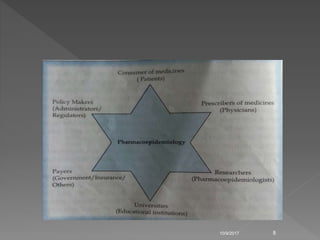
 Since PE is considered as a science of understanding of
medicine safety issues,all those who use, prescribe, study,
monitoror deal with medicine at academic ,research or
regulatory level need PE.
10/9/2017 7
10/9/2017 8
 Lack of alternative models to investigate some drug events.
Eg.to evaluate the teratogenic effect of a new medicine.
 CTs are inadequate to answer to questions about drug safety
as they lack adequate statistical power.
 If at all adequate for establishing effectiveness, the sample
size are inadequate to detect less common ADR.
10/9/2017 9
 CTs are conducted on highly selected patients without any co-
morbidities and who taking no other medications.
 CT does not involve elderly paediatric or pregnant patients.
 CT investigates the single indication
 Hence CT fail to provide adequate information related to
safety and efficacy of a drug under non trial condition.
10/9/2017 10
 In contrast, PE models provide alternative approaches to
evaluate drug effects.
10/9/2017 11
 The pharmacoepidemiological studies concentrate on the
period after the drug enters the market known as post
marketing surveillance (PMS)
 These studies are concerned with two main aspects:
1. the study of adverse effects of drugs
2. the appropriate use of medicines
10/9/2017 12
SIGNAL GENERATION
 The term signal is widely used in electronics for many years .
it was coined in ADR reporting and pharmacovigilance in
recent times with the evolvement of ADR monitoring system
at global level with support of WHO. It is used as an early
warning in the case of ADRs.
 Signal is a reported information on a possible causal
relationship between an adverse event and a drug or medicine.
Eg; aspirin 1st indicated for pain & inflamation later it is used for
in cardiac disease bcoz of its blood thinning property
Minoxidil- anti hypertensive, hirsutism
10/9/2017 13
RISK QUANTIFICATION
 Risk quantification is the process of evaluating the risk that
have been identified & developing the data for other
purposes like making decisions on other occations.
 Various measures of the risk are used in PE to quantify the
probability of experiencing an adverse outcome capture the
relative increases in risk b/w treated & untreated populations.
eg; cumulative incidence, incidence rate, absolute risk
reduction , relative risk, odds ratio, incidence rate ratio
10/9/2017 14
 In PE it involves the use of comparison groups of population
to find out whether there are differences variables of interest
10/9/2017 15
ESTIMATION OF RISKS OF DRUG USE:
 The risk involved in drug use can be quantified
 The benefits & risks of use of a drug may be weighed
 Risk estimation also helps to identify risk situation
10/9/2017 16
Ex:
Case reports of triazolam induced psychiatric disturbances
appeared soon after its introduction to market
The drug was withdrawn in some countries
The reaction was likely due to dose related, hence the
problem was abated by recommending a lower dose
10/9/2017 17
USE IN PATIENT COUNSELING:
collection & analysis of observational data from other
studies may help to address certain issues through
counseling the patients
Ex:
A pregnant patient may wish to terminate pregnancy if
there is a substantial risk for producing a seriously
malformed child, but would also wish to proceed with
the pregnancy if the risk is low.
10/9/2017 18
FORMULATION OF PUBLIC HEALTH POLICY
DECISIONS:
Qualitative as well as quantitative information from PEY
studies helps to address many issues
Ex:
If an inappropriate prescribing is observed among prescribers,
regulatory agencies may require educational intervention or
may impose restrictions on specific drugs or on practitioners
PEY studies also helps the policy makers to assess whether a
drug should be withdrawn from the market or allowed to
remain
10/9/2017 19
FORMULATION OF THERAPEUTIC GUIDELINES &
DISCOVERY OF NEW INDICATIONS:
PEY studies helps to examine the effectiveness of drugs in
elderly & pediatric patients
Also in patients with co-morbidities and/or using other
medications
PEY studies help to discover the new indications of a drug
10/9/2017 20
FACILITATION OF PHARMACOECONOMICS
EVALUATIONS
Data from PEY studies can be used to measure the effects of
drugs on overall health care costs & resource consumption
Ex:
Hospitalization due to serious adverse effects of a drug leads
to more expenses as well as resource consumption, which
could be avoidable.
10/9/2017 21
1. Age based medicine use and it’s analysis.
2. Generation of data bases for other studies
3. Pharmacovigilance
4.drug usage analysis
5.empowering pharmacogenomic studies
6.evaluation of hospital committees
10/9/2017 22
 Can be useful in many cases where other models cannot
 Allow quantification of drug effects in special
population/patients with co morbid conditions & patients who
are on polypharmacy
 Allows quantification of drug effects in a more realistic
environment
10/9/2017 23
 Serve as alerting mechanism for clinicians, manufacturers and
regulatory authorities
 Also serve as signal generators which further directs towards
research and indicate new areas to explore
 Allows comparison of drug use patterns between areas
 Quantification of DRPs
 Allows rational use of drugs
10/9/2017 24
 These are non-experimental studies
 Some times Causation may be difficult
 Confounding factors, biases (like selection, informational)
may threaten the validity
10/9/2017 25
 Text book of Pharmacoepidemiology by BRIAN L.
STORM,Third edition.
 WWW.PharmaDost.info
 Pharmacoepidemiology & pharmacoeconomics concepts and
practice by K.G Ravikumar .
10/9/2017 26

introduction to Pharmacoepidemiology

  • 1.
  • 2.
     Pharmacoepidemiology isthe study of use and effect of drugs in large no of people.  PE is the application of principles of epidemiology to drug effects and drug use.  The term pharmacoepidemiology contains two components “pharmaco” and “epidemiology”  Pharmaco means drug & epidemiology means study of distribution and determinants of disease in a population 10/9/2017 2
  • 3.
     Epidemiology hastwo major areas- one is the study of infectious disease in large population called epidemics and the second is the study of chronic disease.  PE involves gathering & analysis of information in order to identify possible causation & related factors that can be applied in clinical practice to group of people &also individual undergoing treatment.  So it examines the relationship b/w drug exposure & health outcome in a defined population. 10/9/2017 3
  • 4.
     Initially therewere no regulation to ensure the safety and efficacy of drugs available in the market.  In 1906 US govt passed pure food and drug act in response to excessive adulteration & misbranding of food and drugs.  In 1937 ,over 100 of people died from renal failure as a result of the elixir sulfanilamide dissolved in diethylene glycol. 10/9/2017 4
  • 5.
     In 1938D&C act was passed ,bcoz of this manufactures required an approvel from FDA before marketing a drug.  In 1950 chloramphenicol induced aplastic anemia discovered  In the same year drug induced dyscrasias.  In 1961 , the case reports of maternal use of thalidomide with malformation in offspring results in awareness of the potential for drugs to cause ADR. 10/9/2017 5
  • 6.
     In 1968UK established a committee on safety of medicine.  WHO established a bureau to collect and analyse information from this and similar national drug monitoring organizations.  In early 1960, the related field of drug utilization was developed along with the study of ADRs  With all these development 1960’s considered to be the beginning of field of pharmaco epidemiology.  ISPE was formed to obtain more data on risk & benefits of drugs in population and to discuss, develop & disseminate information about pharmacoepidemiological methods. 10/9/2017 6
  • 7.
     Since PEis considered as a science of understanding of medicine safety issues,all those who use, prescribe, study, monitoror deal with medicine at academic ,research or regulatory level need PE. 10/9/2017 7
  • 8.
  • 9.
     Lack ofalternative models to investigate some drug events. Eg.to evaluate the teratogenic effect of a new medicine.  CTs are inadequate to answer to questions about drug safety as they lack adequate statistical power.  If at all adequate for establishing effectiveness, the sample size are inadequate to detect less common ADR. 10/9/2017 9
  • 10.
     CTs areconducted on highly selected patients without any co- morbidities and who taking no other medications.  CT does not involve elderly paediatric or pregnant patients.  CT investigates the single indication  Hence CT fail to provide adequate information related to safety and efficacy of a drug under non trial condition. 10/9/2017 10
  • 11.
     In contrast,PE models provide alternative approaches to evaluate drug effects. 10/9/2017 11
  • 12.
     The pharmacoepidemiologicalstudies concentrate on the period after the drug enters the market known as post marketing surveillance (PMS)  These studies are concerned with two main aspects: 1. the study of adverse effects of drugs 2. the appropriate use of medicines 10/9/2017 12
  • 13.
    SIGNAL GENERATION  Theterm signal is widely used in electronics for many years . it was coined in ADR reporting and pharmacovigilance in recent times with the evolvement of ADR monitoring system at global level with support of WHO. It is used as an early warning in the case of ADRs.  Signal is a reported information on a possible causal relationship between an adverse event and a drug or medicine. Eg; aspirin 1st indicated for pain & inflamation later it is used for in cardiac disease bcoz of its blood thinning property Minoxidil- anti hypertensive, hirsutism 10/9/2017 13
  • 14.
    RISK QUANTIFICATION  Riskquantification is the process of evaluating the risk that have been identified & developing the data for other purposes like making decisions on other occations.  Various measures of the risk are used in PE to quantify the probability of experiencing an adverse outcome capture the relative increases in risk b/w treated & untreated populations. eg; cumulative incidence, incidence rate, absolute risk reduction , relative risk, odds ratio, incidence rate ratio 10/9/2017 14
  • 15.
     In PEit involves the use of comparison groups of population to find out whether there are differences variables of interest 10/9/2017 15
  • 16.
    ESTIMATION OF RISKSOF DRUG USE:  The risk involved in drug use can be quantified  The benefits & risks of use of a drug may be weighed  Risk estimation also helps to identify risk situation 10/9/2017 16
  • 17.
    Ex: Case reports oftriazolam induced psychiatric disturbances appeared soon after its introduction to market The drug was withdrawn in some countries The reaction was likely due to dose related, hence the problem was abated by recommending a lower dose 10/9/2017 17
  • 18.
    USE IN PATIENTCOUNSELING: collection & analysis of observational data from other studies may help to address certain issues through counseling the patients Ex: A pregnant patient may wish to terminate pregnancy if there is a substantial risk for producing a seriously malformed child, but would also wish to proceed with the pregnancy if the risk is low. 10/9/2017 18
  • 19.
    FORMULATION OF PUBLICHEALTH POLICY DECISIONS: Qualitative as well as quantitative information from PEY studies helps to address many issues Ex: If an inappropriate prescribing is observed among prescribers, regulatory agencies may require educational intervention or may impose restrictions on specific drugs or on practitioners PEY studies also helps the policy makers to assess whether a drug should be withdrawn from the market or allowed to remain 10/9/2017 19
  • 20.
    FORMULATION OF THERAPEUTICGUIDELINES & DISCOVERY OF NEW INDICATIONS: PEY studies helps to examine the effectiveness of drugs in elderly & pediatric patients Also in patients with co-morbidities and/or using other medications PEY studies help to discover the new indications of a drug 10/9/2017 20
  • 21.
    FACILITATION OF PHARMACOECONOMICS EVALUATIONS Datafrom PEY studies can be used to measure the effects of drugs on overall health care costs & resource consumption Ex: Hospitalization due to serious adverse effects of a drug leads to more expenses as well as resource consumption, which could be avoidable. 10/9/2017 21
  • 22.
    1. Age basedmedicine use and it’s analysis. 2. Generation of data bases for other studies 3. Pharmacovigilance 4.drug usage analysis 5.empowering pharmacogenomic studies 6.evaluation of hospital committees 10/9/2017 22
  • 23.
     Can beuseful in many cases where other models cannot  Allow quantification of drug effects in special population/patients with co morbid conditions & patients who are on polypharmacy  Allows quantification of drug effects in a more realistic environment 10/9/2017 23
  • 24.
     Serve asalerting mechanism for clinicians, manufacturers and regulatory authorities  Also serve as signal generators which further directs towards research and indicate new areas to explore  Allows comparison of drug use patterns between areas  Quantification of DRPs  Allows rational use of drugs 10/9/2017 24
  • 25.
     These arenon-experimental studies  Some times Causation may be difficult  Confounding factors, biases (like selection, informational) may threaten the validity 10/9/2017 25
  • 26.
     Text bookof Pharmacoepidemiology by BRIAN L. STORM,Third edition.  WWW.PharmaDost.info  Pharmacoepidemiology & pharmacoeconomics concepts and practice by K.G Ravikumar . 10/9/2017 26