P:1 U:2
Vedanti Gharat
M.Sc. Part -1
Roll No. - 09
UBIQUITIN- PROTEASOME
PATHWAY
PROTEIN DEGRADATION
 The levels of proteins within cells are determined not
only by rates of synthesis but also by rates of
degradation.
 The half-lives of proteins within cells vary widely and
differential rates of protein degradation are an
important aspect of cell regulation.
 Many rapidly degraded proteins function as regulatory
molecules.
 In eukaryotic cells, the ubiquitin-proteasome pathway
is the major mediator of regulated protein degradation.
UBIQUITIN- PROTEASOME
PATHWAY
 Ubiquitin is a 76- A.A polypeptide that is highly
conserved in all eukaryotes.
 Proteins are marked for degradation by the attachment
of ubiquitin to the amino group of the side chain of a
lysine residue.
 The selective addition of ubiquitin to target proteins is
a multistep process.
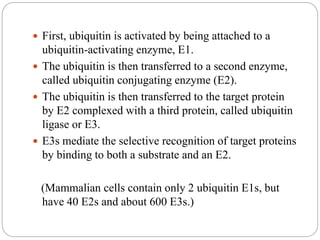
 First, ubiquitin is activated by being attached to a
ubiquitin-activating enzyme, E1.
 The ubiquitin is then transferred to a second enzyme,
called ubiquitin conjugating enzyme (E2).
 The ubiquitin is then transferred to the target protein
by E2 complexed with a third protein, called ubiquitin
ligase or E3.
 E3s mediate the selective recognition of target proteins
by binding to both a substrate and an E2.
(Mammalian cells contain only 2 ubiquitin E1s, but
have 40 E2s and about 600 E3s.)
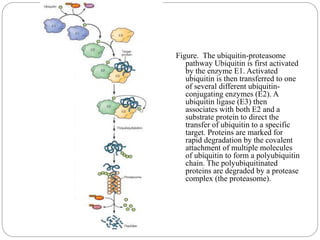
Figure. The ubiquitin-proteasome
pathway Ubiquitin is first activated
by the enzyme E1. Activated
ubiquitin is then transferred to one
of several different ubiquitin-
conjugating enzymes (E2). A
ubiquitin ligase (E3) then
associates with both E2 and a
substrate protein to direct the
transfer of ubiquitin to a specific
target. Proteins are marked for
rapid degradation by the covalent
attachment of multiple molecules
of ubiquitin to form a polyubiquitin
chain. The polyubiquitinated
proteins are degraded by a protease
complex (the proteasome).
 Proteins targeted for degradation are marked by the
addition of multiple ubiquitins to form a polyubiquitin
chain, which is catalyzed by some E3s.
 Such polyubiquinated proteins are recognized and
degraded by a large, multi subunit protease complex,
called the proteasome.
 Ubiquitin is released in the process, so it can be reused
in another cycle.
 An interesting example of controlled degradation is
provided by proteins (known as cyclins), that regulate
progression through the division cycle of eukaryotic
cells.
 The entry of all eukaryotic cells into mitosis is
controlled in part by cyclin B, which is a regulatory
subunit of a protein kinase called Cdk1.
 The association of cyclin B with Cdk1 is required for
activation of the Cdk1 kinase, which initiates the
events of mitosis by phosphorylating various cellular
proteins.
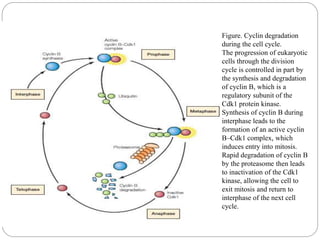
Figure. Cyclin degradation
during the cell cycle.
The progression of eukaryotic
cells through the division
cycle is controlled in part by
the synthesis and degradation
of cyclin B, which is a
regulatory subunit of the
Cdk1 protein kinase.
Synthesis of cyclin B during
interphase leads to the
formation of an active cyclin
B–Cdk1 complex, which
induces entry into mitosis.
Rapid degradation of cyclin B
by the proteasome then leads
to inactivation of the Cdk1
kinase, allowing the cell to
exit mitosis and return to
interphase of the next cell
cycle.
 Cdk1 also activates a ubiquitin ligase that targets
cyclin B for degradation toward the end of mitosis.
 This degradation of cyclin B inactivates Cdk1,
allowing the cell to exit mitosis and progress to
interphase of the next cell cycle.
 The ubiquitylation of cyclin B is a highly selective
reaction, targeted by a nine amino-acid cyclin B
sequence called the destruction box.
 Mutations of this sequence prevent cyclin B
proteolysis and lead to the arrest of dividing cells in
mitosis, demonstrating the importance of regulated
protein degradation in controlling the fundamental
process of cell division.
BIBLIOGRAPHY
 The cell- molecular approach by G. Cooper.

Ubiquitin proteasome pathway.pptx

  • 1.
    P:1 U:2 Vedanti Gharat M.Sc.Part -1 Roll No. - 09 UBIQUITIN- PROTEASOME PATHWAY
  • 2.
    PROTEIN DEGRADATION  Thelevels of proteins within cells are determined not only by rates of synthesis but also by rates of degradation.  The half-lives of proteins within cells vary widely and differential rates of protein degradation are an important aspect of cell regulation.  Many rapidly degraded proteins function as regulatory molecules.  In eukaryotic cells, the ubiquitin-proteasome pathway is the major mediator of regulated protein degradation.
  • 3.
    UBIQUITIN- PROTEASOME PATHWAY  Ubiquitinis a 76- A.A polypeptide that is highly conserved in all eukaryotes.  Proteins are marked for degradation by the attachment of ubiquitin to the amino group of the side chain of a lysine residue.  The selective addition of ubiquitin to target proteins is a multistep process.
  • 4.
     First, ubiquitinis activated by being attached to a ubiquitin-activating enzyme, E1.  The ubiquitin is then transferred to a second enzyme, called ubiquitin conjugating enzyme (E2).  The ubiquitin is then transferred to the target protein by E2 complexed with a third protein, called ubiquitin ligase or E3.  E3s mediate the selective recognition of target proteins by binding to both a substrate and an E2. (Mammalian cells contain only 2 ubiquitin E1s, but have 40 E2s and about 600 E3s.)
  • 5.
    Figure. The ubiquitin-proteasome pathwayUbiquitin is first activated by the enzyme E1. Activated ubiquitin is then transferred to one of several different ubiquitin- conjugating enzymes (E2). A ubiquitin ligase (E3) then associates with both E2 and a substrate protein to direct the transfer of ubiquitin to a specific target. Proteins are marked for rapid degradation by the covalent attachment of multiple molecules of ubiquitin to form a polyubiquitin chain. The polyubiquitinated proteins are degraded by a protease complex (the proteasome).
  • 6.
     Proteins targetedfor degradation are marked by the addition of multiple ubiquitins to form a polyubiquitin chain, which is catalyzed by some E3s.  Such polyubiquinated proteins are recognized and degraded by a large, multi subunit protease complex, called the proteasome.  Ubiquitin is released in the process, so it can be reused in another cycle.
  • 7.
     An interestingexample of controlled degradation is provided by proteins (known as cyclins), that regulate progression through the division cycle of eukaryotic cells.  The entry of all eukaryotic cells into mitosis is controlled in part by cyclin B, which is a regulatory subunit of a protein kinase called Cdk1.  The association of cyclin B with Cdk1 is required for activation of the Cdk1 kinase, which initiates the events of mitosis by phosphorylating various cellular proteins.
  • 8.
    Figure. Cyclin degradation duringthe cell cycle. The progression of eukaryotic cells through the division cycle is controlled in part by the synthesis and degradation of cyclin B, which is a regulatory subunit of the Cdk1 protein kinase. Synthesis of cyclin B during interphase leads to the formation of an active cyclin B–Cdk1 complex, which induces entry into mitosis. Rapid degradation of cyclin B by the proteasome then leads to inactivation of the Cdk1 kinase, allowing the cell to exit mitosis and return to interphase of the next cell cycle.
  • 9.
     Cdk1 alsoactivates a ubiquitin ligase that targets cyclin B for degradation toward the end of mitosis.  This degradation of cyclin B inactivates Cdk1, allowing the cell to exit mitosis and progress to interphase of the next cell cycle.  The ubiquitylation of cyclin B is a highly selective reaction, targeted by a nine amino-acid cyclin B sequence called the destruction box.  Mutations of this sequence prevent cyclin B proteolysis and lead to the arrest of dividing cells in mitosis, demonstrating the importance of regulated protein degradation in controlling the fundamental process of cell division.
  • 10.
    BIBLIOGRAPHY  The cell-molecular approach by G. Cooper.