Definition and
scope ofPharmacoepidemiology
Submitted By :
Abu Bakr Ansari
Pharm. D 5th Year
Roll No. 1601096001
Enroll No. 1600100627
Submitted To :
Dr. Mohd Khustar Sir
Associate Professor
Integral University, Lucknow
Faculty of Pharmacy
PRY – 502 Pharmacoepidemiology
and Pharmacoeconomics
Definition and Introduction
 Pharmacoepidemiology is derived from the words
‘pharmacology’ and ‘epidemiology’; the study of
population or diseases in a population. The
pharmacoepidemiology is applying of principles of
epidemiology into pharmacology. It is a specialized
branch of epidemiology that looks into the effects of
drugs approved in the market. Pharmacoepidemiology
can be applied in drug utilization studies (prospective or
retrospective), outcomes studies and data analytics.
• It is the bridging between clinical pharmacology
and epidemiology.
Pharmacoepidemiology
Pharmakon-
Drug
Epi – uponor
among
Demos –People
or district
Logos -Study
Aim
• WHO targets its pharmacoepidemiological efforts to ensure the
quality, safety and efficacy of drugs.
• The studies focus on
• Global trends in prescribing
• Appropriateness of drug use
• Medication adherence
• Lifestyle effects on drug therapy
• Special population (Elderly, Pediatric, etc.) drug therapy
• Drug Interactions
• Predictable ADRs
• Uncommon and unpredictable ADRs
Sources of Data
• The sources of drug data includes:
- Institutionalized medical records and databases from
hospital and pharmacy claims
- System wide databases from health insurance
claims or pharmaceutical organization.
- National databases like Medical Expenditure
Panel Survey, National Ambulatory Medical Care
Survey.
- Field data like records from dispensers,
sellers or distributers or from small groups.
- Experimental clinical trial data.
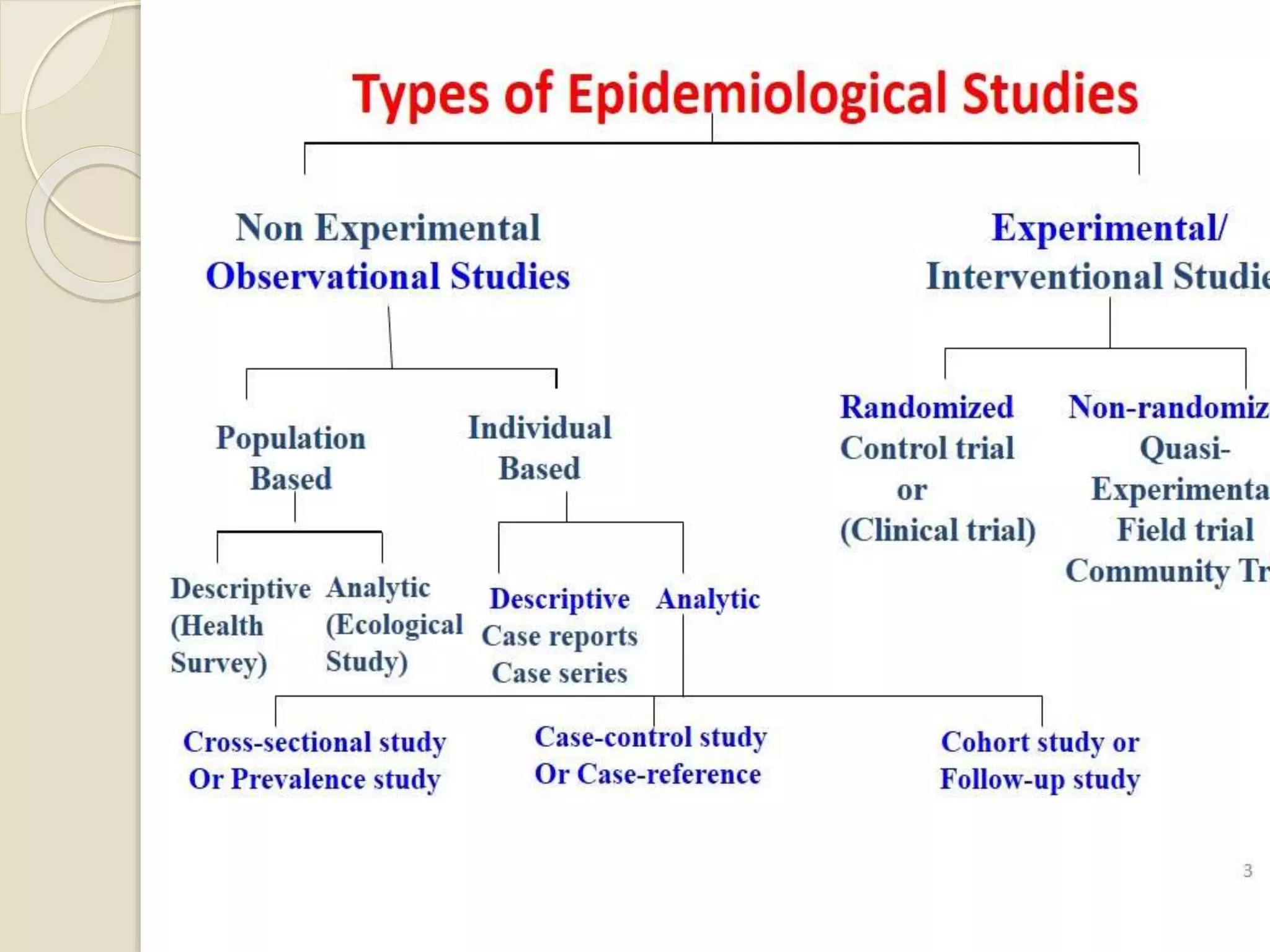
Types
 Epidemiological studies can be divided into two
main types:
1. Observational Study
2. Intervention Study
Cross Sectional Study
 These studies are examinations of the use of drugs at
one specific point in time.
 They are usually done through surveys, chart
reviews and data base analyses.
 They provide a view of the state of affairs at that time
and an estimate of the prevalence of utilization and of
outcomes.
 Such information can be used for
formulary management and policy development.
 Used to compare drug use between countries or
regions within in a country.
 Eg: cross-sectional studies was published by Dua and
colleagues, who examined inappropriate sale of antibiotic use
in pharmacies in Nagpur.
 Such studies can identify problem areas and suggest where
remedial action should be directed.
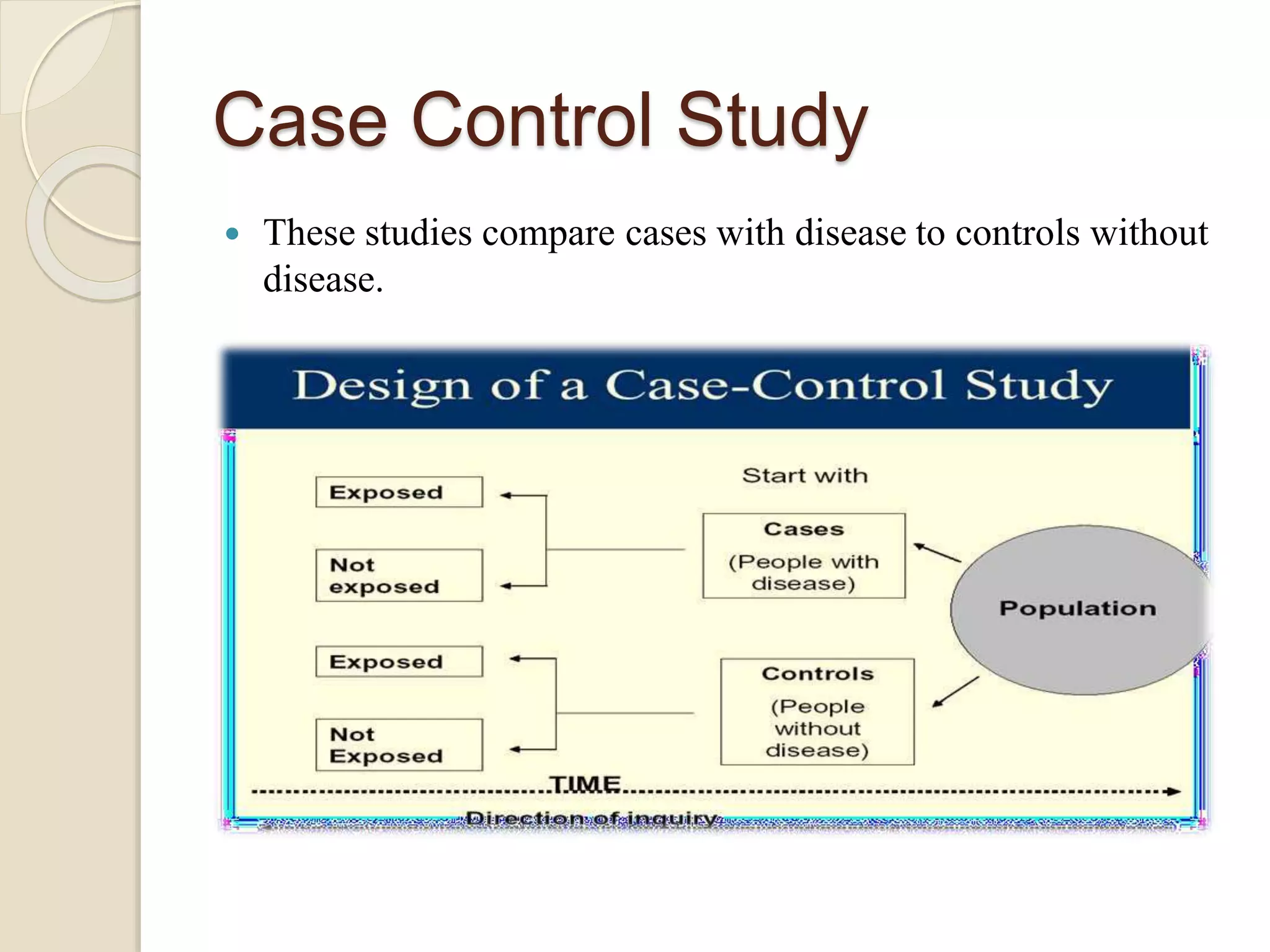
Case Control Study
 These studies compare cases with disease to controls without
disease.
Advantages
• Useful to study multiple possible
causes of a single disease.
• Useful to study uncommon diseases.
• Relatively easy to carry out.
• Rapid and inexpensive.
• Requires comparatively few subjects.
• Does not need an ethical clearance.
• There is no risk to the subject .
Disadvantages
• It introduces bias.
• To select an appropriate
control could be difficult .
• It may be difficult to
distinguish between the
cause of a disease and an
associated factor.
Cohort Study
 Cohort studies identify subsets of a defined population and
follows them over time, looking for differences in their
outcome.
 They are useful to compare exposed patients to unexposed
patients.
Advantages
 There is no bias.
 It is effective for studying rare
exposures.
 It allows the study of the natural
history of the disease.
 It assists in determining the temporal
relationship between the etiological
factor & the disease.
 Can study multiple outcomes.
Disadvantages
• It takes a long time.
• It is expensive.
• Large no of subjects are
needed.
• There could be changes in
the standard methods
or diagnostic criteria .
Need of
Pharmacoepidemiology
 There are 3 main reasons why there is a strong need for PE.
1. Source of supplementation of information available from pre-marketing
studies: It is useful for the better quantification of the incidence of
known adverse and beneficial effects.Advantages of being a source of
supplemental information are: higher precision in results, provides
information of patients not studied in pre-marketing studies (for eg;
elderly, pregnant population etc), provides understanding of how a
drug is modified by other drugs and illnesses and helps to compare
with other drugs for the same indication in terms of safety and efficacy.
2. Source of new information not available from pre-marketing studies:
These PE studies provide information on (a) undetected adverse
events and beneficial effects (b) pattern of drug utilization (c) effects of
drug over doses (d) economic implications.
3. General contributions of PE: PE studies can reassure drug
safety and also fulfill certain ethical and legal obligations.Aims
of PE: The aim of PE is to describe, explain, control and
predict the uses and effects of drugs in a defined time, space
and population.
Applications of PE
• Government agencies & Health care plans:
Pharmacoepidemiology research is important for the government
agencies like the Agency for Healthcare Research and Quality
(AHRQ) and the Centers for Medicare and Medicaid Services
(CMS) and Healthcare plans.
• Practitioners:
Pharmacoepidemiological studies can help Pharmacists,
Physicians, Nurses and other Public health care practitioners to
make informed decisions about treatment for patients.
 Pharmaceutical industries:
The pharmaceutical industry want to understand how a drug is
prescribed, used and what are all the positive and negative
outcomes.
 Academicians:
Academicians often conduct pharmacoepidemiological studies to
find answers to practice related questions.
 Attorneys:
Findings from pharmacoepidemiological studies can be used as can
be used as evidence that a drug product did or didn’t cause an event.
 Consumers and Patients:
To learn about safetyand effectiveness of drug products,
patients and consumers rely on pharmacoepidemiological
studies.
Reference
1. Textbook of clinical pharmacy practice,
pharmacoepidemiology, by Jayashri
Sankaranararyanan and Thomas R Einarson; page
no: 467- 483.
2. https://en.wikipedia.org/wiki/Pharmacoepidemiolo
gy
3. https://www.slideshare.net/DivjyotKaur/pharmacoe
pidemiology
THANK YOU
Faculty of Pharmacy

Definition and scope of Pharmacoepidemiology

  • 1.
    Definition and scope ofPharmacoepidemiology SubmittedBy : Abu Bakr Ansari Pharm. D 5th Year Roll No. 1601096001 Enroll No. 1600100627 Submitted To : Dr. Mohd Khustar Sir Associate Professor Integral University, Lucknow Faculty of Pharmacy PRY – 502 Pharmacoepidemiology and Pharmacoeconomics
  • 2.
    Definition and Introduction Pharmacoepidemiology is derived from the words ‘pharmacology’ and ‘epidemiology’; the study of population or diseases in a population. The pharmacoepidemiology is applying of principles of epidemiology into pharmacology. It is a specialized branch of epidemiology that looks into the effects of drugs approved in the market. Pharmacoepidemiology can be applied in drug utilization studies (prospective or retrospective), outcomes studies and data analytics.
  • 3.
    • It isthe bridging between clinical pharmacology and epidemiology. Pharmacoepidemiology Pharmakon- Drug Epi – uponor among Demos –People or district Logos -Study
  • 4.
    Aim • WHO targetsits pharmacoepidemiological efforts to ensure the quality, safety and efficacy of drugs. • The studies focus on • Global trends in prescribing • Appropriateness of drug use • Medication adherence • Lifestyle effects on drug therapy • Special population (Elderly, Pediatric, etc.) drug therapy • Drug Interactions • Predictable ADRs • Uncommon and unpredictable ADRs
  • 5.
    Sources of Data •The sources of drug data includes: - Institutionalized medical records and databases from hospital and pharmacy claims - System wide databases from health insurance claims or pharmaceutical organization. - National databases like Medical Expenditure Panel Survey, National Ambulatory Medical Care Survey. - Field data like records from dispensers, sellers or distributers or from small groups. - Experimental clinical trial data.
  • 6.
    Types  Epidemiological studiescan be divided into two main types: 1. Observational Study 2. Intervention Study
  • 8.
    Cross Sectional Study These studies are examinations of the use of drugs at one specific point in time.  They are usually done through surveys, chart reviews and data base analyses.  They provide a view of the state of affairs at that time and an estimate of the prevalence of utilization and of outcomes.  Such information can be used for formulary management and policy development.  Used to compare drug use between countries or regions within in a country.
  • 9.
     Eg: cross-sectionalstudies was published by Dua and colleagues, who examined inappropriate sale of antibiotic use in pharmacies in Nagpur.  Such studies can identify problem areas and suggest where remedial action should be directed.
  • 10.
    Case Control Study These studies compare cases with disease to controls without disease.
  • 11.
    Advantages • Useful tostudy multiple possible causes of a single disease. • Useful to study uncommon diseases. • Relatively easy to carry out. • Rapid and inexpensive. • Requires comparatively few subjects. • Does not need an ethical clearance. • There is no risk to the subject . Disadvantages • It introduces bias. • To select an appropriate control could be difficult . • It may be difficult to distinguish between the cause of a disease and an associated factor.
  • 12.
    Cohort Study  Cohortstudies identify subsets of a defined population and follows them over time, looking for differences in their outcome.  They are useful to compare exposed patients to unexposed patients.
  • 13.
    Advantages  There isno bias.  It is effective for studying rare exposures.  It allows the study of the natural history of the disease.  It assists in determining the temporal relationship between the etiological factor & the disease.  Can study multiple outcomes. Disadvantages • It takes a long time. • It is expensive. • Large no of subjects are needed. • There could be changes in the standard methods or diagnostic criteria .
  • 14.
    Need of Pharmacoepidemiology  Thereare 3 main reasons why there is a strong need for PE. 1. Source of supplementation of information available from pre-marketing studies: It is useful for the better quantification of the incidence of known adverse and beneficial effects.Advantages of being a source of supplemental information are: higher precision in results, provides information of patients not studied in pre-marketing studies (for eg; elderly, pregnant population etc), provides understanding of how a drug is modified by other drugs and illnesses and helps to compare with other drugs for the same indication in terms of safety and efficacy. 2. Source of new information not available from pre-marketing studies: These PE studies provide information on (a) undetected adverse events and beneficial effects (b) pattern of drug utilization (c) effects of drug over doses (d) economic implications.
  • 15.
    3. General contributionsof PE: PE studies can reassure drug safety and also fulfill certain ethical and legal obligations.Aims of PE: The aim of PE is to describe, explain, control and predict the uses and effects of drugs in a defined time, space and population.
  • 16.
    Applications of PE •Government agencies & Health care plans: Pharmacoepidemiology research is important for the government agencies like the Agency for Healthcare Research and Quality (AHRQ) and the Centers for Medicare and Medicaid Services (CMS) and Healthcare plans. • Practitioners: Pharmacoepidemiological studies can help Pharmacists, Physicians, Nurses and other Public health care practitioners to make informed decisions about treatment for patients.
  • 17.
     Pharmaceutical industries: Thepharmaceutical industry want to understand how a drug is prescribed, used and what are all the positive and negative outcomes.  Academicians: Academicians often conduct pharmacoepidemiological studies to find answers to practice related questions.  Attorneys: Findings from pharmacoepidemiological studies can be used as can be used as evidence that a drug product did or didn’t cause an event.  Consumers and Patients: To learn about safetyand effectiveness of drug products, patients and consumers rely on pharmacoepidemiological studies.
  • 18.
    Reference 1. Textbook ofclinical pharmacy practice, pharmacoepidemiology, by Jayashri Sankaranararyanan and Thomas R Einarson; page no: 467- 483. 2. https://en.wikipedia.org/wiki/Pharmacoepidemiolo gy 3. https://www.slideshare.net/DivjyotKaur/pharmacoe pidemiology
  • 19.