1
GUIDED BY
Prof.
Dr.P.M.GAIKWAD
M.Pharm, Ph.D
(Head, Dept of
Pharmacology)
COGUIDED BY
Prof.V.V.Nimbalkar
Dept. Of pharmacology
PRESENTED BY
Miss. Joshi Uttara L.
M.Pharm (sem II)
(Pharmacology)
Roll no.08
Dr. V.V.P.F’S COLLEGE OF PHARMACY
AHMEDNAGAR (2018-2019 )
 Introduction
 Types of clinical trials
 Phases of clinical trials
 Clinical Design
• Observational
• Experimental
 Reference
2
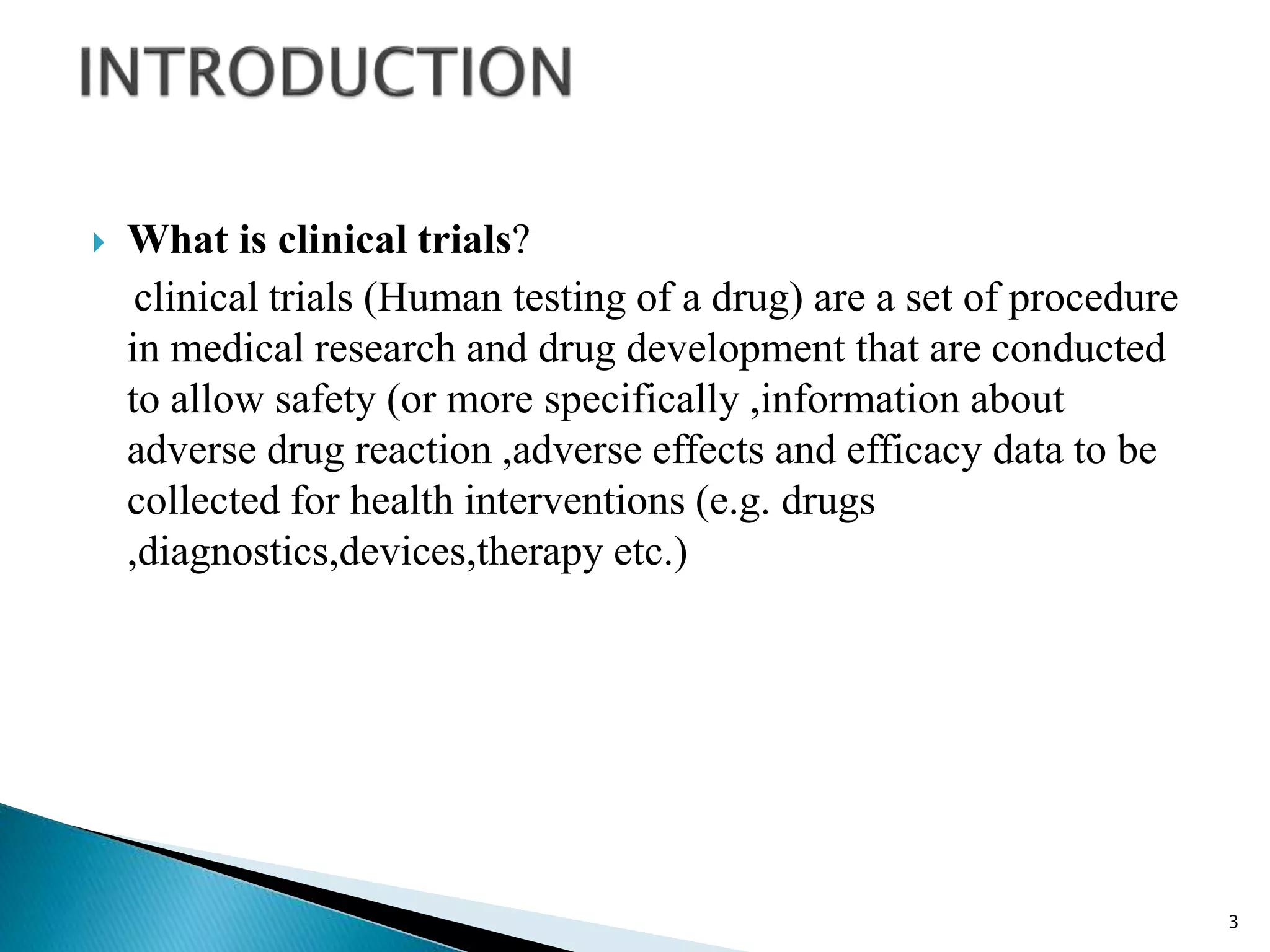
 What is clinical trials?
clinical trials (Human testing of a drug) are a set of procedure
in medical research and drug development that are conducted
to allow safety (or more specifically ,information about
adverse drug reaction ,adverse effects and efficacy data to be
collected for health interventions (e.g. drugs
,diagnostics,devices,therapy etc.)
3
 Treatment trials test experimental
treatments, new combinations of drugs,
or new approaches to surgery or
radiation therapy.
 Prevention trials look for better ways to
prevent disease in people who
have never had the disease or to prevent a disease from
returning. These approaches may include medicines,
vaccines, vitamins, minerals, or lifestyle changes.
4
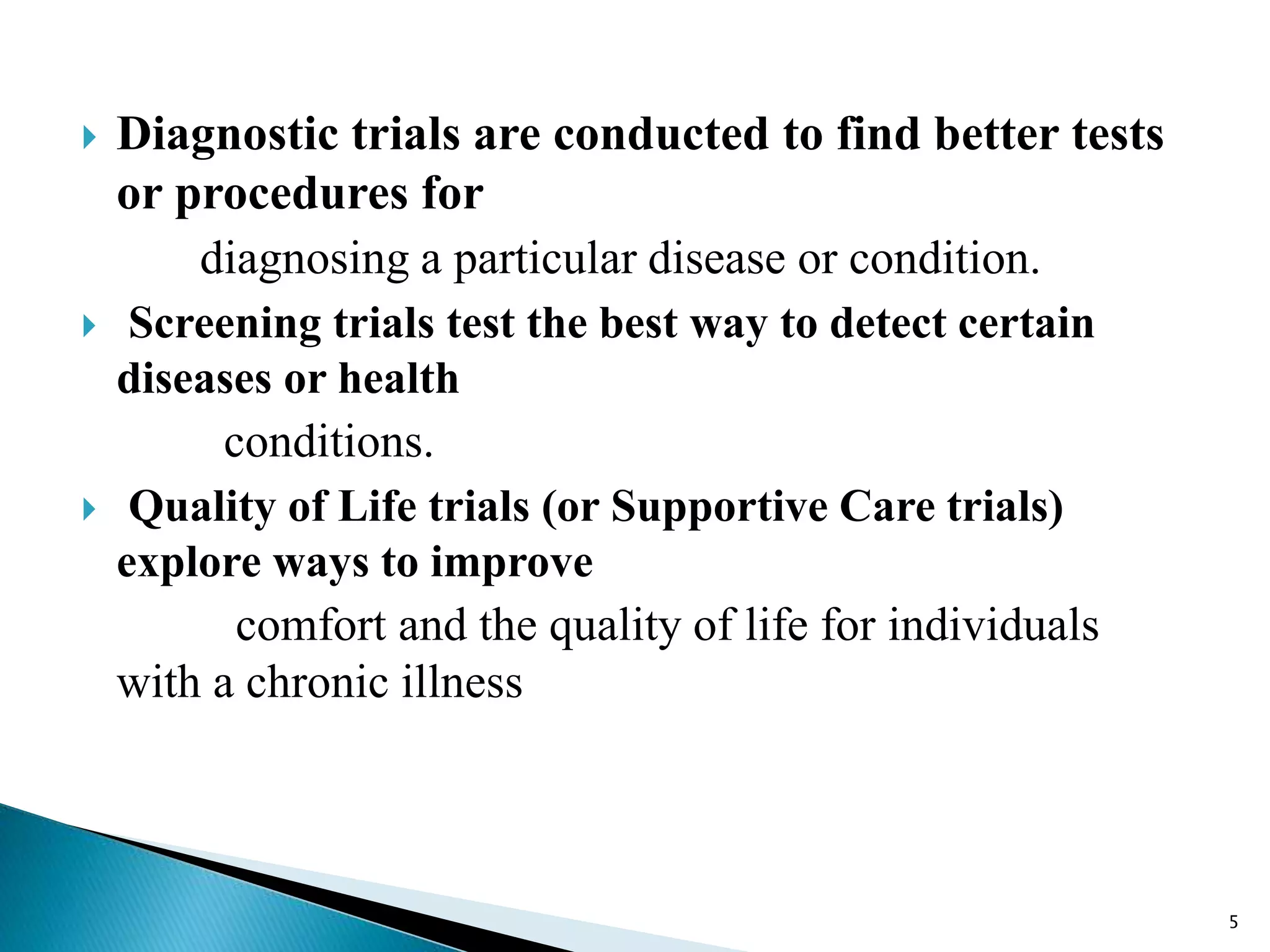
 Diagnostic trials are conducted to find better tests
or procedures for
diagnosing a particular disease or condition.
 Screening trials test the best way to detect certain
diseases or health
conditions.
 Quality of Life trials (or Supportive Care trials)
explore ways to improve
comfort and the quality of life for individuals
with a chronic illness
5
6
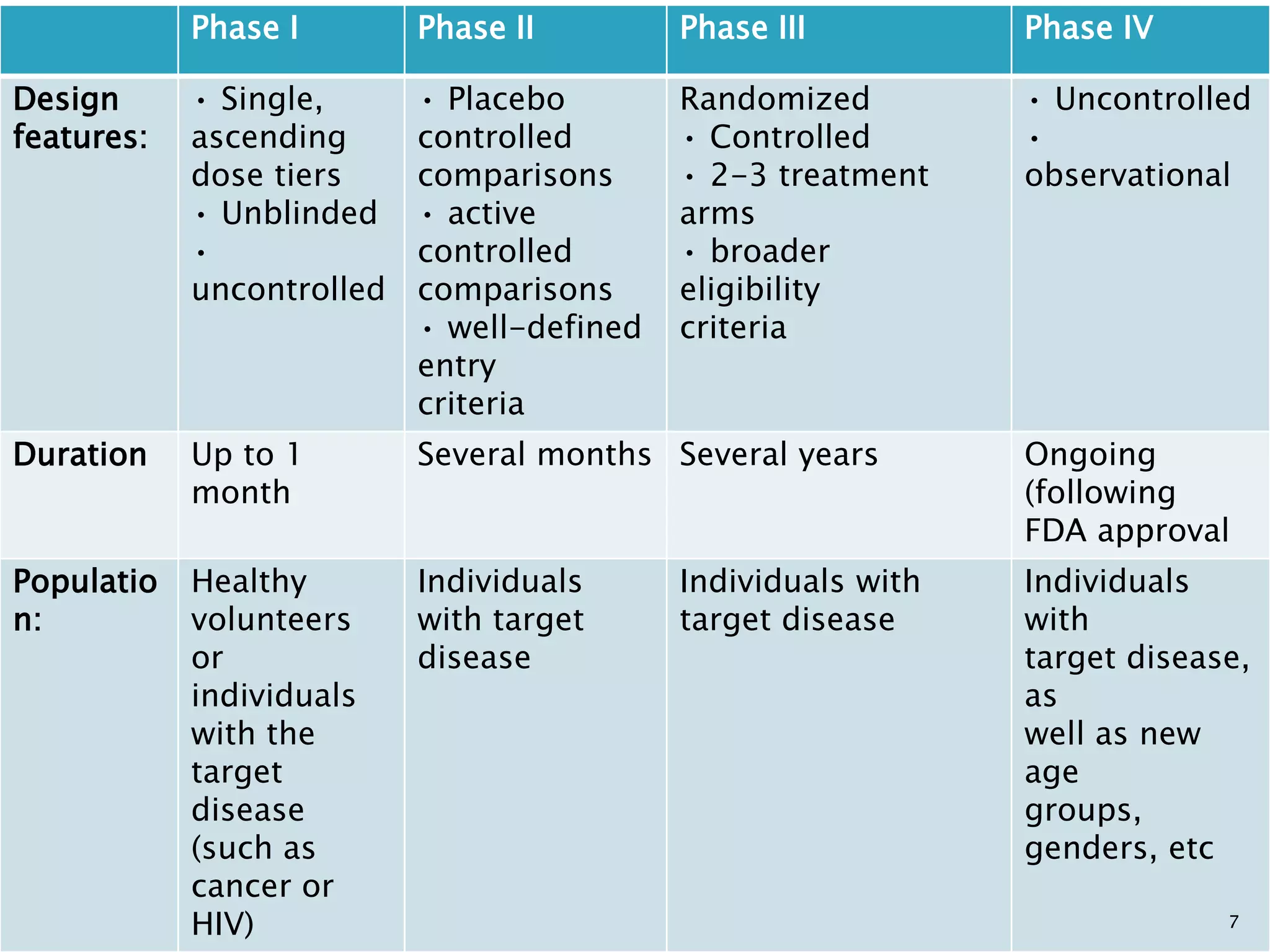
Phase I Phase II Phase III Phase IV
Design
features:
• Single,
ascending
dose tiers
• Unblinded
•
uncontrolled
• Placebo
controlled
comparisons
• active
controlled
comparisons
• well-defined
entry
criteria
Randomized
• Controlled
• 2-3 treatment
arms
• broader
eligibility
criteria
• Uncontrolled
•
observational
Duration Up to 1
month
Several months Several years Ongoing
(following
FDA approval
Populatio
n:
Healthy
volunteers
or
individuals
with the
target
disease
(such as
cancer or
HIV)
Individuals
with target
disease
Individuals with
target disease
Individuals
with
target disease,
as
well as new
age
groups,
genders, etc
7
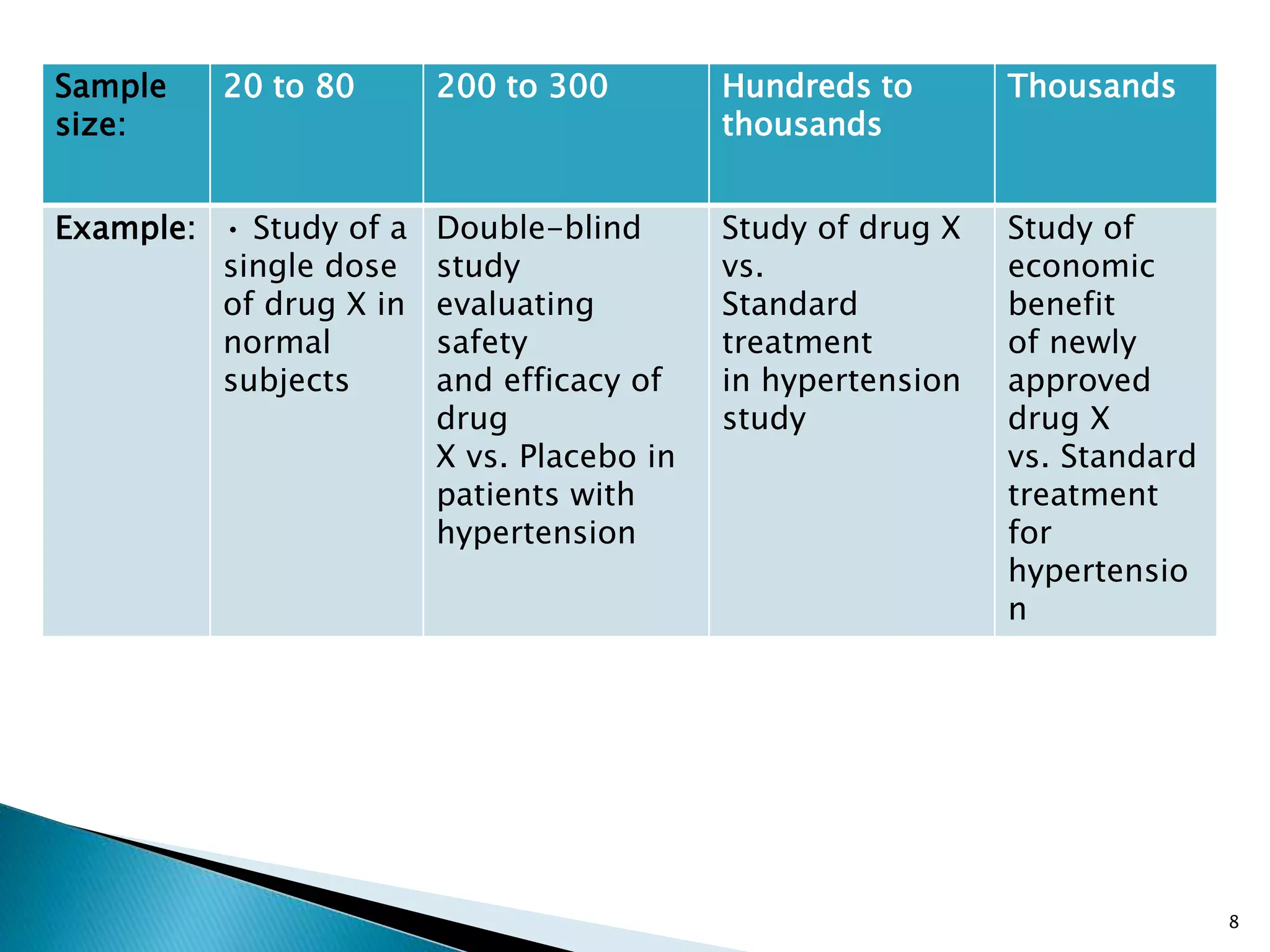
Sample
size:
20 to 80 200 to 300 Hundreds to
thousands
Thousands
Example: • Study of a
single dose
of drug X in
normal
subjects
Double-blind
study
evaluating
safety
and efficacy of
drug
X vs. Placebo in
patients with
hypertension
Study of drug X
vs.
Standard
treatment
in hypertension
study
Study of
economic
benefit
of newly
approved
drug X
vs. Standard
treatment
for
hypertensio
n
8
9
OBSERVATIONAL
STUDY
COHORT STUDY
CASE CONTROL
CROSS SECTIONAL
STUDY
EXPERIMENTAL
STUDY
RCT
NON RCT
10
 A population at risk for the disease events is
followed over time for the occurrence of disease
and events.
 This study used to estimate how often disease or
life events happen in a certain population.
 These are the best method for determining the
incidence and natural history of a condition
11
POPULATION
(SAMPLE)
EXPOSED
(SMOKING)
DISEASE (LUNG
CANCER)
NO DISEASE
UNEXPOSED
DISEASE (LUNG
CANCER)
NO DISEASE
12
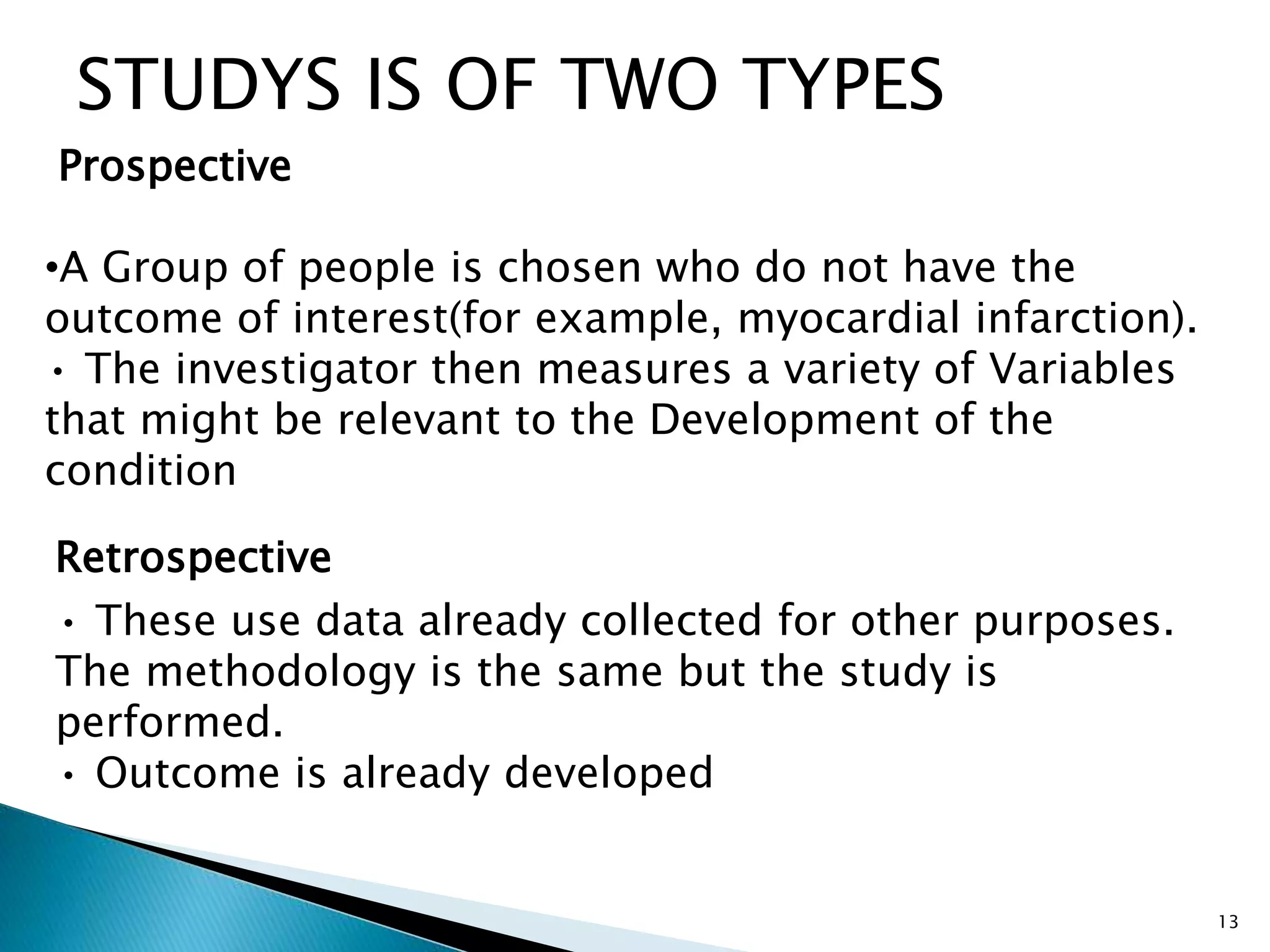
STUDYS IS OF TWO TYPES
Prospective
•A Group of people is chosen who do not have the
outcome of interest(for example, myocardial infarction).
• The investigator then measures a variety of Variables
that might be relevant to the Development of the
condition
Retrospective
• These use data already collected for other purposes.
The methodology is the same but the study is
performed.
• Outcome is already developed
13
 Studies carried out from present time to future
 Can be tailored to collect specific exposure rate
 But long wait for events to occur
 Expensive
 Prone to high dropout rates
Retrospective
• Look at medical events from past to present
• Information is available immediately
• Difficulty in tracing subjects and doubt on
quality of recorded information
14
 Is a type of observational study that are primarily
used to determine prevalence.
 Prevalence equals the number of cases in a
population at a given point in time.
 All the measurements on each person are made at
one point in time.
COHORT STUDY CROSS
SECTIONAL
Study group Population at risk Entire
population
Common
measures
Risks and rates Prevalence
15
 The prevalence of a health outcome is simply the
proportion of
 individuals with the health outcome in a population
PREVELENCE = CASE/TOTAL POPULATION
16
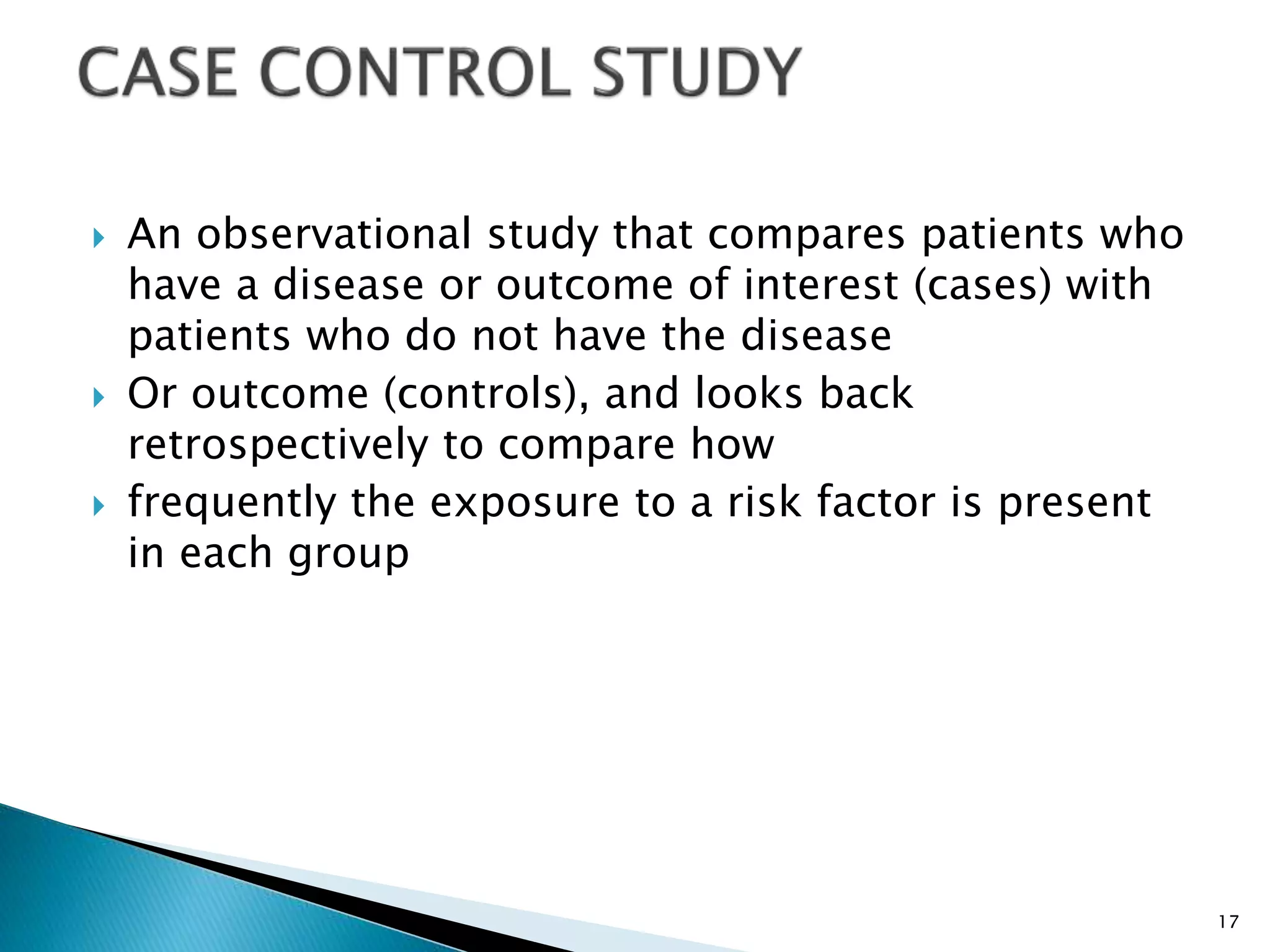
 An observational study that compares patients who
have a disease or outcome of interest (cases) with
patients who do not have the disease
 Or outcome (controls), and looks back
retrospectively to compare how
 frequently the exposure to a risk factor is present
in each group
17
 Case control studies are usually retrospective.
 In this study the only outcome is presence or
absence of the disease
 or whatever criteria was chosen to select the cases.
 Aim to identify predictors of an outcome
 Permit assessment of the influence of predictors on
outcome via
 calculation of an odds ratio
 Can only look at one outcome
18
ADVANTAGE DISADVANTAGE
 Efficient- saves time
and energy
 Used for rare diseases,
small sample sizes
 Can generate
hypothesis for future
study
 Susceptible to bias-
recall, reporting
 Prone to
methodological errors
 Selection of an
appropriate
comparison group may
be difficult
19
20
 An epidemiological experiment in which subjects in a
population are randomly allocated into groups, usually called
study and control.
 Groups, to receive or not receive an experimental preventive
or therapeutic
 Patients are randomly assigned to the study all groups that
help in avoiding bias in patient
21
 Comparative
 One treatment is directly compared to another to establish
 superiority.
 Minimizes bias
 Randomization minimizes allocation bias and selection
bias
 Blinding minimizes performance bias
 Minimizes confounding factors
 Randomization makes groups comparable according both
known
 and unknown factors
 Statistical reliability
 Statistical test of significance is readily interpretable when
the
 study is randomised
22
 Might demand vast samples size, which require more
resources from the investigators
 Sometimes allocation of participants may be
predictable and result in selection bias when the
study groups are unmasked Trials are of longer
duration and more expensive.
 Results may not always mimic real life treatment
situation (e.g.
 Inclusion / exclusion criteria; highly controlled
setting)
 Ethical limitations: some research cannot be ethically
performed as an RCT (classically, RCT of the effects
of parachutes on the survival of sky-divers)
23
• Parallel group trial design
• Cross-over trial design
• Factorial design
• Group allocation
• Adaptive design
24
Types of RCT
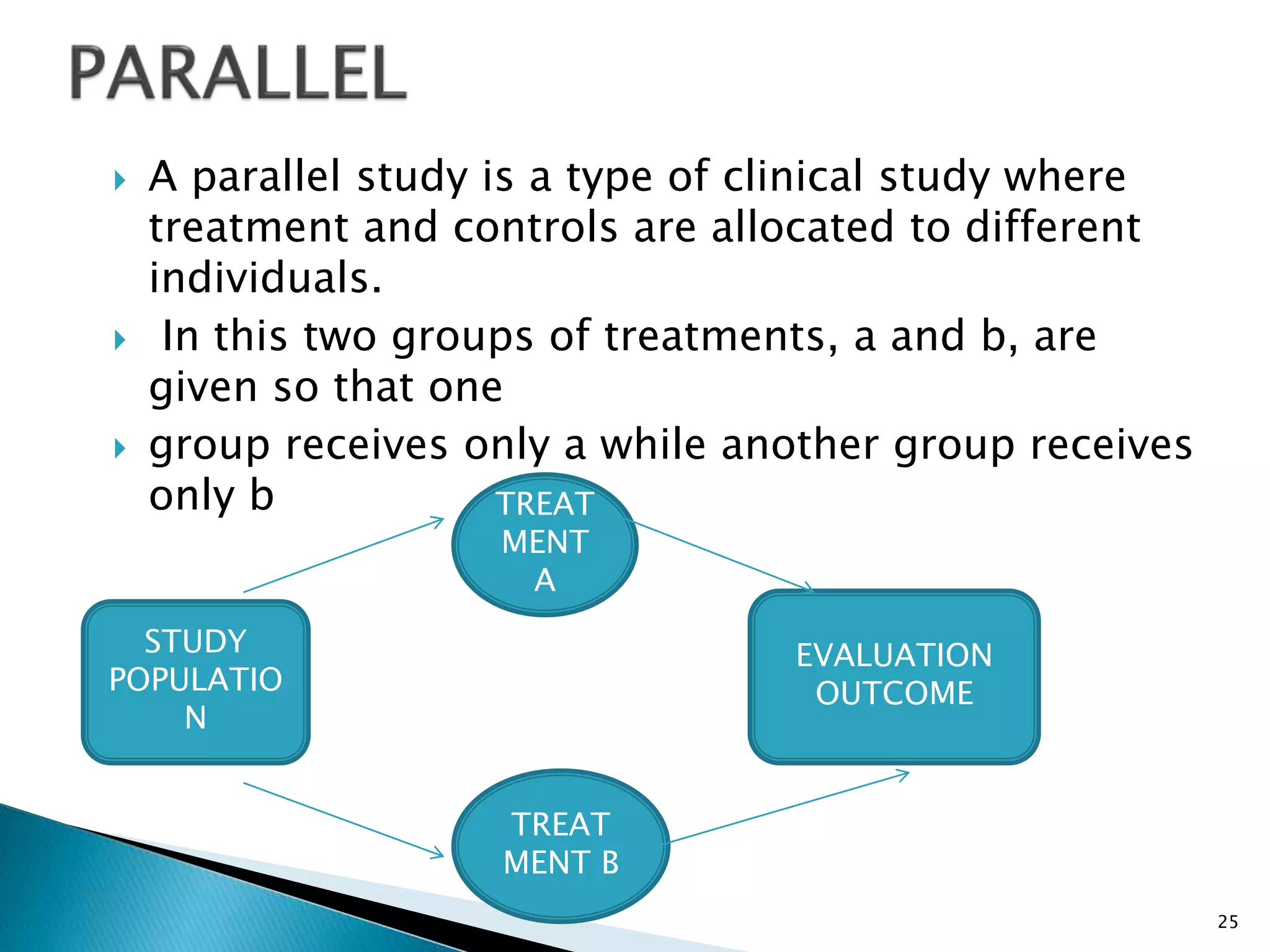
 A parallel study is a type of clinical study where
treatment and controls are allocated to different
individuals.
 In this two groups of treatments, a and b, are
given so that one
 group receives only a while another group receives
only b
STUDY
POPULATIO
N
TREAT
MENT
A
TREAT
MENT B
EVALUATION
OUTCOME
25
 This is unlike a crossover study where at first one
group receives treatment A, followed by treatment
B later, while the other group receives vice versa
 Key element of this design is randomization
 One treatment group, and one treatment-as-usual
group.
 Two active treatment groups. One of the groups
might receive an active comparator (a treatment
that’s known to be effective).
26
 One treatment group, and one treatment-as-usual
group. Two active treatment groups. One of the
groups might receive an active
 comparator (a treatment that’s known to be
effective).
 However, these studies generally require large
number of patients for the analysis
27
 In these types of studies each patient serves as his
own control. Each patient gets both treatments.
 Each patient receive first treatment then washout
time is provided then other treatment is provided
to the same.
28
Study
population
Treatment A
Treatment B
Washout
Period
Treatment A
Treatment B
29
 Studies involving two or more factors while
randomizing are called factorial.
 Factorial design permits researchers to investigate
the joint effect of two or more factors on a
dependent variable.
 Used when it is desired to study the influence of a
number of factors on the treatments compared as
well as their interaction with different treatments
factors on a dependent variables l designs
30
 If no interaction, can perform two experiments with
less patients than
 performing two separate experiments
 Can examine interactions if this is of interest.
 Cost: It is possible to evaluate multiple treatments
within the same trial using
 fewer patients than individual comparisons
DISADVANTAGE
• Potential for adverse effects
31
 Groups of individuals are considered as sampling
unit and treatment is given to group rather than
indivisual subject .
 Allows mass intervention
 It requirs more patients than indivisuals design
 Necessitaties cluster sampling method
32
 An adaptive design allows modification /adaptation
to trial and /or statistical procedure of ongoing
clinical trials .
 Major adaptation of trial and /or statistical
procedure of ongoing trials may results in a totally
different trials that is unable to address the
scientific /medical questions the trial intends to
answer.
33
 A clinical trials in which the particepents are not
assigned by chance to diiferent treatment groups .
Particepents may choose which group they want to
be in,or they may be assigned to the groups by the
researchers.
 NON RANDMIZED CONCURRENT CONTROL
STUDIES
 NON RANDMIZED HISTORICAL CONTROL
STUDIES
34
 Control group is predetermined (already selection
of patients has done )
 Non randmized controlled trials relay on
partiecepent
1.Voluenters to join the study
2.Are geographically close to the study site
35
 Historical controls is external control and it
includes
 Patient in consecative series
 Patient form the literature
 Patient from previous studies
 Patient as own control
 Concurrent ,non randmised
36
 Sunil d.shewale , sharad n. shinde, vikas g. wawale
“Basis of clinical reserch” first edition , Page no 85-94
 Dr. H.P. Tipnis, Dr. Amrita Bajaj,”Clinical
Pharmacy”Thired edition , page no:312-328
 Jullia lioyd ,ann raven,” handbook of clinical reserch”
page no 66
 David machin ,simon day “Textbook of clinical trials”
page no 74-89
 Mann, C.J., 2003. Observational research methods.
Research design II: cohort, cross sectional, and case-
control studies. Emergency medicine journal, 20(1),
pp.54-60.
37
Thank you……
38

clinical trials types and design

  • 1.
    1 GUIDED BY Prof. Dr.P.M.GAIKWAD M.Pharm, Ph.D (Head,Dept of Pharmacology) COGUIDED BY Prof.V.V.Nimbalkar Dept. Of pharmacology PRESENTED BY Miss. Joshi Uttara L. M.Pharm (sem II) (Pharmacology) Roll no.08 Dr. V.V.P.F’S COLLEGE OF PHARMACY AHMEDNAGAR (2018-2019 )
  • 2.
     Introduction  Typesof clinical trials  Phases of clinical trials  Clinical Design • Observational • Experimental  Reference 2
  • 3.
     What isclinical trials? clinical trials (Human testing of a drug) are a set of procedure in medical research and drug development that are conducted to allow safety (or more specifically ,information about adverse drug reaction ,adverse effects and efficacy data to be collected for health interventions (e.g. drugs ,diagnostics,devices,therapy etc.) 3
  • 4.
     Treatment trialstest experimental treatments, new combinations of drugs, or new approaches to surgery or radiation therapy.  Prevention trials look for better ways to prevent disease in people who have never had the disease or to prevent a disease from returning. These approaches may include medicines, vaccines, vitamins, minerals, or lifestyle changes. 4
  • 5.
     Diagnostic trialsare conducted to find better tests or procedures for diagnosing a particular disease or condition.  Screening trials test the best way to detect certain diseases or health conditions.  Quality of Life trials (or Supportive Care trials) explore ways to improve comfort and the quality of life for individuals with a chronic illness 5
  • 6.
  • 7.
    Phase I PhaseII Phase III Phase IV Design features: • Single, ascending dose tiers • Unblinded • uncontrolled • Placebo controlled comparisons • active controlled comparisons • well-defined entry criteria Randomized • Controlled • 2-3 treatment arms • broader eligibility criteria • Uncontrolled • observational Duration Up to 1 month Several months Several years Ongoing (following FDA approval Populatio n: Healthy volunteers or individuals with the target disease (such as cancer or HIV) Individuals with target disease Individuals with target disease Individuals with target disease, as well as new age groups, genders, etc 7
  • 8.
    Sample size: 20 to 80200 to 300 Hundreds to thousands Thousands Example: • Study of a single dose of drug X in normal subjects Double-blind study evaluating safety and efficacy of drug X vs. Placebo in patients with hypertension Study of drug X vs. Standard treatment in hypertension study Study of economic benefit of newly approved drug X vs. Standard treatment for hypertensio n 8
  • 9.
  • 10.
    OBSERVATIONAL STUDY COHORT STUDY CASE CONTROL CROSSSECTIONAL STUDY EXPERIMENTAL STUDY RCT NON RCT 10
  • 11.
     A populationat risk for the disease events is followed over time for the occurrence of disease and events.  This study used to estimate how often disease or life events happen in a certain population.  These are the best method for determining the incidence and natural history of a condition 11
  • 12.
  • 13.
    STUDYS IS OFTWO TYPES Prospective •A Group of people is chosen who do not have the outcome of interest(for example, myocardial infarction). • The investigator then measures a variety of Variables that might be relevant to the Development of the condition Retrospective • These use data already collected for other purposes. The methodology is the same but the study is performed. • Outcome is already developed 13
  • 14.
     Studies carriedout from present time to future  Can be tailored to collect specific exposure rate  But long wait for events to occur  Expensive  Prone to high dropout rates Retrospective • Look at medical events from past to present • Information is available immediately • Difficulty in tracing subjects and doubt on quality of recorded information 14
  • 15.
     Is atype of observational study that are primarily used to determine prevalence.  Prevalence equals the number of cases in a population at a given point in time.  All the measurements on each person are made at one point in time. COHORT STUDY CROSS SECTIONAL Study group Population at risk Entire population Common measures Risks and rates Prevalence 15
  • 16.
     The prevalenceof a health outcome is simply the proportion of  individuals with the health outcome in a population PREVELENCE = CASE/TOTAL POPULATION 16
  • 17.
     An observationalstudy that compares patients who have a disease or outcome of interest (cases) with patients who do not have the disease  Or outcome (controls), and looks back retrospectively to compare how  frequently the exposure to a risk factor is present in each group 17
  • 18.
     Case controlstudies are usually retrospective.  In this study the only outcome is presence or absence of the disease  or whatever criteria was chosen to select the cases.  Aim to identify predictors of an outcome  Permit assessment of the influence of predictors on outcome via  calculation of an odds ratio  Can only look at one outcome 18
  • 19.
    ADVANTAGE DISADVANTAGE  Efficient-saves time and energy  Used for rare diseases, small sample sizes  Can generate hypothesis for future study  Susceptible to bias- recall, reporting  Prone to methodological errors  Selection of an appropriate comparison group may be difficult 19
  • 20.
  • 21.
     An epidemiologicalexperiment in which subjects in a population are randomly allocated into groups, usually called study and control.  Groups, to receive or not receive an experimental preventive or therapeutic  Patients are randomly assigned to the study all groups that help in avoiding bias in patient 21
  • 22.
     Comparative  Onetreatment is directly compared to another to establish  superiority.  Minimizes bias  Randomization minimizes allocation bias and selection bias  Blinding minimizes performance bias  Minimizes confounding factors  Randomization makes groups comparable according both known  and unknown factors  Statistical reliability  Statistical test of significance is readily interpretable when the  study is randomised 22
  • 23.
     Might demandvast samples size, which require more resources from the investigators  Sometimes allocation of participants may be predictable and result in selection bias when the study groups are unmasked Trials are of longer duration and more expensive.  Results may not always mimic real life treatment situation (e.g.  Inclusion / exclusion criteria; highly controlled setting)  Ethical limitations: some research cannot be ethically performed as an RCT (classically, RCT of the effects of parachutes on the survival of sky-divers) 23
  • 24.
    • Parallel grouptrial design • Cross-over trial design • Factorial design • Group allocation • Adaptive design 24 Types of RCT
  • 25.
     A parallelstudy is a type of clinical study where treatment and controls are allocated to different individuals.  In this two groups of treatments, a and b, are given so that one  group receives only a while another group receives only b STUDY POPULATIO N TREAT MENT A TREAT MENT B EVALUATION OUTCOME 25
  • 26.
     This isunlike a crossover study where at first one group receives treatment A, followed by treatment B later, while the other group receives vice versa  Key element of this design is randomization  One treatment group, and one treatment-as-usual group.  Two active treatment groups. One of the groups might receive an active comparator (a treatment that’s known to be effective). 26
  • 27.
     One treatmentgroup, and one treatment-as-usual group. Two active treatment groups. One of the groups might receive an active  comparator (a treatment that’s known to be effective).  However, these studies generally require large number of patients for the analysis 27
  • 28.
     In thesetypes of studies each patient serves as his own control. Each patient gets both treatments.  Each patient receive first treatment then washout time is provided then other treatment is provided to the same. 28
  • 29.
  • 30.
     Studies involvingtwo or more factors while randomizing are called factorial.  Factorial design permits researchers to investigate the joint effect of two or more factors on a dependent variable.  Used when it is desired to study the influence of a number of factors on the treatments compared as well as their interaction with different treatments factors on a dependent variables l designs 30
  • 31.
     If nointeraction, can perform two experiments with less patients than  performing two separate experiments  Can examine interactions if this is of interest.  Cost: It is possible to evaluate multiple treatments within the same trial using  fewer patients than individual comparisons DISADVANTAGE • Potential for adverse effects 31
  • 32.
     Groups ofindividuals are considered as sampling unit and treatment is given to group rather than indivisual subject .  Allows mass intervention  It requirs more patients than indivisuals design  Necessitaties cluster sampling method 32
  • 33.
     An adaptivedesign allows modification /adaptation to trial and /or statistical procedure of ongoing clinical trials .  Major adaptation of trial and /or statistical procedure of ongoing trials may results in a totally different trials that is unable to address the scientific /medical questions the trial intends to answer. 33
  • 34.
     A clinicaltrials in which the particepents are not assigned by chance to diiferent treatment groups . Particepents may choose which group they want to be in,or they may be assigned to the groups by the researchers.  NON RANDMIZED CONCURRENT CONTROL STUDIES  NON RANDMIZED HISTORICAL CONTROL STUDIES 34
  • 35.
     Control groupis predetermined (already selection of patients has done )  Non randmized controlled trials relay on partiecepent 1.Voluenters to join the study 2.Are geographically close to the study site 35
  • 36.
     Historical controlsis external control and it includes  Patient in consecative series  Patient form the literature  Patient from previous studies  Patient as own control  Concurrent ,non randmised 36
  • 37.
     Sunil d.shewale, sharad n. shinde, vikas g. wawale “Basis of clinical reserch” first edition , Page no 85-94  Dr. H.P. Tipnis, Dr. Amrita Bajaj,”Clinical Pharmacy”Thired edition , page no:312-328  Jullia lioyd ,ann raven,” handbook of clinical reserch” page no 66  David machin ,simon day “Textbook of clinical trials” page no 74-89  Mann, C.J., 2003. Observational research methods. Research design II: cohort, cross sectional, and case- control studies. Emergency medicine journal, 20(1), pp.54-60. 37
  • 38.