RIPER
AUTONOMOUS
NAAC &
NBA (UG)
SIRO- DSIR
Raghavendra Institute of Pharmaceutical Education and Research - Autonomous
K.R.Palli Cross, Chiyyedu, Anantapuramu, A. P- 515721 1
SEVERITY AND SERIOUSNESS
ASSESSMENT OF ADR’S
A Seminar as a part of curricular requirement
for I year M. Pharm II semester
Presented by
Ms. B. Mary Vishali
(Reg. No. 20L81S0104)
Department of Pharmacology
Under the guidance/Mentorship of
Dr. Pradeep Kumar., PhD
Assistant Professor
Department of Pharmacology.
RIPER
AUTONOMOUS
NAAC &
NBA (UG)
SIRO- DSIR
Raghavendra Institute of Pharmaceutical Education and Research - Autonomous
K.R.Palli Cross, Chiyyedu, Anantapuramu, A. P- 515721 2
• Definitions
• Severity assessment
• Seriousness assessment
• Naranjo algorithm
• Preventability assessment
• References
CONTENTS:
RIPER
AUTONOMOUS
NAAC &
NBA (UG)
SIRO- DSIR
Raghavendra Institute of Pharmaceutical Education and Research - Autonomous
K.R.Palli Cross, Chiyyedu, Anantapuramu, A. P- 515721 3
• Adverse Drug Reaction: According to WHO Adverse drug reaction is
defined as ”A response to a drug which is noxious and unintended,
and which occurs at doses normally used in man for the prophylaxis,
diagnosis, or therapy of disease, or for the modifications of
physiological function.”
• Adverse Event: Adverse event is defined as ” Any medical
occurrence temporally associated with the use of a medicinal product,
but not necessarily causally related.”
• Severity: It describes the extent to which the ADRs influence the
everyday life of a patients.
• Seriousness: It is of an ADR is related to its life threatening nature
and is defined as any untoward reaction to the medicinal product that
may result in death and requires patient hospitalization.
DEFINITIONS:
RIPER
AUTONOMOUS
NAAC &
NBA (UG)
SIRO- DSIR
Raghavendra Institute of Pharmaceutical Education and Research - Autonomous
K.R.Palli Cross, Chiyyedu, Anantapuramu, A. P- 515721 4
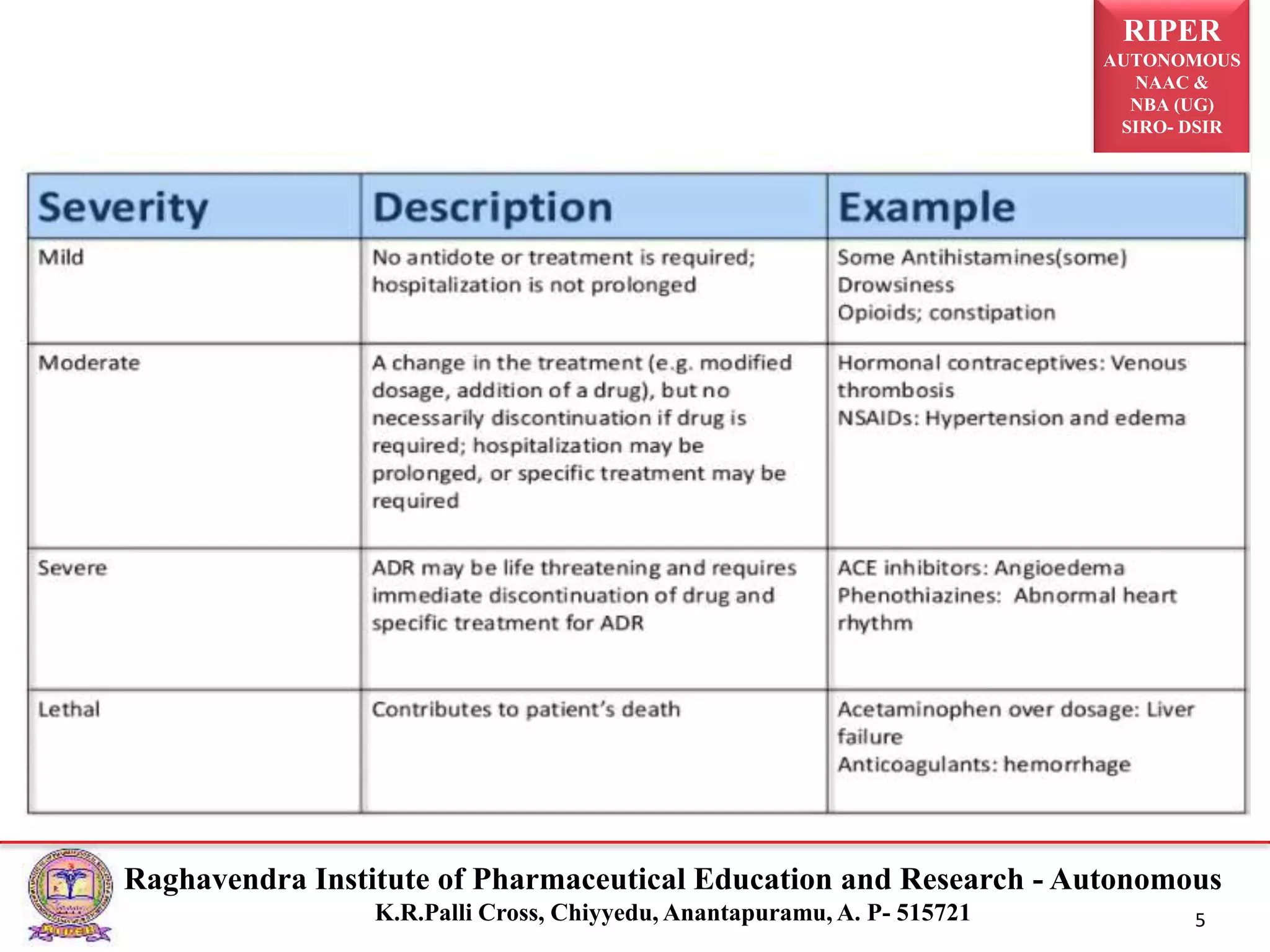
1.Karch and Lasagna classify severity into minor, moderate, severe and
lethal.
• Mild(Minor)
• Moderate
• Severe
• lethal
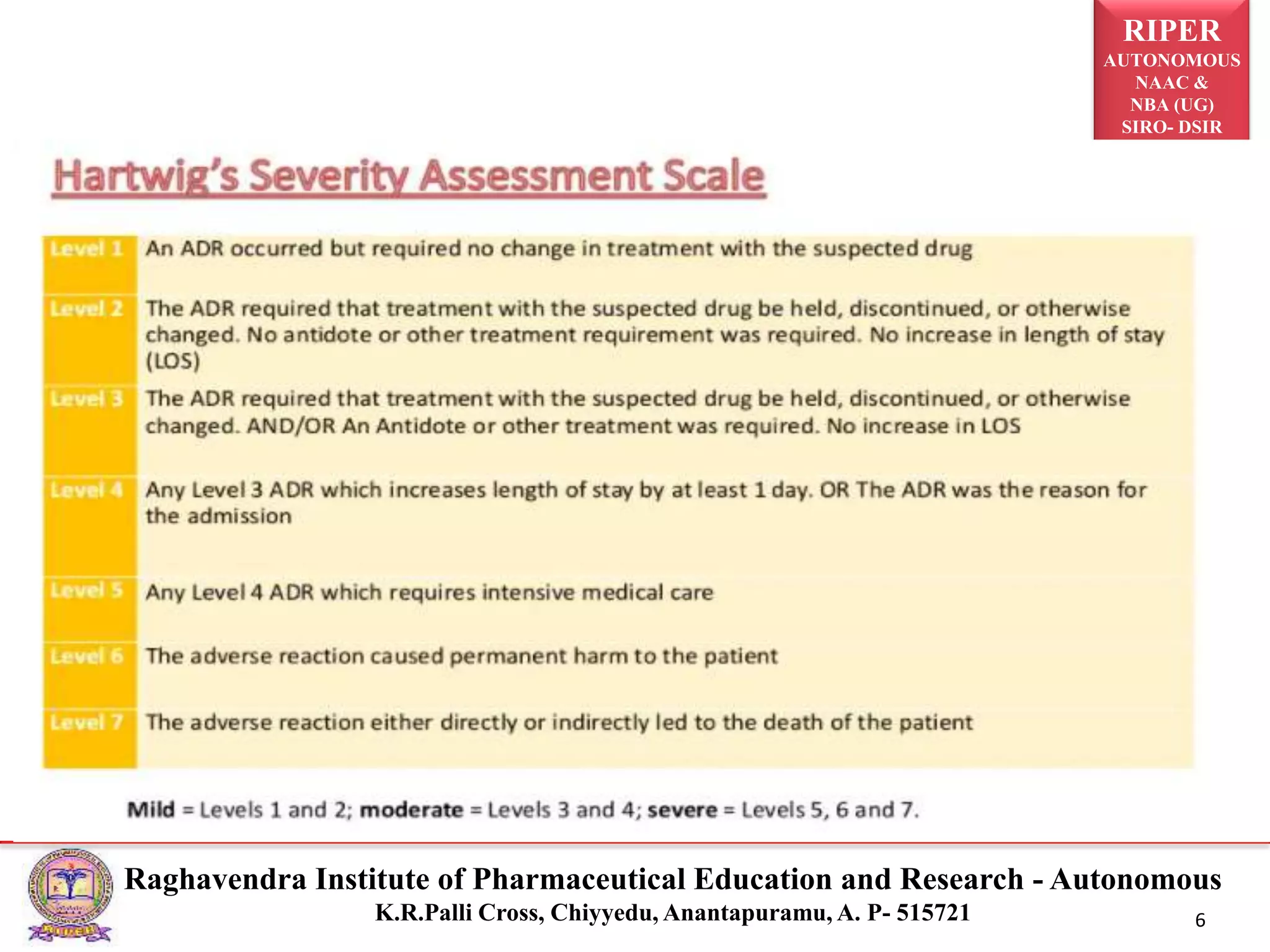
2.Hartwig et al categorized ADRs into seven levels as per their
severity.
• Level 1 & 2 fall under mild category, level 3 & 4 under moderate and
level 5, 6 & 7 fall under severe category.
Severity Assessment:
RIPER
AUTONOMOUS
NAAC &
NBA (UG)
SIRO- DSIR
Raghavendra Institute of Pharmaceutical Education and Research - Autonomous
K.R.Palli Cross, Chiyyedu, Anantapuramu, A. P- 515721 5
RIPER
AUTONOMOUS
NAAC &
NBA (UG)
SIRO- DSIR
Raghavendra Institute of Pharmaceutical Education and Research - Autonomous
K.R.Palli Cross, Chiyyedu, Anantapuramu, A. P- 515721 6
RIPER
AUTONOMOUS
NAAC &
NBA (UG)
SIRO- DSIR
Raghavendra Institute of Pharmaceutical Education and Research - Autonomous
K.R.Palli Cross, Chiyyedu, Anantapuramu, A. P- 515721 7
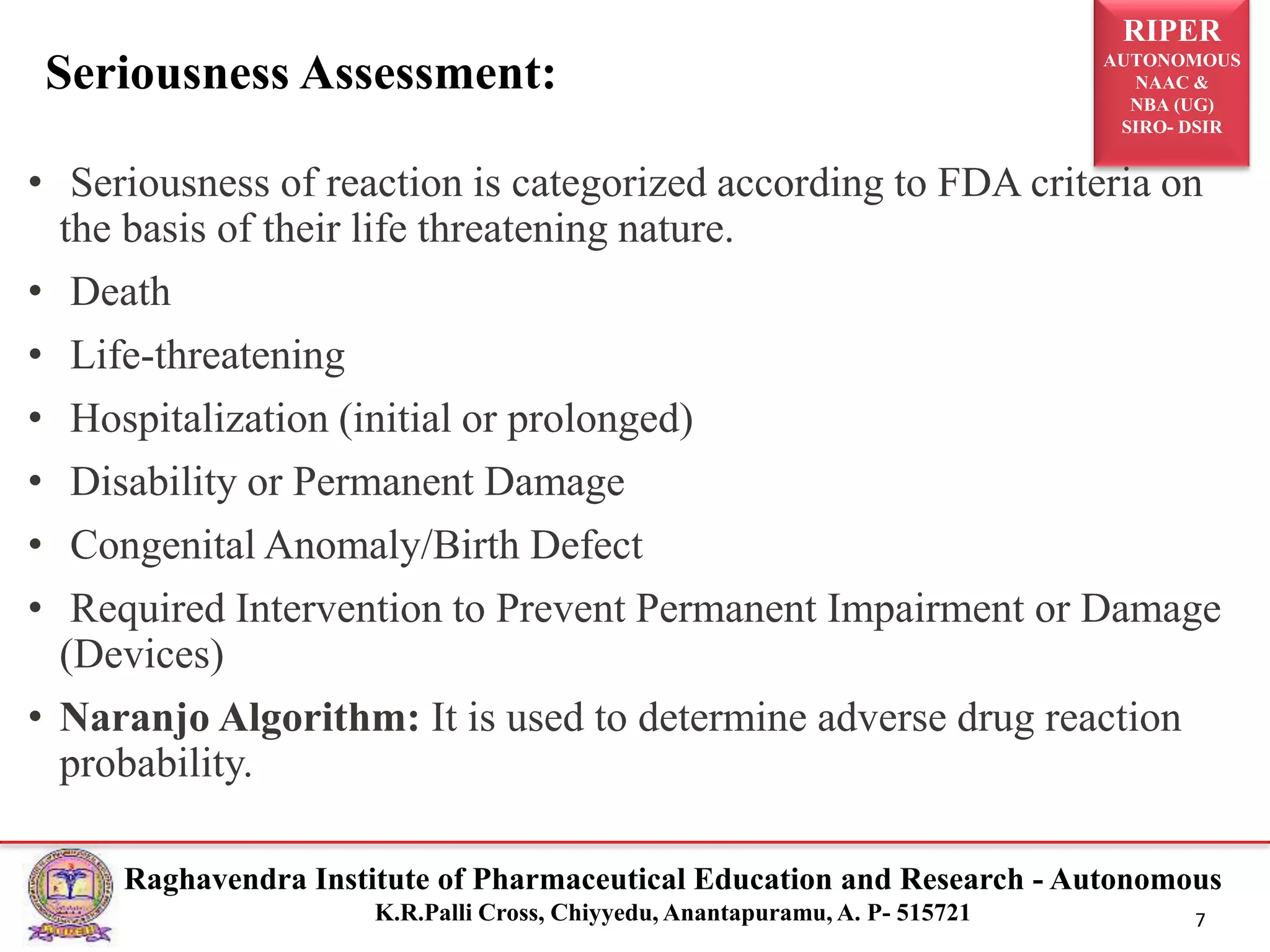
• Seriousness of reaction is categorized according to FDA criteria on
the basis of their life threatening nature.
• Death
• Life-threatening
• Hospitalization (initial or prolonged)
• Disability or Permanent Damage
• Congenital Anomaly/Birth Defect
• Required Intervention to Prevent Permanent Impairment or Damage
(Devices)
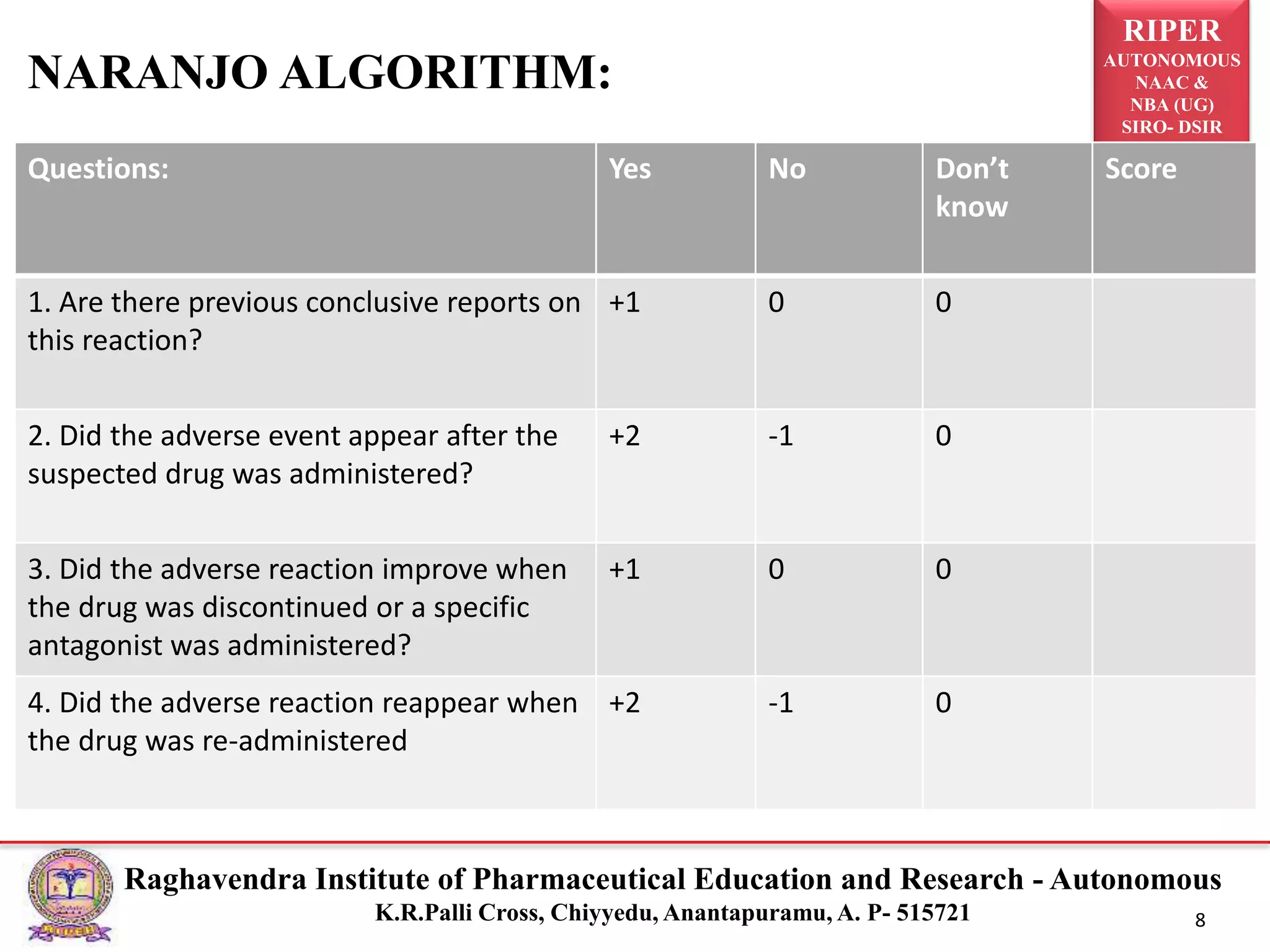
• Naranjo Algorithm: It is used to determine adverse drug reaction
probability.
Seriousness Assessment:
RIPER
AUTONOMOUS
NAAC &
NBA (UG)
SIRO- DSIR
Raghavendra Institute of Pharmaceutical Education and Research - Autonomous
K.R.Palli Cross, Chiyyedu, Anantapuramu, A. P- 515721 8
Questions: Yes No Don’t
know
Score
1. Are there previous conclusive reports on
this reaction?
+1 0 0
2. Did the adverse event appear after the
suspected drug was administered?
+2 -1 0
3. Did the adverse reaction improve when
the drug was discontinued or a specific
antagonist was administered?
+1 0 0
4. Did the adverse reaction reappear when
the drug was re-administered
+2 -1 0
NARANJO ALGORITHM:
RIPER
AUTONOMOUS
NAAC &
NBA (UG)
SIRO- DSIR
Raghavendra Institute of Pharmaceutical Education and Research - Autonomous
K.R.Palli Cross, Chiyyedu, Anantapuramu, A. P- 515721 9
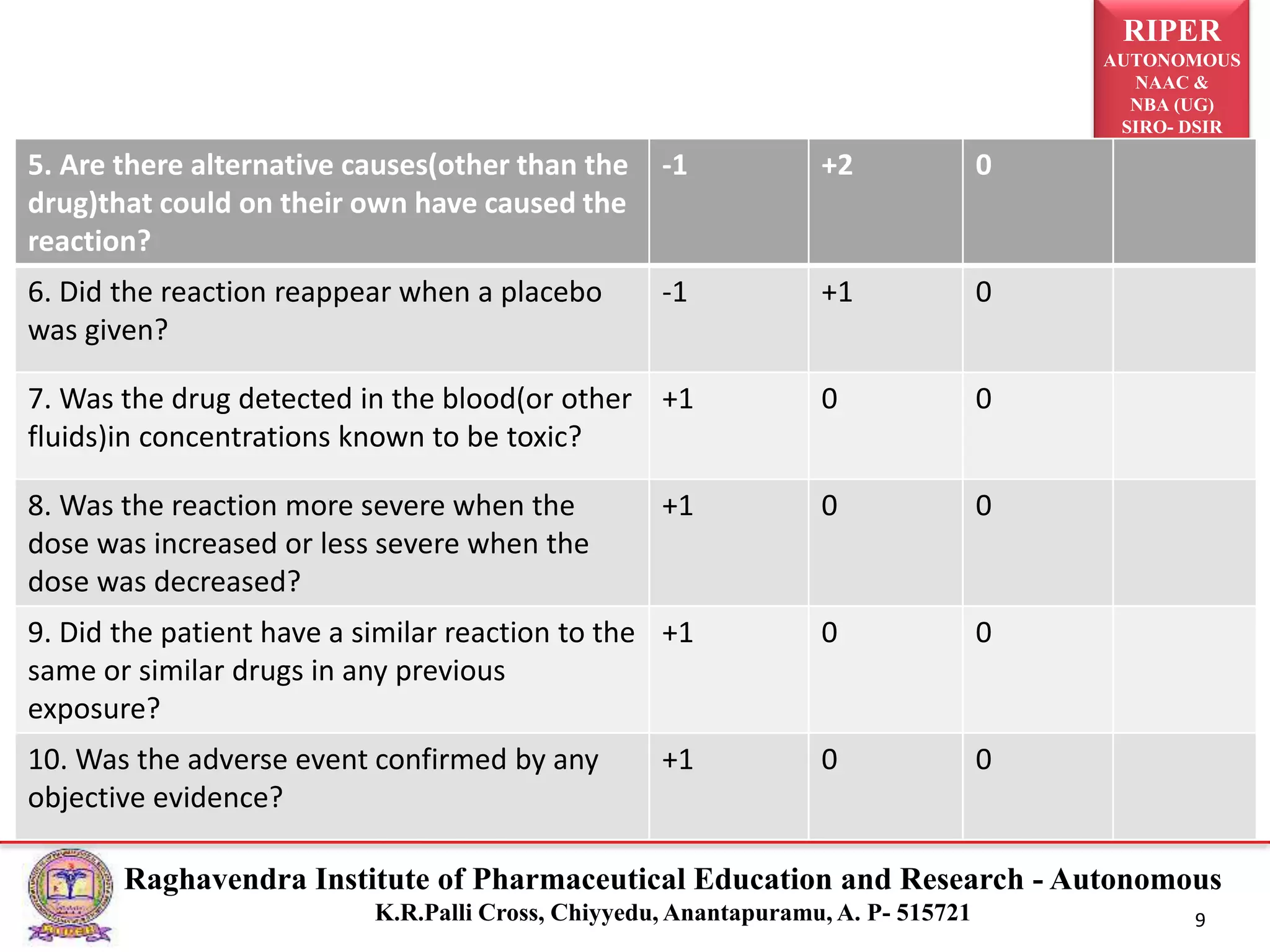
5. Are there alternative causes(other than the
drug)that could on their own have caused the
reaction?
-1 +2 0
6. Did the reaction reappear when a placebo
was given?
-1 +1 0
7. Was the drug detected in the blood(or other
fluids)in concentrations known to be toxic?
+1 0 0
8. Was the reaction more severe when the
dose was increased or less severe when the
dose was decreased?
+1 0 0
9. Did the patient have a similar reaction to the
same or similar drugs in any previous
exposure?
+1 0 0
10. Was the adverse event confirmed by any
objective evidence?
+1 0 0
RIPER
AUTONOMOUS
NAAC &
NBA (UG)
SIRO- DSIR
Raghavendra Institute of Pharmaceutical Education and Research - Autonomous
K.R.Palli Cross, Chiyyedu, Anantapuramu, A. P- 515721 10
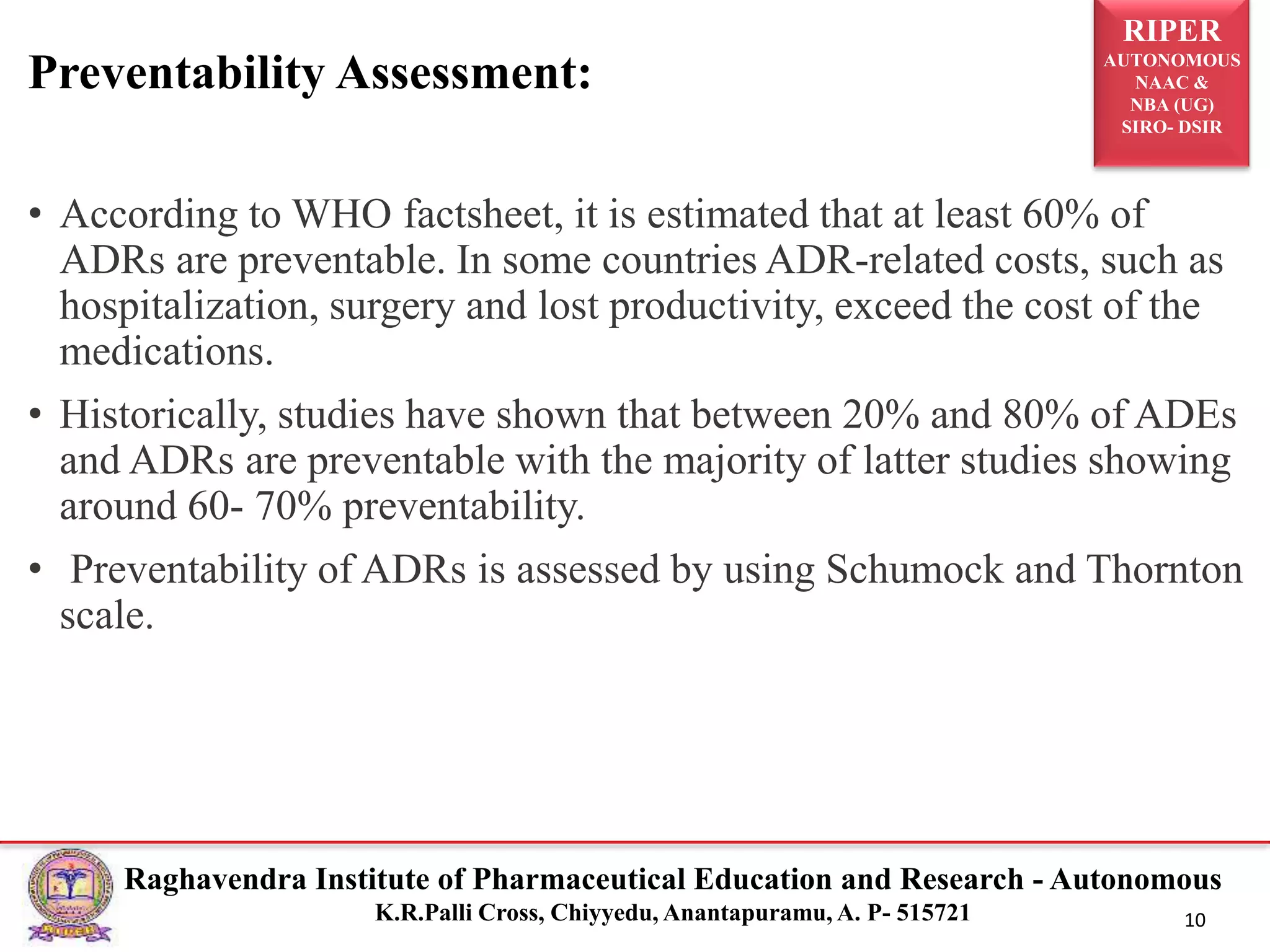
• According to WHO factsheet, it is estimated that at least 60% of
ADRs are preventable. In some countries ADR-related costs, such as
hospitalization, surgery and lost productivity, exceed the cost of the
medications.
• Historically, studies have shown that between 20% and 80% of ADEs
and ADRs are preventable with the majority of latter studies showing
around 60- 70% preventability.
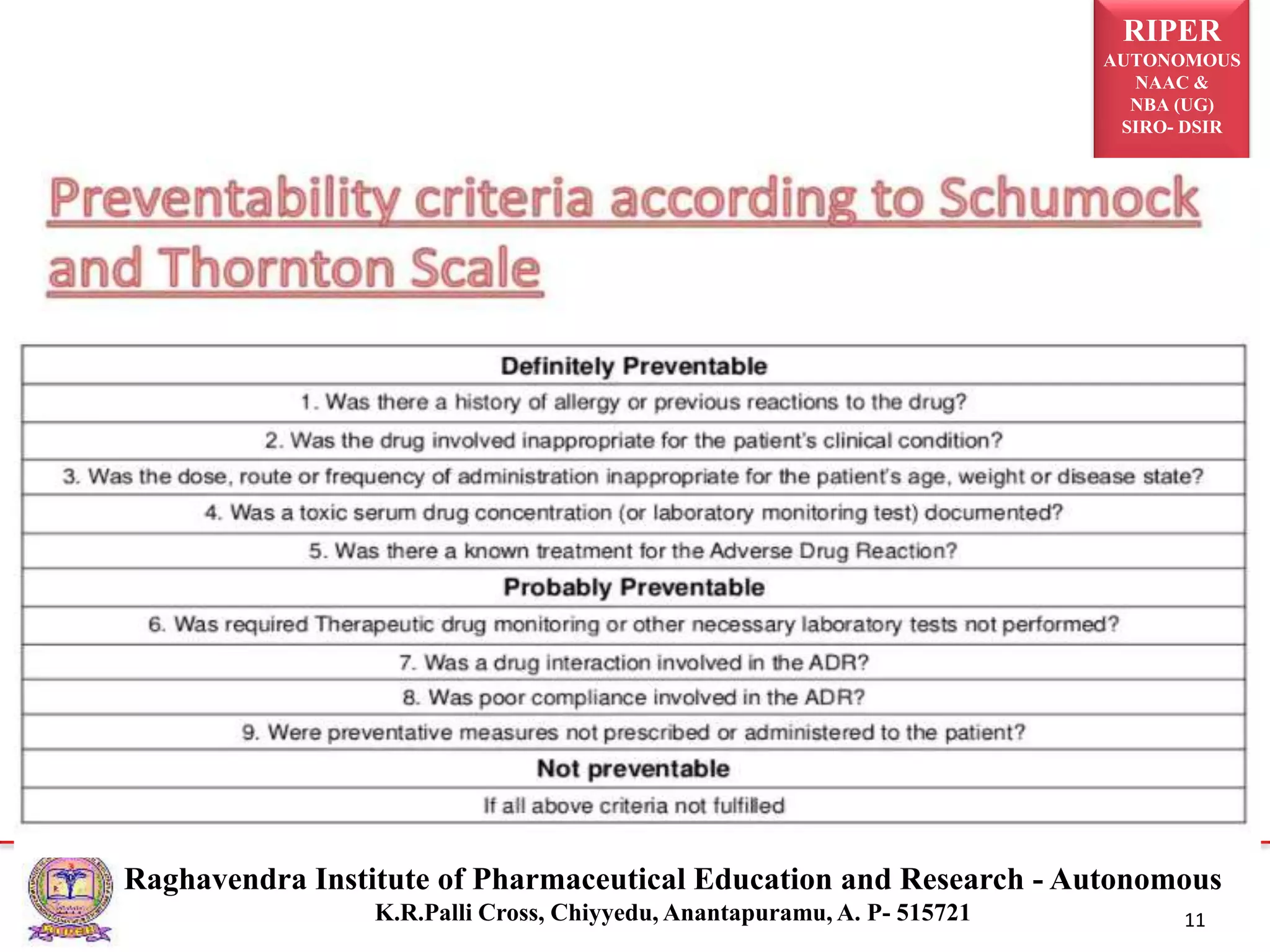
• Preventability of ADRs is assessed by using Schumock and Thornton
scale.
Preventability Assessment:
RIPER
AUTONOMOUS
NAAC &
NBA (UG)
SIRO- DSIR
Raghavendra Institute of Pharmaceutical Education and Research - Autonomous
K.R.Palli Cross, Chiyyedu, Anantapuramu, A. P- 515721 11
RIPER
AUTONOMOUS
NAAC &
NBA (UG)
SIRO- DSIR
Raghavendra Institute of Pharmaceutical Education and Research - Autonomous
K.R.Palli Cross, Chiyyedu, Anantapuramu, A. P- 515721 12
1. Parthasarathy G, Hansen k Nyfort, Nahata CM; A textbook of
Clinical Pharmacy Practice; pp 89-97
2. Schumock GT and Thornton JP. Focusing on the Preventability of
Adverse Drug Reactions. Hosp. Pharm. 1992;27:538.
3. Uppsala Monitoring Centre. Hospital based pharmacovigilance: a
clinical pharmacist’s perspective. Uppsala reports. 2002;20:10–11.
REFERENCES :
RIPER
AUTONOMOUS
NAAC &
NBA (UG)
SIRO- DSIR
Raghavendra Institute of Pharmaceutical Education and Research - Autonomous
K.R.Palli Cross, Chiyyedu, Anantapuramu, A. P- 515721 13

SEVERITY AND SERIOUSNESS ASSESSMENT OF ADR’S

  • 1.
    RIPER AUTONOMOUS NAAC & NBA (UG) SIRO-DSIR Raghavendra Institute of Pharmaceutical Education and Research - Autonomous K.R.Palli Cross, Chiyyedu, Anantapuramu, A. P- 515721 1 SEVERITY AND SERIOUSNESS ASSESSMENT OF ADR’S A Seminar as a part of curricular requirement for I year M. Pharm II semester Presented by Ms. B. Mary Vishali (Reg. No. 20L81S0104) Department of Pharmacology Under the guidance/Mentorship of Dr. Pradeep Kumar., PhD Assistant Professor Department of Pharmacology.
  • 2.
    RIPER AUTONOMOUS NAAC & NBA (UG) SIRO-DSIR Raghavendra Institute of Pharmaceutical Education and Research - Autonomous K.R.Palli Cross, Chiyyedu, Anantapuramu, A. P- 515721 2 • Definitions • Severity assessment • Seriousness assessment • Naranjo algorithm • Preventability assessment • References CONTENTS:
  • 3.
    RIPER AUTONOMOUS NAAC & NBA (UG) SIRO-DSIR Raghavendra Institute of Pharmaceutical Education and Research - Autonomous K.R.Palli Cross, Chiyyedu, Anantapuramu, A. P- 515721 3 • Adverse Drug Reaction: According to WHO Adverse drug reaction is defined as ”A response to a drug which is noxious and unintended, and which occurs at doses normally used in man for the prophylaxis, diagnosis, or therapy of disease, or for the modifications of physiological function.” • Adverse Event: Adverse event is defined as ” Any medical occurrence temporally associated with the use of a medicinal product, but not necessarily causally related.” • Severity: It describes the extent to which the ADRs influence the everyday life of a patients. • Seriousness: It is of an ADR is related to its life threatening nature and is defined as any untoward reaction to the medicinal product that may result in death and requires patient hospitalization. DEFINITIONS:
  • 4.
    RIPER AUTONOMOUS NAAC & NBA (UG) SIRO-DSIR Raghavendra Institute of Pharmaceutical Education and Research - Autonomous K.R.Palli Cross, Chiyyedu, Anantapuramu, A. P- 515721 4 1.Karch and Lasagna classify severity into minor, moderate, severe and lethal. • Mild(Minor) • Moderate • Severe • lethal 2.Hartwig et al categorized ADRs into seven levels as per their severity. • Level 1 & 2 fall under mild category, level 3 & 4 under moderate and level 5, 6 & 7 fall under severe category. Severity Assessment:
  • 5.
    RIPER AUTONOMOUS NAAC & NBA (UG) SIRO-DSIR Raghavendra Institute of Pharmaceutical Education and Research - Autonomous K.R.Palli Cross, Chiyyedu, Anantapuramu, A. P- 515721 5
  • 6.
    RIPER AUTONOMOUS NAAC & NBA (UG) SIRO-DSIR Raghavendra Institute of Pharmaceutical Education and Research - Autonomous K.R.Palli Cross, Chiyyedu, Anantapuramu, A. P- 515721 6
  • 7.
    RIPER AUTONOMOUS NAAC & NBA (UG) SIRO-DSIR Raghavendra Institute of Pharmaceutical Education and Research - Autonomous K.R.Palli Cross, Chiyyedu, Anantapuramu, A. P- 515721 7 • Seriousness of reaction is categorized according to FDA criteria on the basis of their life threatening nature. • Death • Life-threatening • Hospitalization (initial or prolonged) • Disability or Permanent Damage • Congenital Anomaly/Birth Defect • Required Intervention to Prevent Permanent Impairment or Damage (Devices) • Naranjo Algorithm: It is used to determine adverse drug reaction probability. Seriousness Assessment:
  • 8.
    RIPER AUTONOMOUS NAAC & NBA (UG) SIRO-DSIR Raghavendra Institute of Pharmaceutical Education and Research - Autonomous K.R.Palli Cross, Chiyyedu, Anantapuramu, A. P- 515721 8 Questions: Yes No Don’t know Score 1. Are there previous conclusive reports on this reaction? +1 0 0 2. Did the adverse event appear after the suspected drug was administered? +2 -1 0 3. Did the adverse reaction improve when the drug was discontinued or a specific antagonist was administered? +1 0 0 4. Did the adverse reaction reappear when the drug was re-administered +2 -1 0 NARANJO ALGORITHM:
  • 9.
    RIPER AUTONOMOUS NAAC & NBA (UG) SIRO-DSIR Raghavendra Institute of Pharmaceutical Education and Research - Autonomous K.R.Palli Cross, Chiyyedu, Anantapuramu, A. P- 515721 9 5. Are there alternative causes(other than the drug)that could on their own have caused the reaction? -1 +2 0 6. Did the reaction reappear when a placebo was given? -1 +1 0 7. Was the drug detected in the blood(or other fluids)in concentrations known to be toxic? +1 0 0 8. Was the reaction more severe when the dose was increased or less severe when the dose was decreased? +1 0 0 9. Did the patient have a similar reaction to the same or similar drugs in any previous exposure? +1 0 0 10. Was the adverse event confirmed by any objective evidence? +1 0 0
  • 10.
    RIPER AUTONOMOUS NAAC & NBA (UG) SIRO-DSIR Raghavendra Institute of Pharmaceutical Education and Research - Autonomous K.R.Palli Cross, Chiyyedu, Anantapuramu, A. P- 515721 10 • According to WHO factsheet, it is estimated that at least 60% of ADRs are preventable. In some countries ADR-related costs, such as hospitalization, surgery and lost productivity, exceed the cost of the medications. • Historically, studies have shown that between 20% and 80% of ADEs and ADRs are preventable with the majority of latter studies showing around 60- 70% preventability. • Preventability of ADRs is assessed by using Schumock and Thornton scale. Preventability Assessment:
  • 11.
    RIPER AUTONOMOUS NAAC & NBA (UG) SIRO-DSIR Raghavendra Institute of Pharmaceutical Education and Research - Autonomous K.R.Palli Cross, Chiyyedu, Anantapuramu, A. P- 515721 11
  • 12.
    RIPER AUTONOMOUS NAAC & NBA (UG) SIRO-DSIR Raghavendra Institute of Pharmaceutical Education and Research - Autonomous K.R.Palli Cross, Chiyyedu, Anantapuramu, A. P- 515721 12 1. Parthasarathy G, Hansen k Nyfort, Nahata CM; A textbook of Clinical Pharmacy Practice; pp 89-97 2. Schumock GT and Thornton JP. Focusing on the Preventability of Adverse Drug Reactions. Hosp. Pharm. 1992;27:538. 3. Uppsala Monitoring Centre. Hospital based pharmacovigilance: a clinical pharmacist’s perspective. Uppsala reports. 2002;20:10–11. REFERENCES :
  • 13.
    RIPER AUTONOMOUS NAAC & NBA (UG) SIRO-DSIR Raghavendra Institute of Pharmaceutical Education and Research - Autonomous K.R.Palli Cross, Chiyyedu, Anantapuramu, A. P- 515721 13