Random Matrix Theory for Machine Learning
Introduction to Random Matrix Theory
Fabian Pedregosa, Courtney Paquette, Tom Trogdon, Jeffrey Pennington
https://random-matrix-learning.github.io
Table of contents
1. Stieltjes Transform
2. R-Transform
1
Stieltjes Transform
Maximum entropy principle
A disordered (real world) system will be random in all ways that are
not explicitly prevented.
Conversely, a matrix is interesting only in those ways it fails to look
like a random matrix.
Notes of Elliot Paquette and the thesis, A random matrix framework for large
dimensional machine learning and neural networks by Zhenyu Liao
2
Example MNIST
MNIST M (60, 000 × 28 × 28), form sample covariance matrix, S = MMT
Does S look like a random matrix?
3
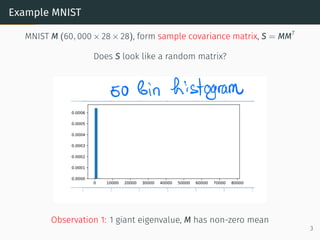
Example MNIST
MNIST M (60, 000 × 28 × 28), form sample covariance matrix, S = MMT
Does S look like a random matrix?
Observation 1: 1 giant eigenvalue, M has non-zero mean
3
Example MNIST
Remove large eigenvalue
4
Example MNIST
Observation 2: There is a bulk component
• Fit bulk with Marchenko-Pastur(1) to correspond to point mass
• Large eigenvalue correspond to interesting outliers
• May be ”hidden” (weak) outliers in the bulk eigenvalues
5
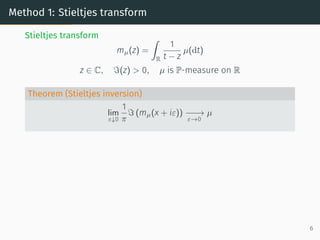
Method 1: Stieltjes transform
Stieltjes transform
mµ(z) =
Z
R
1
t − z
µ(dt)
z ∈ C, ℑ(z) > 0, µ is P-measure on R
Theorem (Stieltjes inversion)
lim
ε↓0
1
π
ℑ (mµ(x + iε)) −
−
−
→
ε→0
µ
6
Method 1: Stieltjes transform
Stieltjes transform
mµ(z) =
Z
R
1
t − z
µ(dt)
z ∈ C, ℑ(z) > 0, µ is P-measure on R
Theorem (Stieltjes inversion)
lim
ε↓0
1
π
ℑ (mµ(x + iε)) −
−
−
→
ε→0
µ
Example: µ is law of Unif([−1, 1])
Stieltjes transform:
mµ(z) =
1
2
Z
R
1
t − z
1 ({|t| ≤ 1}) dt =
1
2
Z 1
−1
dt
t − z
=
1
2
log

1 − z
−1 − z

Inversion lim
ε↓0
ℑ
π

1
2
log

1 − z
−1 − z
z=x+iε
=







1
2
, if |x|  1
0, if |x|  1
⋆, |x| = 1
6
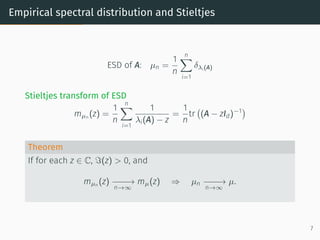
Empirical spectral distribution and Stieltjes
ESD of A: µn =
1
n
n
X
i=1
δλi(A)
Stieltjes transform of ESD
mµn
(z) =
1
n
n
X
i=1
1
λi(A) − z
=
1
n
tr (A − zId)−1

Theorem
If for each z ∈ C, ℑ(z)  0, and
mµn
(z) −
−
−
→
n→∞
mµ(z) ⇒ µn −
−
−
→
n→∞
µ.
7
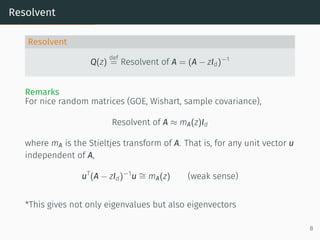
Resolvent
Resolvent
Q(z)
def
= Resolvent of A = (A − zId)−1
Remarks
For nice random matrices (GOE, Wishart, sample covariance),
Resolvent of A ≈ mA(z)Id
where mA is the Stieltjes transform of A. That is, for any unit vector u
independent of A,
uT
(A − zId)−1
u ∼
= mA(z) (weak sense)
*This gives not only eigenvalues but also eigenvectors
8
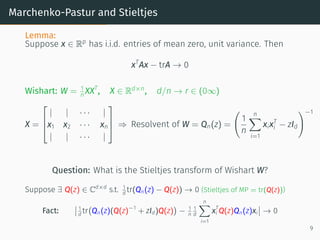
Marchenko-Pastur and Stieltjes
Lemma:
Suppose x ∈ Rp
has i.i.d. entries of mean zero, unit variance. Then
xT
Ax − trA → 0
Wishart: W = 1
n XXT
, X ∈ Rd×n
, d/n → r ∈ (0∞)
X =



| | · · · |
x1 x2 · · · xn
| | · · · |


 ⇒ Resolvent of W = Qn(z) =
1
n
n
X
i=1
xixT
i − zId
!−1
Question: What is the Stieltjes transform of Wishart W?
Suppose ∃ Q(z) ∈ Cd×d
s.t. 1
d
tr(Qn(z) − Q(z)) → 0 (Stieltjes of MP = tr(Q(z)))
Fact:
1
d
tr Qn(z)(Q(z)−1
+ zId)Q(z)

− 1
n
1
d
n
X
i=1
xT
i Q(z)Qn(z)xi
→ 0
9
Marchenko-Pastur and Stieltjes
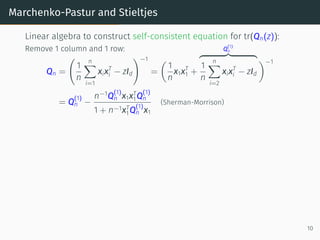
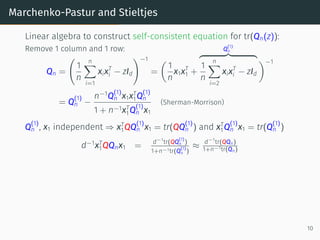
Linear algebra to construct self-consistent equation for tr(Qn(z)):
Remove 1 column and 1 row:
Qn =
1
n
n
X
i=1
xixT
i − zId
!−1
=

1
n
x1xT
1 +
Q
(1)
n
z }| {
1
n
n
X
i=2
xixT
i − zId
−1
= Q
(1)
n −
n−1
Q
(1)
n x1xT
1 Q
(1)
n
1 + n−1xT
1 Q
(1)
n x1
(Sherman-Morrison)
10
Marchenko-Pastur and Stieltjes
Linear algebra to construct self-consistent equation for tr(Qn(z)):
Remove 1 column and 1 row:
Qn =
1
n
n
X
i=1
xixT
i − zId
!−1
=

1
n
x1xT
1 +
Q
(1)
n
z }| {
1
n
n
X
i=2
xixT
i − zId
−1
= Q
(1)
n −
n−1
Q
(1)
n x1xT
1 Q
(1)
n
1 + n−1xT
1 Q
(1)
n x1
(Sherman-Morrison)
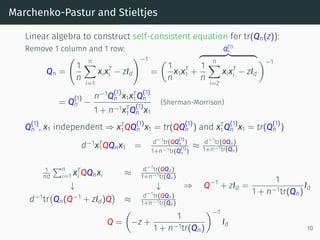
Q
(1)
n , x1 independent ⇒ xT
1 QQ
(1)
n x1 = tr(QQ
(1)
n ) and xT
1 Q
(1)
n x1 = tr(Q
(1)
n )
d−1
xT
1 QQnx1 = d−1
tr(QQ
(1)
n )
1+n−1tr(Q
(1)
n )
≈ d−1
tr(QQn)
1+n−1tr(Qn)
10
Marchenko-Pastur and Stieltjes
Linear algebra to construct self-consistent equation for tr(Qn(z)):
Remove 1 column and 1 row:
Qn =
1
n
n
X
i=1
xixT
i − zId
!−1
=

1
n
x1xT
1 +
Q
(1)
n
z }| {
1
n
n
X
i=2
xixT
i − zId
−1
= Q
(1)
n −
n−1
Q
(1)
n x1xT
1 Q
(1)
n
1 + n−1xT
1 Q
(1)
n x1
(Sherman-Morrison)
Q
(1)
n , x1 independent ⇒ xT
1 QQ
(1)
n x1 = tr(QQ
(1)
n ) and xT
1 Q
(1)
n x1 = tr(Q
(1)
n )
d−1
xT
1 QQnx1 = d−1
tr(QQ
(1)
n )
1+n−1tr(Q
(1)
n )
≈ d−1
tr(QQn)
1+n−1tr(Qn)
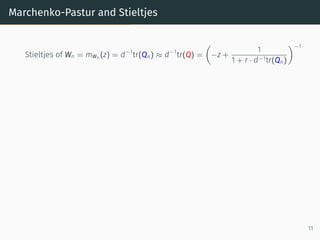
1
nd
Pn
i=1 xT
i QQnxi ≈ d−1
tr(QQn)
1+n−1tr(Qn)
↓ ↓
d−1
tr Qn(Q−1
+ zId)Q

≈ d−1
tr(QQn)
1+n−1tr(Qn)
⇒ Q−1
+ zId =
1
1 + n−1tr(Qn)
Id
Q =

−z +
1
1 + n−1tr(Qn)
−1
Id
10
Marchenko-Pastur and Stieltjes
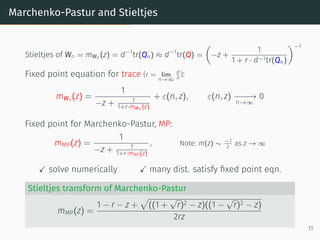
Stieltjes of Wn = mWn (z) = d−1
tr(Qn) ≈ d−1
tr(Q) =

−z +
1
1 + r · d−1tr(Qn)
−1
11
Marchenko-Pastur and Stieltjes
Stieltjes of Wn = mWn (z) = d−1
tr(Qn) ≈ d−1
tr(Q) =

−z +
1
1 + r · d−1tr(Qn)
−1
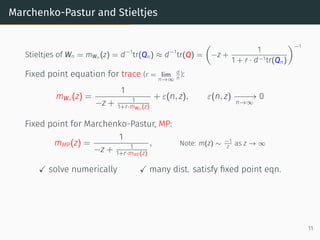
Fixed point equation for trace (r = lim
n→∞
d
n
):
mWn
(z) =
1
−z + 1
1+r·mWn (z)
+ ε(n, z), ε(n, z) −
−
−
→
n→∞
0
Fixed point for Marchenko-Pastur, MP:
mMP(z) =
1
−z + 1
1+r·mMP(z)
, Note: m(z) ∼ −1
z
as z → ∞
✓ solve numerically ✓ many dist. satisfy fixed point eqn.
11
Marchenko-Pastur and Stieltjes
Stieltjes of Wn = mWn (z) = d−1
tr(Qn) ≈ d−1
tr(Q) =

−z +
1
1 + r · d−1tr(Qn)
−1
Fixed point equation for trace (r = lim
n→∞
d
n
):
mWn
(z) =
1
−z + 1
1+r·mWn (z)
+ ε(n, z), ε(n, z) −
−
−
→
n→∞
0
Fixed point for Marchenko-Pastur, MP:
mMP(z) =
1
−z + 1
1+r·mMP(z)
, Note: m(z) ∼ −1
z
as z → ∞
✓ solve numerically ✓ many dist. satisfy fixed point eqn.
Stieltjes transform of Marchenko-Pastur
mMP(z) =
1 − r − z +
p
((1 +
√
r)2 − z)((1 −
√
r)2 − z)
2rz
11
Bulk + outliers
How do we model this?
Bulk + Outliers
↓ ↓
Model: Marchenko-Pastur + Spikes
12
Sample covariance matrices
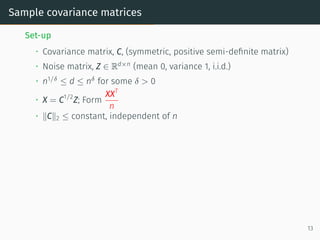
Set-up
• Covariance matrix, C, (symmetric, positive semi-definite matrix)
• Noise matrix, Z ∈ Rd×n
(mean 0, variance 1, i.i.d.)
• n1/δ
≤ d ≤ nδ
for some δ  0
• X = C1/2
Z; Form
XXT
n
• ∥C∥2 ≤ constant, independent of n
13
Sample covariance matrices
Set-up
• Covariance matrix, C, (symmetric, positive semi-definite matrix)
• Noise matrix, Z ∈ Rd×n
(mean 0, variance 1, i.i.d.)
• n1/δ
≤ d ≤ nδ
for some δ  0
• X = C1/2
Z; Form
XXT
n
• ∥C∥2 ≤ constant, independent of n
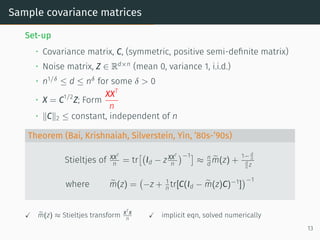
Theorem (Bai, Krishnaiah, Silverstein, Yin, ’80s-’90s)
Stieltjes of XXT
n = tr

Id − zXXT
n
−1
≈ n
d
e
m(z) +
1− d
n
d
n z
where e
m(z) = −z + 1
n tr[C(Id − e
m(z)C)−1
]
−1
✓ e
m(z) ≈ Stieltjes transform XT
X
n
✓ implicit eqn, solved numerically
13
Examples of Sample Covariances
See Colab for details
14
R-Transform
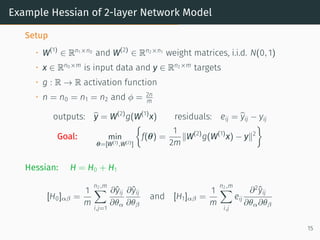
Example Hessian of 2-layer Network Model
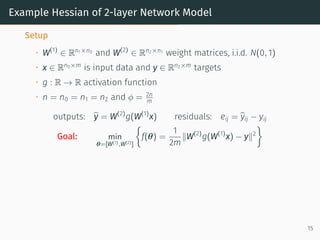
Setup
• W(1)
∈ Rn1×n0
and W(2)
∈ Rn2×n1
weight matrices, i.i.d. N(0, 1)
• x ∈ Rn0×m
is input data and y ∈ Rn2×m
targets
• g : R → R activation function
• n = n0 = n1 = n2 and ϕ = 2n
m
outputs: b
y = W(2)
g(W(1)
x) residuals: eij = b
yij − yij
Goal: min
θ=[W(1),W(2)]

f(θ) =
1
2m
∥W(2)
g(W(1)
x) − y∥2

15
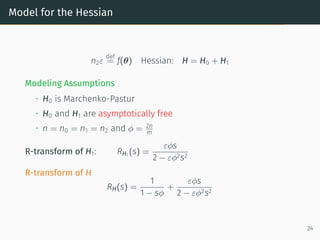
Example Hessian of 2-layer Network Model
Setup
• W(1)
∈ Rn1×n0
and W(2)
∈ Rn2×n1
weight matrices, i.i.d. N(0, 1)
• x ∈ Rn0×m
is input data and y ∈ Rn2×m
targets
• g : R → R activation function
• n = n0 = n1 = n2 and ϕ = 2n
m
outputs: b
y = W(2)
g(W(1)
x) residuals: eij = b
yij − yij
Goal: min
θ=[W(1),W(2)]

f(θ) =
1
2m
∥W(2)
g(W(1)
x) − y∥2

Hessian: H = H0 + H1
[H0]αβ =
1
m
n2,m
X
i,j=1
∂ŷij
∂θα
∂ŷij
∂θβ
and [H1]αβ =
1
m
n2,m
X
i,j
eij
∂2
ŷij
∂θα∂θβ
15
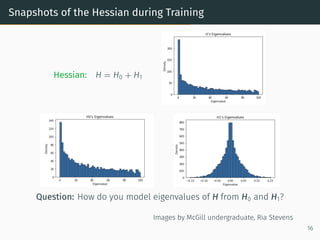
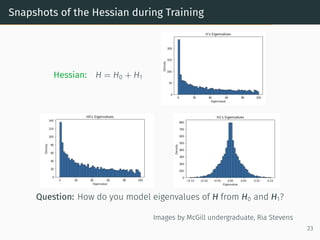
Snapshots of the Hessian during Training
Hessian: H = H0 + H1
Question: How do you model eigenvalues of H from H0 and H1?
Images by McGill undergraduate, Ria Stevens
16
R-Transform
R-Transform
Tool for writing simple formulas for densities from known densities
17
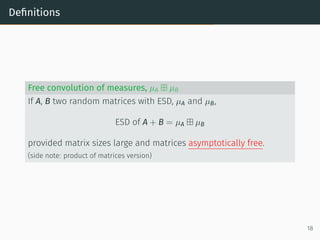
Definitions
Free convolution of measures, µA ⊞ µB
If A, B two random matrices with ESD, µA and µB,
ESD of A + B = µA ⊞ µB
provided matrix sizes large and matrices asymptotically free.
(side note: product of matrices version)
18
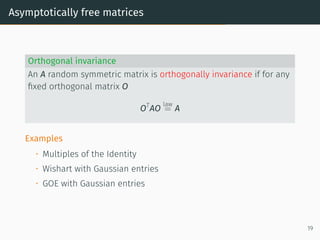
Asymptotically free matrices
Orthogonal invariance
An A random symmetric matrix is orthogonally invariance if for any
fixed orthogonal matrix O
OT
AO
law
= A
Examples
• Multiples of the Identity
• Wishart with Gaussian entries
• GOE with Gaussian entries
19
Asymptotically free matrices
Sufficient condition
Suppose {An} and {Bn} are n × n random matrices. If the following
• An and Bn are independent
• An is orthogonally invariant
Then An and Bn are asymptotically free and µAn ⊞ µBn
∼
= µAn+Bn
Intuition: Eigenvectors of An are completely unaligned from Bn
20
Stieltjes and R-transform
R-transform
R-transform is inverse of Stieltjes of m
R(−m(z)) −
1
m(z)
= z.
Examples
• βuuT
is RβuuT = β
n(1−sβ)
• RMarchenko-Pastur(r)(s) = 1
1−sr
• Rsemicircle(s) = s
21
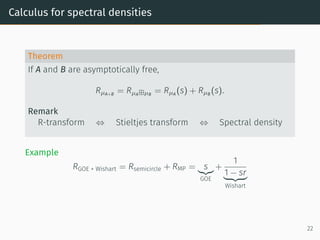
Calculus for spectral densities
Theorem
If A and B are asymptotically free,
RµA+B
= RµA⊞µB
= RµA
(s) + RµB
(s).
Remark
R-transform ⇔ Stieltjes transform ⇔ Spectral density
Example
RGOE + Wishart = Rsemicircle + RMP = s
|{z}
GOE
+
1
1 − sr
| {z }
Wishart
22

Random Matrix Theory and Machine Learning - Part 2

  • 1.
    Random Matrix Theoryfor Machine Learning Introduction to Random Matrix Theory Fabian Pedregosa, Courtney Paquette, Tom Trogdon, Jeffrey Pennington https://random-matrix-learning.github.io
  • 2.
    Table of contents 1.Stieltjes Transform 2. R-Transform 1
  • 3.
  • 4.
    Maximum entropy principle Adisordered (real world) system will be random in all ways that are not explicitly prevented. Conversely, a matrix is interesting only in those ways it fails to look like a random matrix. Notes of Elliot Paquette and the thesis, A random matrix framework for large dimensional machine learning and neural networks by Zhenyu Liao 2
  • 5.
    Example MNIST MNIST M(60, 000 × 28 × 28), form sample covariance matrix, S = MMT Does S look like a random matrix? 3
  • 6.
    Example MNIST MNIST M(60, 000 × 28 × 28), form sample covariance matrix, S = MMT Does S look like a random matrix? Observation 1: 1 giant eigenvalue, M has non-zero mean 3
  • 7.
  • 8.
    Example MNIST Observation 2:There is a bulk component • Fit bulk with Marchenko-Pastur(1) to correspond to point mass • Large eigenvalue correspond to interesting outliers • May be ”hidden” (weak) outliers in the bulk eigenvalues 5
  • 9.
    Method 1: Stieltjestransform Stieltjes transform mµ(z) = Z R 1 t − z µ(dt) z ∈ C, ℑ(z) > 0, µ is P-measure on R Theorem (Stieltjes inversion) lim ε↓0 1 π ℑ (mµ(x + iε)) − − − → ε→0 µ 6
  • 10.
    Method 1: Stieltjestransform Stieltjes transform mµ(z) = Z R 1 t − z µ(dt) z ∈ C, ℑ(z) > 0, µ is P-measure on R Theorem (Stieltjes inversion) lim ε↓0 1 π ℑ (mµ(x + iε)) − − − → ε→0 µ Example: µ is law of Unif([−1, 1]) Stieltjes transform: mµ(z) = 1 2 Z R 1 t − z 1 ({|t| ≤ 1}) dt = 1 2 Z 1 −1 dt t − z = 1 2 log 1 − z −1 − z Inversion lim ε↓0 ℑ π 1 2 log 1 − z −1 − z
  • 12.
  • 13.
    Empirical spectral distributionand Stieltjes ESD of A: µn = 1 n n X i=1 δλi(A) Stieltjes transform of ESD mµn (z) = 1 n n X i=1 1 λi(A) − z = 1 n tr (A − zId)−1 Theorem If for each z ∈ C, ℑ(z) 0, and mµn (z) − − − → n→∞ mµ(z) ⇒ µn − − − → n→∞ µ. 7
  • 14.
    Resolvent Resolvent Q(z) def = Resolvent ofA = (A − zId)−1 Remarks For nice random matrices (GOE, Wishart, sample covariance), Resolvent of A ≈ mA(z)Id where mA is the Stieltjes transform of A. That is, for any unit vector u independent of A, uT (A − zId)−1 u ∼ = mA(z) (weak sense) *This gives not only eigenvalues but also eigenvectors 8
  • 15.
    Marchenko-Pastur and Stieltjes Lemma: Supposex ∈ Rp has i.i.d. entries of mean zero, unit variance. Then xT Ax − trA → 0 Wishart: W = 1 n XXT , X ∈ Rd×n , d/n → r ∈ (0∞) X =    | | · · · | x1 x2 · · · xn | | · · · |    ⇒ Resolvent of W = Qn(z) = 1 n n X i=1 xixT i − zId !−1 Question: What is the Stieltjes transform of Wishart W? Suppose ∃ Q(z) ∈ Cd×d s.t. 1 d tr(Qn(z) − Q(z)) → 0 (Stieltjes of MP = tr(Q(z))) Fact:
  • 17.
    1 d tr Qn(z)(Q(z)−1 + zId)Q(z) −1 n 1 d n X i=1 xT i Q(z)Qn(z)xi
  • 19.
  • 20.
    Marchenko-Pastur and Stieltjes Linearalgebra to construct self-consistent equation for tr(Qn(z)): Remove 1 column and 1 row: Qn = 1 n n X i=1 xixT i − zId !−1 = 1 n x1xT 1 + Q (1) n z }| { 1 n n X i=2 xixT i − zId −1 = Q (1) n − n−1 Q (1) n x1xT 1 Q (1) n 1 + n−1xT 1 Q (1) n x1 (Sherman-Morrison) 10
  • 21.
    Marchenko-Pastur and Stieltjes Linearalgebra to construct self-consistent equation for tr(Qn(z)): Remove 1 column and 1 row: Qn = 1 n n X i=1 xixT i − zId !−1 = 1 n x1xT 1 + Q (1) n z }| { 1 n n X i=2 xixT i − zId −1 = Q (1) n − n−1 Q (1) n x1xT 1 Q (1) n 1 + n−1xT 1 Q (1) n x1 (Sherman-Morrison) Q (1) n , x1 independent ⇒ xT 1 QQ (1) n x1 = tr(QQ (1) n ) and xT 1 Q (1) n x1 = tr(Q (1) n ) d−1 xT 1 QQnx1 = d−1 tr(QQ (1) n ) 1+n−1tr(Q (1) n ) ≈ d−1 tr(QQn) 1+n−1tr(Qn) 10
  • 22.
    Marchenko-Pastur and Stieltjes Linearalgebra to construct self-consistent equation for tr(Qn(z)): Remove 1 column and 1 row: Qn = 1 n n X i=1 xixT i − zId !−1 = 1 n x1xT 1 + Q (1) n z }| { 1 n n X i=2 xixT i − zId −1 = Q (1) n − n−1 Q (1) n x1xT 1 Q (1) n 1 + n−1xT 1 Q (1) n x1 (Sherman-Morrison) Q (1) n , x1 independent ⇒ xT 1 QQ (1) n x1 = tr(QQ (1) n ) and xT 1 Q (1) n x1 = tr(Q (1) n ) d−1 xT 1 QQnx1 = d−1 tr(QQ (1) n ) 1+n−1tr(Q (1) n ) ≈ d−1 tr(QQn) 1+n−1tr(Qn) 1 nd Pn i=1 xT i QQnxi ≈ d−1 tr(QQn) 1+n−1tr(Qn) ↓ ↓ d−1 tr Qn(Q−1 + zId)Q ≈ d−1 tr(QQn) 1+n−1tr(Qn) ⇒ Q−1 + zId = 1 1 + n−1tr(Qn) Id Q = −z + 1 1 + n−1tr(Qn) −1 Id 10
  • 23.
    Marchenko-Pastur and Stieltjes Stieltjesof Wn = mWn (z) = d−1 tr(Qn) ≈ d−1 tr(Q) = −z + 1 1 + r · d−1tr(Qn) −1 11
  • 24.
    Marchenko-Pastur and Stieltjes Stieltjesof Wn = mWn (z) = d−1 tr(Qn) ≈ d−1 tr(Q) = −z + 1 1 + r · d−1tr(Qn) −1 Fixed point equation for trace (r = lim n→∞ d n ): mWn (z) = 1 −z + 1 1+r·mWn (z) + ε(n, z), ε(n, z) − − − → n→∞ 0 Fixed point for Marchenko-Pastur, MP: mMP(z) = 1 −z + 1 1+r·mMP(z) , Note: m(z) ∼ −1 z as z → ∞ ✓ solve numerically ✓ many dist. satisfy fixed point eqn. 11
  • 25.
    Marchenko-Pastur and Stieltjes Stieltjesof Wn = mWn (z) = d−1 tr(Qn) ≈ d−1 tr(Q) = −z + 1 1 + r · d−1tr(Qn) −1 Fixed point equation for trace (r = lim n→∞ d n ): mWn (z) = 1 −z + 1 1+r·mWn (z) + ε(n, z), ε(n, z) − − − → n→∞ 0 Fixed point for Marchenko-Pastur, MP: mMP(z) = 1 −z + 1 1+r·mMP(z) , Note: m(z) ∼ −1 z as z → ∞ ✓ solve numerically ✓ many dist. satisfy fixed point eqn. Stieltjes transform of Marchenko-Pastur mMP(z) = 1 − r − z + p ((1 + √ r)2 − z)((1 − √ r)2 − z) 2rz 11
  • 26.
    Bulk + outliers Howdo we model this? Bulk + Outliers ↓ ↓ Model: Marchenko-Pastur + Spikes 12
  • 27.
    Sample covariance matrices Set-up •Covariance matrix, C, (symmetric, positive semi-definite matrix) • Noise matrix, Z ∈ Rd×n (mean 0, variance 1, i.i.d.) • n1/δ ≤ d ≤ nδ for some δ 0 • X = C1/2 Z; Form XXT n • ∥C∥2 ≤ constant, independent of n 13
  • 28.
    Sample covariance matrices Set-up •Covariance matrix, C, (symmetric, positive semi-definite matrix) • Noise matrix, Z ∈ Rd×n (mean 0, variance 1, i.i.d.) • n1/δ ≤ d ≤ nδ for some δ 0 • X = C1/2 Z; Form XXT n • ∥C∥2 ≤ constant, independent of n Theorem (Bai, Krishnaiah, Silverstein, Yin, ’80s-’90s) Stieltjes of XXT n = tr Id − zXXT n −1 ≈ n d e m(z) + 1− d n d n z where e m(z) = −z + 1 n tr[C(Id − e m(z)C)−1 ] −1 ✓ e m(z) ≈ Stieltjes transform XT X n ✓ implicit eqn, solved numerically 13
  • 29.
    Examples of SampleCovariances See Colab for details 14
  • 30.
  • 31.
    Example Hessian of2-layer Network Model Setup • W(1) ∈ Rn1×n0 and W(2) ∈ Rn2×n1 weight matrices, i.i.d. N(0, 1) • x ∈ Rn0×m is input data and y ∈ Rn2×m targets • g : R → R activation function • n = n0 = n1 = n2 and ϕ = 2n m outputs: b y = W(2) g(W(1) x) residuals: eij = b yij − yij Goal: min θ=[W(1),W(2)] f(θ) = 1 2m ∥W(2) g(W(1) x) − y∥2 15
  • 32.
    Example Hessian of2-layer Network Model Setup • W(1) ∈ Rn1×n0 and W(2) ∈ Rn2×n1 weight matrices, i.i.d. N(0, 1) • x ∈ Rn0×m is input data and y ∈ Rn2×m targets • g : R → R activation function • n = n0 = n1 = n2 and ϕ = 2n m outputs: b y = W(2) g(W(1) x) residuals: eij = b yij − yij Goal: min θ=[W(1),W(2)] f(θ) = 1 2m ∥W(2) g(W(1) x) − y∥2 Hessian: H = H0 + H1 [H0]αβ = 1 m n2,m X i,j=1 ∂ŷij ∂θα ∂ŷij ∂θβ and [H1]αβ = 1 m n2,m X i,j eij ∂2 ŷij ∂θα∂θβ 15
  • 33.
    Snapshots of theHessian during Training Hessian: H = H0 + H1 Question: How do you model eigenvalues of H from H0 and H1? Images by McGill undergraduate, Ria Stevens 16
  • 34.
    R-Transform R-Transform Tool for writingsimple formulas for densities from known densities 17
  • 35.
    Definitions Free convolution ofmeasures, µA ⊞ µB If A, B two random matrices with ESD, µA and µB, ESD of A + B = µA ⊞ µB provided matrix sizes large and matrices asymptotically free. (side note: product of matrices version) 18
  • 36.
    Asymptotically free matrices Orthogonalinvariance An A random symmetric matrix is orthogonally invariance if for any fixed orthogonal matrix O OT AO law = A Examples • Multiples of the Identity • Wishart with Gaussian entries • GOE with Gaussian entries 19
  • 37.
    Asymptotically free matrices Sufficientcondition Suppose {An} and {Bn} are n × n random matrices. If the following • An and Bn are independent • An is orthogonally invariant Then An and Bn are asymptotically free and µAn ⊞ µBn ∼ = µAn+Bn Intuition: Eigenvectors of An are completely unaligned from Bn 20
  • 38.
    Stieltjes and R-transform R-transform R-transformis inverse of Stieltjes of m R(−m(z)) − 1 m(z) = z. Examples • βuuT is RβuuT = β n(1−sβ) • RMarchenko-Pastur(r)(s) = 1 1−sr • Rsemicircle(s) = s 21
  • 39.
    Calculus for spectraldensities Theorem If A and B are asymptotically free, RµA+B = RµA⊞µB = RµA (s) + RµB (s). Remark R-transform ⇔ Stieltjes transform ⇔ Spectral density Example RGOE + Wishart = Rsemicircle + RMP = s |{z} GOE + 1 1 − sr | {z } Wishart 22