Analysis and Design of
Algorithms
UNIT-1
Recurrence Relations
Content
 Recurrence Relation
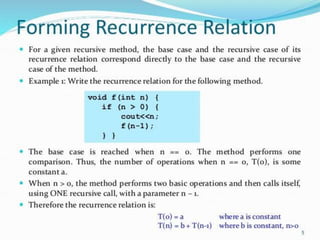
 Forming Recurrence Relation
 Solving Recurrence Relations
– Iterative Method
– Substitution Method
– Recursion Tree Method
– Master’s Method
2
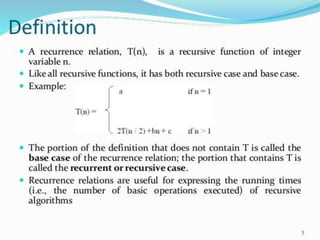
3
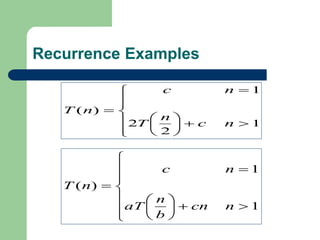
Recurrence Examples

















1
2
2
1
)
(
n
c
n
T
n
c
n
T

















1
1
)
(
n
cn
b
n
aT
n
c
n
T
Examples of recurrence relations
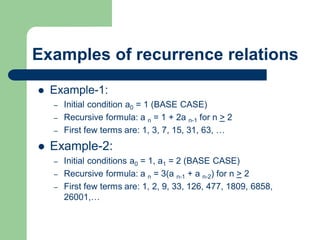
 Example-1:
– Initial condition a0 = 1 (BASE CASE)
– Recursive formula: a n = 1 + 2a n-1 for n > 2
– First few terms are: 1, 3, 7, 15, 31, 63, …
 Example-2:
– Initial conditions a0 = 1, a1 = 2 (BASE CASE)
– Recursive formula: a n = 3(a n-1 + a n-2) for n > 2
– First few terms are: 1, 2, 9, 33, 126, 477, 1809, 6858,
26001,…
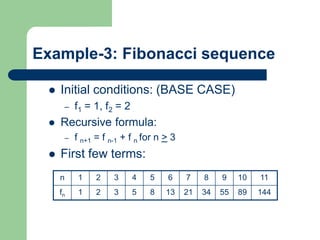
Example-3: Fibonacci sequence
 Initial conditions: (BASE CASE)
– f1 = 1, f2 = 2
 Recursive formula:
– f n+1 = f n-1 + f n for n > 3
 First few terms:
n 1 2 3 4 5 6 7 8 9 10 11
fn 1 2 3 5 8 13 21 34 55 89 144
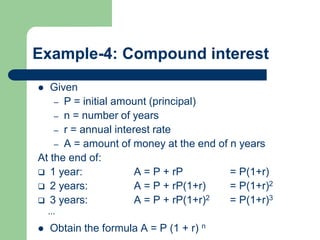
Example-4: Compound interest
 Given
– P = initial amount (principal)
– n = number of years
– r = annual interest rate
– A = amount of money at the end of n years
At the end of:
 1 year: A = P + rP = P(1+r)
 2 years: A = P + rP(1+r) = P(1+r)2
 3 years: A = P + rP(1+r)2 = P(1+r)3
…
 Obtain the formula A = P (1 + r) n
Recurrence Relations: Terms
 Recurrence relations have two parts:
– recursive terms and
– non-recursive terms
T(n) = 2T(n-2) + n2 -10
 Recursive terms come from when an algorithms calls
itself
 Non-recursive terms correspond to the non-recursive
cost of the algorithm: work the algorithm performs
within a function
 First, we need to know how to solve recurrences.
9
10
11
Solving Recurrence Relations
 Iteration method
 Substitution method
 Recursion Tree
 Master method
Iteration method
12
13
14
15
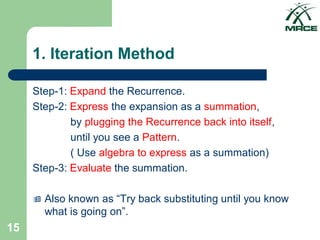
1. Iteration Method
Step-1: Expand the Recurrence.
Step-2: Express the expansion as a summation,
by plugging the Recurrence back into itself,
until you see a Pattern.
( Use algebra to express as a summation)
Step-3: Evaluate the summation.
 Also known as “Try back substituting until you know
what is going on”.
16
17
18
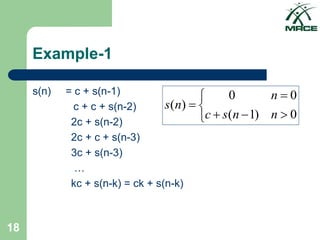
Example-1
s(n) = c + s(n-1)
c + c + s(n-2)
2c + s(n-2)
2c + c + s(n-3)
3c + s(n-3)
…
kc + s(n-k) = ck + s(n-k)








0
)
1
(
0
0
)
(
n
n
s
c
n
n
s
Example-1
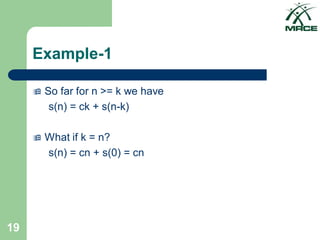
 So far for n >= k we have
s(n) = ck + s(n-k)
 What if k = n?
s(n) = cn + s(0) = cn
19
20
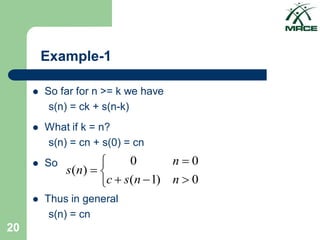
 So far for n >= k we have
s(n) = ck + s(n-k)
 What if k = n?
s(n) = cn + s(0) = cn
 So
 Thus in general
s(n) = cn








0
)
1
(
0
0
)
(
n
n
s
c
n
n
s
Example-1
21
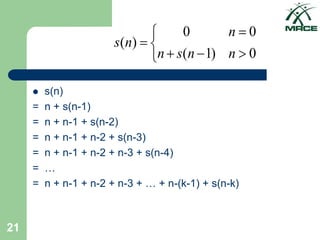
 s(n)
= n + s(n-1)
= n + n-1 + s(n-2)
= n + n-1 + n-2 + s(n-3)
= n + n-1 + n-2 + n-3 + s(n-4)
= …
= n + n-1 + n-2 + n-3 + … + n-(k-1) + s(n-k)








0
)
1
(
0
0
)
(
n
n
s
n
n
n
s
22
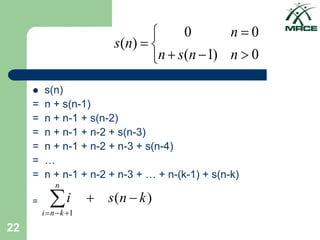
 s(n)
= n + s(n-1)
= n + n-1 + s(n-2)
= n + n-1 + n-2 + s(n-3)
= n + n-1 + n-2 + n-3 + s(n-4)
= …
= n + n-1 + n-2 + n-3 + … + n-(k-1) + s(n-k)
=








0
)
1
(
0
0
)
(
n
n
s
n
n
n
s
)
(
1
k
n
s
i
n
k
n
i





23
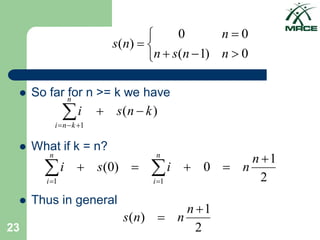
 So far for n >= k we have
 What if k = n?
 Thus in general








0
)
1
(
0
0
)
(
n
n
s
n
n
n
s
)
(
1
k
n
s
i
n
k
n
i





2
1
0
)
0
(
1
1




 
 

n
n
i
s
i
n
i
n
i
2
1
)
(


n
n
n
s
Example-2
24
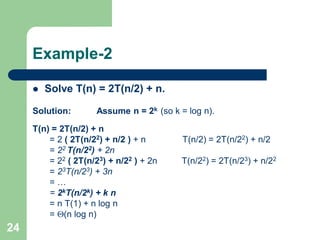
 Solve T(n) = 2T(n/2) + n.
Solution: Assume n = 2k (so k = log n).
T(n) = 2T(n/2) + n
= 2 ( 2T(n/22) + n/2 ) + n T(n/2) = 2T(n/22) + n/2
= 22 T(n/22) + 2n
= 22 ( 2T(n/23) + n/22 ) + 2n T(n/22) = 2T(n/23) + n/22
= 23T(n/23) + 3n
= …
= 2kT(n/2k) + k n
= n T(1) + n log n
= (n log n)

8.-DAA-LECTURE-8-RECURRENCES-AND-ITERATION-METHOD.pdf

  • 1.
    Analysis and Designof Algorithms UNIT-1 Recurrence Relations
  • 2.
    Content  Recurrence Relation Forming Recurrence Relation  Solving Recurrence Relations – Iterative Method – Substitution Method – Recursion Tree Method – Master’s Method 2
  • 3.
  • 4.
  • 5.
    Examples of recurrencerelations  Example-1: – Initial condition a0 = 1 (BASE CASE) – Recursive formula: a n = 1 + 2a n-1 for n > 2 – First few terms are: 1, 3, 7, 15, 31, 63, …  Example-2: – Initial conditions a0 = 1, a1 = 2 (BASE CASE) – Recursive formula: a n = 3(a n-1 + a n-2) for n > 2 – First few terms are: 1, 2, 9, 33, 126, 477, 1809, 6858, 26001,…
  • 6.
    Example-3: Fibonacci sequence Initial conditions: (BASE CASE) – f1 = 1, f2 = 2  Recursive formula: – f n+1 = f n-1 + f n for n > 3  First few terms: n 1 2 3 4 5 6 7 8 9 10 11 fn 1 2 3 5 8 13 21 34 55 89 144
  • 7.
    Example-4: Compound interest Given – P = initial amount (principal) – n = number of years – r = annual interest rate – A = amount of money at the end of n years At the end of:  1 year: A = P + rP = P(1+r)  2 years: A = P + rP(1+r) = P(1+r)2  3 years: A = P + rP(1+r)2 = P(1+r)3 …  Obtain the formula A = P (1 + r) n
  • 8.
    Recurrence Relations: Terms Recurrence relations have two parts: – recursive terms and – non-recursive terms T(n) = 2T(n-2) + n2 -10  Recursive terms come from when an algorithms calls itself  Non-recursive terms correspond to the non-recursive cost of the algorithm: work the algorithm performs within a function  First, we need to know how to solve recurrences.
  • 9.
  • 10.
  • 11.
    11 Solving Recurrence Relations Iteration method  Substitution method  Recursion Tree  Master method
  • 12.
  • 13.
  • 14.
  • 15.
    15 1. Iteration Method Step-1:Expand the Recurrence. Step-2: Express the expansion as a summation, by plugging the Recurrence back into itself, until you see a Pattern. ( Use algebra to express as a summation) Step-3: Evaluate the summation.  Also known as “Try back substituting until you know what is going on”.
  • 16.
  • 17.
  • 18.
    18 Example-1 s(n) = c+ s(n-1) c + c + s(n-2) 2c + s(n-2) 2c + c + s(n-3) 3c + s(n-3) … kc + s(n-k) = ck + s(n-k)         0 ) 1 ( 0 0 ) ( n n s c n n s
  • 19.
    Example-1  So farfor n >= k we have s(n) = ck + s(n-k)  What if k = n? s(n) = cn + s(0) = cn 19
  • 20.
    20  So farfor n >= k we have s(n) = ck + s(n-k)  What if k = n? s(n) = cn + s(0) = cn  So  Thus in general s(n) = cn         0 ) 1 ( 0 0 ) ( n n s c n n s Example-1
  • 21.
    21  s(n) = n+ s(n-1) = n + n-1 + s(n-2) = n + n-1 + n-2 + s(n-3) = n + n-1 + n-2 + n-3 + s(n-4) = … = n + n-1 + n-2 + n-3 + … + n-(k-1) + s(n-k)         0 ) 1 ( 0 0 ) ( n n s n n n s
  • 22.
    22  s(n) = n+ s(n-1) = n + n-1 + s(n-2) = n + n-1 + n-2 + s(n-3) = n + n-1 + n-2 + n-3 + s(n-4) = … = n + n-1 + n-2 + n-3 + … + n-(k-1) + s(n-k) =         0 ) 1 ( 0 0 ) ( n n s n n n s ) ( 1 k n s i n k n i     
  • 23.
    23  So farfor n >= k we have  What if k = n?  Thus in general         0 ) 1 ( 0 0 ) ( n n s n n n s ) ( 1 k n s i n k n i      2 1 0 ) 0 ( 1 1          n n i s i n i n i 2 1 ) (   n n n s
  • 24.
    Example-2 24  Solve T(n)= 2T(n/2) + n. Solution: Assume n = 2k (so k = log n). T(n) = 2T(n/2) + n = 2 ( 2T(n/22) + n/2 ) + n T(n/2) = 2T(n/22) + n/2 = 22 T(n/22) + 2n = 22 ( 2T(n/23) + n/22 ) + 2n T(n/22) = 2T(n/23) + n/22 = 23T(n/23) + 3n = … = 2kT(n/2k) + k n = n T(1) + n log n = (n log n)