Pankaj Das 
M.Sc. (Agricultural Statistics) 
Roll no. – 20394
 Introduction 
 Mathematical background 
 Wishart distribution 
 Inverse-Wishart distribution. 
 Relationship ofWishart and Inverse-Wishart distribution 
 Conclusion
 In the modern Era of science and information technology, there has 
been a huge influx of high-dimensional data from various fields 
such as genomics, environmental sciences, finance and the social 
sciences. 
 In sense of all the many complex relationships and multivariate 
dependencies present in the data and formulating correct models and 
developing inferential procedures are the major challenges in 
modern day statistics.
 In parametric models the covariance or correlation matrix (or its 
inverse) is the fundamental object that quantifies relationships 
between random variables. 
 Estimating the covariance matrix in a sparse way is crucial in high 
dimensional problems and enables the detection of the most 
important relationship. 
 Covariance matrices provide the simplest measure of dependency, 
and therefore, much attention has been placed on modelling 
covariance matrices. It has a significant impact on statistical 
inferences.
 In short correlation matrix plays vital role in multivariate statistics. 
 The correlation/covariance matrix is directly involved in a variety of 
statistical models. Estimation of correlation matrix is important. 
 In the estimation of covariance matrices in multivariate statistics 
Wishart & inverse wishart distribution is used.
 Suppose is p-random variable drawn from a p-variate normal 
distribution with mean vector and covariance matrix Σ. 
T 
    P α 
α α α X = x , ..., x ~N (μ ,Σ) ; α = 1, ...,n 
Then the joint density function of is given by 
...(1) 
(α) X 
1 2 , , n x x x 
n -1 x i -μ Σ-1 x i -μ f  1 x 1 ,…,x n μ,Σ  
= e 2 i=1 p/2 1/2 2π Σ 
  
    
1 n -1 - xi-μ Σ xi-μ 1 2i=1 = e 
  
    
np/2 n/2 
2π Σ 
 
 
 
 
μ
p× n X  Where is called data matrix which is given by 
 x 
1 
 
  
x x x x 2 11 12 1n 
. x x 21 22 x p×n = = 
2n   
  
  
  
  
  
  
  
. 
. x x xpn p1 p2 
xp 
  
  
  
    
  
  
X 
 The Mean vector is shown as 
   
n p×1 
n 
α 
α=1 
1 
x= x 
x 
1 
x 
2 
  
  
  
  
  
  
  
  
  
  
1 . 
= x1+x2…+xn = 
n . 
. 
xp
 The variance-covariance matrix is given by 
  
  
  
n 
11 1 
   
  
  
  
p 1 
pn 
ˆ 
 Another way 
' 
n 
ˆ 1 (x )( ) 
  
    
n   
  
1 
1 
x x x 
 This dispersion matrix is semi-positive definite.
 The sample covariance matrix 
 Where, 
  
  
        
 
    
  
  
s s s 
s s s 
11 12 1 
12 11 2 
 
1 1 1 
1 2 
1 
1 
p 
n 
p 
j j 
p p j p p 
p p pp 
x x x x 
n 
s s s 
s 
   
   
1 
1 
1 
n 
  
s  x  x x  
x 
ik ij i kj k 
n j 

 The sampling distribution of the sample covariance matrix S and 
follow a distribution which is known as Wishart 
n-1 ˆ Σ= S 
n 
distribution. 
2 n (n-1)s = (x -x)(x -x) 
  j ~W  n-1, Σ 
 j 
p j=1 
 It is named in honor of John Wishart, who first formulated the 
distribution in 1928.
 The Wishart distribution is a multivariate extension of the Gamma 
distribution. It simplifies to a multivariate generalization of the χ2 
distribution. 
 χ2 distribution describes the sum of squares of n draws from a 
univariate normal distribution, where the Wishart distribution 
represents the sum of squares (and cross-products) of n draws from a 
multivariate normal distribution. 
 It is a family of probability distributions defined over symmetric, 
nonnegative-definite matrix-valued random variables.
Contd... 
 The Wishart distribution arises as the distribution of the sample 
covariance matrix for a sample from a multivariate normal 
distribution.
Let be k independent random p-vectors . Each having a 
p-variate normal distribution with mean vector and covariance 
matrix 
Let 
1 2 k z ,z ,…,z 
1 0 p 
 
pp 
' ' ' 
U =z z +z z +…+z z 
1 1 2 2 k k 
p×p 
Then U is said to have the p-variate Wishart distribution with k 
degrees of freedom and the covariance matrix , where . 
~   p U W k 
p×1 0 
p p  
The joint density of the p-variateWishart distribution is 
  
      
 
   
1 
2 
u tr u 
   
  
k p 
1 /2 
exp 
f u 
U kp k p p 
/2 /2 
k 
2 / 2 
  
p 
 
where is a multivariate gamma function. 
i.e. 
p 
 k   p  p 
 
1  /4 
 k j   / 2    1  / 2 
 
 
1 
p 
j 
This is known as centralWishart distribution. 
...(2) 
...(3) 
(.)  
Contd... 
(.) 
Let 
T 
   , . ..,  ~ N ( , ) ; 1,2,...,k 
p X x x          
k 
  pk   1 2 , ,..., k    
Then ' 
where M is a matrix with columns 
  
1 
p x x W k   
~ ( , ,M) 
 x x 
 
11 1 
k 
  
  
  
  
Where ' 
& 
x x 
p 1 
pk 
 
  
11 1 
  
    
  
 1 
 
' ( ') 
This is called non-centralWishart distribution. 
k 
p pk 
M 
  
 
 
 When M = 0 then Wp is called central wishart distribution & we 
write as 
(k, ) p W  
 It can be easily checked that when p = 1 and Σ= 1 then the Wishart 
distribution becomes the chi-square distribution with k degrees of 
freedom. Note that we must have k> p-1 to ensure Σ is invertible. If 
k > p-1 does not hold, is called singular Wishart distribution due to 
Σ being a singular matrix.
~ W(k , ) i i Let S  where  i  1 ,...,n 
 The expected value of S is 
...(4) 
(S)  k 
 The expected value of a Wishart distribution depends on number of 
draws one makes from the multivariate normal distribution. 
 In comparison, the expected value of a distribution is k, so that 
the only differences between a Wishart expectation and a 
expectation are the underlying dimensionality of the data and a 
scale component. 
2 (k) 
2 (k)
 We can find the individual variances of the elements of S. for instance, 
the variance of the ijth element of S is: 
...(5) 
    2 ij Var S  k  ij  ii j j 
 Where is the ijth element of the matrix and can be thought of as the 
population covariance between variable i and variable j. When p = 1, so 
that the only element of the variance/covariance matrix is 
 ij  th ij 
Therefore, we get Var(X) = k (1 + 1 x 1) = 2k, which is the familiar 
variance of a variable. 
  2  k 
th ij 
2 
11 11   1 
ij   
2 (k)
 Equation (5) is a set of variances rather than depicting the 
variance/covariance matrix because every observation of the Wishart 
distribution is a matrix. 
 Therefore, describing all combinations of variances and covariance 
of S requires either an array of higher order or a Kronecker 
operation to represent that higher order array as a matrix
 In 2007 Eaton et al. present a new idea to derive for derivation the 
covariance matrix of S. The covariance matrix of S can be represented 
as 
k 
T 
x x 
  
Cov(S) cov( ) 
 
1 
i i 
i 
  
 
1 
T 
Cov x x 
( ) 
k 
i i 
i 
(Cz C ) T T 
 kCov i zi 
CCT 
Where is the Cholesky decomposition of the (square, 
symmetric) matrix , and 
  T 
i i p E z z  I 
...(6)
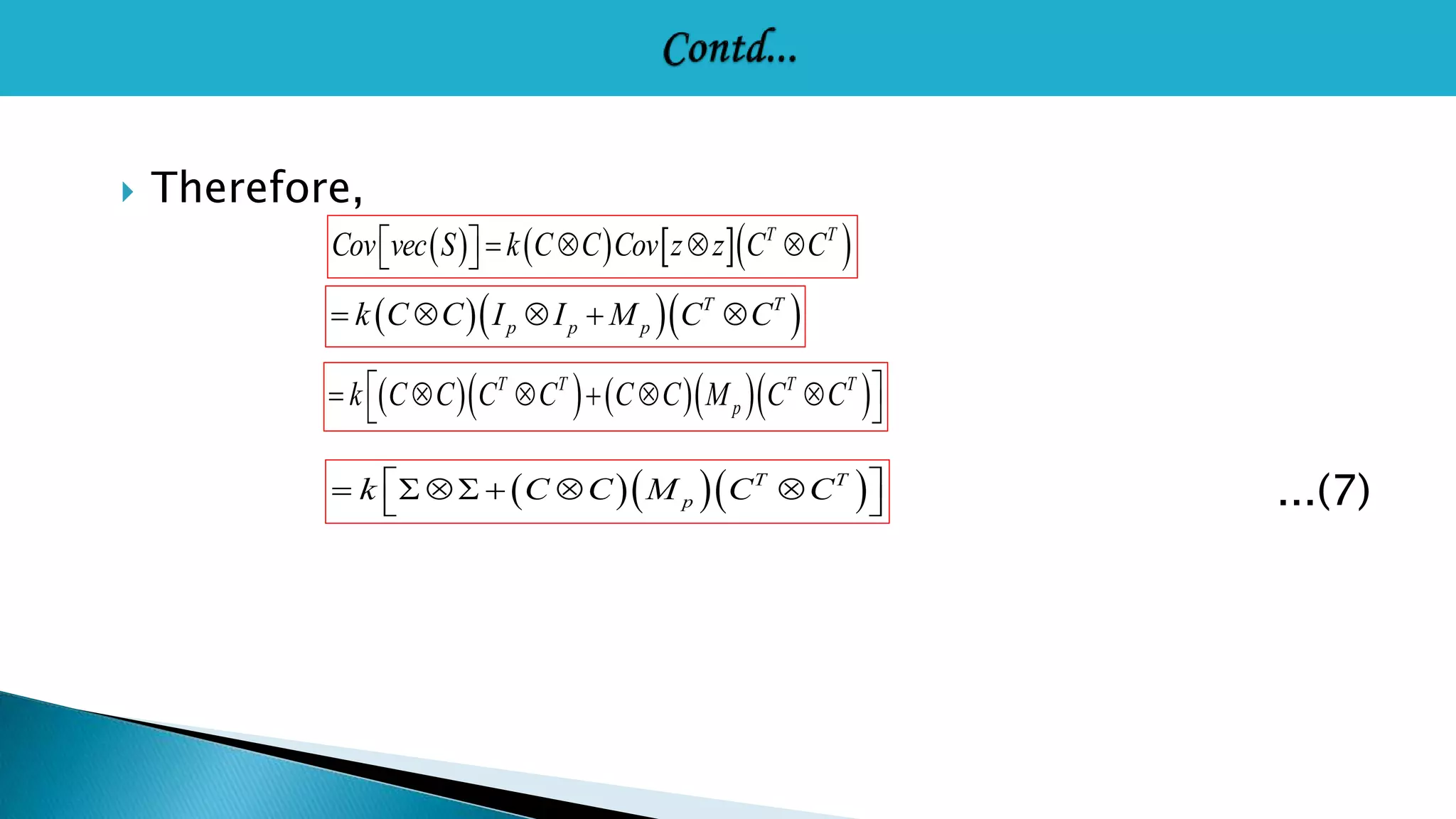
 Applying the vector(vec) operator to S, which forms a long vector 
by stacking the columns of S, so that Cov[vec(s)] is a matrix rather 
than an array, so we have 
  k   T T Cov vec S   Cov vec Czz C    
    T  kCov  CC vec zz  
  
     T T k C C Cov vec zz  C C 
   
  
     T T  k CC Cov zz C C 
(by the vec to Kronecker property) 
(by vec and Kronecker properties) 
z
 To determine cov [vec(s)] (as a proxy for cov(s)), one would only 
need to know 
Covzz 
(1) The variance of (where n is any element of z); 
(2) The variance of Z Z (where no 
are any two elements of z); 
n o (3) The covariance between & ; 
2 
n Z 2 
(4) The covariance between & and 
o Z 
(5) The covariance between and (where at most two of i, j, n, or 
o are the same). 
n o ZZ o n ZZ 
n o Z Z 
2 
n Z
1. is standard normally distributed, so follows a distribution 
variance equal to 2(1) = 2. Therefore, = 2 for all k. 
n Z 
2. & are uncorrelated standard normal random variables, which 
implies that they are also independent. Therefore, 
due to independence 
Here & both follow a distribution. 
2 ) (1 
              2 2 2 2 2 0 n o n o n o Var Z Z  E  Z Z   E Z E Z  E Z Z   E Z E Z 
  
2 2 ( ) ( )( ) 1 1 1 n o n o Var Z Z  E Z Z    
2  (1) 
n Z 
2 ()n VZ
3. & uncorrelated standard normal random variables, 
         2 2   2  2 — — 1— 0 1 n o o n n o o n n o o n n o n o Cov Z Z Z Z  E Z Z Z Z E Z Z E Z Z  E Z Z E Z E Z   
so 
4.       2 2 2 2 2 2 ( , ) — 1 1 0 n o n o n o Cov Z Z  E Z Z E Z E Z    
5.  ,  0 i j n o Cov Z Z Z Z 
Therefore, the [p(n-1)+ n,p(n -1)+n] elements of will all be 2 
because Var  Z 2   
2 and the remaining diagonal elements of 
k will all be 1 because Var  Z Z   
1 n o for all k = l. The off-diagonal elements 
must be 0 except for those elements symbolizing the covariance 
between ZZ and ZZ 
j i , which will be 1. 
i j Ultimately can be written as 
i j Z Z j i Z Z 
is a matrix of 1s and 0s. 
I p I p Mp  
p M 2 2 p  p 
2 2 p p  p M
 Therefore, 
     Cov vec S   k CC Cov zz CT CT  
    T T 
p p p  k CC I I M C C 
       T T T T 
p  k  CC C C  CC M C C  
  
     T T 
  ...(7) 
p  k   CC M C C 
 And we can check the derivation by simulating draws from a 
Wishart distribution and comparing the simulated covariance with 
the empirical covariance matrix calculated using equation (7). 
 Analysis is done with the help of R console.
 Results shows that replications must be very large to be for the 
empirical covariance matrix to be close to the theoretical covariance 
matrix.
Some Theorems of Wishart Distribution
Some Theorems on Wishart Distribution
 Wishart distribution have great importance in the estimation of 
covariance matrices in multivariate statistics. 
 The Wishart distribution is frequently used as the prior on the 
precision matrix parameter of a multivariate normal distribution. 
 The Wishart distribution arises as models for random variation and 
descriptions of uncertainty about variance and precision matrices. They 
are of particular interest in sampling and inference on covariance and 
association structure in multivariate normal models, and in ranges of 
extensions in regression.
 The Inverse-Wishart distribution is the multivariate extension of the 
Inverse-Gamma distribution. 
 Even though the Wishart distribution generates sums of squares 
matrices, one can think of the Inverse-Wishart distribution as 
generating random covariance matrices. 
 However, those covariance matrices would be inverses of the 
covariance matrices generated underWishart distribution.
 Let T ~ InvWishp 
Where denotes a positive definite scale matrix, m denotes the degrees of 
freedom, and p indicates the dimensions of T (i.e. ). 
Then T is positive definite with probability density function is given as 
m 
|Ψ| 2 1 = exp[- tr(ΨT-1)] 
  ...(8) 
m+p+1 mp 2 
2 2 m | T | 2 Γp( ) 
f 
2 
T = 
( , ) m  
Ψ 
p×p TR
 The expected value of T is 
...(9) 
T 
 ( ) 
 
 
m p 
  
1 
 In respect to the distribution, the only differences between the 
2 Inverse-Wishart expectation and the inverse- χ 
expectation are the 
dimensionality of the data and a scale component. 
 The Inverse-Wishart distribution has finite expectation only when m > 
(p -1).
 The variance of the ijth element of T is 
2 
m p m p 
( 1) ( 1) 
        
ij ii jj 
2 
(T ) 
m p m p m p 
( )( 1) ( 3) 
ij 
Var 
 
     
ij ψ 
Where is the element of the matrix 
If p = 1, then only element of the variance/covariance matrix is given by 
2 
11 11   1 
 The variance expression is given by 
m m m 
( )  1  (  2)  1  1 2(  
1) 2 
   
2 2 2 
Var X 
( ) 
m m m m m m m m 
(  1)(  2) (  4) (  1)(  2) (  4) (  2) (  
4) 
Inv-χ2(m) 
Which is same as the variance of variable.
 The Wishart distribution is related to the normal distribution, Chi-square 
distribution and Gamma distribution . The Inverse-Wishart distribution 
is related to the those distributions in a similar way. 
let 
~ (k, ) p S W  
1 1 ~ ( , ) p S InvWish m    
then 
Where m=k is the degrees of freedom
 The Inverse-Wishart distribution is frequently used as the prior on 
the variance/covariance matrix parameter (S) of a multivariate 
normal distribution. Note that the Inverse-Gamma distribution is the 
conjugate prior for the variance parameter of a univariate normal 
distribution, and the Inverse-Wishart distribution (as its multivariate 
generalization) extends conjugacy to the multivariate normal 
distribution.
 The Wishart and Inverse-Wishart distribution is an important 
distribution having a certain good and useful statistical properties. 
These distributions have important role in estimating parameter in 
multivariate studies. 
 Wishart distribution help to develop a framework for bayesian 
inference for Gaussian covariance graph models. 
 Hence this work completes the powerful theory that has been developed 
in the mathematical statistics literature for decomposable models. This 
models help to draw a valid inference.
Conclusion: 
 The generalized Wishart process (GWP) – which we used to model 
time-varying covariance matrices σ(t). In the future, the GWP could be 
applied to study how Σ depends on covariates like interest rates.
Anderson, T. W.(2003). An Introduction to Multivariate Statistical 
Analysis. Wiley India (P) Ltd., New Delhi. 
Chatfield, C. and Collins, A. J.(1980). Introduction to Multivariate 
Analysis. Chapman and Hall-CRC, London. 
Chib, S. and Greenberg, E.(1998). Bayesian analysis of multivariate 
probit models. Biometrika , 85, 347-361. 
Cook, R. D.(2011). On the mean and variance of the generalized 
inverse of a singular Wishart matrix . Electronic Journal of Statistics 
, 5, 146-158.
Eaton, M. L.(2007). Multivariate statistics: A vector space approach , . 
Wiley India (P) Ltd., New Delhi. 
Nydick, S. W.(2012). The Wishart and inverse Wishart distributions. 
International Journal of Electronics and Communication, 
22, 119-139. 
Pourahmadi, M., Daniels, M. J. and Park, T.(2006). Simultaneously 
modelling of the cholesky decomposition of several covariance 
matrices. Journal of Multivariate Analysis, 97, 125-135.
Rao, C. R.(1965). Linear statistical inference and its applications, 
Wiley India (P) Ltd., New Delhi.
Cholesky decomposition 
It is a decomposition of hermitian positive definite 
matrix into the product of lower triangular matrix 
and it conjugate transpose. 
The cholesky decomposition of a hermitian positive-definite 
matrix a is a decomposition of the form. 
A LL  
Where L is a lower triangular matrix with real and 
positive diagonal entries, and L* denotes the 
conjugate transpose of L
R CODE
M
Any 
Question 
s ????

The Wishart and inverse-wishart distribution

  • 1.
    Pankaj Das M.Sc.(Agricultural Statistics) Roll no. – 20394
  • 2.
     Introduction Mathematical background  Wishart distribution  Inverse-Wishart distribution.  Relationship ofWishart and Inverse-Wishart distribution  Conclusion
  • 3.
     In themodern Era of science and information technology, there has been a huge influx of high-dimensional data from various fields such as genomics, environmental sciences, finance and the social sciences.  In sense of all the many complex relationships and multivariate dependencies present in the data and formulating correct models and developing inferential procedures are the major challenges in modern day statistics.
  • 4.
     In parametricmodels the covariance or correlation matrix (or its inverse) is the fundamental object that quantifies relationships between random variables.  Estimating the covariance matrix in a sparse way is crucial in high dimensional problems and enables the detection of the most important relationship.  Covariance matrices provide the simplest measure of dependency, and therefore, much attention has been placed on modelling covariance matrices. It has a significant impact on statistical inferences.
  • 5.
     In shortcorrelation matrix plays vital role in multivariate statistics.  The correlation/covariance matrix is directly involved in a variety of statistical models. Estimation of correlation matrix is important.  In the estimation of covariance matrices in multivariate statistics Wishart & inverse wishart distribution is used.
  • 6.
     Suppose isp-random variable drawn from a p-variate normal distribution with mean vector and covariance matrix Σ. T     P α α α α X = x , ..., x ~N (μ ,Σ) ; α = 1, ...,n Then the joint density function of is given by ...(1) (α) X 1 2 , , n x x x n -1 x i -μ Σ-1 x i -μ f  1 x 1 ,…,x n μ,Σ  = e 2 i=1 p/2 1/2 2π Σ       1 n -1 - xi-μ Σ xi-μ 1 2i=1 = e       np/2 n/2 2π Σ     μ
  • 7.
    p× n X Where is called data matrix which is given by  x 1    x x x x 2 11 12 1n . x x 21 22 x p×n = = 2n                 . . x x xpn p1 p2 xp               X  The Mean vector is shown as    n p×1 n α α=1 1 x= x x 1 x 2                     1 . = x1+x2…+xn = n . . xp
  • 8.
     The variance-covariancematrix is given by       n 11 1          p 1 pn ˆ  Another way ' n ˆ 1 (x )( )       n     1 1 x x x  This dispersion matrix is semi-positive definite.
  • 9.
     The samplecovariance matrix  Where,                      s s s s s s 11 12 1 12 11 2  1 1 1 1 2 1 1 p n p j j p p j p p p p pp x x x x n s s s s       1 1 1 n   s  x  x x  x ik ij i kj k n j 
  • 10.
     The samplingdistribution of the sample covariance matrix S and follow a distribution which is known as Wishart n-1 ˆ Σ= S n distribution. 2 n (n-1)s = (x -x)(x -x)   j ~W  n-1, Σ  j p j=1  It is named in honor of John Wishart, who first formulated the distribution in 1928.
  • 11.
     The Wishartdistribution is a multivariate extension of the Gamma distribution. It simplifies to a multivariate generalization of the χ2 distribution.  χ2 distribution describes the sum of squares of n draws from a univariate normal distribution, where the Wishart distribution represents the sum of squares (and cross-products) of n draws from a multivariate normal distribution.  It is a family of probability distributions defined over symmetric, nonnegative-definite matrix-valued random variables.
  • 12.
    Contd...  TheWishart distribution arises as the distribution of the sample covariance matrix for a sample from a multivariate normal distribution.
  • 13.
    Let be kindependent random p-vectors . Each having a p-variate normal distribution with mean vector and covariance matrix Let 1 2 k z ,z ,…,z 1 0 p  pp ' ' ' U =z z +z z +…+z z 1 1 2 2 k k p×p Then U is said to have the p-variate Wishart distribution with k degrees of freedom and the covariance matrix , where . ~   p U W k p×1 0 p p  
  • 14.
    The joint densityof the p-variateWishart distribution is             1 2 u tr u      k p 1 /2 exp f u U kp k p p /2 /2 k 2 / 2   p  where is a multivariate gamma function. i.e. p  k   p  p  1  /4  k j   / 2    1  / 2   1 p j This is known as centralWishart distribution. ...(2) ...(3) (.)  Contd... (.) 
  • 15.
    Let T   , . ..,  ~ N ( , ) ; 1,2,...,k p X x x          k   pk   1 2 , ,..., k    Then ' where M is a matrix with columns   1 p x x W k   ~ ( , ,M)  x x  11 1 k         Where ' & x x p 1 pk    11 1          1  ' ( ') This is called non-centralWishart distribution. k p pk M     
  • 16.
     When M= 0 then Wp is called central wishart distribution & we write as (k, ) p W   It can be easily checked that when p = 1 and Σ= 1 then the Wishart distribution becomes the chi-square distribution with k degrees of freedom. Note that we must have k> p-1 to ensure Σ is invertible. If k > p-1 does not hold, is called singular Wishart distribution due to Σ being a singular matrix.
  • 17.
    ~ W(k ,) i i Let S  where  i  1 ,...,n  The expected value of S is ...(4) (S)  k  The expected value of a Wishart distribution depends on number of draws one makes from the multivariate normal distribution.  In comparison, the expected value of a distribution is k, so that the only differences between a Wishart expectation and a expectation are the underlying dimensionality of the data and a scale component. 2 (k) 2 (k)
  • 18.
     We canfind the individual variances of the elements of S. for instance, the variance of the ijth element of S is: ...(5)     2 ij Var S  k  ij  ii j j  Where is the ijth element of the matrix and can be thought of as the population covariance between variable i and variable j. When p = 1, so that the only element of the variance/covariance matrix is  ij  th ij Therefore, we get Var(X) = k (1 + 1 x 1) = 2k, which is the familiar variance of a variable.   2  k th ij 2 11 11   1 ij   2 (k)
  • 19.
     Equation (5)is a set of variances rather than depicting the variance/covariance matrix because every observation of the Wishart distribution is a matrix.  Therefore, describing all combinations of variances and covariance of S requires either an array of higher order or a Kronecker operation to represent that higher order array as a matrix
  • 20.
     In 2007Eaton et al. present a new idea to derive for derivation the covariance matrix of S. The covariance matrix of S can be represented as k T x x   Cov(S) cov( )  1 i i i    1 T Cov x x ( ) k i i i (Cz C ) T T  kCov i zi CCT Where is the Cholesky decomposition of the (square, symmetric) matrix , and   T i i p E z z  I ...(6)
  • 21.
     Applying thevector(vec) operator to S, which forms a long vector by stacking the columns of S, so that Cov[vec(s)] is a matrix rather than an array, so we have   k   T T Cov vec S   Cov vec Czz C        T  kCov  CC vec zz         T T k C C Cov vec zz  C C           T T  k CC Cov zz C C (by the vec to Kronecker property) (by vec and Kronecker properties) z
  • 22.
     To determinecov [vec(s)] (as a proxy for cov(s)), one would only need to know Covzz (1) The variance of (where n is any element of z); (2) The variance of Z Z (where no are any two elements of z); n o (3) The covariance between & ; 2 n Z 2 (4) The covariance between & and o Z (5) The covariance between and (where at most two of i, j, n, or o are the same). n o ZZ o n ZZ n o Z Z 2 n Z
  • 23.
    1. is standardnormally distributed, so follows a distribution variance equal to 2(1) = 2. Therefore, = 2 for all k. n Z 2. & are uncorrelated standard normal random variables, which implies that they are also independent. Therefore, due to independence Here & both follow a distribution. 2 ) (1               2 2 2 2 2 0 n o n o n o Var Z Z  E  Z Z   E Z E Z  E Z Z   E Z E Z   2 2 ( ) ( )( ) 1 1 1 n o n o Var Z Z  E Z Z    2  (1) n Z 2 ()n VZ
  • 24.
    3. & uncorrelatedstandard normal random variables,          2 2   2  2 — — 1— 0 1 n o o n n o o n n o o n n o n o Cov Z Z Z Z  E Z Z Z Z E Z Z E Z Z  E Z Z E Z E Z   so 4.       2 2 2 2 2 2 ( , ) — 1 1 0 n o n o n o Cov Z Z  E Z Z E Z E Z    5.  ,  0 i j n o Cov Z Z Z Z 
  • 25.
    Therefore, the [p(n-1)+n,p(n -1)+n] elements of will all be 2 because Var  Z 2   2 and the remaining diagonal elements of k will all be 1 because Var  Z Z   1 n o for all k = l. The off-diagonal elements must be 0 except for those elements symbolizing the covariance between ZZ and ZZ j i , which will be 1. i j Ultimately can be written as i j Z Z j i Z Z is a matrix of 1s and 0s. I p I p Mp  p M 2 2 p  p 2 2 p p  p M
  • 26.
     Therefore,     Cov vec S   k CC Cov zz CT CT      T T p p p  k CC I I M C C        T T T T p  k  CC C C  CC M C C         T T   ...(7) p  k   CC M C C 
  • 27.
     And wecan check the derivation by simulating draws from a Wishart distribution and comparing the simulated covariance with the empirical covariance matrix calculated using equation (7).  Analysis is done with the help of R console.
  • 28.
     Results showsthat replications must be very large to be for the empirical covariance matrix to be close to the theoretical covariance matrix.
  • 29.
    Some Theorems ofWishart Distribution
  • 30.
    Some Theorems onWishart Distribution
  • 31.
     Wishart distributionhave great importance in the estimation of covariance matrices in multivariate statistics.  The Wishart distribution is frequently used as the prior on the precision matrix parameter of a multivariate normal distribution.  The Wishart distribution arises as models for random variation and descriptions of uncertainty about variance and precision matrices. They are of particular interest in sampling and inference on covariance and association structure in multivariate normal models, and in ranges of extensions in regression.
  • 32.
     The Inverse-Wishartdistribution is the multivariate extension of the Inverse-Gamma distribution.  Even though the Wishart distribution generates sums of squares matrices, one can think of the Inverse-Wishart distribution as generating random covariance matrices.  However, those covariance matrices would be inverses of the covariance matrices generated underWishart distribution.
  • 33.
     Let T~ InvWishp Where denotes a positive definite scale matrix, m denotes the degrees of freedom, and p indicates the dimensions of T (i.e. ). Then T is positive definite with probability density function is given as m |Ψ| 2 1 = exp[- tr(ΨT-1)]   ...(8) m+p+1 mp 2 2 2 m | T | 2 Γp( ) f 2 T = ( , ) m  Ψ p×p TR
  • 34.
     The expectedvalue of T is ...(9) T  ( )   m p   1  In respect to the distribution, the only differences between the 2 Inverse-Wishart expectation and the inverse- χ expectation are the dimensionality of the data and a scale component.  The Inverse-Wishart distribution has finite expectation only when m > (p -1).
  • 35.
     The varianceof the ijth element of T is 2 m p m p ( 1) ( 1)         ij ii jj 2 (T ) m p m p m p ( )( 1) ( 3) ij Var       ij ψ Where is the element of the matrix If p = 1, then only element of the variance/covariance matrix is given by 2 11 11   1  The variance expression is given by m m m ( )  1  (  2)  1  1 2(  1) 2    2 2 2 Var X ( ) m m m m m m m m (  1)(  2) (  4) (  1)(  2) (  4) (  2) (  4) Inv-χ2(m) Which is same as the variance of variable.
  • 36.
     The Wishartdistribution is related to the normal distribution, Chi-square distribution and Gamma distribution . The Inverse-Wishart distribution is related to the those distributions in a similar way. let ~ (k, ) p S W  1 1 ~ ( , ) p S InvWish m    then Where m=k is the degrees of freedom
  • 39.
     The Inverse-Wishartdistribution is frequently used as the prior on the variance/covariance matrix parameter (S) of a multivariate normal distribution. Note that the Inverse-Gamma distribution is the conjugate prior for the variance parameter of a univariate normal distribution, and the Inverse-Wishart distribution (as its multivariate generalization) extends conjugacy to the multivariate normal distribution.
  • 40.
     The Wishartand Inverse-Wishart distribution is an important distribution having a certain good and useful statistical properties. These distributions have important role in estimating parameter in multivariate studies.  Wishart distribution help to develop a framework for bayesian inference for Gaussian covariance graph models.  Hence this work completes the powerful theory that has been developed in the mathematical statistics literature for decomposable models. This models help to draw a valid inference.
  • 41.
    Conclusion:  Thegeneralized Wishart process (GWP) – which we used to model time-varying covariance matrices σ(t). In the future, the GWP could be applied to study how Σ depends on covariates like interest rates.
  • 42.
    Anderson, T. W.(2003).An Introduction to Multivariate Statistical Analysis. Wiley India (P) Ltd., New Delhi. Chatfield, C. and Collins, A. J.(1980). Introduction to Multivariate Analysis. Chapman and Hall-CRC, London. Chib, S. and Greenberg, E.(1998). Bayesian analysis of multivariate probit models. Biometrika , 85, 347-361. Cook, R. D.(2011). On the mean and variance of the generalized inverse of a singular Wishart matrix . Electronic Journal of Statistics , 5, 146-158.
  • 43.
    Eaton, M. L.(2007).Multivariate statistics: A vector space approach , . Wiley India (P) Ltd., New Delhi. Nydick, S. W.(2012). The Wishart and inverse Wishart distributions. International Journal of Electronics and Communication, 22, 119-139. Pourahmadi, M., Daniels, M. J. and Park, T.(2006). Simultaneously modelling of the cholesky decomposition of several covariance matrices. Journal of Multivariate Analysis, 97, 125-135.
  • 44.
    Rao, C. R.(1965).Linear statistical inference and its applications, Wiley India (P) Ltd., New Delhi.
  • 46.
    Cholesky decomposition Itis a decomposition of hermitian positive definite matrix into the product of lower triangular matrix and it conjugate transpose. The cholesky decomposition of a hermitian positive-definite matrix a is a decomposition of the form. A LL  Where L is a lower triangular matrix with real and positive diagonal entries, and L* denotes the conjugate transpose of L
  • 47.
  • 48.
  • 49.