Random Matrix Theory for Machine Learning
Part 1: Motivating Questions and Building Blocks
Fabian Pedregosa1
, Courtney Paquette1,2
, Tom Trogdon3
, Jeffrey Pennington1
1
Google Research , 2
McGill University , 3
University of Washington
https://random-matrix-learning.github.io
About this tutorial
Objective:
• Applications of Random Matrix Theory (RMT) in Machine Learning.
• Proof techniques in RMT
1
About this tutorial
Objective:
• Applications of Random Matrix Theory (RMT) in Machine Learning.
• Proof techniques in RMT
Structure:
1. Motivating Questions and Building Blocks, Fabian Pedregosa
2. Introduction to Random Matrix Theory, Courtney Paquette
3. Analysis of Numerical Algorithms, Tom Trogdon
4. The Mystery of Generalization: Why Does Deep Learning Work?, Jeffrey Pennington
https://random-matrix-learning.github.io
1
What is a Random Matrix?
A random matrix is a matrix whose entries are random variables, not necessarily
independent.
2
What is a Random Matrix?
A random matrix is a matrix whose entries are random variables, not necessarily
independent.
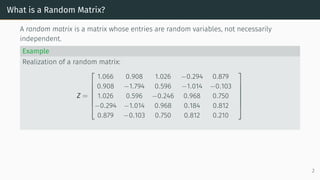
Example
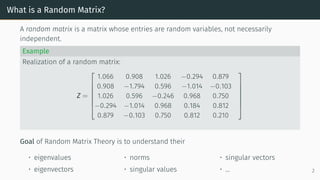
Realization of a random matrix:
Z =



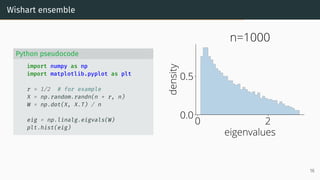
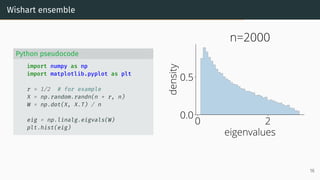
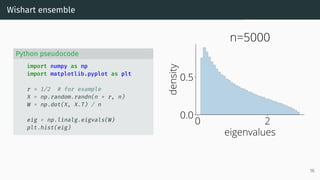
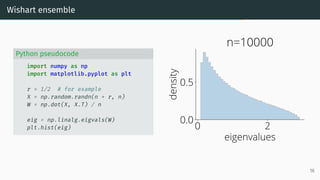




1.066 0.908 1.026 −0.294 0.879
0.908 −1.794 0.596 −1.014 −0.103
1.026 0.596 −0.246 0.968 0.750
−0.294 −1.014 0.968 0.184 0.812
0.879 −0.103 0.750 0.812 0.210




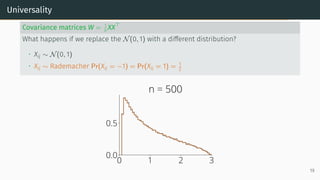
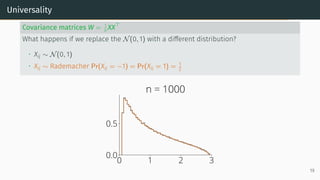



2
What is a Random Matrix?
A random matrix is a matrix whose entries are random variables, not necessarily
independent.
Example
Realization of a random matrix:
Z =







1.066 0.908 1.026 −0.294 0.879
0.908 −1.794 0.596 −1.014 −0.103
1.026 0.596 −0.246 0.968 0.750
−0.294 −1.014 0.968 0.184 0.812
0.879 −0.103 0.750 0.812 0.210







Goal of Random Matrix Theory is to understand their
• eigenvalues
• eigenvectors
• norms
• singular values
• singular vectors
• … 2
Where do Random Matrices
Come From?
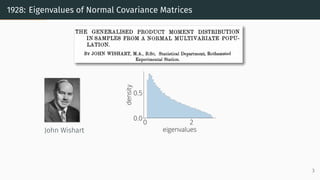
1928: Eigenvalues of Normal Covariance Matrices
John Wishart
0 2
eigenvalues
0.0
0.5
density
3
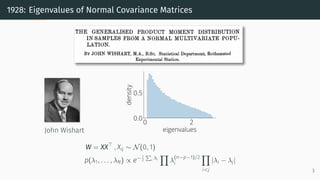
1928: Eigenvalues of Normal Covariance Matrices
John Wishart
0 2
eigenvalues
0.0
0.5
density
W = XX⊤
, Xij ∼ N(0, 1)
p(λ1, . . . , λN) ∝ e− 1
2
∑
i λi
Y
λ
(n−p−1)/2
i
Y
i<j
|λi − λj|
3
1955: Random Symmetric Matrices
Eugene Wigner
Energy levels of heavy nuclei,
compared with the random
matrix theory prediction.
Source: [Rosenzweig and Porter,
1960]
4
Model for high-dimensional phenomena
• Number Theory [Montgomery, 1973,
Keating, 1993].
• Graph Theory [Erdos and Rényi, 1960].
• Finance [Bouchaud and Potters, 2009].
• Wireless communication [Tulino et al.,
2004]
• Machine Learning ... Distribution function of gaps between eigenvalues compared
with histogram of gaps between ζ zeros. Source: [Odlyzko, 1987]
5
Random Matrices in Machine Learning: Loss Landscape
Spin Glass model of the Loss Landscape
Early: [Amit et al., 1985, Gardner and Derrida, 1988, Dotsenko, 1995]
Late: [Dauphin et al., 2014, Sagun et al., 2014, Choromanska et al., 2015, Baity-Jesi et al., 2018]
Loss study through spin-glass model. Scaled test losses for the spin-glass (left) and the neural
network (right). Source: Choromanska et al. [2015] The Loss Surfaces of Multilayer Networks.
6
Random Matrices in Machine Learning: Loss Landscape
New methods and software1,2,3
to compute
Hessian eigenvalues of large models
[Ghorbani et al., 2019, Yao et al., 2020,
Papyan, 2020]
1
https://github.com/amirgholami/PyHessian
2
https://github.com/google/spectral-density/
3
https://github.com/deep-lab/DeepnetHessian
Source: [Papyan, 2020]
7
Random Matrices in Machine Learning: Loss Landscape
New methods and software1,2,3
to compute
Hessian eigenvalues of large models
[Ghorbani et al., 2019, Yao et al., 2020,
Papyan, 2020]
1
https://github.com/amirgholami/PyHessian
2
https://github.com/google/spectral-density/
3
https://github.com/deep-lab/DeepnetHessian
RMT model for the Hessian still an open
problem [Liao and Mahoney, 2021,
Baskerville et al., 2021] ...
Source: [Papyan, 2020]
7
Random Matrices in Machine Learning: Numerical Algorithms
Analyze algorithms with random data.
• Simplex [Borgwardt, 1987, Smale, 1983, Spielman
and Teng, 2004, Vershynin, 2009] etc.
• Conjugate Gradient [Deift and Trogdon, 2017,
Paquette and Trogdon, 2020]
• Acceleration [Pedregosa and Scieur, 2020,
Lacotte and Pilanci, 2020]
8
Random Matrices in Machine Learning: Numerical Algorithms
Analyze algorithms with random data.
• Simplex [Borgwardt, 1987, Smale, 1983, Spielman
and Teng, 2004, Vershynin, 2009] etc.
• Conjugate Gradient [Deift and Trogdon, 2017,
Paquette and Trogdon, 2020]
• Acceleration [Pedregosa and Scieur, 2020,
Lacotte and Pilanci, 2020]
Topic of Part 3 of this tutorial
8
Random Matrices in Machine Learning: Generalization
As a model for generalization [Hastie et al., 2019,
Mei and Montanari, 2019, Adlam and Pennington, 2020,
Liao et al., 2020]
Random Matrices can be used to model the double
descent generalization curve. Source: [Mei and Montanari,
2019] The generalization error of random features regression:
Precise asymptotics and double descent curve
9
Random Matrices in Machine Learning: Generalization
As a model for generalization [Hastie et al., 2019,
Mei and Montanari, 2019, Adlam and Pennington, 2020,
Liao et al., 2020]
Random Matrices can be used to model the double
descent generalization curve. Source: [Mei and Montanari,
2019] The generalization error of random features regression:
Precise asymptotics and double descent curve
Part 4 of this tutorial 9
Building Blocks
Classical Random Matrix
Ensembles
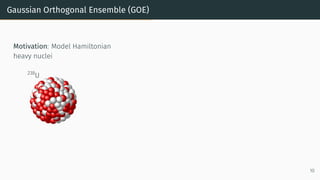
Gaussian Orthogonal Ensemble (GOE)
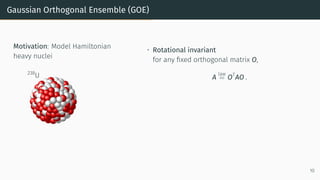
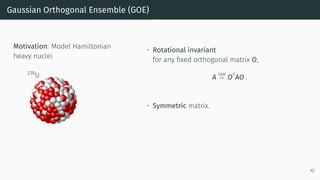
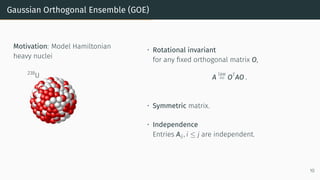
Motivation: Model Hamiltonian
heavy nuclei
238
U
10
Gaussian Orthogonal Ensemble (GOE)
Motivation: Model Hamiltonian
heavy nuclei
238
U
• Rotational invariant
for any fixed orthogonal matrix O,
A
law
= OT
AO .
10
Gaussian Orthogonal Ensemble (GOE)
Motivation: Model Hamiltonian
heavy nuclei
238
U
• Rotational invariant
for any fixed orthogonal matrix O,
A
law
= OT
AO .
• Symmetric matrix.
10
Gaussian Orthogonal Ensemble (GOE)
Motivation: Model Hamiltonian
heavy nuclei
238
U
• Rotational invariant
for any fixed orthogonal matrix O,
A
law
= OT
AO .
• Symmetric matrix.
• Independence
Entries Aij, i ≤ j are independent.
10
Gaussian Orthogonal Ensemble (GOE)
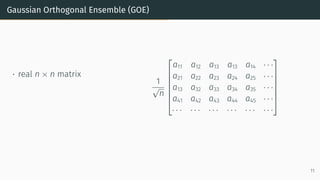
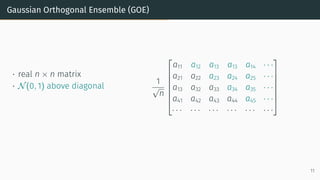
• real n × n matrix
1
√
n







a11 a12 a13 a13 a14 · · ·
a21 a22 a23 a24 a25 · · ·
a13 a32 a33 a34 a35 · · ·
a41 a42 a43 a44 a45 · · ·
· · · · · · · · · · · · · · · · · ·







11
Gaussian Orthogonal Ensemble (GOE)
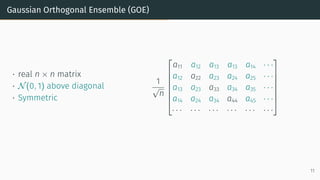
• real n × n matrix
• N(0, 1) above diagonal
1
√
n







a11 a12 a13 a13 a14 · · ·
a21 a22 a23 a24 a25 · · ·
a13 a32 a33 a34 a35 · · ·
a41 a42 a43 a44 a45 · · ·
· · · · · · · · · · · · · · · · · ·







11
Gaussian Orthogonal Ensemble (GOE)
• real n × n matrix
• N(0, 1) above diagonal
• Symmetric
1
√
n







a11 a12 a13 a13 a14 · · ·
a12 a22 a23 a24 a25 · · ·
a13 a23 a33 a34 a35 · · ·
a14 a24 a34 a44 a45 · · ·
· · · · · · · · · · · · · · · · · ·







11
Gaussian Orthogonal Ensemble (GOE)
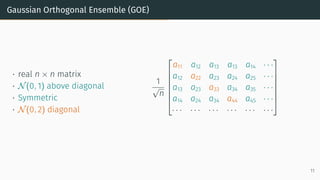
• real n × n matrix
• N(0, 1) above diagonal
• Symmetric
• N(0, 2) diagonal
1
√
n







a11 a12 a13 a13 a14 · · ·
a12 a22 a23 a24 a25 · · ·
a13 a23 a33 a34 a35 · · ·
a14 a24 a34 a44 a45 · · ·
· · · · · · · · · · · · · · · · · ·







11
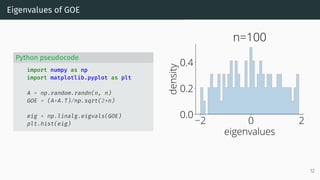
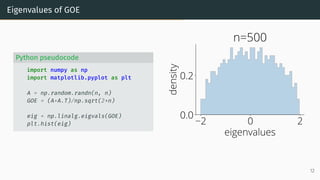
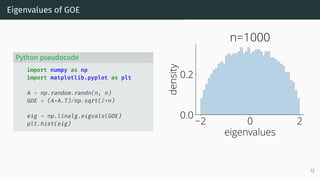
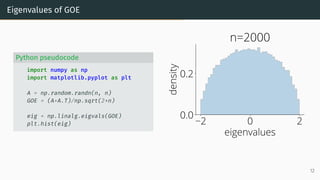
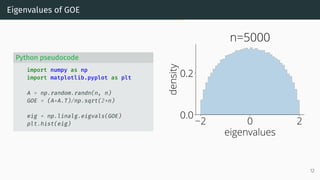
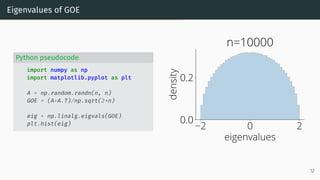
Eigenvalues of GOE
Python pseudocode
import numpy as np
import matplotlib.pyplot as plt
A = np.random.randn(n, n)
GOE = (A+A.T)/np.sqrt(2*n)
eig = np.linalg.eigvals(GOE)
plt.hist(eig) 2 0 2
eigenvalues
0.0
0.2
0.4
density
n=100
12
Eigenvalues of GOE
Python pseudocode
import numpy as np
import matplotlib.pyplot as plt
A = np.random.randn(n, n)
GOE = (A+A.T)/np.sqrt(2*n)
eig = np.linalg.eigvals(GOE)
plt.hist(eig) 2 0 2
eigenvalues
0.0
0.2
density
n=500
12
Eigenvalues of GOE
Python pseudocode
import numpy as np
import matplotlib.pyplot as plt
A = np.random.randn(n, n)
GOE = (A+A.T)/np.sqrt(2*n)
eig = np.linalg.eigvals(GOE)
plt.hist(eig) 2 0 2
eigenvalues
0.0
0.2
density
n=1000
12
Eigenvalues of GOE
Python pseudocode
import numpy as np
import matplotlib.pyplot as plt
A = np.random.randn(n, n)
GOE = (A+A.T)/np.sqrt(2*n)
eig = np.linalg.eigvals(GOE)
plt.hist(eig) 2 0 2
eigenvalues
0.0
0.2
density
n=2000
12
Eigenvalues of GOE
Python pseudocode
import numpy as np
import matplotlib.pyplot as plt
A = np.random.randn(n, n)
GOE = (A+A.T)/np.sqrt(2*n)
eig = np.linalg.eigvals(GOE)
plt.hist(eig) 2 0 2
eigenvalues
0.0
0.2
density
n=5000
12
Eigenvalues of GOE
Python pseudocode
import numpy as np
import matplotlib.pyplot as plt
A = np.random.randn(n, n)
GOE = (A+A.T)/np.sqrt(2*n)
eig = np.linalg.eigvals(GOE)
plt.hist(eig)
2 0 2
eigenvalues
0.0
0.2
density
n=10000
12
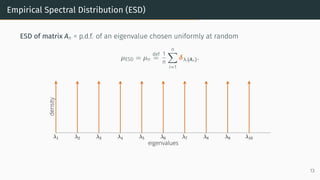
Empirical Spectral Distribution (ESD)
ESD of matrix An = p.d.f. of an eigenvalue chosen uniformly at random
µESD = µn
def
=
1
n
n
X
i=1
δλi(An).
λ1 λ2 λ3 λ4 λ5 λ6 λ7 λ8 λ9 λ10
eigenvalues
density
13
Wigner Semicircle Law
µESD converges as n → ∞ to the semicircular distribution,
µSC(x)
def
=
1
2π
p
(4 − x2)+ dx .
2 0 2
eigenvalues
0.0
0.2
density
µSC
Wigner semicircle
To know more: [Tao, 2012, Bai and Silverstein, 2010].
14
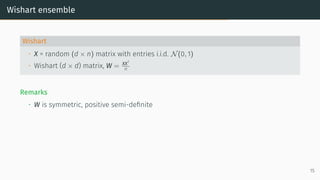
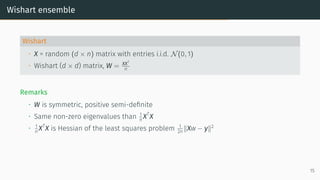
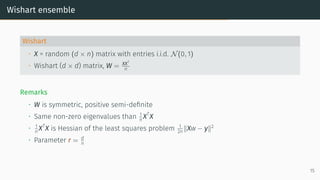
Wishart ensemble
Wishart
• X = random (d × n) matrix with entries i.i.d. N(0, 1)
• Wishart (d × d) matrix, W = XXT
n
Remarks
• W is symmetric, positive semi-definite
15
Wishart ensemble
Wishart
• X = random (d × n) matrix with entries i.i.d. N(0, 1)
• Wishart (d × d) matrix, W = XXT
n
Remarks
• W is symmetric, positive semi-definite
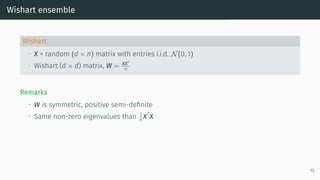
• Same non-zero eigenvalues than 1
n XT
X
15
Wishart ensemble
Wishart
• X = random (d × n) matrix with entries i.i.d. N(0, 1)
• Wishart (d × d) matrix, W = XXT
n
Remarks
• W is symmetric, positive semi-definite
• Same non-zero eigenvalues than 1
n XT
X
• 1
n XT
X is Hessian of the least squares problem 1
2n ∥Xw − y∥2
15
Wishart ensemble
Wishart
• X = random (d × n) matrix with entries i.i.d. N(0, 1)
• Wishart (d × d) matrix, W = XXT
n
Remarks
• W is symmetric, positive semi-definite
• Same non-zero eigenvalues than 1
n XT
X
• 1
n XT
X is Hessian of the least squares problem 1
2n ∥Xw − y∥2
• Parameter r = d
n
15
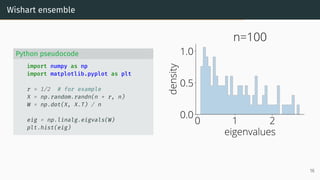
Wishart ensemble
Python pseudocode
import numpy as np
import matplotlib.pyplot as plt
r = 1/2 # for example
X = np.random.randn(n * r, n)
W = np.dot(X, X.T) / n
eig = np.linalg.eigvals(W)
plt.hist(eig)
0 1 2
eigenvalues
0.0
0.5
1.0
density
n=100
16
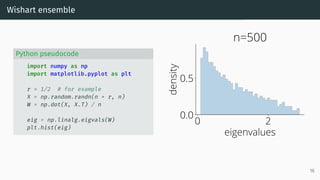
Wishart ensemble
Python pseudocode
import numpy as np
import matplotlib.pyplot as plt
r = 1/2 # for example
X = np.random.randn(n * r, n)
W = np.dot(X, X.T) / n
eig = np.linalg.eigvals(W)
plt.hist(eig)
0 2
eigenvalues
0.0
0.5
density
n=500
16
Wishart ensemble
Python pseudocode
import numpy as np
import matplotlib.pyplot as plt
r = 1/2 # for example
X = np.random.randn(n * r, n)
W = np.dot(X, X.T) / n
eig = np.linalg.eigvals(W)
plt.hist(eig)
0 2
eigenvalues
0.0
0.5
density
n=1000
16
Wishart ensemble
Python pseudocode
import numpy as np
import matplotlib.pyplot as plt
r = 1/2 # for example
X = np.random.randn(n * r, n)
W = np.dot(X, X.T) / n
eig = np.linalg.eigvals(W)
plt.hist(eig)
0 2
eigenvalues
0.0
0.5
density
n=2000
16
Wishart ensemble
Python pseudocode
import numpy as np
import matplotlib.pyplot as plt
r = 1/2 # for example
X = np.random.randn(n * r, n)
W = np.dot(X, X.T) / n
eig = np.linalg.eigvals(W)
plt.hist(eig)
0 2
eigenvalues
0.0
0.5
density
n=5000
16
Wishart ensemble
Python pseudocode
import numpy as np
import matplotlib.pyplot as plt
r = 1/2 # for example
X = np.random.randn(n * r, n)
W = np.dot(X, X.T) / n
eig = np.linalg.eigvals(W)
plt.hist(eig) 0 2
eigenvalues
0.0
0.5
density
n=10000
16
Limit of Wishart matrices
Marchenko-Pastur (MP) law [Marčenko and Pastur, 1967]
As n, d → ∞, d
n → r, µESD converges to the Marchenko-Pastur distribution:
µMP(x)
def
= (1 − 1
r )+δ0(x)
| {z }
nonzero if r > 1
+
p
(λ+ − x)(x − λ−)
2πr x
1x∈[λ−,λ+] dx .
with λ−
= (1 −
√
r)2
, λ+
= (1 +
√
r)2
0 2
eigenvalues
0.0
0.5
density
Marchenko-Pastur
λ −
λ +
17
The r = d
n
parameter
• r < 1 =⇒ d < n =⇒ W is product of two fat matrices.
• r > 1 =⇒ d > n =⇒ W is product of two thin matrices (rank-deficient).
1 2
eigenvalues
0.0
0.5
1.0
density
λ −
λ +
r=0.2
µMP(x)
def
= (1 − 1
r )+δ0(x)
| {z }
nonzero if r > 1
+
p
(λ+ − x)(x − λ−)
2πr x
1x∈[λ−,λ+] dx .
18
The r = d
n
parameter
• r < 1 =⇒ d < n =⇒ W is product of two fat matrices.
• r > 1 =⇒ d > n =⇒ W is product of two thin matrices (rank-deficient).
0 2
eigenvalues
0.0
0.5
1.0
density
λ −
λ +
r=0.5
µMP(x)
def
= (1 − 1
r )+δ0(x)
| {z }
nonzero if r > 1
+
p
(λ+ − x)(x − λ−)
2πr x
1x∈[λ−,λ+] dx .
18
The r = d
n
parameter
• r < 1 =⇒ d < n =⇒ W is product of two fat matrices.
• r > 1 =⇒ d > n =⇒ W is product of two thin matrices (rank-deficient).
0 2
eigenvalues
0
1
2
density
λ −
λ +
r=0.9
µMP(x)
def
= (1 − 1
r )+δ0(x)
| {z }
nonzero if r > 1
+
p
(λ+ − x)(x − λ−)
2πr x
1x∈[λ−,λ+] dx .
18
The r = d
n
parameter
• r < 1 =⇒ d < n =⇒ W is product of two fat matrices.
• r > 1 =⇒ d > n =⇒ W is product of two thin matrices (rank-deficient).
0 2 4
eigenvalues
0
2
4
density
λ −
λ +
r=1.0
µMP(x)
def
= (1 − 1
r )+δ0(x)
| {z }
nonzero if r > 1
+
p
(λ+ − x)(x − λ−)
2πr x
1x∈[λ−,λ+] dx .
18
The r = d
n
parameter
• r < 1 =⇒ d < n =⇒ W is product of two fat matrices.
• r > 1 =⇒ d > n =⇒ W is product of two thin matrices (rank-deficient).
0.0 2.5 5.0
eigenvalues
0.0
0.1
0.2
0.3
density
λ −
λ +
r=2.0
µMP(x)
def
= (1 − 1
r )+δ0(x)
| {z }
nonzero if r > 1
+
p
(λ+ − x)(x − λ−)
2πr x
1x∈[λ−,λ+] dx .
18
The r = d
n
parameter
• r < 1 =⇒ d < n =⇒ W is product of two fat matrices.
• r > 1 =⇒ d > n =⇒ W is product of two thin matrices (rank-deficient).
0 5 10
eigenvalues
0.00
0.05
0.10
density
λ −
λ +
r=5.0
µMP(x)
def
= (1 − 1
r )+δ0(x)
| {z }
nonzero if r > 1
+
p
(λ+ − x)(x − λ−)
2πr x
1x∈[λ−,λ+] dx .
18
Universality
Covariance matrices W = 1
n XX⊤
What happens if we replace the N(0, 1) with a different distribution?
• Xij ∼ N(0, 1)
• Xij ∼ Rademacher Pr(Xij = −1) = Pr(Xij = 1) = 1
2
19
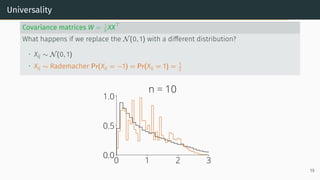
Universality
Covariance matrices W = 1
n XX⊤
What happens if we replace the N(0, 1) with a different distribution?
• Xij ∼ N(0, 1)
• Xij ∼ Rademacher Pr(Xij = −1) = Pr(Xij = 1) = 1
2
0 1 2 3
0.0
0.5
1.0
n = 10
19
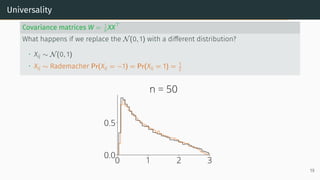
Universality
Covariance matrices W = 1
n XX⊤
What happens if we replace the N(0, 1) with a different distribution?
• Xij ∼ N(0, 1)
• Xij ∼ Rademacher Pr(Xij = −1) = Pr(Xij = 1) = 1
2
0 1 2 3
0.0
0.5
n = 50
19
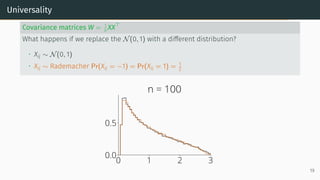
Universality
Covariance matrices W = 1
n XX⊤
What happens if we replace the N(0, 1) with a different distribution?
• Xij ∼ N(0, 1)
• Xij ∼ Rademacher Pr(Xij = −1) = Pr(Xij = 1) = 1
2
0 1 2 3
0.0
0.5
n = 100
19
Universality
Covariance matrices W = 1
n XX⊤
What happens if we replace the N(0, 1) with a different distribution?
• Xij ∼ N(0, 1)
• Xij ∼ Rademacher Pr(Xij = −1) = Pr(Xij = 1) = 1
2
0 1 2 3
0.0
0.5
n = 500
19
Universality
Covariance matrices W = 1
n XX⊤
What happens if we replace the N(0, 1) with a different distribution?
• Xij ∼ N(0, 1)
• Xij ∼ Rademacher Pr(Xij = −1) = Pr(Xij = 1) = 1
2
0 1 2 3
0.0
0.5
n = 1000
19
Universality
Universality
• Statistics only mildly depend on the lower order moments of distribution of the
entries
20
Universality
Universality
• Statistics only mildly depend on the lower order moments of distribution of the
entries
Example: Marchenko-Pastur [Marčenko and Pastur, 1967]
Let X be a d × n random matrix with i.i.d. entries that verifies
E[Xij] = 0, E[X2
ij] = 1, E[X4
ij] < ∞
Universality: As n, d → ∞ with d
n → r, the ESD of W = XXT
n converges to
Marchenko-Pastur(r)
20
May others ...
Other matrix ensembles
• Ginibre. Let Gn be n × n matrix of i.i.d. N(0, 1), (bilinear games [Domingo-Enrich et al., 2020])
(Circle law) ESD of Gn/
√
n → Unif(disk) .
• Uniform probability measure on orthogonal matrices. V ∼ Unif(O(n)),
ESD of V → Unif(S1
) .
21
References i
References
Ben Adlam and Jeffrey Pennington. The neural tangent kernel in high dimensions: Triple descent and a multi-scale theory of
generalization. In International Conference on Machine Learning. PMLR, 2020. URL
https://arxiv.org/pdf/2008.06786.pdf.
Daniel J Amit, Hanoch Gutfreund, and Haim Sompolinsky. Spin-glass models of neural networks. Physical Review A, 1985. URL
https://doi.org/10.1103/PhysRevA.32.1007.
Z. Bai and J. Silverstein. Spectral analysis of large dimensional random matrices, volume 20. Springer, 2010.
Marco Baity-Jesi, Levent Sagun, Mario Geiger, Stefano Spigler, Gérard Ben Arous, Chiara Cammarota, Yann LeCun, Matthieu Wyart,
and Giulio Biroli. Comparing dynamics: Deep neural networks versus glassy systems. In International Conference on Machine
Learning. PMLR, 2018. URL https://arxiv.org/pdf/1803.06969.pdf.
Nicholas P Baskerville, Diego Granziol, and Jonathan P Keating. Applicability of random matrix theory in deep learning. arXiv
preprint arXiv:2102.06740, 2021. URL https://arxiv.org/pdf/2102.06740.pdf.
K H Borgwardt. The simplex method: A probabilistic analysis. Springer–Verlag, Berlin, Heidelberg, 1987. URL
https://www.springer.com/gp/book/9783540170969.
References ii
Jean-Philippe Bouchaud and Marc Potters. Financial applications of random matrix theory: a short review. arXiv preprint
arXiv:0910.1205, 2009. URL https://arxiv.org/pdf/0910.1205.
Anna Choromanska, Mikael Henaff, Michael Mathieu, Gérard Ben Arous, and Yann LeCun. The loss surfaces of multilayer
networks. In Artificial intelligence and statistics. PMLR, 2015. URL https://arxiv.org/pdf/1412.0233.pdf.
Yann Dauphin, Razvan Pascanu, Caglar Gulcehre, Kyunghyun Cho, Surya Ganguli, and Yoshua Bengio. Identifying and attacking
the saddle point problem in high-dimensional non-convex optimization. arXiv preprint arXiv:1406.2572, 2014. URL
https://arxiv.org/pdf/1406.2572.pdf.
P Deift and T Trogdon. Universality for Eigenvalue Algorithms on Sample Covariance Matrices. SIAM Journal on Numerical
Analysis, 2017. URL http://arxiv.org/abs/1701.01896.
Carles Domingo-Enrich, Fabian Pedregosa, and Damien Scieur. Average-case acceleration for bilinear games and normal
matrices. arXiv preprint arXiv:2010.02076, 2020.
Viktor Dotsenko. An introduction to the theory of spin glasses and neural networks. World Scientific, 1995. URL
https://doi.org/10.1142/2460.
Paul Erdos and Alfréd Rényi. On the evolution of random graphs. Publ. Math. Inst. Hung. Acad. Sci, 1960. URL
http://citeseerx.ist.psu.edu/viewdoc/download?doi=10.1.1.348.530&rep=rep1&type=pdf.
Elizabeth Gardner and Bernard Derrida. Optimal storage properties of neural network models. Journal of Physics A:
Mathematical and general, 1988. URL http://www.phys.ens.fr/~derrida/PAPIERS/1988/optimal-storage.pdf.
References iii
Behrooz Ghorbani, Shankar Krishnan, and Ying Xiao. An investigation into neural net optimization via hessian eigenvalue
density. In International Conference on Machine Learning. PMLR, 2019. URL https://arxiv.org/pdf/1901.10159.pdf.
Trevor Hastie, Andrea Montanari, Saharon Rosset, and Ryan J Tibshirani. Surprises in high-dimensional ridgeless least squares
interpolation. arXiv preprint arXiv:1903.08560, 2019. URL https://arxiv.org/pdf/1903.08560.pdf.
J Keating. The Riemann zeta-function and quantum chaology. In Quantum chaos. Elsevier, 1993. URL
https://arxiv.org/pdf/0708.4223.pdf.
Jonathan Lacotte and Mert Pilanci. Optimal randomized first-order methods for least-squares problems. In International
Conference on Machine Learning. PMLR, 2020. URL https://arxiv.org/pdf/2002.09488.pdf.
Z Liao and M W Mahoney. Hessian Eigenspectra of More Realistic Nonlinear Models. mar 2021. URL
http://arxiv.org/abs/2103.01519.
Zhenyu Liao, Romain Couillet, and Michael W Mahoney. A random matrix analysis of random fourier features: beyond the
gaussian kernel, a precise phase transition, and the corresponding double descent. arXiv preprint arXiv:2006.05013, 2020. URL
https://arxiv.org/pdf/2006.05013.pdf.
Vladimir A Marčenko and Leonid Andreevich Pastur. Distribution of eigenvalues for some sets of random matrices. Mathematics
of the USSR-Sbornik, 1967. URL
https://iopscience.iop.org/article/10.1070/SM1967v001n04ABEH001994/meta.
Song Mei and Andrea Montanari. The generalization error of random features regression: Precise asymptotics and double
descent curve. arXiv preprint arXiv:1908.05355, 2019. URL https://arxiv.org/pdf/1908.05355.pdf.
References iv
Hugh L Montgomery. The pair correlation of zeros of the zeta function. In Proc. Symp. Pure Math, 1973. URL
http://www-personal.umich.edu/~hlm/paircor1.pdf.
Andrew M Odlyzko. On the distribution of spacings between zeros of the zeta function. Mathematics of Computation, 1987. URL
https://doi.org/10.1090/S0025-5718-1987-0866115-0.
Vardan Papyan. Traces of class/cross-class structure pervade deep learning spectra. Journal of Machine Learning Research,
2020. URL http://jmlr.org/papers/v21/20-933.html.
Elliot Paquette and Thomas Trogdon. Universality for the conjugate gradient and minres algorithms on sample covariance
matrices. arXiv preprint arXiv:2007.00640, 2020. URL https://arxiv.org/pdf/2007.00640.pdf.
Fabian Pedregosa and Damien Scieur. Acceleration through spectral density estimation. In International Conference on Machine
Learning. PMLR, 2020. URL https://arxiv.org/pdf/2002.04756.pdf.
Norbert Rosenzweig and Charles E. Porter. ”repulsion of energy levels” in complex atomic spectra. Phys. Rev., 1960. URL
https://link.aps.org/doi/10.1103/PhysRev.120.1698.
Levent Sagun, V Ugur Guney, Gerard Ben Arous, and Yann LeCun. Explorations on high dimensional landscapes. arXiv preprint
arXiv:1412.6615, 2014. URL https://arxiv.org/pdf/1412.6615.pdf.
S Smale. On the average number of steps of the simplex method of linear programming. Mathematical Programming, 27(3):
241–262, oct 1983. ISSN 0025-5610. doi: 10.1007/BF02591902. URL
http://link.springer.com/10.1007/BF02591902.
References v
D A Spielman and S-H Teng. Smoothed analysis of algorithms. Journal of the ACM, 51(3):385–463, may 2004. ISSN 00045411. doi:
10.1145/990308.990310. URL http://dl.acm.org/citation.cfm?id=990308.990310.
Terence Tao. Topics in random matrix theory. American Mathematical Soc., 2012.
Antonia M Tulino, Sergio Verdú, and Sergio Verdu. Random matrix theory and wireless communications. Now Publishers Inc,
2004. URL http://dx.doi.org/10.1561/0100000001.
R Vershynin. Beyond Hirsch Conjecture: Walks on Random Polytopes and Smoothed Complexity of the Simplex Method. SIAM
Journal on Computing, 39, 2009. URL http://epubs.siam.org/doi/10.1137/070683386.
Eugene Wigner. Characteristic vectors of bordered matrices with infinite dimensions. Annals of Mathematics, 1955. URL
https://doi.org/10.1007/978-3-662-02781-3_35.
John Wishart. The generalised product moment distribution in samples from a normal multivariate population. Biometrika,
1928. URL https://doi.org/10.2307/2331939.
Zhewei Yao, Amir Gholami, Kurt Keutzer, and Michael W Mahoney. Pyhessian: Neural networks through the lens of the hessian. In
2020 IEEE International Conference on Big Data (Big Data). IEEE, 2020. URL
https://github.com/amirgholami/PyHessian.

Random Matrix Theory and Machine Learning - Part 1

  • 1.
    Random Matrix Theoryfor Machine Learning Part 1: Motivating Questions and Building Blocks Fabian Pedregosa1 , Courtney Paquette1,2 , Tom Trogdon3 , Jeffrey Pennington1 1 Google Research , 2 McGill University , 3 University of Washington https://random-matrix-learning.github.io
  • 2.
    About this tutorial Objective: •Applications of Random Matrix Theory (RMT) in Machine Learning. • Proof techniques in RMT 1
  • 3.
    About this tutorial Objective: •Applications of Random Matrix Theory (RMT) in Machine Learning. • Proof techniques in RMT Structure: 1. Motivating Questions and Building Blocks, Fabian Pedregosa 2. Introduction to Random Matrix Theory, Courtney Paquette 3. Analysis of Numerical Algorithms, Tom Trogdon 4. The Mystery of Generalization: Why Does Deep Learning Work?, Jeffrey Pennington https://random-matrix-learning.github.io 1
  • 4.
    What is aRandom Matrix? A random matrix is a matrix whose entries are random variables, not necessarily independent. 2
  • 5.
    What is aRandom Matrix? A random matrix is a matrix whose entries are random variables, not necessarily independent. Example Realization of a random matrix: Z =        1.066 0.908 1.026 −0.294 0.879 0.908 −1.794 0.596 −1.014 −0.103 1.026 0.596 −0.246 0.968 0.750 −0.294 −1.014 0.968 0.184 0.812 0.879 −0.103 0.750 0.812 0.210        2
  • 6.
    What is aRandom Matrix? A random matrix is a matrix whose entries are random variables, not necessarily independent. Example Realization of a random matrix: Z =        1.066 0.908 1.026 −0.294 0.879 0.908 −1.794 0.596 −1.014 −0.103 1.026 0.596 −0.246 0.968 0.750 −0.294 −1.014 0.968 0.184 0.812 0.879 −0.103 0.750 0.812 0.210        Goal of Random Matrix Theory is to understand their • eigenvalues • eigenvectors • norms • singular values • singular vectors • … 2
  • 7.
    Where do RandomMatrices Come From?
  • 8.
    1928: Eigenvalues ofNormal Covariance Matrices John Wishart 0 2 eigenvalues 0.0 0.5 density 3
  • 9.
    1928: Eigenvalues ofNormal Covariance Matrices John Wishart 0 2 eigenvalues 0.0 0.5 density W = XX⊤ , Xij ∼ N(0, 1) p(λ1, . . . , λN) ∝ e− 1 2 ∑ i λi Y λ (n−p−1)/2 i Y i<j |λi − λj| 3
  • 10.
    1955: Random SymmetricMatrices Eugene Wigner Energy levels of heavy nuclei, compared with the random matrix theory prediction. Source: [Rosenzweig and Porter, 1960] 4
  • 11.
    Model for high-dimensionalphenomena • Number Theory [Montgomery, 1973, Keating, 1993]. • Graph Theory [Erdos and Rényi, 1960]. • Finance [Bouchaud and Potters, 2009]. • Wireless communication [Tulino et al., 2004] • Machine Learning ... Distribution function of gaps between eigenvalues compared with histogram of gaps between ζ zeros. Source: [Odlyzko, 1987] 5
  • 12.
    Random Matrices inMachine Learning: Loss Landscape Spin Glass model of the Loss Landscape Early: [Amit et al., 1985, Gardner and Derrida, 1988, Dotsenko, 1995] Late: [Dauphin et al., 2014, Sagun et al., 2014, Choromanska et al., 2015, Baity-Jesi et al., 2018] Loss study through spin-glass model. Scaled test losses for the spin-glass (left) and the neural network (right). Source: Choromanska et al. [2015] The Loss Surfaces of Multilayer Networks. 6
  • 13.
    Random Matrices inMachine Learning: Loss Landscape New methods and software1,2,3 to compute Hessian eigenvalues of large models [Ghorbani et al., 2019, Yao et al., 2020, Papyan, 2020] 1 https://github.com/amirgholami/PyHessian 2 https://github.com/google/spectral-density/ 3 https://github.com/deep-lab/DeepnetHessian Source: [Papyan, 2020] 7
  • 14.
    Random Matrices inMachine Learning: Loss Landscape New methods and software1,2,3 to compute Hessian eigenvalues of large models [Ghorbani et al., 2019, Yao et al., 2020, Papyan, 2020] 1 https://github.com/amirgholami/PyHessian 2 https://github.com/google/spectral-density/ 3 https://github.com/deep-lab/DeepnetHessian RMT model for the Hessian still an open problem [Liao and Mahoney, 2021, Baskerville et al., 2021] ... Source: [Papyan, 2020] 7
  • 15.
    Random Matrices inMachine Learning: Numerical Algorithms Analyze algorithms with random data. • Simplex [Borgwardt, 1987, Smale, 1983, Spielman and Teng, 2004, Vershynin, 2009] etc. • Conjugate Gradient [Deift and Trogdon, 2017, Paquette and Trogdon, 2020] • Acceleration [Pedregosa and Scieur, 2020, Lacotte and Pilanci, 2020] 8
  • 16.
    Random Matrices inMachine Learning: Numerical Algorithms Analyze algorithms with random data. • Simplex [Borgwardt, 1987, Smale, 1983, Spielman and Teng, 2004, Vershynin, 2009] etc. • Conjugate Gradient [Deift and Trogdon, 2017, Paquette and Trogdon, 2020] • Acceleration [Pedregosa and Scieur, 2020, Lacotte and Pilanci, 2020] Topic of Part 3 of this tutorial 8
  • 17.
    Random Matrices inMachine Learning: Generalization As a model for generalization [Hastie et al., 2019, Mei and Montanari, 2019, Adlam and Pennington, 2020, Liao et al., 2020] Random Matrices can be used to model the double descent generalization curve. Source: [Mei and Montanari, 2019] The generalization error of random features regression: Precise asymptotics and double descent curve 9
  • 18.
    Random Matrices inMachine Learning: Generalization As a model for generalization [Hastie et al., 2019, Mei and Montanari, 2019, Adlam and Pennington, 2020, Liao et al., 2020] Random Matrices can be used to model the double descent generalization curve. Source: [Mei and Montanari, 2019] The generalization error of random features regression: Precise asymptotics and double descent curve Part 4 of this tutorial 9
  • 19.
  • 20.
    Gaussian Orthogonal Ensemble(GOE) Motivation: Model Hamiltonian heavy nuclei 238 U 10
  • 21.
    Gaussian Orthogonal Ensemble(GOE) Motivation: Model Hamiltonian heavy nuclei 238 U • Rotational invariant for any fixed orthogonal matrix O, A law = OT AO . 10
  • 22.
    Gaussian Orthogonal Ensemble(GOE) Motivation: Model Hamiltonian heavy nuclei 238 U • Rotational invariant for any fixed orthogonal matrix O, A law = OT AO . • Symmetric matrix. 10
  • 23.
    Gaussian Orthogonal Ensemble(GOE) Motivation: Model Hamiltonian heavy nuclei 238 U • Rotational invariant for any fixed orthogonal matrix O, A law = OT AO . • Symmetric matrix. • Independence Entries Aij, i ≤ j are independent. 10
  • 24.
    Gaussian Orthogonal Ensemble(GOE) • real n × n matrix 1 √ n        a11 a12 a13 a13 a14 · · · a21 a22 a23 a24 a25 · · · a13 a32 a33 a34 a35 · · · a41 a42 a43 a44 a45 · · · · · · · · · · · · · · · · · · · · ·        11
  • 25.
    Gaussian Orthogonal Ensemble(GOE) • real n × n matrix • N(0, 1) above diagonal 1 √ n        a11 a12 a13 a13 a14 · · · a21 a22 a23 a24 a25 · · · a13 a32 a33 a34 a35 · · · a41 a42 a43 a44 a45 · · · · · · · · · · · · · · · · · · · · ·        11
  • 26.
    Gaussian Orthogonal Ensemble(GOE) • real n × n matrix • N(0, 1) above diagonal • Symmetric 1 √ n        a11 a12 a13 a13 a14 · · · a12 a22 a23 a24 a25 · · · a13 a23 a33 a34 a35 · · · a14 a24 a34 a44 a45 · · · · · · · · · · · · · · · · · · · · ·        11
  • 27.
    Gaussian Orthogonal Ensemble(GOE) • real n × n matrix • N(0, 1) above diagonal • Symmetric • N(0, 2) diagonal 1 √ n        a11 a12 a13 a13 a14 · · · a12 a22 a23 a24 a25 · · · a13 a23 a33 a34 a35 · · · a14 a24 a34 a44 a45 · · · · · · · · · · · · · · · · · · · · ·        11
  • 28.
    Eigenvalues of GOE Pythonpseudocode import numpy as np import matplotlib.pyplot as plt A = np.random.randn(n, n) GOE = (A+A.T)/np.sqrt(2*n) eig = np.linalg.eigvals(GOE) plt.hist(eig) 2 0 2 eigenvalues 0.0 0.2 0.4 density n=100 12
  • 29.
    Eigenvalues of GOE Pythonpseudocode import numpy as np import matplotlib.pyplot as plt A = np.random.randn(n, n) GOE = (A+A.T)/np.sqrt(2*n) eig = np.linalg.eigvals(GOE) plt.hist(eig) 2 0 2 eigenvalues 0.0 0.2 density n=500 12
  • 30.
    Eigenvalues of GOE Pythonpseudocode import numpy as np import matplotlib.pyplot as plt A = np.random.randn(n, n) GOE = (A+A.T)/np.sqrt(2*n) eig = np.linalg.eigvals(GOE) plt.hist(eig) 2 0 2 eigenvalues 0.0 0.2 density n=1000 12
  • 31.
    Eigenvalues of GOE Pythonpseudocode import numpy as np import matplotlib.pyplot as plt A = np.random.randn(n, n) GOE = (A+A.T)/np.sqrt(2*n) eig = np.linalg.eigvals(GOE) plt.hist(eig) 2 0 2 eigenvalues 0.0 0.2 density n=2000 12
  • 32.
    Eigenvalues of GOE Pythonpseudocode import numpy as np import matplotlib.pyplot as plt A = np.random.randn(n, n) GOE = (A+A.T)/np.sqrt(2*n) eig = np.linalg.eigvals(GOE) plt.hist(eig) 2 0 2 eigenvalues 0.0 0.2 density n=5000 12
  • 33.
    Eigenvalues of GOE Pythonpseudocode import numpy as np import matplotlib.pyplot as plt A = np.random.randn(n, n) GOE = (A+A.T)/np.sqrt(2*n) eig = np.linalg.eigvals(GOE) plt.hist(eig) 2 0 2 eigenvalues 0.0 0.2 density n=10000 12
  • 34.
    Empirical Spectral Distribution(ESD) ESD of matrix An = p.d.f. of an eigenvalue chosen uniformly at random µESD = µn def = 1 n n X i=1 δλi(An). λ1 λ2 λ3 λ4 λ5 λ6 λ7 λ8 λ9 λ10 eigenvalues density 13
  • 35.
    Wigner Semicircle Law µESDconverges as n → ∞ to the semicircular distribution, µSC(x) def = 1 2π p (4 − x2)+ dx . 2 0 2 eigenvalues 0.0 0.2 density µSC Wigner semicircle To know more: [Tao, 2012, Bai and Silverstein, 2010]. 14
  • 36.
    Wishart ensemble Wishart • X= random (d × n) matrix with entries i.i.d. N(0, 1) • Wishart (d × d) matrix, W = XXT n Remarks • W is symmetric, positive semi-definite 15
  • 37.
    Wishart ensemble Wishart • X= random (d × n) matrix with entries i.i.d. N(0, 1) • Wishart (d × d) matrix, W = XXT n Remarks • W is symmetric, positive semi-definite • Same non-zero eigenvalues than 1 n XT X 15
  • 38.
    Wishart ensemble Wishart • X= random (d × n) matrix with entries i.i.d. N(0, 1) • Wishart (d × d) matrix, W = XXT n Remarks • W is symmetric, positive semi-definite • Same non-zero eigenvalues than 1 n XT X • 1 n XT X is Hessian of the least squares problem 1 2n ∥Xw − y∥2 15
  • 39.
    Wishart ensemble Wishart • X= random (d × n) matrix with entries i.i.d. N(0, 1) • Wishart (d × d) matrix, W = XXT n Remarks • W is symmetric, positive semi-definite • Same non-zero eigenvalues than 1 n XT X • 1 n XT X is Hessian of the least squares problem 1 2n ∥Xw − y∥2 • Parameter r = d n 15
  • 40.
    Wishart ensemble Python pseudocode importnumpy as np import matplotlib.pyplot as plt r = 1/2 # for example X = np.random.randn(n * r, n) W = np.dot(X, X.T) / n eig = np.linalg.eigvals(W) plt.hist(eig) 0 1 2 eigenvalues 0.0 0.5 1.0 density n=100 16
  • 41.
    Wishart ensemble Python pseudocode importnumpy as np import matplotlib.pyplot as plt r = 1/2 # for example X = np.random.randn(n * r, n) W = np.dot(X, X.T) / n eig = np.linalg.eigvals(W) plt.hist(eig) 0 2 eigenvalues 0.0 0.5 density n=500 16
  • 42.
    Wishart ensemble Python pseudocode importnumpy as np import matplotlib.pyplot as plt r = 1/2 # for example X = np.random.randn(n * r, n) W = np.dot(X, X.T) / n eig = np.linalg.eigvals(W) plt.hist(eig) 0 2 eigenvalues 0.0 0.5 density n=1000 16
  • 43.
    Wishart ensemble Python pseudocode importnumpy as np import matplotlib.pyplot as plt r = 1/2 # for example X = np.random.randn(n * r, n) W = np.dot(X, X.T) / n eig = np.linalg.eigvals(W) plt.hist(eig) 0 2 eigenvalues 0.0 0.5 density n=2000 16
  • 44.
    Wishart ensemble Python pseudocode importnumpy as np import matplotlib.pyplot as plt r = 1/2 # for example X = np.random.randn(n * r, n) W = np.dot(X, X.T) / n eig = np.linalg.eigvals(W) plt.hist(eig) 0 2 eigenvalues 0.0 0.5 density n=5000 16
  • 45.
    Wishart ensemble Python pseudocode importnumpy as np import matplotlib.pyplot as plt r = 1/2 # for example X = np.random.randn(n * r, n) W = np.dot(X, X.T) / n eig = np.linalg.eigvals(W) plt.hist(eig) 0 2 eigenvalues 0.0 0.5 density n=10000 16
  • 46.
    Limit of Wishartmatrices Marchenko-Pastur (MP) law [Marčenko and Pastur, 1967] As n, d → ∞, d n → r, µESD converges to the Marchenko-Pastur distribution: µMP(x) def = (1 − 1 r )+δ0(x) | {z } nonzero if r > 1 + p (λ+ − x)(x − λ−) 2πr x 1x∈[λ−,λ+] dx . with λ− = (1 − √ r)2 , λ+ = (1 + √ r)2 0 2 eigenvalues 0.0 0.5 density Marchenko-Pastur λ − λ + 17
  • 47.
    The r =d n parameter • r < 1 =⇒ d < n =⇒ W is product of two fat matrices. • r > 1 =⇒ d > n =⇒ W is product of two thin matrices (rank-deficient). 1 2 eigenvalues 0.0 0.5 1.0 density λ − λ + r=0.2 µMP(x) def = (1 − 1 r )+δ0(x) | {z } nonzero if r > 1 + p (λ+ − x)(x − λ−) 2πr x 1x∈[λ−,λ+] dx . 18
  • 48.
    The r =d n parameter • r < 1 =⇒ d < n =⇒ W is product of two fat matrices. • r > 1 =⇒ d > n =⇒ W is product of two thin matrices (rank-deficient). 0 2 eigenvalues 0.0 0.5 1.0 density λ − λ + r=0.5 µMP(x) def = (1 − 1 r )+δ0(x) | {z } nonzero if r > 1 + p (λ+ − x)(x − λ−) 2πr x 1x∈[λ−,λ+] dx . 18
  • 49.
    The r =d n parameter • r < 1 =⇒ d < n =⇒ W is product of two fat matrices. • r > 1 =⇒ d > n =⇒ W is product of two thin matrices (rank-deficient). 0 2 eigenvalues 0 1 2 density λ − λ + r=0.9 µMP(x) def = (1 − 1 r )+δ0(x) | {z } nonzero if r > 1 + p (λ+ − x)(x − λ−) 2πr x 1x∈[λ−,λ+] dx . 18
  • 50.
    The r =d n parameter • r < 1 =⇒ d < n =⇒ W is product of two fat matrices. • r > 1 =⇒ d > n =⇒ W is product of two thin matrices (rank-deficient). 0 2 4 eigenvalues 0 2 4 density λ − λ + r=1.0 µMP(x) def = (1 − 1 r )+δ0(x) | {z } nonzero if r > 1 + p (λ+ − x)(x − λ−) 2πr x 1x∈[λ−,λ+] dx . 18
  • 51.
    The r =d n parameter • r < 1 =⇒ d < n =⇒ W is product of two fat matrices. • r > 1 =⇒ d > n =⇒ W is product of two thin matrices (rank-deficient). 0.0 2.5 5.0 eigenvalues 0.0 0.1 0.2 0.3 density λ − λ + r=2.0 µMP(x) def = (1 − 1 r )+δ0(x) | {z } nonzero if r > 1 + p (λ+ − x)(x − λ−) 2πr x 1x∈[λ−,λ+] dx . 18
  • 52.
    The r =d n parameter • r < 1 =⇒ d < n =⇒ W is product of two fat matrices. • r > 1 =⇒ d > n =⇒ W is product of two thin matrices (rank-deficient). 0 5 10 eigenvalues 0.00 0.05 0.10 density λ − λ + r=5.0 µMP(x) def = (1 − 1 r )+δ0(x) | {z } nonzero if r > 1 + p (λ+ − x)(x − λ−) 2πr x 1x∈[λ−,λ+] dx . 18
  • 53.
    Universality Covariance matrices W= 1 n XX⊤ What happens if we replace the N(0, 1) with a different distribution? • Xij ∼ N(0, 1) • Xij ∼ Rademacher Pr(Xij = −1) = Pr(Xij = 1) = 1 2 19
  • 54.
    Universality Covariance matrices W= 1 n XX⊤ What happens if we replace the N(0, 1) with a different distribution? • Xij ∼ N(0, 1) • Xij ∼ Rademacher Pr(Xij = −1) = Pr(Xij = 1) = 1 2 0 1 2 3 0.0 0.5 1.0 n = 10 19
  • 55.
    Universality Covariance matrices W= 1 n XX⊤ What happens if we replace the N(0, 1) with a different distribution? • Xij ∼ N(0, 1) • Xij ∼ Rademacher Pr(Xij = −1) = Pr(Xij = 1) = 1 2 0 1 2 3 0.0 0.5 n = 50 19
  • 56.
    Universality Covariance matrices W= 1 n XX⊤ What happens if we replace the N(0, 1) with a different distribution? • Xij ∼ N(0, 1) • Xij ∼ Rademacher Pr(Xij = −1) = Pr(Xij = 1) = 1 2 0 1 2 3 0.0 0.5 n = 100 19
  • 57.
    Universality Covariance matrices W= 1 n XX⊤ What happens if we replace the N(0, 1) with a different distribution? • Xij ∼ N(0, 1) • Xij ∼ Rademacher Pr(Xij = −1) = Pr(Xij = 1) = 1 2 0 1 2 3 0.0 0.5 n = 500 19
  • 58.
    Universality Covariance matrices W= 1 n XX⊤ What happens if we replace the N(0, 1) with a different distribution? • Xij ∼ N(0, 1) • Xij ∼ Rademacher Pr(Xij = −1) = Pr(Xij = 1) = 1 2 0 1 2 3 0.0 0.5 n = 1000 19
  • 59.
    Universality Universality • Statistics onlymildly depend on the lower order moments of distribution of the entries 20
  • 60.
    Universality Universality • Statistics onlymildly depend on the lower order moments of distribution of the entries Example: Marchenko-Pastur [Marčenko and Pastur, 1967] Let X be a d × n random matrix with i.i.d. entries that verifies E[Xij] = 0, E[X2 ij] = 1, E[X4 ij] < ∞ Universality: As n, d → ∞ with d n → r, the ESD of W = XXT n converges to Marchenko-Pastur(r) 20
  • 61.
    May others ... Othermatrix ensembles • Ginibre. Let Gn be n × n matrix of i.i.d. N(0, 1), (bilinear games [Domingo-Enrich et al., 2020]) (Circle law) ESD of Gn/ √ n → Unif(disk) . • Uniform probability measure on orthogonal matrices. V ∼ Unif(O(n)), ESD of V → Unif(S1 ) . 21
  • 62.
    References i References Ben Adlamand Jeffrey Pennington. The neural tangent kernel in high dimensions: Triple descent and a multi-scale theory of generalization. In International Conference on Machine Learning. PMLR, 2020. URL https://arxiv.org/pdf/2008.06786.pdf. Daniel J Amit, Hanoch Gutfreund, and Haim Sompolinsky. Spin-glass models of neural networks. Physical Review A, 1985. URL https://doi.org/10.1103/PhysRevA.32.1007. Z. Bai and J. Silverstein. Spectral analysis of large dimensional random matrices, volume 20. Springer, 2010. Marco Baity-Jesi, Levent Sagun, Mario Geiger, Stefano Spigler, Gérard Ben Arous, Chiara Cammarota, Yann LeCun, Matthieu Wyart, and Giulio Biroli. Comparing dynamics: Deep neural networks versus glassy systems. In International Conference on Machine Learning. PMLR, 2018. URL https://arxiv.org/pdf/1803.06969.pdf. Nicholas P Baskerville, Diego Granziol, and Jonathan P Keating. Applicability of random matrix theory in deep learning. arXiv preprint arXiv:2102.06740, 2021. URL https://arxiv.org/pdf/2102.06740.pdf. K H Borgwardt. The simplex method: A probabilistic analysis. Springer–Verlag, Berlin, Heidelberg, 1987. URL https://www.springer.com/gp/book/9783540170969.
  • 63.
    References ii Jean-Philippe Bouchaudand Marc Potters. Financial applications of random matrix theory: a short review. arXiv preprint arXiv:0910.1205, 2009. URL https://arxiv.org/pdf/0910.1205. Anna Choromanska, Mikael Henaff, Michael Mathieu, Gérard Ben Arous, and Yann LeCun. The loss surfaces of multilayer networks. In Artificial intelligence and statistics. PMLR, 2015. URL https://arxiv.org/pdf/1412.0233.pdf. Yann Dauphin, Razvan Pascanu, Caglar Gulcehre, Kyunghyun Cho, Surya Ganguli, and Yoshua Bengio. Identifying and attacking the saddle point problem in high-dimensional non-convex optimization. arXiv preprint arXiv:1406.2572, 2014. URL https://arxiv.org/pdf/1406.2572.pdf. P Deift and T Trogdon. Universality for Eigenvalue Algorithms on Sample Covariance Matrices. SIAM Journal on Numerical Analysis, 2017. URL http://arxiv.org/abs/1701.01896. Carles Domingo-Enrich, Fabian Pedregosa, and Damien Scieur. Average-case acceleration for bilinear games and normal matrices. arXiv preprint arXiv:2010.02076, 2020. Viktor Dotsenko. An introduction to the theory of spin glasses and neural networks. World Scientific, 1995. URL https://doi.org/10.1142/2460. Paul Erdos and Alfréd Rényi. On the evolution of random graphs. Publ. Math. Inst. Hung. Acad. Sci, 1960. URL http://citeseerx.ist.psu.edu/viewdoc/download?doi=10.1.1.348.530&rep=rep1&type=pdf. Elizabeth Gardner and Bernard Derrida. Optimal storage properties of neural network models. Journal of Physics A: Mathematical and general, 1988. URL http://www.phys.ens.fr/~derrida/PAPIERS/1988/optimal-storage.pdf.
  • 64.
    References iii Behrooz Ghorbani,Shankar Krishnan, and Ying Xiao. An investigation into neural net optimization via hessian eigenvalue density. In International Conference on Machine Learning. PMLR, 2019. URL https://arxiv.org/pdf/1901.10159.pdf. Trevor Hastie, Andrea Montanari, Saharon Rosset, and Ryan J Tibshirani. Surprises in high-dimensional ridgeless least squares interpolation. arXiv preprint arXiv:1903.08560, 2019. URL https://arxiv.org/pdf/1903.08560.pdf. J Keating. The Riemann zeta-function and quantum chaology. In Quantum chaos. Elsevier, 1993. URL https://arxiv.org/pdf/0708.4223.pdf. Jonathan Lacotte and Mert Pilanci. Optimal randomized first-order methods for least-squares problems. In International Conference on Machine Learning. PMLR, 2020. URL https://arxiv.org/pdf/2002.09488.pdf. Z Liao and M W Mahoney. Hessian Eigenspectra of More Realistic Nonlinear Models. mar 2021. URL http://arxiv.org/abs/2103.01519. Zhenyu Liao, Romain Couillet, and Michael W Mahoney. A random matrix analysis of random fourier features: beyond the gaussian kernel, a precise phase transition, and the corresponding double descent. arXiv preprint arXiv:2006.05013, 2020. URL https://arxiv.org/pdf/2006.05013.pdf. Vladimir A Marčenko and Leonid Andreevich Pastur. Distribution of eigenvalues for some sets of random matrices. Mathematics of the USSR-Sbornik, 1967. URL https://iopscience.iop.org/article/10.1070/SM1967v001n04ABEH001994/meta. Song Mei and Andrea Montanari. The generalization error of random features regression: Precise asymptotics and double descent curve. arXiv preprint arXiv:1908.05355, 2019. URL https://arxiv.org/pdf/1908.05355.pdf.
  • 65.
    References iv Hugh LMontgomery. The pair correlation of zeros of the zeta function. In Proc. Symp. Pure Math, 1973. URL http://www-personal.umich.edu/~hlm/paircor1.pdf. Andrew M Odlyzko. On the distribution of spacings between zeros of the zeta function. Mathematics of Computation, 1987. URL https://doi.org/10.1090/S0025-5718-1987-0866115-0. Vardan Papyan. Traces of class/cross-class structure pervade deep learning spectra. Journal of Machine Learning Research, 2020. URL http://jmlr.org/papers/v21/20-933.html. Elliot Paquette and Thomas Trogdon. Universality for the conjugate gradient and minres algorithms on sample covariance matrices. arXiv preprint arXiv:2007.00640, 2020. URL https://arxiv.org/pdf/2007.00640.pdf. Fabian Pedregosa and Damien Scieur. Acceleration through spectral density estimation. In International Conference on Machine Learning. PMLR, 2020. URL https://arxiv.org/pdf/2002.04756.pdf. Norbert Rosenzweig and Charles E. Porter. ”repulsion of energy levels” in complex atomic spectra. Phys. Rev., 1960. URL https://link.aps.org/doi/10.1103/PhysRev.120.1698. Levent Sagun, V Ugur Guney, Gerard Ben Arous, and Yann LeCun. Explorations on high dimensional landscapes. arXiv preprint arXiv:1412.6615, 2014. URL https://arxiv.org/pdf/1412.6615.pdf. S Smale. On the average number of steps of the simplex method of linear programming. Mathematical Programming, 27(3): 241–262, oct 1983. ISSN 0025-5610. doi: 10.1007/BF02591902. URL http://link.springer.com/10.1007/BF02591902.
  • 66.
    References v D ASpielman and S-H Teng. Smoothed analysis of algorithms. Journal of the ACM, 51(3):385–463, may 2004. ISSN 00045411. doi: 10.1145/990308.990310. URL http://dl.acm.org/citation.cfm?id=990308.990310. Terence Tao. Topics in random matrix theory. American Mathematical Soc., 2012. Antonia M Tulino, Sergio Verdú, and Sergio Verdu. Random matrix theory and wireless communications. Now Publishers Inc, 2004. URL http://dx.doi.org/10.1561/0100000001. R Vershynin. Beyond Hirsch Conjecture: Walks on Random Polytopes and Smoothed Complexity of the Simplex Method. SIAM Journal on Computing, 39, 2009. URL http://epubs.siam.org/doi/10.1137/070683386. Eugene Wigner. Characteristic vectors of bordered matrices with infinite dimensions. Annals of Mathematics, 1955. URL https://doi.org/10.1007/978-3-662-02781-3_35. John Wishart. The generalised product moment distribution in samples from a normal multivariate population. Biometrika, 1928. URL https://doi.org/10.2307/2331939. Zhewei Yao, Amir Gholami, Kurt Keutzer, and Michael W Mahoney. Pyhessian: Neural networks through the lens of the hessian. In 2020 IEEE International Conference on Big Data (Big Data). IEEE, 2020. URL https://github.com/amirgholami/PyHessian.