Presented By: M.Shahbaz
The Islamia University of Bahawalpur
Presented By: M.Shahbaz
Topic:
Splay Tree
Presented By:
Muhammad Shahbaz
The splay tree was invented by Daniel
Sleator and Robert Tarjan in 1985.[1]
A splay tree is a self-adjusting binary search tree with the
additional property that recently accessed elements are
quick to access again. ., splay trees perform better than
other search trees, even when the specific pattern of the
sequence is unknown
All normal operations on a binary search tree are combined
with one basic operation, called splaying.
oSplaying the tree for a certain element rearranges the
tree so that the element is placed at the root of the tree.
Presented By: M.Shahbaz
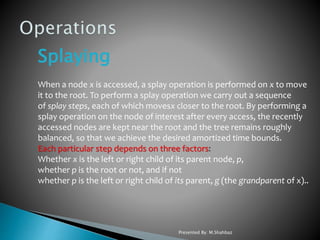
Splaying
When a node x is accessed, a splay operation is performed on x to move
it to the root. To perform a splay operation we carry out a sequence
of splay steps, each of which movesx closer to the root. By performing a
splay operation on the node of interest after every access, the recently
accessed nodes are kept near the root and the tree remains roughly
balanced, so that we achieve the desired amortized time bounds.
Each particular step depends on three factors:
Whether x is the left or right child of its parent node, p,
whether p is the root or not, and if not
whether p is the left or right child of its parent, g (the grandparent of x)..
Presented By: M.Shahbaz
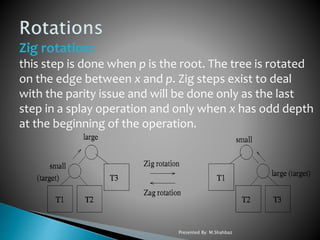
Zig rotation:
this step is done when p is the root. The tree is rotated
on the edge between x and p. Zig steps exist to deal
with the parity issue and will be done only as the last
step in a splay operation and only when x has odd depth
at the beginning of the operation.
Presented By: M.Shahbaz
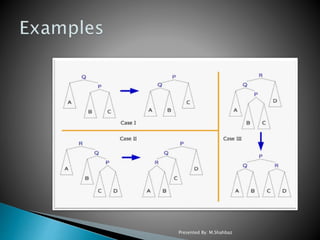
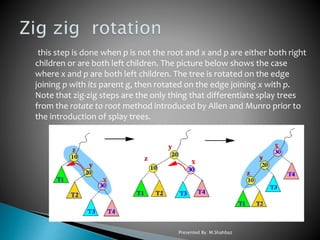
this step is done when p is not the root and x and p are either both right
children or are both left children. The picture below shows the case
where x and p are both left children. The tree is rotated on the edge
joining p with its parent g, then rotated on the edge joining x with p.
Note that zig-zig steps are the only thing that differentiate splay trees
from the rotate to root method introduced by Allen and Munro prior to
the introduction of splay trees.
Presented By: M.Shahbaz
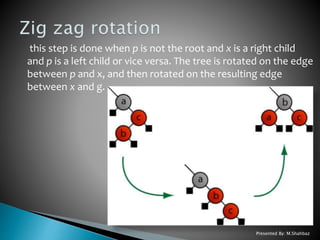
this step is done when p is not the root and x is a right child
and p is a left child or vice versa. The tree is rotated on the edge
between p and x, and then rotated on the resulting edge
between x and g.
Presented By: M.Shahbaz
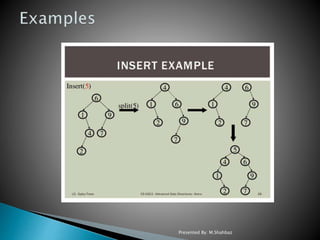
Starts the same as a BST with the new node
created at the a leaf. The new leaf node is
splayed until it becomes the root.
Splaying also occurs on
unsuccessful searches. The last
item on the access path is splayed
in this case.
Presented By: M.Shahbaz
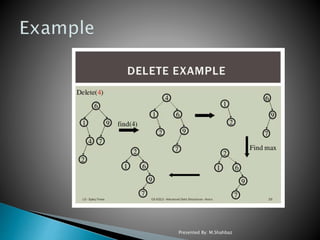
• First access the node to force it to percolate
to the root.
• Remove the root.
• Determine the largest item in the left subtree
and rotate it to the root of the left subtree
which results in the left subtree new root
having no right child.
• The right subtree is then added as the right
child of the new root.
Presented By: M.Shahbaz
Good performance for a splay tree depends on the fact
that it is self-optimizing, in that frequently accessed nodes
will move nearer to the root where they can be accessed
more quickly. The worst-case height—though unlikely—is
O(n), with the average being O(log n).
Having frequently used nodes near the root is an
advantage for many practical applications (also see Locality
of reference), and is particularly useful for
implementing caches and garbage collection algorithms
Small memory footprint: Splay trees do not need to store
any bookkeeping data.
Presented By: M.Shahbaz
The most significant disadvantage of splay trees is that the
height of a splay tree can be linear.
The representation of splay trees can change even when
they are accessed in a 'read-only' manner (i.e.
by find operations). This complicates the use of such splay
trees in a multi-threaded environment.
Specifically, extra management is needed if multiple threads
are allowed to perform find operations concurrently. This
also makes them unsuitable for general use in purely
functional programming, although even there they can be
used in limited ways to implement priority queues.
Presented By: M.Shahbaz
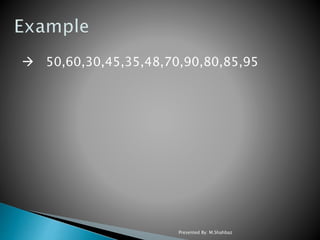
 50,60,30,45,35,48,70,90,80,85,95
Presented By: M.Shahbaz

Splay Tree Presentation Slides

  • 1.
    Presented By: M.Shahbaz TheIslamia University of Bahawalpur
  • 2.
    Presented By: M.Shahbaz Topic: SplayTree Presented By: Muhammad Shahbaz
  • 3.
    The splay treewas invented by Daniel Sleator and Robert Tarjan in 1985.[1] A splay tree is a self-adjusting binary search tree with the additional property that recently accessed elements are quick to access again. ., splay trees perform better than other search trees, even when the specific pattern of the sequence is unknown All normal operations on a binary search tree are combined with one basic operation, called splaying. oSplaying the tree for a certain element rearranges the tree so that the element is placed at the root of the tree. Presented By: M.Shahbaz
  • 4.
  • 5.
    Splaying When a nodex is accessed, a splay operation is performed on x to move it to the root. To perform a splay operation we carry out a sequence of splay steps, each of which movesx closer to the root. By performing a splay operation on the node of interest after every access, the recently accessed nodes are kept near the root and the tree remains roughly balanced, so that we achieve the desired amortized time bounds. Each particular step depends on three factors: Whether x is the left or right child of its parent node, p, whether p is the root or not, and if not whether p is the left or right child of its parent, g (the grandparent of x).. Presented By: M.Shahbaz
  • 6.
  • 7.
    Zig rotation: this stepis done when p is the root. The tree is rotated on the edge between x and p. Zig steps exist to deal with the parity issue and will be done only as the last step in a splay operation and only when x has odd depth at the beginning of the operation. Presented By: M.Shahbaz
  • 8.
    this step isdone when p is not the root and x and p are either both right children or are both left children. The picture below shows the case where x and p are both left children. The tree is rotated on the edge joining p with its parent g, then rotated on the edge joining x with p. Note that zig-zig steps are the only thing that differentiate splay trees from the rotate to root method introduced by Allen and Munro prior to the introduction of splay trees. Presented By: M.Shahbaz
  • 9.
    this step isdone when p is not the root and x is a right child and p is a left child or vice versa. The tree is rotated on the edge between p and x, and then rotated on the resulting edge between x and g. Presented By: M.Shahbaz
  • 10.
    Starts the sameas a BST with the new node created at the a leaf. The new leaf node is splayed until it becomes the root. Splaying also occurs on unsuccessful searches. The last item on the access path is splayed in this case. Presented By: M.Shahbaz
  • 11.
  • 12.
    • First accessthe node to force it to percolate to the root. • Remove the root. • Determine the largest item in the left subtree and rotate it to the root of the left subtree which results in the left subtree new root having no right child. • The right subtree is then added as the right child of the new root. Presented By: M.Shahbaz
  • 13.
  • 14.
    Good performance fora splay tree depends on the fact that it is self-optimizing, in that frequently accessed nodes will move nearer to the root where they can be accessed more quickly. The worst-case height—though unlikely—is O(n), with the average being O(log n). Having frequently used nodes near the root is an advantage for many practical applications (also see Locality of reference), and is particularly useful for implementing caches and garbage collection algorithms Small memory footprint: Splay trees do not need to store any bookkeeping data. Presented By: M.Shahbaz
  • 15.
    The most significantdisadvantage of splay trees is that the height of a splay tree can be linear. The representation of splay trees can change even when they are accessed in a 'read-only' manner (i.e. by find operations). This complicates the use of such splay trees in a multi-threaded environment. Specifically, extra management is needed if multiple threads are allowed to perform find operations concurrently. This also makes them unsuitable for general use in purely functional programming, although even there they can be used in limited ways to implement priority queues. Presented By: M.Shahbaz
  • 16.
  • 17.