







Network Topology &it’s Types
By : Zeeshan Ahmed Lodro
Batch 2k14
Department of Electrical Engineering Sukkur IBA
Network Topology
 What is Network Topology ?
 Network topology is Physical arrangement of connecting
various computers for networking .
Types of Network Topology
 There are five types of network topology
1. Bus Topology
2. Star Topology
3. Ring Topology
4. Mesh Topology
5. Tree Topology
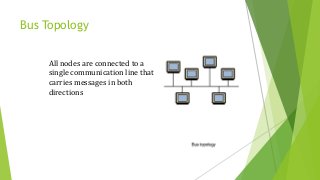
Bus Topology
All nodes are connected to a
single communication line that
carries messages in both
directions
Advantages & Disadvantages
Advantages
 Works well for small networks
 Relatively inexpensive to implement
 Easy to add to it
Disadvantages
 Management costs can be high
 Potential for congestion with network traffic
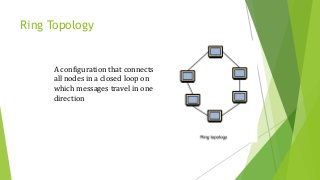
Ring Topology
A configuration that connects
all nodes in a closed loop on
which messages travel in one
direction
Advantages
 Easier to manage; easier to locate a defective node or cable
problem
 Well-suited for transmitting signals over long distances on a
LAN
 Handles high-volume network traffic
 Enables reliable communication
Disadvantages
 Expensive
 Requires more cable and network equipment at the
start
 Not used as widely as bus topology
 Fewer equipment options
 Fewer options for expansion to high-speed communication
Star Topology
A configuration that centers
around one node to which all
others are connected and through
which all messages are sent
Advantages
 Easy to connect new nodes or devices.
 centralized management. It helps in monitoring the network.
 Failure of one node or link doesn’t affect the rest of network.
At the same time its easy to detect the failure and
troubleshoot it.
Disadvantages
 Too much dependency on central device has its own
drawbacks. If it fails whole network goes down.
 The use of hub, a router or a switch as central device
increases the overall cost of the network.
 Performance and as well number of nodes which can be
added in such topology is depended on capacity of central
device.
Keep Reading
Mesh Topology
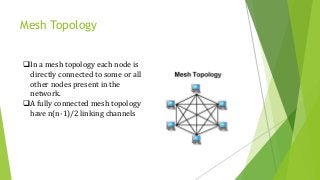
In a mesh topology each node is
directly connected to some or all
other nodes present in the
network.
A fully connected mesh topology
have n(n-1)/2 linking channels
Advantages
 Data can be transmitted from different devices
simultaneously. This topology can withstand high traffic.
 Even if one of the components fails there is always an
alternative present. So data transfer doesn’t get affected.
 Expansion and modification in topology can be done without
disrupting other nodes.
Disadvantages
 There are high chances of redundancy in many of the
network connections.
 Overall cost of this network is way too high as compared to
other network topologies.
 Set-up and maintenance of this topology is very difficult. Even
administration of the network is tough.
Tree Topology
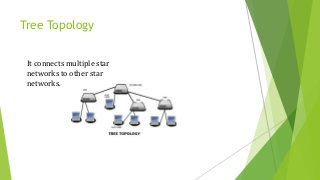
It connects multiple star
networks to other star
networks.
Advantages
 It is an extension of Star and bus Topologies, so in networks
where these topologies can't be implemented individually for
reasons related to scalability, tree topology is the best
alternative.
Error detection and correction is easy.
 Each segment is provided with dedicated point-to-point
wiring to the central hub.
 If one segment is damaged, other segments are not affected.
Disadvantages
 Because of its basic structure, tree topology, relies heavily on
the main bus cable, if it breaks whole network is crippled.
 As more and more nodes and segments are added, the
maintenance becomes difficult.
 Scalability of the network depends on the type of cable used.
networking topology

networking topology

  • 1.
    Network Topology &it’sTypes By : Zeeshan Ahmed Lodro Batch 2k14 Department of Electrical Engineering Sukkur IBA
  • 2.
    Network Topology  Whatis Network Topology ?  Network topology is Physical arrangement of connecting various computers for networking .
  • 3.
    Types of NetworkTopology  There are five types of network topology 1. Bus Topology 2. Star Topology 3. Ring Topology 4. Mesh Topology 5. Tree Topology
  • 4.
    Bus Topology All nodesare connected to a single communication line that carries messages in both directions
  • 5.
    Advantages & Disadvantages Advantages Works well for small networks  Relatively inexpensive to implement  Easy to add to it Disadvantages  Management costs can be high  Potential for congestion with network traffic
  • 6.
    Ring Topology A configurationthat connects all nodes in a closed loop on which messages travel in one direction
  • 7.
    Advantages  Easier tomanage; easier to locate a defective node or cable problem  Well-suited for transmitting signals over long distances on a LAN  Handles high-volume network traffic  Enables reliable communication
  • 8.
    Disadvantages  Expensive  Requiresmore cable and network equipment at the start  Not used as widely as bus topology  Fewer equipment options  Fewer options for expansion to high-speed communication
  • 9.
    Star Topology A configurationthat centers around one node to which all others are connected and through which all messages are sent
  • 10.
    Advantages  Easy toconnect new nodes or devices.  centralized management. It helps in monitoring the network.  Failure of one node or link doesn’t affect the rest of network. At the same time its easy to detect the failure and troubleshoot it.
  • 11.
    Disadvantages  Too muchdependency on central device has its own drawbacks. If it fails whole network goes down.  The use of hub, a router or a switch as central device increases the overall cost of the network.  Performance and as well number of nodes which can be added in such topology is depended on capacity of central device. Keep Reading
  • 12.
    Mesh Topology In amesh topology each node is directly connected to some or all other nodes present in the network. A fully connected mesh topology have n(n-1)/2 linking channels
  • 13.
    Advantages  Data canbe transmitted from different devices simultaneously. This topology can withstand high traffic.  Even if one of the components fails there is always an alternative present. So data transfer doesn’t get affected.  Expansion and modification in topology can be done without disrupting other nodes.
  • 14.
    Disadvantages  There arehigh chances of redundancy in many of the network connections.  Overall cost of this network is way too high as compared to other network topologies.  Set-up and maintenance of this topology is very difficult. Even administration of the network is tough.
  • 15.
    Tree Topology It connectsmultiple star networks to other star networks.
  • 16.
    Advantages  It isan extension of Star and bus Topologies, so in networks where these topologies can't be implemented individually for reasons related to scalability, tree topology is the best alternative. Error detection and correction is easy.  Each segment is provided with dedicated point-to-point wiring to the central hub.  If one segment is damaged, other segments are not affected.
  • 17.
    Disadvantages  Because ofits basic structure, tree topology, relies heavily on the main bus cable, if it breaks whole network is crippled.  As more and more nodes and segments are added, the maintenance becomes difficult.  Scalability of the network depends on the type of cable used.