HOLOGRAPHIC DATA STORAGE
Name : Krishna kumar Pankaj
Roll No : 13/IT/22
INTRODUCTION
The Holography technique was invented in 1948 by the Hungarian
Dennis Gabor
 This technique have been evolving in the last few years.
 A hologram is a 3D image produced form a pattern of
interference.
 It promises to be the data storing system of the future.
WHAT IS HOLOGRAPHIC DATA STORAGE
It is a storage that records information throughout the volume of
the medium and is capable of recording multiple images in the
same area utilizing light at different angles.
 Storage System that can store up to 1000 GB of data into a 1 cm3
recording medium.
HOW DOES IT WORK ?
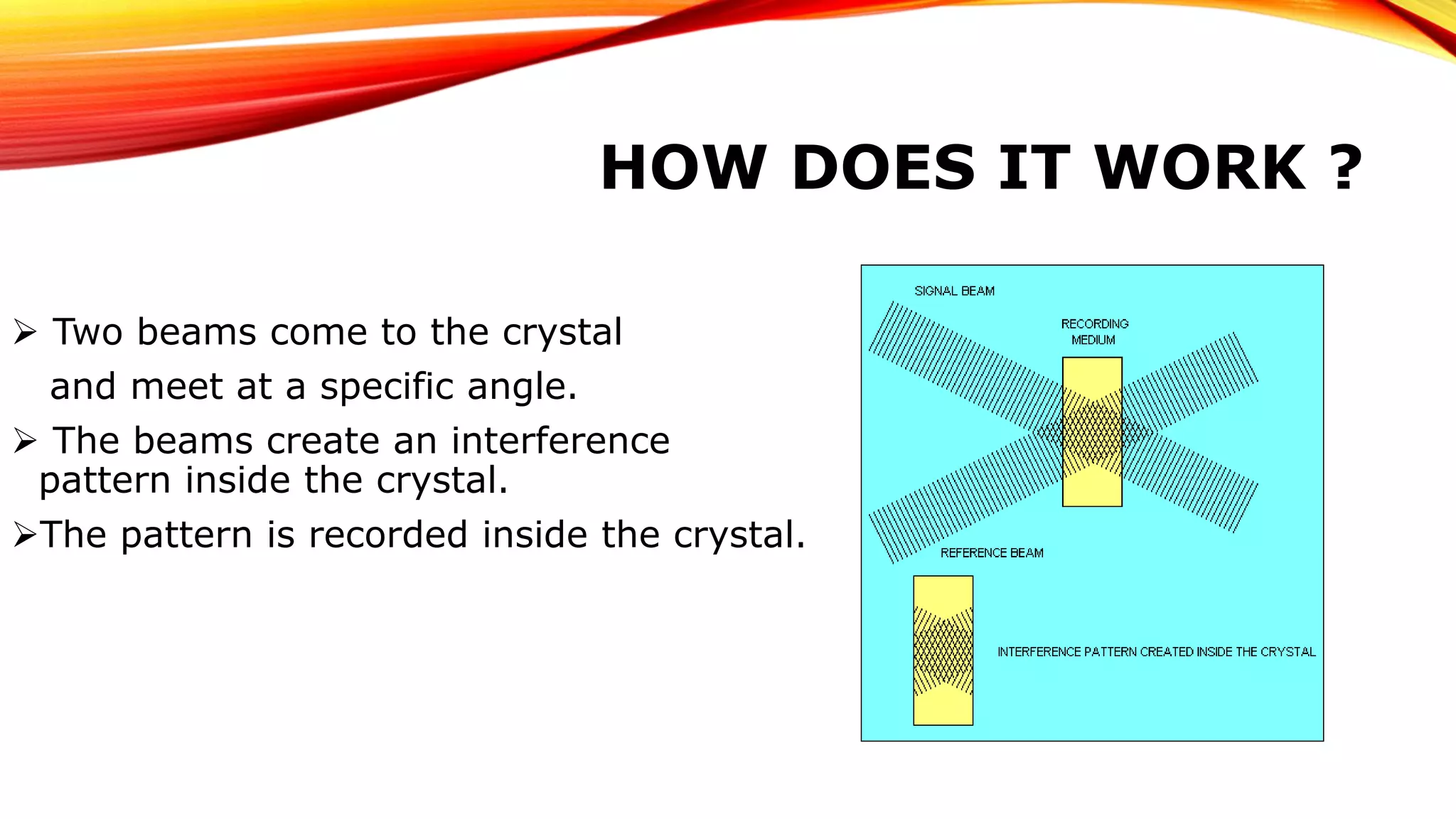
 Two beams come to the crystal
and meet at a specific angle.
 The beams create an interference
pattern inside the crystal.
The pattern is recorded inside the crystal.
HOW DOES IT WORK?
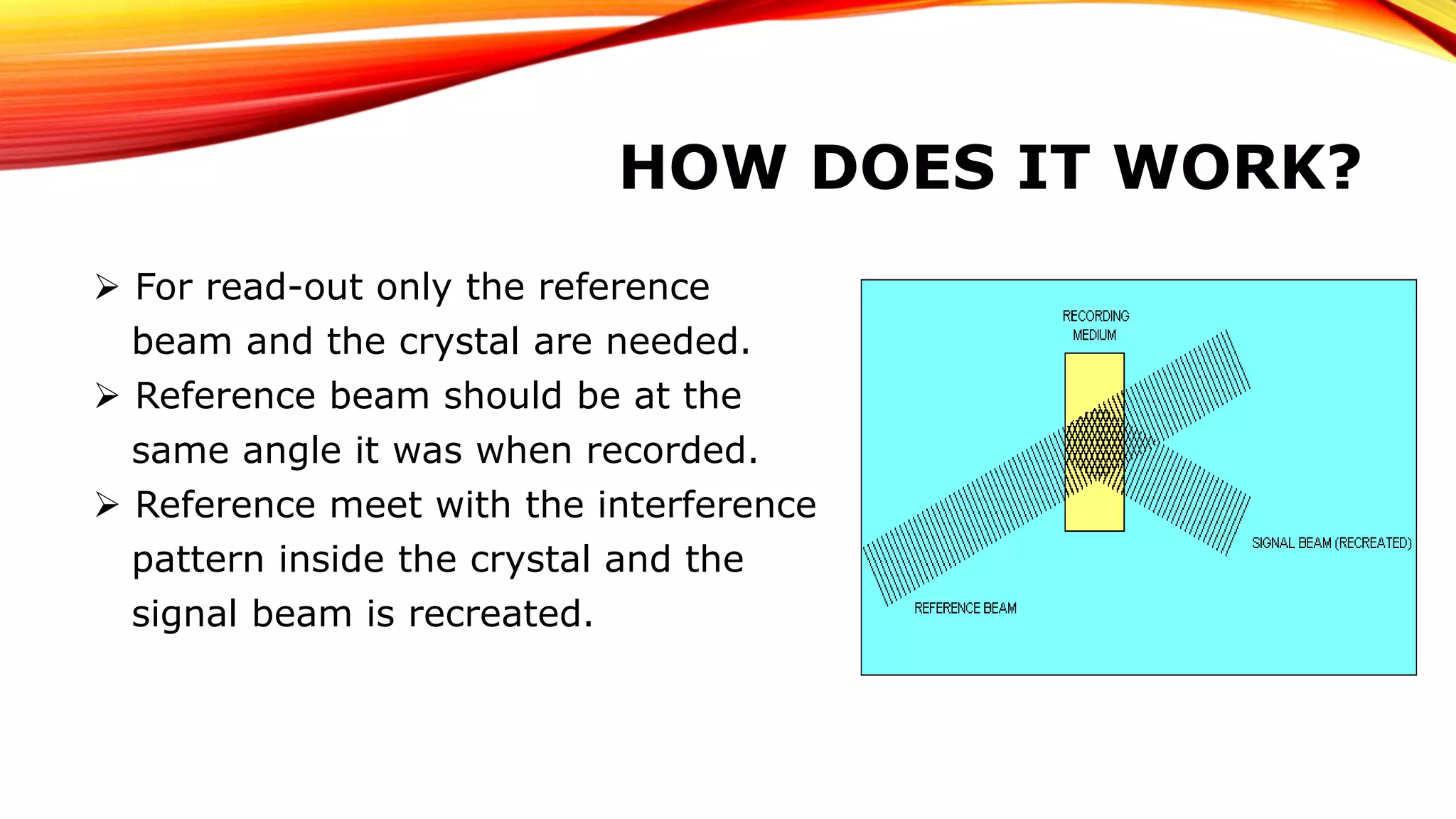
 For read-out only the reference
beam and the crystal are needed.
 Reference beam should be at the
same angle it was when recorded.
 Reference meet with the interference
pattern inside the crystal and the
signal beam is recreated.
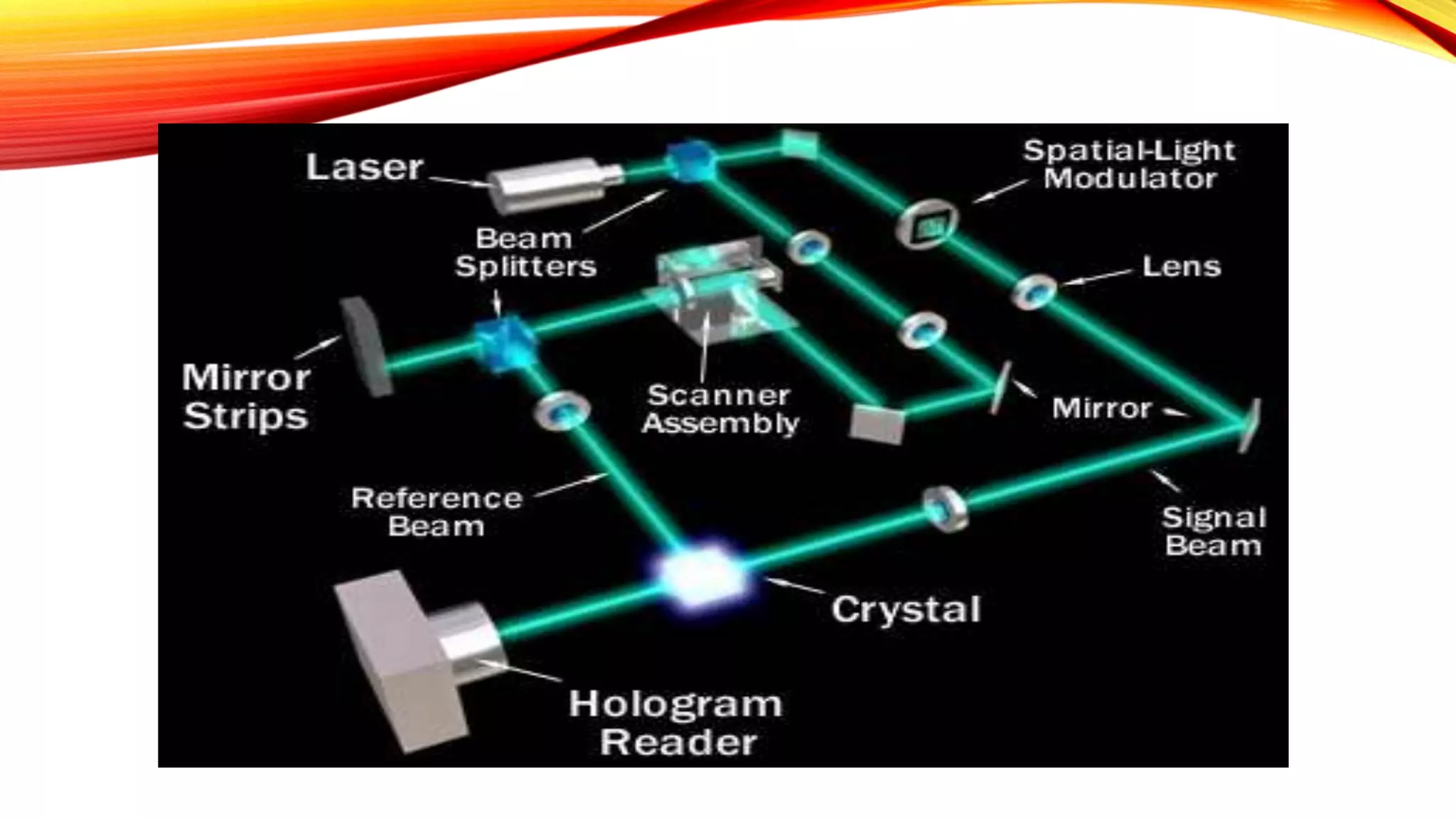
BASIC COMPONENTS OF THE SYSTEM
Laser
Recording Medium
Mirrors
Spatial light modulator
Beam splitter
Shutters
Iris
Lenses
Half-wave plate
WHY THE INTEREST IN
HOLOGRAPHIC DATA STORAGE ?
Increased storage capacity
Increased read/write speed
Stable and reliable
Security Holograms
INCREASED SPEED
• Holography allows a million bits of data to be written and read out
in single flashes of light, enabling data transfer rates as high as a
billion bits per second (fast enough to transfer a DVD movie in
about 20 seconds).
WHY IT IS SO FAST
STABLE AND RELIABLE
Holographic data storage allows us to keep our data stored safely
for up to 50 years, something that both magnetic and optical discs
and tapes cannot quite promise.
Archival life of CD/DVD is 2 to 5 years.
SECURITY HOLOGRAMS
Security holograms are labels with a hologram printed onto it for
sale security reasons.
Security holograms are very difficult to forge because they are
replicated from a master hologram which requires expensive,
specialized and technologically advanced equipment.
They are used widely in several banknotes around the world, in
particular those that are of high denominations.
 They are also used in passports, credit and bank cards as well as
quality products.
CHALLENGES OF HOLOGRAPHIC
DATA STORAGE
The challenge is to find the right recording material-a
photosensitive substance that is both stable and cheap enough to
use commercially.
Because holographic storage is an upcoming technology, will likely
be cost prohibitive compared to traditional storage options
Of course, holographic storage is expected to get cheaper and
better over time.
INTERESTING FACTS
It has been estimated that all the books in the U.S. Library of
Congress, could be stored on six (6) HVD's.
The pictures of every landmass on Earth (Google Earth for
example) can be stored on two (2) HVD's.
With MPEG4 ASP encoding, a HVD can hold between 4,600 to
11,900 hours of video, which is enough for non-stop playing for a
year.
DRAWBACKS OF HOLOGRAPHIC
DATA STORAGE
Problems with parallel recording.
Spatial light modulators in a low cost system.
Holographic recording is also very data sensitive. You have to keep
the data streaming. It’s not appropriate for partial recordings.
CONCLUSION
The future of holographic memory is very promising. The
holographic storage provide high data density. It can easily store
1000GB of data in a small cubic centimeter crystal reducing the
cost on the other hand. It may offer high data transfer rate.
But even then the holographic way of storing data is still at the
base stage and it may take another couple of years for this
technique to hit desktop with a real life data storage solution.
Holographic data storage

Holographic data storage

  • 1.
    HOLOGRAPHIC DATA STORAGE Name: Krishna kumar Pankaj Roll No : 13/IT/22
  • 2.
    INTRODUCTION The Holography techniquewas invented in 1948 by the Hungarian Dennis Gabor  This technique have been evolving in the last few years.  A hologram is a 3D image produced form a pattern of interference.  It promises to be the data storing system of the future.
  • 3.
    WHAT IS HOLOGRAPHICDATA STORAGE It is a storage that records information throughout the volume of the medium and is capable of recording multiple images in the same area utilizing light at different angles.  Storage System that can store up to 1000 GB of data into a 1 cm3 recording medium.
  • 4.
    HOW DOES ITWORK ?  Two beams come to the crystal and meet at a specific angle.  The beams create an interference pattern inside the crystal. The pattern is recorded inside the crystal.
  • 5.
    HOW DOES ITWORK?  For read-out only the reference beam and the crystal are needed.  Reference beam should be at the same angle it was when recorded.  Reference meet with the interference pattern inside the crystal and the signal beam is recreated.
  • 6.
    BASIC COMPONENTS OFTHE SYSTEM Laser Recording Medium Mirrors Spatial light modulator Beam splitter Shutters Iris Lenses Half-wave plate
  • 8.
    WHY THE INTERESTIN HOLOGRAPHIC DATA STORAGE ? Increased storage capacity Increased read/write speed Stable and reliable Security Holograms
  • 9.
    INCREASED SPEED • Holographyallows a million bits of data to be written and read out in single flashes of light, enabling data transfer rates as high as a billion bits per second (fast enough to transfer a DVD movie in about 20 seconds).
  • 10.
    WHY IT ISSO FAST
  • 11.
    STABLE AND RELIABLE Holographicdata storage allows us to keep our data stored safely for up to 50 years, something that both magnetic and optical discs and tapes cannot quite promise. Archival life of CD/DVD is 2 to 5 years.
  • 12.
    SECURITY HOLOGRAMS Security hologramsare labels with a hologram printed onto it for sale security reasons. Security holograms are very difficult to forge because they are replicated from a master hologram which requires expensive, specialized and technologically advanced equipment.
  • 13.
    They are usedwidely in several banknotes around the world, in particular those that are of high denominations.  They are also used in passports, credit and bank cards as well as quality products.
  • 14.
    CHALLENGES OF HOLOGRAPHIC DATASTORAGE The challenge is to find the right recording material-a photosensitive substance that is both stable and cheap enough to use commercially. Because holographic storage is an upcoming technology, will likely be cost prohibitive compared to traditional storage options Of course, holographic storage is expected to get cheaper and better over time.
  • 15.
    INTERESTING FACTS It hasbeen estimated that all the books in the U.S. Library of Congress, could be stored on six (6) HVD's. The pictures of every landmass on Earth (Google Earth for example) can be stored on two (2) HVD's. With MPEG4 ASP encoding, a HVD can hold between 4,600 to 11,900 hours of video, which is enough for non-stop playing for a year.
  • 16.
    DRAWBACKS OF HOLOGRAPHIC DATASTORAGE Problems with parallel recording. Spatial light modulators in a low cost system. Holographic recording is also very data sensitive. You have to keep the data streaming. It’s not appropriate for partial recordings.
  • 17.
    CONCLUSION The future ofholographic memory is very promising. The holographic storage provide high data density. It can easily store 1000GB of data in a small cubic centimeter crystal reducing the cost on the other hand. It may offer high data transfer rate. But even then the holographic way of storing data is still at the base stage and it may take another couple of years for this technique to hit desktop with a real life data storage solution.